



Ted Yanagihara, Assistant Professor of Radiation Oncology at UNC School of Medicine, shared on X:
“Have PROSPECT and ESOPEC changed GI radiation referrals.
If so, what does that mean for resident training?
Dana Casey and I teamed up to examine a decade of experience at UNC Lineberger.
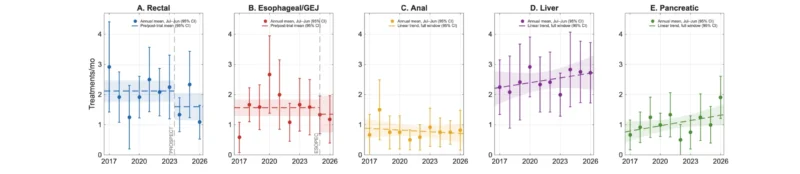
We identified >900 GI radiation treatment starts from July 2016 – May 2026:
- Liver: 294
- Rectal: 234
- Esophageal/GEJ: 183
- Pancreatic: 125
- Anal: 95
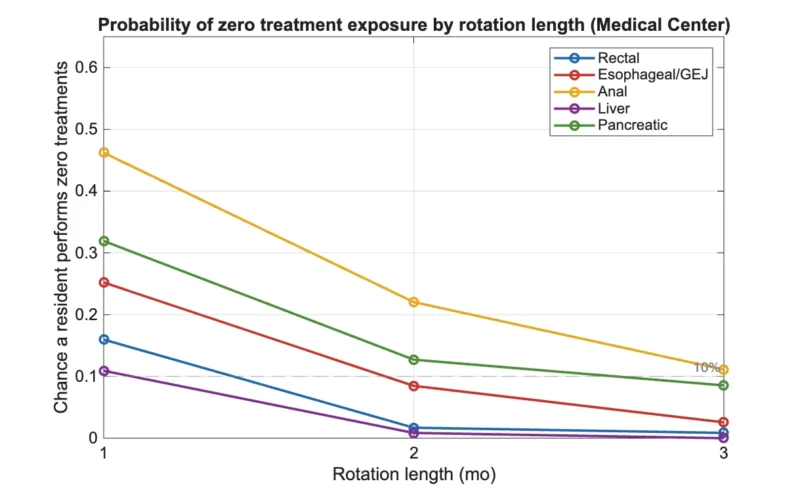
We examined volume trends and how often rotation blocks contained ZERO starts for each disease site.
After PROSPECT & ESOPEC publication, respectively, mean monthly starts fell modestly:
Rectal: 2.12 – 1.60
Esophageal/GEJ: 1.57 – 1.35
Neither decline was statistically significant. But wide CIs mean we cannot conclude that volume was unchanged.
Overall GI treatment volume was maintained, with higher liver and pancreatic volumes offsetting declines elsewhere
But adequate overall volume does not guarantee breadth of training.
A busy GI rotation can still have no new cases of a particular disease.
Across the full study period, the proportion of 2-month blocks with ZERO treatment starts was:
- Anal: 22%
- Pancreatic: 13%
- Esophageal/GEJ: 8%
- Rectal: 2%
- Liver: 1%
The are estimates based on CT simulations, not based on resident self-report (i.e., not ACGME case logs)
We then modeled 1- and 3-month rotation blocks. Even over 3-month blocks:
- ~11% of blocks would have no anal starts
- ~9% would have no pancreatic starts
Low-volume sites can leave meaningful training gaps even without a sharp decline after de-escalation trials.
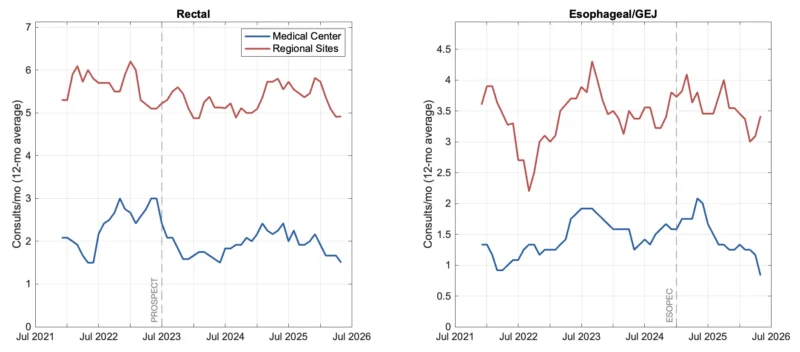
We also looked at consult volume, not just simulation volume.
Workup and pt discussion still hold valuable learning, even if you don’t end up treating the patient.
This shows monthly consults at the medical center and the sum of all regional sites with available data:
Practical takeaways.
Programs should:
- carefully inspect case availability by disease subsite
- flag uncommon cases
- develop strategies to ensure breadth of training across subsit”
Read the full article:
Main findings of Ted Yanagihara’s and Dana Casey’s study
- No significant decline in treatment volume: Following publication of the PROSPECT and ESOPEC de-escalation trials, rectal and esophageal/GEJ radiation treatments showed modest, statistically non-significant declines. Overall GI treatment volume remained stable, supported by increased treatment of liver and pancreatic cancers.
- Gradual adoption of de-escalation strategies: The absence of an abrupt decline may reflect restrictive trial eligibility criteria, gradual changes in referral and staging pathways, and delays in translating trial findings into routine clinical practice.
- Educational challenges for radiation oncology residents: Despite stable overall treatment volumes, individual GI cancer subsites remain low-volume. Short rotations may provide insufficient exposure, particularly to anal and pancreatic cancers, highlighting the need for proactive case screening and improved scheduling.
- Implications for residency training: The study concludes that the main educational risk is the naturally low frequency of certain GI cancers rather than a sudden reduction in radiation treatments following de-escalation trials. Programs can use site-specific treatment data to optimize rotations and ensure broader resident exposure.
Title: Gastrointestinal Radiation Treatment Volume After Practice-Changing De-escalation Trials and Implications for Resident Disease-Site Case Availability
Authors: Ted Yanagihara, Dana Casey
You may also be interested in: