A medication routinely used to control seizures may have an unexpected role in the biology of one of the most aggressive pediatric brain tumors.
A new study published in Nature Medicine reports that levetiracetam was associated with longer overall survival in children with diffuse midline glioma (DMG). The researchers went beyond the retrospective clinical observation, showing in experimental models that the drug can reduce DMG growth by interfering with GABAergic neuron-to-glioma synaptic signaling.
Levetiracetam therapeutically targets GABAergic synapses in diffuse midline glioma
Authors: Tara Barron, Richard Drexler, Aaron Mochizuki, Evan Cantor, Kiarash Shamardani, Pamelyn J. Woo, Neeraj Soni, Dana Tlais, Andrea Franson, Samantha Lyons, Truman Knowles, Shannon Raber, Vilina Mehta, Michael A. Quezada, Michael B. Keough, Samin Malaki Jahan, Linh Thuy Vo, Enrique Herrera Castañeda, Kathryn R. Taylor, Lijun Ni, Kim Kilian, Samuel H. Wu, Franz L. Ricklefs, Ulrich Schüller, Michelle Monje
Nature Medicine, September 17, 2026, DOI: 10.1038/s41591-026-04646-6
The study was led by Tara Barron and colleagues, with Michelle Monje as senior author.
The findings bring together clinical data, patient-derived tumor models, electrophysiology, and mechanistic experiments to explore an intriguing possibility: a familiar antiseizure drug may influence tumor behavior through the electrical and synaptic environment surrounding glioma cells.
Importantly, the clinical evidence remains retrospective. The study does not establish levetiracetam as a treatment for DMG, but provides a rationale for prospective clinical investigation.
Why Look at an Antiseizure Drug in Glioma?
The connection between the nervous system and cancer has become an increasingly important area of cancer biology.
Gliomas do not simply grow independently within the brain. Research has demonstrated that neuronal activity can influence glioma progression and that glioma cells can integrate into neural circuits through functional synaptic connections.
DMG cells can receive synaptic input from surrounding neurons, and these neuron-to-glioma interactions can promote tumor growth.
This raised an important question: could an existing drug capable of modifying neuronal signaling also alter the biology of the tumor?
Levetiracetam offered a particularly interesting candidate.
The drug is widely used to treat seizures and acts primarily through binding to synaptic vesicle protein 2A (SV2A), thereby modifying neurotransmitter release. It is also commonly encountered in the care of patients with brain tumors who develop seizures.
Barron and colleagues therefore investigated whether exposure to levetiracetam might be associated with outcomes in pediatric high-grade glioma and, subsequently, whether the drug could directly influence tumor growth.
Levetiracetam Was Associated With Longer Survival in DMG
The researchers first examined retrospective real-world clinical data from pediatric patients with high-grade glioma treated at Stanford University and the University of Michigan.
The analysis included 218 children with pediatric high-grade glioma. When patients were examined according to tumor location and subtype, a striking difference emerged in DMG.
Among children with DMG, those with a history of levetiracetam use had a median overall survival of 20.96 months, compared with 9.92 months among patients without a history of levetiracetam exposure.
The difference was statistically significant (P=0.015).
In contrast, this association was not evident among patients with hemispheric high-grade glioma. Median overall survival was 24.0 months with levetiracetam and 22.2 months without levetiracetam (P=0.96).
The observation therefore suggested that the potential effect might not simply reflect a general association between antiseizure medication use and outcomes in pediatric brain tumors. Instead, it appeared particularly relevant to DMG.
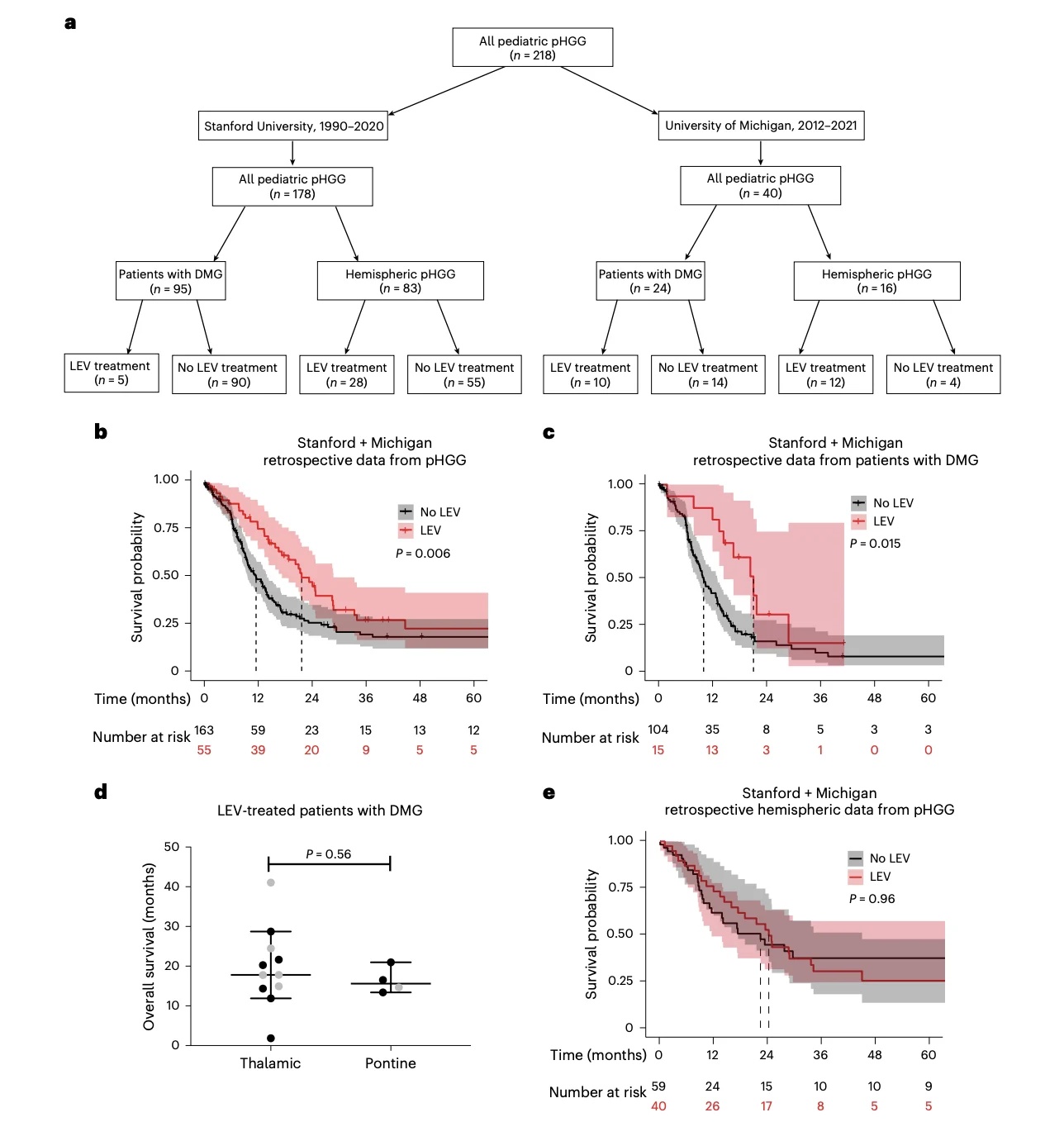
Association between levetiracetam exposure and overall survival in pediatric high-grade glioma, including analyses of patients with diffuse midline glioma and hemispheric high-grade glioma. Source: Barron T, et al. Nature Medicine. 2026.
Could the Survival Association Be Reproduced Elsewhere?
Because retrospective analyses can be influenced by multiple sources of bias and confounding, the investigators examined additional independent patient cohorts.
The first validation cohort came from the University Medical Center Hamburg-Eppendorf.
Among patients with DMG in this cohort, median overall survival was 24.0 months among six children who received levetiracetam, compared with 11.0 months among 19 children who did not.
The researchers then examined another independent cohort from the University of California, San Francisco.
Median overall survival was 15.5 months among five patients exposed to levetiracetam, compared with 12.2 months among 30 patients without levetiracetam exposure. Although these validation cohorts were small, combining the independent datasets provided additional support for the association observed in the original patient population.
Still, an association in retrospective patient records cannot establish that levetiracetam itself caused the survival difference. That led to the next question: could the drug directly affect DMG growth experimentally?
Testing Levetiracetam in DMG Models
The researchers moved from patient data into laboratory models using patient-derived DMG cells and xenografts.
In mice carrying H3K27M-positive DMG xenografts, treatment with levetiracetam reduced tumor growth and malignant cell proliferation.
Levetiracetam treatment was also associated with prolonged survival in the experimental models. Importantly, the effect again appeared to depend on the type of glioma being studied.
When the researchers evaluated models of hemispheric high-grade glioma, levetiracetam did not produce the same significant reduction in malignant cell proliferation.
This mirrored the clinical observations, where the survival association was evident in DMG but not in hemispheric pediatric high-grade glioma.
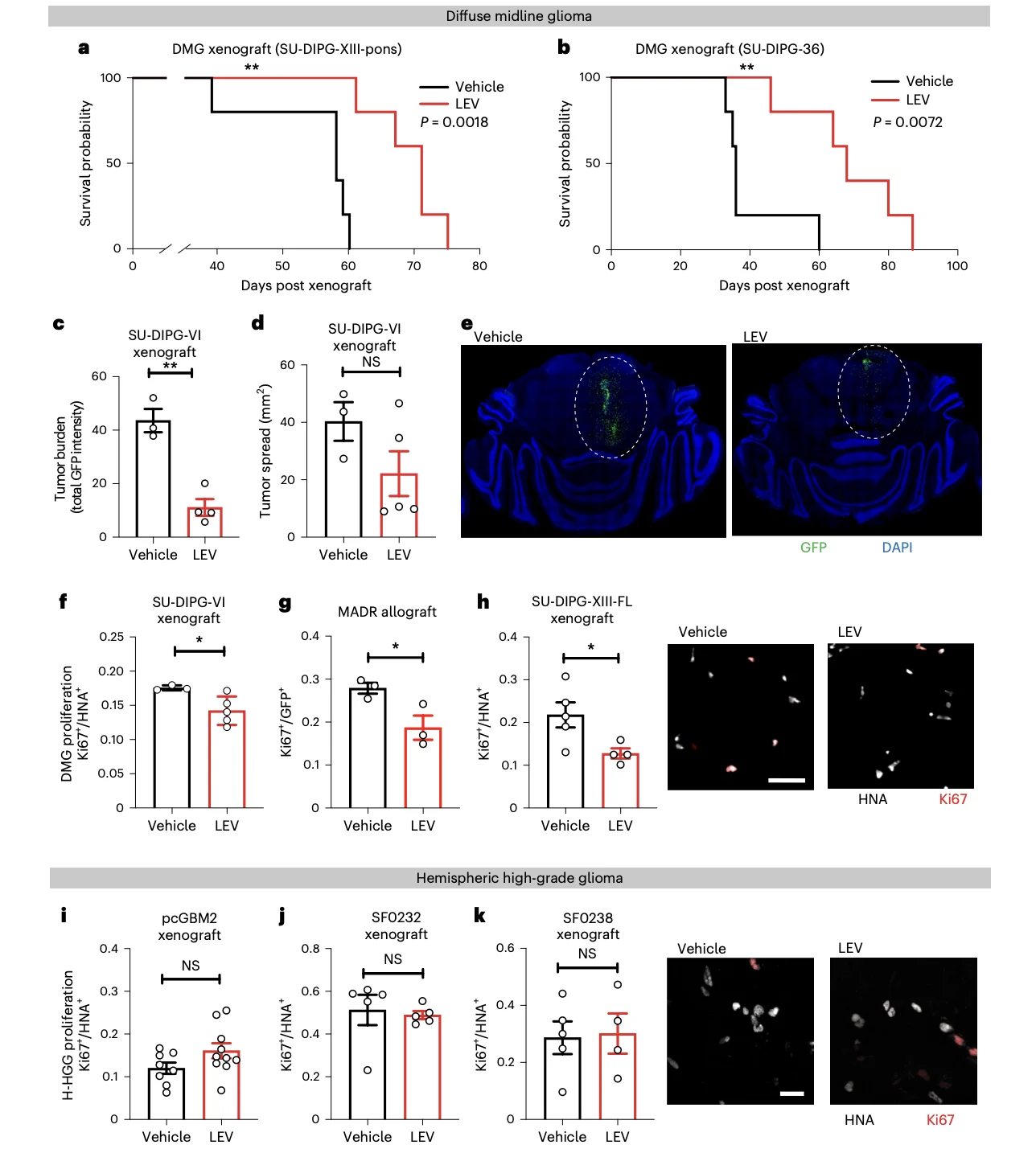
Levetiracetam extends survival and reduces tumor growth in diffuse midline glioma preclinical models but not hemispheric high-grade glioma models. Source: Barron T, et al. Nature Medicine (2026).
Is This Simply an Effect of Controlling Neuronal Activity?
One possible explanation was straightforward: perhaps reducing neuronal excitability broadly reduced the neuronal signals supporting tumor growth.
The researchers therefore investigated other antiseizure medications. However, ethosuximide and phenytoin did not reproduce the antiproliferative effect of levetiracetam in the DMG models examined.
This suggested that the observation could not simply be explained by seizure control or a generalized reduction in neuronal excitability.
Instead, levetiracetam appeared to be affecting a more specific biological interaction. That interaction led investigators to GABAergic neuron-to-glioma synapses.
The Unexpected Target: Neuron-to-Glioma Synapses
One of the most important concepts emerging from modern glioma biology is that tumor cells can participate in neural circuitry. Neurons communicate through electrical and chemical synapses. Remarkably, glioma cells can receive synaptic signals from neurons as well.
In DMG, these interactions can provide signals that support malignant growth. The investigators found that levetiracetam attenuated GABAergic neuron-to-glioma synaptic currents in DMG cells. This provided a potential mechanistic bridge between the clinical survival observation and the experimental reduction in tumor growth.
Rather than acting simply by suppressing seizures, levetiracetam appeared capable of interfering with communication between neurons and cancer cells.
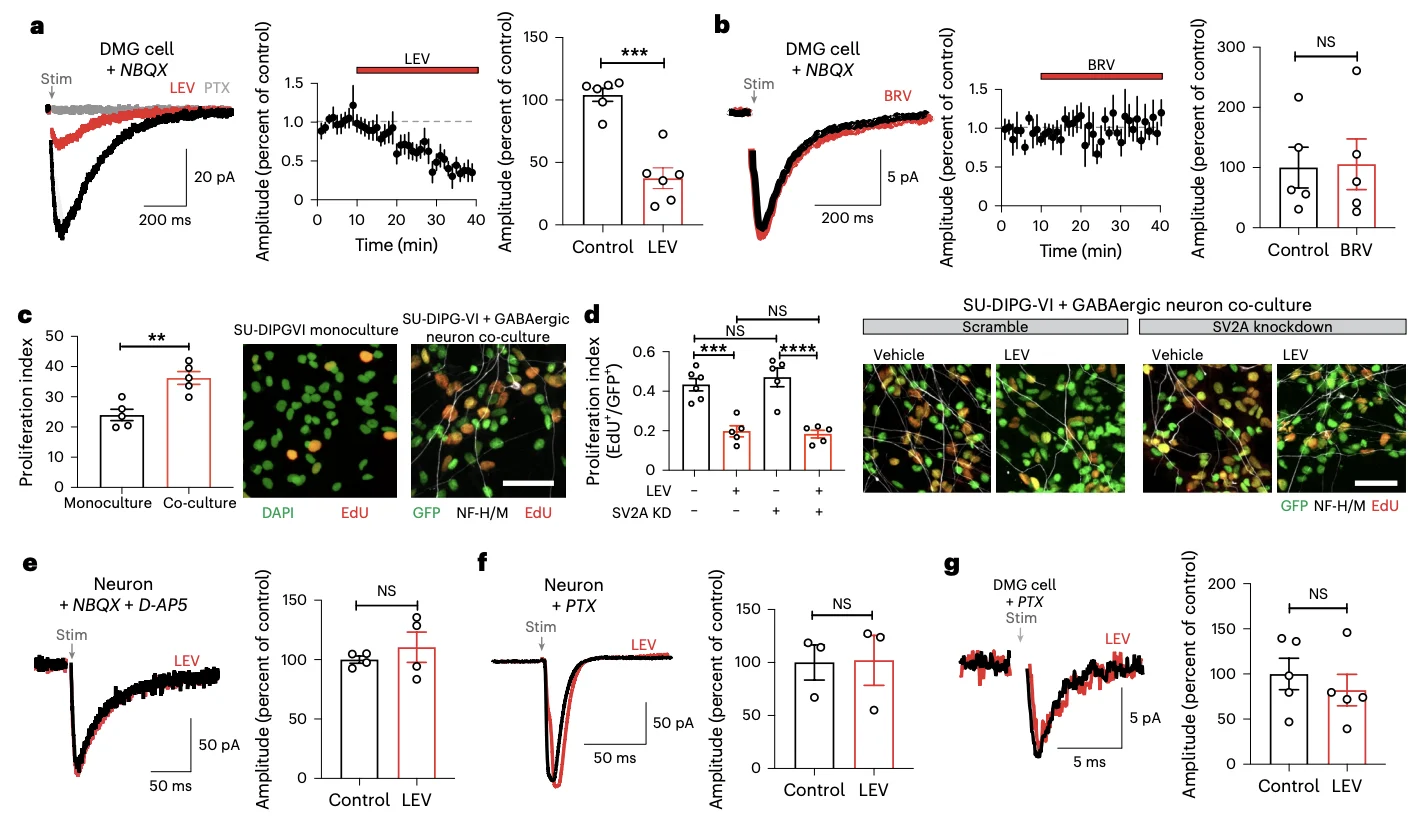
Levetiracetam attenuates GABAergic neuron-to-glioma synaptic signaling in diffuse midline glioma. Source: Barron T, et al. Nature Medicine. 2026.
A Mechanism Beyond Levetiracetam’s Familiar Target
The mechanistic findings became even more intriguing when the researchers investigated SV2A.
SV2A is the major molecular target associated with levetiracetam’s antiseizure activity. It is expressed in synaptic vesicles and plays a role in neurotransmitter release. Yet the study indicated that levetiracetam’s effect on GABAergic neuron-to-glioma signaling was independent of SV2A.
In other words, the mechanism through which levetiracetam may influence DMG appears to differ from the mechanism for which the drug is best known clinically. This raises broader questions about whether established neurological drugs may possess previously unrecognized effects within the neural tumor microenvironment.
What Does This Mean for Patients?
Despite the magnitude of the survival difference observed in the initial cohort, these results should not be interpreted as evidence that levetiracetam is already an established treatment for DMG.
The human component of the study was retrospective, not a randomized prospective clinical trial.
Patients receiving levetiracetam may differ from patients who did not receive the drug in ways that cannot be completely accounted for through retrospective analysis. The validation cohorts were also relatively small.
What strengthens the observation, however, is the convergence of several different lines of evidence.
The survival association appeared in more than one patient population. The effect was reproduced in patient-derived experimental models. The researchers then identified a biological mechanism capable of explaining how levetiracetam could influence DMG growth.
Together, these findings provide a rationale for prospective clinical investigation of levetiracetam in patients with DMG.
When Unexpected Connections Become Relevant
Perhaps one of the most interesting aspects of this study is not only what it found, but where the finding came from.
Levetiracetam was developed and is routinely prescribed as an antiseizure medication. Diffuse midline glioma is an aggressive pediatric brain cancer. At first glance, the connection between the two may seem largely supportive: patients with brain tumors can experience seizures, and antiseizure drugs are used to manage them.
But the biology uncovered here suggests a deeper intersection.
Neurons communicate through synapses. Glioma cells can become part of that communication network. A drug designed to alter neuronal signaling may therefore influence not only seizures, but also the signals that cancer cells use to grow.
It is a reminder of how discoveries can emerge when seemingly separate areas of medicine begin to overlap. Neurology meets oncology; synaptic signaling meets tumor biology; and a familiar drug may acquire an entirely different significance when examined in a new biological context.
Sometimes, the most important connections in science are the ones that were not obvious enough to look connected in the first place.
Read further on OncoDaily: Astellas Network Meta-Analysis Compares Zolbetuximab With ICI Regimens Across PD-L1 Subgroups in Advanced Gastric Cancer