
A new Bayesian network meta-analysis published in ESMO Open has indirectly compared zolbetuximab plus chemotherapy with immune checkpoint inhibitor (ICI)-based regimens across different PD-L1 combined positive score (CPS) subgroups in patients with locally advanced unresectable or metastatic gastric or gastroesophageal junction (GEJ) adenocarcinoma.
The analysis addresses an increasingly important question in first-line gastric cancer care as treatment becomes more biomarker-driven: how should available evidence be interpreted when a patient’s tumor carries more than one therapeutically relevant biomarker, particularly CLDN18.2 and PD-L1?
The study titled Zolbetuximab plus chemotherapy versus immune checkpoint inhibitor regimens by programmed death-ligand 1 combined positive score in locally advanced or metastatic gastric or gastroesophageal junction adenocarcinoma: a Bayesian network meta-analysis was authored by Kohei Shitara, Sun Young Rha, Samuel J. Klempner, Florian Lordick, and colleagues, and was published in ESMO Open on September 16, 2026.
It evaluated the relative efficacy of first-line zolbetuximab and selected ICIs across three PD-L1 CPS categories, focusing on overall survival (OS) and progression-free survival (PFS).
Unlike a randomized head-to-head clinical trial, however, the study uses an indirect statistical comparison across existing trials. The authors therefore stressed that its findings should be interpreted cautiously and confirmed prospectively.
Why CLDN18.2 and PD-L1 Matter in Gastric Cancer
The first-line treatment landscape for advanced gastric and GEJ adenocarcinoma has become increasingly dependent on molecular and immune biomarkers.
CLDN18.2, or claudin 18 isoform 2, is a therapeutic target expressed on a subset of gastric and GEJ cancers and is targeted by zolbetuximab.
At the same time, PD-L1 expression, commonly assessed using the combined positive score, can help inform treatment with immune checkpoint inhibitors.
This creates a clinically relevant area of overlap. A patient with HER2-negative disease may have a tumor that is CLDN18.2-positive while also expressing PD-L1, potentially making more than one biomarker-informed treatment strategy relevant.
Yet zolbetuximab-based and ICI-based first-line strategies have not been directly compared in randomized head-to-head trials.
The new NMA attempts to address that evidence gap by bringing existing randomized evidence into a common comparative framework.
Zolbetuximab Is Already an FDA-Approved First-Line Treatment
Zolbetuximab is not an investigational therapy in this setting.
On October 18, 2024, the U.S. Food and Drug Administration approved zolbetuximab-clzb in combination with fluoropyrimidine- and platinum-containing chemotherapy for the first-line treatment of adults with locally advanced unresectable or metastatic HER2-negative gastric or GEJ adenocarcinoma whose tumors are CLDN18.2-positive, as determined by an FDA-approved test.
The approval was supported by the Phase 3 SPOTLIGHT and GLOW trials.
Zolbetuximab: From Promising Drug to FDA Approval | Exclusive Interview with Astellas
The question addressed by the new ESMO Open analysis is therefore not whether zolbetuximab is effective compared with chemotherapy alone, but how its efficacy can be interpreted alongside that of established ICI-based strategies when PD-L1 is also considered.
How the Network Meta-Analysis Was Conducted
The investigators included studies evaluating zolbetuximab or ICIs plus chemotherapy as first-line therapy in adults with locally advanced unresectable or metastatic gastric or GEJ adenocarcinoma.
A Bayesian fixed-effects network meta-analysis was conducted to compare OS and PFS across treatment strategies.
The analysis considered three PD-L1 CPS groups:
- CPS ≥1 to <5
- CPS ≥5 to <10
- CPS ≥10
Five treatment regimens were represented:
- zolbetuximab plus chemotherapy;
- pembrolizumab plus chemotherapy;
- nivolumab plus chemotherapy;
- tislelizumab plus chemotherapy;
- chemotherapy alone.
A network meta-analysis differs from a conventional pairwise meta-analysis because it can estimate relative treatment effects between therapies that have not been directly compared with each other, provided they can be linked through a common comparator.
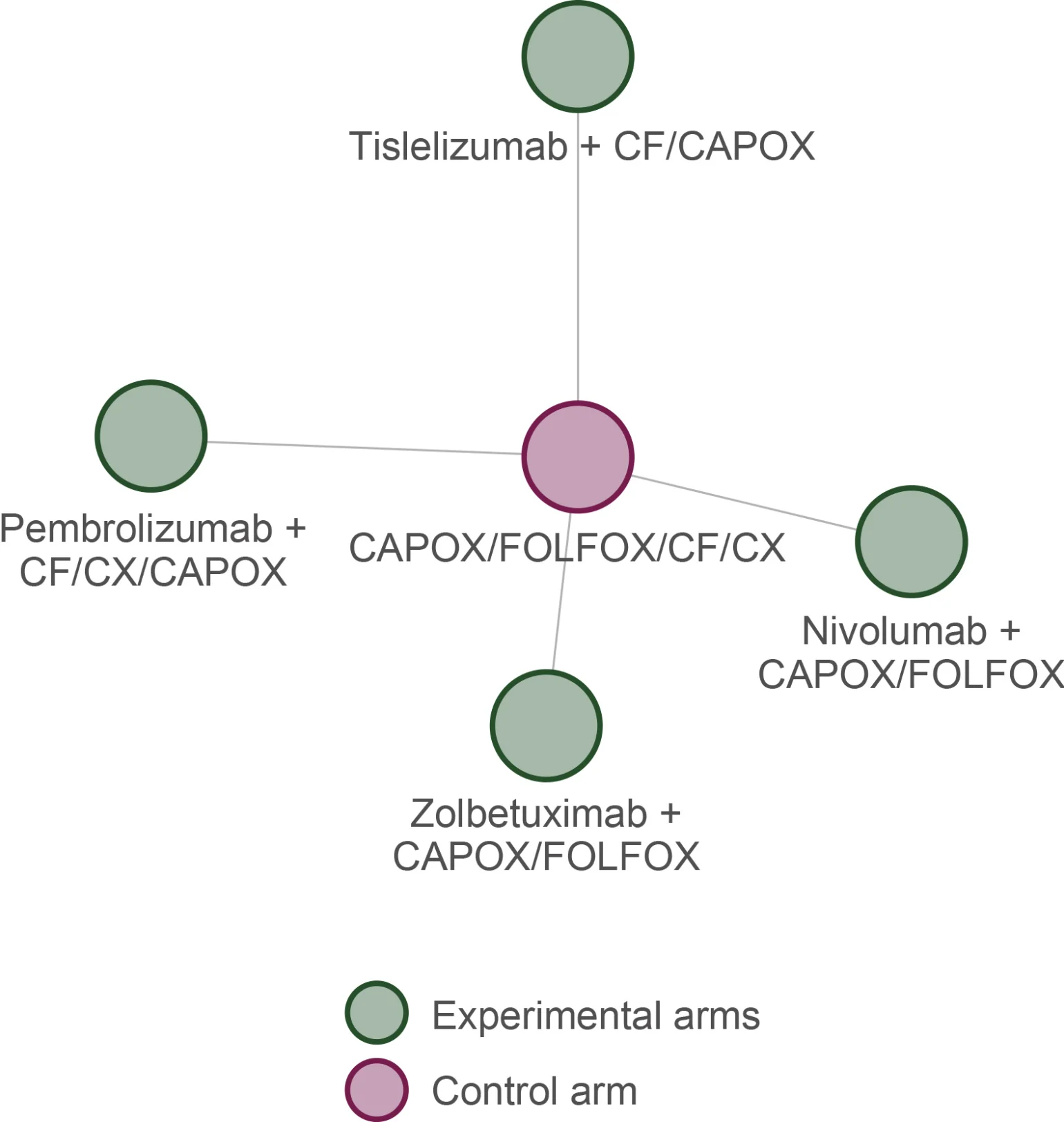
Evidence network of first-line treatment regimens included in the Bayesian network meta-analysis, showing the connections between zolbetuximab plus chemotherapy, ICI-based regimens, and chemotherapy comparators across the included randomized trials. Source: Shitara K, et al. ESMO Open. 2026.
Why PD-L1 Was Handled Differently for ICIs and Zolbetuximab
An important methodological feature of the study concerns how PD-L1 CPS was incorporated into the analysis.
The investigators considered PD-L1 CPS a biologically and clinically validated treatment-effect modifier for immune checkpoint inhibitors. As a result, CPS-specific hazard ratios were used for the ICI regimens.
The same approach was not applied to zolbetuximab because its therapeutic target is CLDN18.2 rather than the PD-1/PD-L1 pathway.
This distinction is central to interpreting the results.
The NMA does not represent a trial in which patients with identical CLDN18.2 and PD-L1 characteristics were randomized directly between zolbetuximab and immunotherapy. Instead, it estimates relative effects using data from separate trials connected within an evidence network.
What Did the Analysis Find?
The results differed according to PD-L1 CPS.
CPS ≥1 to <5
In patients with PD-L1 CPS ≥1 to <5, zolbetuximab plus chemotherapy showed similar or numerically favorable OS and PFS compared with the evaluated ICI-based regimens.
CPS ≥5 to <10
Among patients with CPS ≥5 to <10, both OS and PFS were numerically favorable with zolbetuximab plus chemotherapy compared with the ICI-based regimens included in the network.
Taken together, the authors reported consistent efficacy with zolbetuximab plus chemotherapy across the CPS ≥1 to <10 range and suggested it may represent a relevant first-line option beyond treatment selection based only on PD-L1.
CPS ≥10
The pattern differed among patients with PD-L1 CPS ≥10.
In this group, the evaluated ICI-based regimens showed numerically favorable OS and PFS compared with zolbetuximab plus chemotherapy in the principal analysis.
The use of the word “numerically” is important. These indirect results should not be interpreted as demonstrating clinical superiority of one treatment over another.
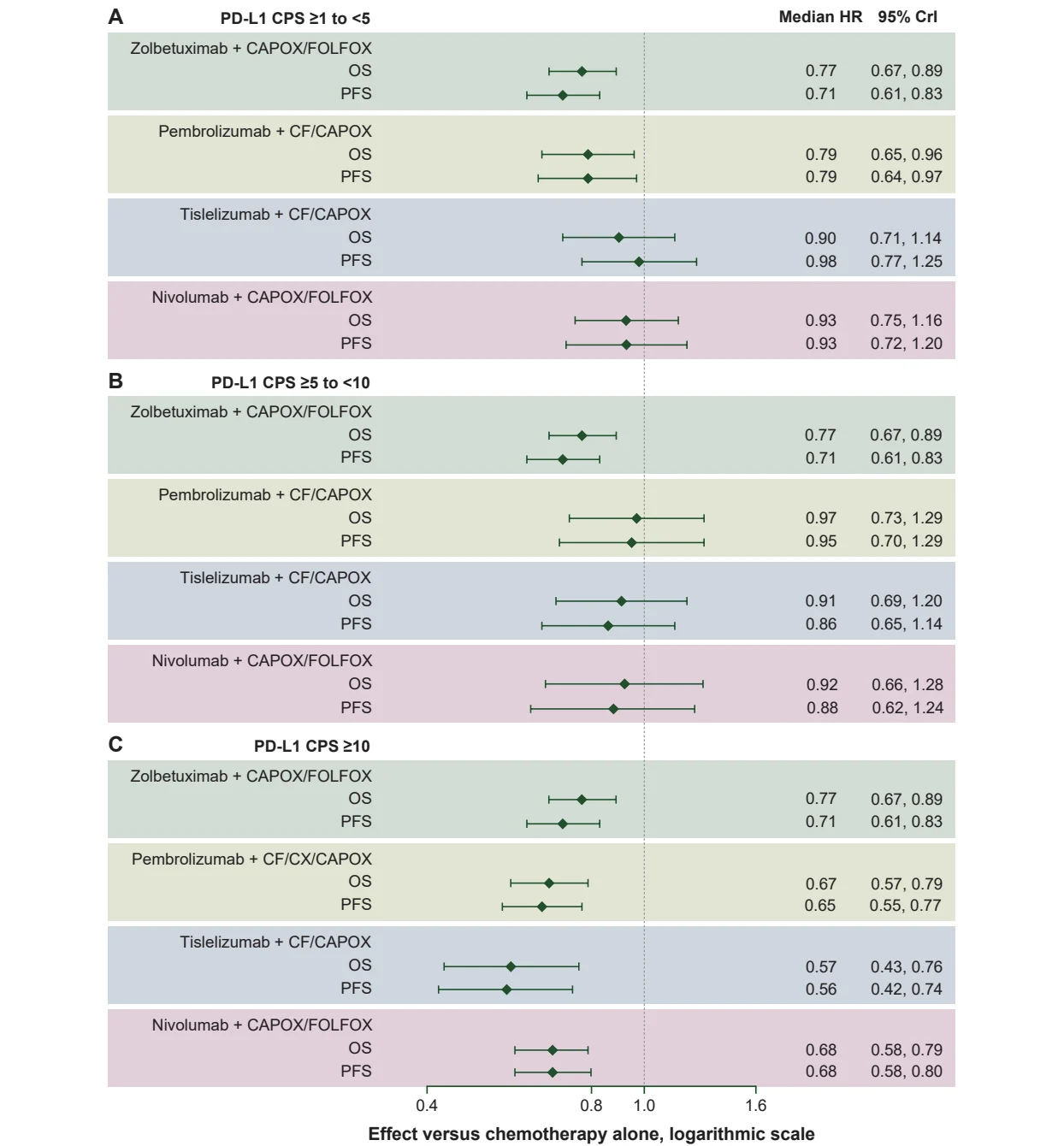
Overall survival and progression-free survival across PD-L1 CPS subgroups in the network meta-analysis. The forest plots compare zolbetuximab plus chemotherapy and selected ICI-based regimens with chemotherapy alone in patients with PD-L1 CPS ≥1 to <5, ≥5 to <10, and ≥10. Source: Shitara K, et al. ESMO Open. 2026.
Sensitivity Analysis at PD-L1 CPS ≥10
The investigators also conducted a sensitivity analysis in the CPS ≥10 group that accounted for zolbetuximab treatment exposure.
For this analysis, patients with optimal zolbetuximab exposure were those who did not experience nausea or vomiting leading to inadequate dose exposure or treatment discontinuation.
Among these patients, zolbetuximab plus chemotherapy showed similar OS and PFS to the evaluated ICI-based regimens.
The authors therefore concluded that zolbetuximab remained clinically meaningful in CPS ≥10 disease when exposure was optimized.
However, the sensitivity analysis should be interpreted separately from the primary analysis and does not establish equivalence between zolbetuximab and ICIs.
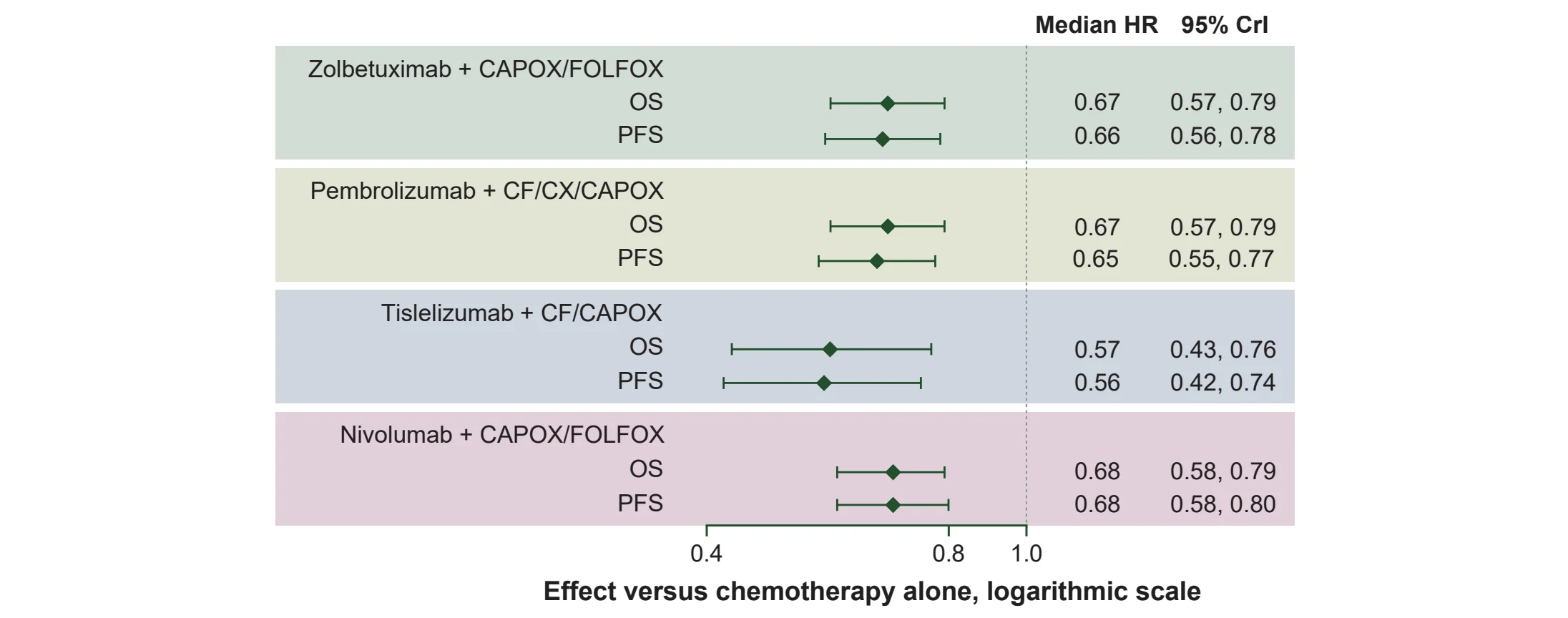
Sensitivity analysis of overall survival and progression-free survival in patients with PD-L1 CPS ≥10 and optimal zolbetuximab exposure. The forest plot compares zolbetuximab plus chemotherapy with selected ICI-based regimens versus chemotherapy alone among patients who did not experience nausea or vomiting leading to inadequate zolbetuximab exposure or treatment discontinuation. Source: Shitara K, et al. ESMO Open. 2026.
Sun Young Rha Exclusively to OncoDaily: Look at the Full Patient Profile
Speaking exclusively to OncoDaily, Sun Young Rha, Professor of Medical Oncology at Yonsei University College of Medicine in Seoul, South Korea, emphasized that treatment decisions in patients whose tumors express both CLDN18.2 and PD-L1 should not be based on an individual biomarker alone.
“In practice, I look at each patient’s full clinical and biomarker profile rather than any single test result in isolation.”
Professor Rha said relevant factors include patient characteristics and comorbidities, performance status, organ function, and the location and extent of tumor involvement.
“Together, these factors help inform the most appropriate treatment approach for an individual patient.”
Her comments highlight the broader clinical issue addressed by the study: as more biomarkers become actionable, treatment selection increasingly requires clinicians to interpret multiple pieces of biological and clinical information simultaneously.
What Was the Most Clinically Meaningful Finding?
Asked about the most clinically meaningful finding of the analysis, Professor Rha said:
“The analyses consistently supported zolbetuximab plus chemotherapy as a clinically relevant treatment option across PD-L1 combined positive score (CPS) subgroups in patients with HER2-negative, CLDN18.2-positive advanced gastric or gastroesophageal junction adenocarcinoma.”
She noted that the results suggest zolbetuximab-based treatment remains relevant across the evaluated PD-L1 CPS groups.
For patients whose tumors co-express CLDN18.2 and PD-L1, this may provide additional context for treatment discussions.
Professor Rha nevertheless emphasized a critical limitation:
“The NMA does not demonstrate that zolbetuximab plus chemotherapy is more effective than the evaluated immune checkpoint inhibitor (ICI)-based regimens or establish a treatment hierarchy, or substitute for a head-to-head randomized comparison between treatments.”
That caveat is essential to interpreting the study.
The analysis provides a framework for comparing existing evidence. It does not establish that zolbetuximab should replace immunotherapy, or that immunotherapy should replace zolbetuximab, in patients potentially eligible for both.
Why Network Meta-Analysis Requires Careful Interpretation
Network meta-analysis can be particularly valuable when multiple therapies exist, but direct randomized comparisons between all treatment options are unavailable.
By linking trials through common comparators, researchers can estimate indirect relative effects and make broader use of the available randomized evidence.
But those estimates depend on the underlying studies being sufficiently comparable.
Differences in:
- trial populations;
- eligibility criteria;
- biomarker assessment;
- chemotherapy backbones
- study design;
and other baseline characteristics can introduce uncertainty into cross-trial comparisons.
Professor Rha emphasized this point in her comments to OncoDaily:
“Clinicians should remember that differences in study populations, biomarker assessment methods, and trial designs can influence cross-trial comparisons.”
She added:
“As an indirect comparison, the findings cannot tell us that one treatment is superior or which treatment is most appropriate for an individual patient.”
The paper itself reaches the same broad conclusion: the findings should be interpreted cautiously because they arise from indirect comparisons and require prospective confirmation.
A Shift Toward Multi-Biomarker Treatment Decisions
One of the most important implications of the study extends beyond the comparison between zolbetuximab and individual checkpoint inhibitors.
The analysis reflects a broader transition in gastric and GEJ cancer from treatment selection based predominantly on disease location and histology toward a multi-biomarker model of care.
For HER2-negative, CLDN18.2-positive tumors, PD-L1 expression adds another layer to treatment decision-making.
The NMA suggests that across CPS ≥1 to <10, zolbetuximab plus chemotherapy retains clinically relevant efficacy in the indirect comparative framework.
At CPS ≥10, ICI-based regimens were numerically favored in the primary analysis, while outcomes were similar in the sensitivity analysis among patients with optimal zolbetuximab exposure.
These findings do not produce a simple treatment hierarchy.
Instead, they reinforce the need to consider the patient’s complete biomarker and clinical profile rather than relying on PD-L1 or CLDN18.2 status in isolation.
What Evidence Is Needed Next?
When we asked what additional evidence could help clarify the relative roles of zolbetuximab- and ICI-based treatment, Professor Rha highlighted the potential value of real-world evidence in biomarker-defined patient populations.
“Such evidence could provide greater clarity when clinicians make first-line treatment decisions.”
Prospective research will also remain important because only direct randomized studies can overcome many of the limitations inherent to indirect comparisons.
The authors similarly concluded that the results of the NMA require confirmation in prospective studies.
For now, the analysis adds a new comparative layer to the evidence surrounding first-line treatment of advanced gastric and GEJ adenocarcinoma, while making clear that no single treatment can be declared superior based on this NMA.
Read also on OncoDaily: Astellas Doses First Patient in Phase 3 ASP2138 Trial for CLDN18.2-Positive Gastric and GEJ Cancer