Astellas has dosed the first patient in a Phase 3 study evaluating ASP2138 in combination with chemotherapy and pembrolizumab as first-line treatment for adults with CLDN18.2-positive, HER2-negative locally advanced unresectable or metastatic gastric or gastroesophageal junction (GEJ) adenocarcinoma.
The milestone advances ASP2138 into Phase 3 development as Astellas continues to expand its research into therapies targeting Claudin 18.2 (CLDN18.2) in gastric and GEJ cancers.
About the Phase 3 ASP2138 Study
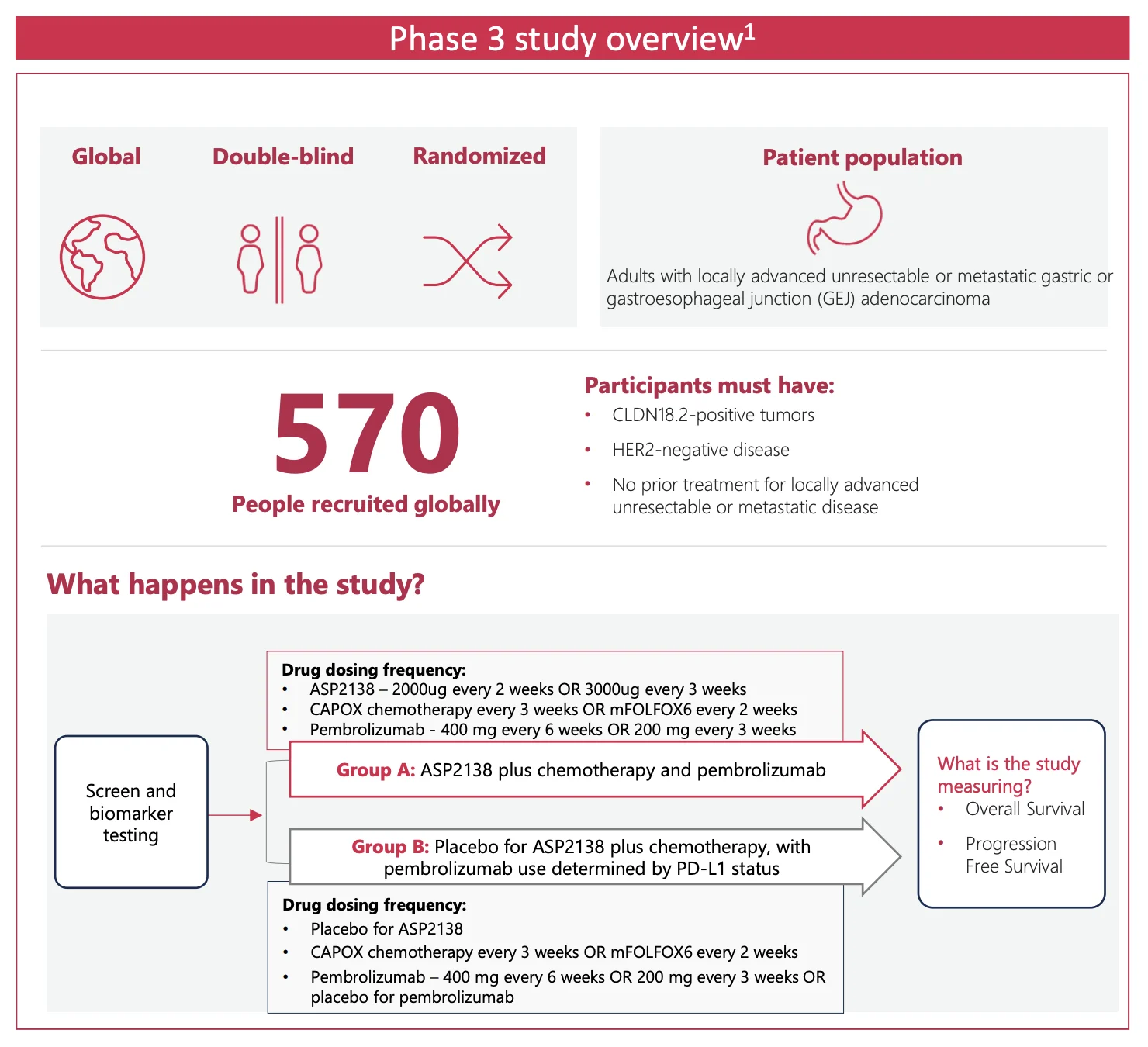
The global Phase 3 study, NCT07673887, is a randomized, double-blind, placebo-controlled trial designed to evaluate the efficacy and safety of ASP2138 plus chemotherapy and pembrolizumab compared with placebo plus chemotherapy with or without pembrolizumab.
Chemotherapy consists of either CAPOX, which combines capecitabine and oxaliplatin, or mFOLFOX6, which includes fluorouracil, leucovorin and oxaliplatin.
The study is enrolling patients with locally advanced unresectable or metastatic gastric or GEJ adenocarcinoma whose tumors are CLDN18.2-positive and HER2-negative. Participants must not have received prior treatment for locally advanced unresectable or metastatic disease.
The study plans to enroll 570 participants across multiple countries, with overall survival and progression-free survival serving as the co-primary endpoints.
1. U.S. National Library of Medicine. A phase 3, global, multi-center, double-blind, randomized study of ASP2138 plus chemotherapy (CAPOX or mFOLFOX6) with pembrolizumab vs placebo plus chemotherapy with or without pembrolizumab in first-line treatment of locally advanced unresectable or metastatic gastric or gastroesophageal junction (GEJ) adenocarcinoma in participants whose tumors are HER2-negative and claudin (CLDN) 18.2-positive. ClinicalTrials.gov. Identifier: NCT07673887. [Online] Available at: https://clinicaltrials.gov/study/NCT07673887 Accessed August 2026
What Is ASP2138?
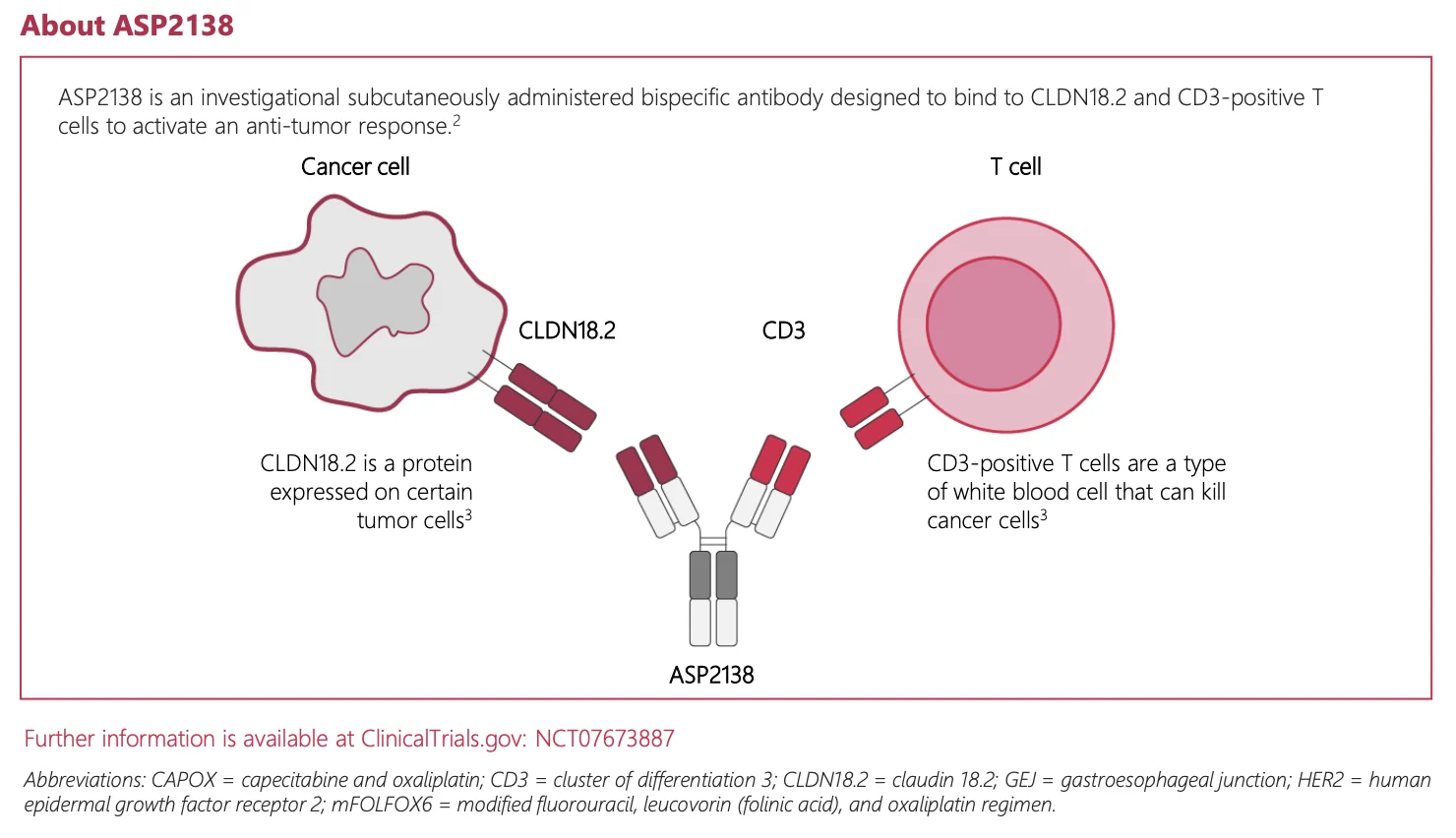
ASP2138 is an investigational subcutaneously administered bispecific antibody designed to bind both CLDN18.2, a protein expressed on certain tumor cells, and CD3-positive T cells, a type of immune cell capable of killing cancer cells.
By binding both targets, ASP2138 is designed to bring T cells closer to CLDN18.2-expressing tumor cells and activate an anti-tumor immune response.
2. Dayyani F, Strickler JH, Hara K, et al. ASP2138 monotherapy or in combination with pembrolizumab and mFOLFOX6 or with ramucirumab and paclitaxel in claudin 18 isoform 2 (CLDN18.2)+ locally advanced unresectable or metastatic gastric or gastroesophageal junction adenocarcinoma: Phase I/Ib trial. Annals of Oncology. 2025;36(Suppl 2):S1120. doi:10.1016/j.annonc.2025.08.2755 3. National Cancer Institute. Anti-CLDN18.2/anti-CD3 bispecific antibody ASP2138. NCI Drug Dictionary. Available at: https://www.cancer.gov/publications/dictionaries/cancer-drug/def/anti-cldn182-anti-cd3-bispecific-antibody-asp2138 Accessed August 2026
CLDN18.2 is a tight-junction protein normally expressed in gastric mucosal cells that can remain expressed in certain gastric and GEJ cancers. Its expression in tumor cells has made CLDN18.2 an important therapeutic target in gastric cancer and the focus of several biomarker-directed treatment approaches. ASP2138 is currently Astellas’ lead program within its Immuno-Oncology Primary Focus.
Commenting on the start of the Phase 3 study, Tadaaki Taniguchi, MD, PhD, Chief Research and Development Officer at Astellas, said:
“The first patient dosed in this Phase 3 study is an important milestone for ASP2138 and for our broader work in CLDN18.2.”
He added that advancing multiple scientific approaches is intended to build evidence around how CLDN18.2-targeted innovation may address different patient needs.
Astellas said it will provide further updates as the study progresses.
ASP2138 remains investigational. Its safety and efficacy have not been established for the uses under investigation, and it has not been approved for these indications.
Read further on OncoDaily: LUCERNA Phase 3: Zolbetuximab, Pembrolizumab, and Chemotherapy in CLDN18.2/PD-L1–Positive Gastric/GEJ Cancer