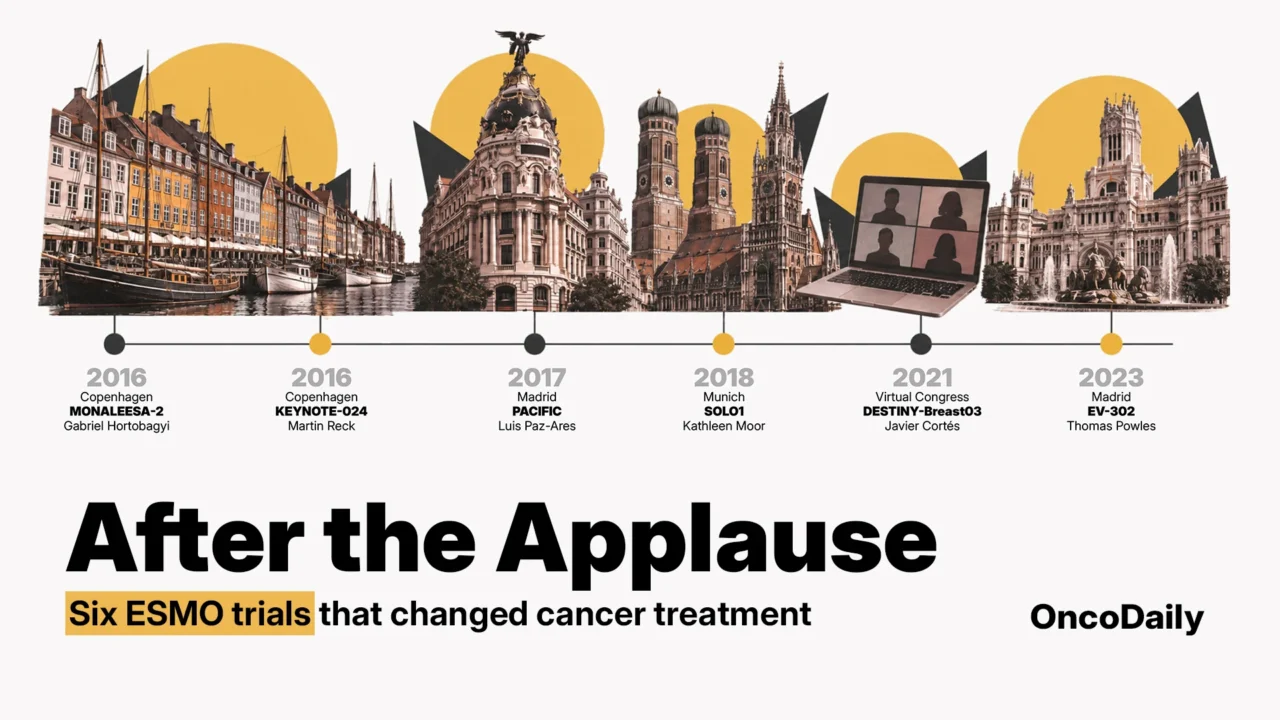
A congress presentation lasts minutes. Its consequences can reshape years of care.
ESMO’s influence reaches well beyond Europe. The congress provides a global stage for the first announcements and debate of potentially practice-changing results.
The phrase “practice-changing” is familiar at oncology congresses. It becomes meaningful when a result changes an actual decision: which treatment to start, whether to add another treatment after the first has finished, or how to reduce the risk that cancer will return and finally to establish what is best for the patient.
While ESMO has been the stage for many other impactful studies that, even without changing guidelines, have changed mindsets and real-world practice, we paint a picture of the past ten years of ESMO annual congresses across cancer types and pivotal clinical trials.
Did endocrine therapy need a backup?

MONALEESA-2, Copenhagen 2016
Back then, endocrine therapy could control hormone receptor-positive, HER2-negative advanced breast cancer, but tumors could become resistant and resume growing. For postmenopausal women, aromatase inhibitors such as letrozole were an established initial treatment, reducing the oestrogen production that helped drive their cancer. Researchers were looking for ways to make that control last longer.
MONALEESA-2 tested whether adding ribociclib could achieve that. The oral drug selectively inhibits CDK4 and CDK6, proteins that help cells pass a checkpoint before copying their DNA and dividing.
“This line of research has been going on for over 15, 20 years, but only recently have the selective CDK4-6 inhibitors become available.”
– said Gabriel Hortobagyi, who chaired MONALEESA-2, at the ESMO 2016 press briefing.
Letrozole reduced the hormonal growth signal; ribociclib interrupted the cell-cycle machinery.
The trial enrolled 668 postmenopausal women with HR-positive, HER2-negative advanced breast cancer who had received no systemic treatment for advanced disease. They were randomly assigned to ribociclib plus letrozole or placebo plus letrozole.
The idea rested on years of drug development. Ribociclib emerged from a collaboration between the Novartis Institutes for BioMedical Research and Astex, announced in December 2005. Earlier attempts to target the cell cycle had struggled with insufficient selectivity and toxicity.
Once the investigators had a promising drug, the clinical trial moved quickly. Gabriel Hortobagyi, later recalled:
“There was a lot of enthusiasm from the concept on a proverbial cocktail napkin until implementation”
At ESMO 2016, the first results showed that adding ribociclib reduced the hazard of progression or death by approximately 44%. The estimated 18-month progression-free survival rate was 63.0% with ribociclib plus letrozole versus 42.2% with letrozole plus placebo.
A more mature analysis subsequently reported medians of 25.3 months with ribociclib plus letrozole versus 16.0 months with letrozole alone.
But one question remained:
Would delaying progression also mean that women lived longer?
That answer required five more years. At ESMO 2021, Hortobagyi presented the overall-survival results. Median survival was 63.9 months with ribociclib plus letrozole, compared with 51.4 months with letrozole alone. Estimated six-year survival was 44.2% versus 32.0%, an absolute difference of 12.2 percentage points.
Hortobagyi had entered oncology in 1974, when survival expectations for metastatic breast cancer were much shorter. Discussing the new results in a 2021 Breastcancer.org podcast episode, he noted that some women enrolled at the beginning of MONALEESA-2 were approaching eight years on treatment:
“Some of the original patients are still receiving ribociclib at this point”
The follow-up had become long enough to encompass years of patients’ lives and to demonstrate a statistically significant overall-survival benefit.
Today, a CDK4/6 inhibitor combined with endocrine therapy is a standard first-line approach for HR-positive, HER2-negative metastatic breast cancer. Ribociclib remains an established option, with blood counts, liver function and electrocardiograms monitored during treatment.
Could the first treatment be immunotherapy alone?

KEYNOTE-024, Copenhagen 2016
For patients with metastatic non-small cell lung cancer without an actionable driver alteration, platinum-based chemotherapy had long been the starting point. Immunotherapy was already changing treatment after chemotherapy failed.
KEYNOTE-024 asked whether selected patients could receive it first and whether they could do better without chemotherapy. The trial tested pembrolizumab, an antibody that blocks PD-1, a receptor on immune cells. Tumors can use its interaction with PD-L1 to suppress an immune response; blocking that interaction allows immune cells to attack the cancer.
Selection was central: the 305 participants had previously untreated metastatic disease, PD-L1 expression on at least 50% of tumor cells, and no sensitizing EGFR mutations or ALK rearrangements. They were randomly assigned to pembrolizumab alone or platinum-based chemotherapy.
At ESMO 2016, Martin Reck presented results that challenged the established sequence. Median progression-free survival was 10.3 months with pembrolizumab versus 6.0 months with chemotherapy. The hazard of death was 40% lower in the initial analysis, although longer follow-up was needed to understand the durability of the benefit.
The results also changed the treatment experience.
Patient-reported outcomes (PROs) showed improved global health status and quality of life with pembrolizumab compared with chemotherapy
KEYNOTE-024 helped establish a new starting point for this defined population: pembrolizumab alone could replace platinum-based chemotherapy as first-line treatment. Testing PD-L1 before treatment now directly affected the choice patients and clinicians faced.
The longer story emerged at ESMO 2020, when the five-year results were presented. In VJOncology’s The Lung Cancer Sessions: ESMO 2020, Reck discussed the findings with fellow lung cancer specialists Solange Peters and Sanjay Popat. Looking for comparable long-term outcomes, he found that many earlier trials ended follow-up after only two or three years.
KEYNOTE-024 was extending the horizon of what investigators could observe.
“These patients remain stable for a couple of months after the two years of pembrolizumab, so this is a real new chance.”
– Martin Reck, discussing KEYNOTE-024 in VJOncology’s The Lung Cancer Sessions: ESMO 2020.
The 2021 five-year analysis reported median overall survival of 26.3 months with pembrolizumab versus 13.4 months with chemotherapy. Estimated five-year survival was 31.9% versus 16.3%. The advantage persisted despite substantial crossover: many patients initially assigned to chemotherapy subsequently received immunotherapy.
Pembrolizumab alone remains a standard first-line option for appropriately selected patients with high PD-L1 expression and no actionable driver alteration.
Other options include immunotherapy-chemotherapy combinations, with treatment chosen according to molecular findings, disease burden, and the patient’s condition.
What Came After Chemoradiotherapy

PACIFIC, Madrid 2017
Completing chemoradiotherapy was a major milestone for patients with unresectable stage III non-small cell lung cancer. Their cancer could not be removed surgically, but treatment still aimed to cure. Concurrent platinum-based chemotherapy and radiation were the established approach. For patients whose disease had not progressed, the next phase generally involved surveillance and the uncertainty of whether the cancer would return.
PACIFIC asked whether that interval could become another opportunity to treat.
The trial enrolled 713 patients whose disease had not progressed after concurrent chemoradiotherapy, randomly assigning them to durvalumab or placebo for up to 12 months. Durvalumab blocks PD-L1, a protein that can help cancer cells suppress an immune response. The aim was to strengthen disease control through consolidation therapy, adding immunotherapy after chemoradiotherapy rather than replacing it.
At the ESMO 2017 press conference, Luis Paz-Ares presented the findings on behalf of the investigators. Scott J. Antonia was the first author of the original publication. The study brought the progress already seen with immunotherapy in metastatic lung cancer into a setting where preventing recurrence could have lasting consequences. Paz-Ares explained why investigators had pursued this approach:
“No major advances had occurred over the last two decades … there’s an urgent clinical need for novel therapeutic approaches in this setting.”
– Luis Paz-Ares, ESMO 2017 press conference; excerpt from the video transcript published by ecancer.
The first readout showed median progression-free survival of 16.8 months with durvalumab versus 5.6 months with placebo, with a 48% lower hazard of progression or death. An important detail sits behind the headline: the clock started at randomization after chemoradiotherapy. These months did not include the preceding treatment period.
The excitement in Madrid came with an unresolved question. Delaying progression was meaningful, but investigators still needed to establish whether patients would live longer. The overall-survival data were not yet mature.
The answer began to arrive in 2018. The subsequent analysis demonstrated a statistically significant overall-survival benefit: estimated two-year survival was 66.3% with durvalumab versus 55.6% with placebo. The additional treatment after chemoradiotherapy was doing more than postponing progression.
Five-year follow-up strengthened that conclusion. Estimated overall survival was 42.9% with durvalumab compared with 33.4% with placebo. Median overall survival was 47.5 versus 29.1 months, respectively. These longer-term results were presented at ASCO 2021 and published in 2022.
The practice change was concrete. Completing chemoradiotherapy no longer necessarily meant moving directly into surveillance. Eligible patients could receive up to a year of durvalumab, with evidence that its benefit extended years beyond the treatment period. At five years, progression-free survival was 33.1% with durvalumab versus 19.0% with placebo.
That additional opportunity also required careful clinical judgment. Chest radiation and immunotherapy can both cause pneumonitis, an inflammatory lung condition. Durvalumab can produce immune-related inflammation in other organs, making recovery from chemoradiotherapy and ongoing monitoring important parts of the treatment sequence.
Durvalumab remains an established consolidation treatment for appropriately selected patients in this setting. In the European Union, its indication requires PD-L1 expression on at least 1% of tumor cells and no progression after platinum-based chemoradiotherapy. This differs from PACIFIC’s enrollment criteria, which did not require a particular PD-L1 level.
The next step after chemoradiotherapy has since become more specific to the cancer’s biology. For patients with an EGFR exon 19 deletion or L858R mutation, osimertinib is now a recommended consolidation option following the separate LAURA trial. PACIFIC’s lasting contribution was to establish that the interval after chemoradiotherapy could be used to improve survival and to make that additional treatment a standard part of care.
Two Years of Treatment. A Benefit That Outlasted It.
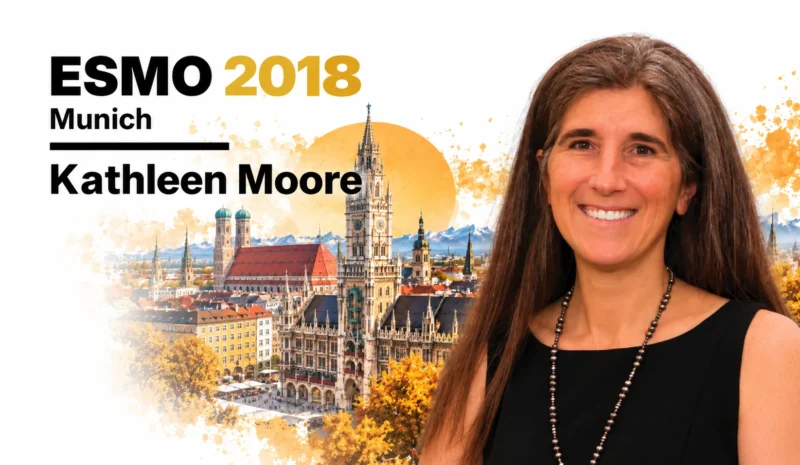
SOLO1, Munich 2018
In advanced ovarian cancer, surgery and platinum-based chemotherapy could produce a complete or partial response, while the risk of recurrence remained a central concern. SOLO1 focused on this first period of disease control, investigating whether maintenance treatment could extend it.
The trial enrolled 391 women with newly diagnosed stage III or IV high-grade serous or endometrioid ovarian, fallopian tube, or primary peritoneal cancer carrying a BRCA1 or BRCA2 mutation. All had responded to first-line platinum-based chemotherapy. They were randomly assigned to maintenance olaparib or placebo, generally for up to two years.
At the time, initial treatment centered on surgery and chemotherapy, usually carboplatin and paclitaxel. Observation after a response remained a common approach, although bevacizumab maintenance was an option for selected patients. PARP inhibitors had already demonstrated activity in recurrent ovarian cancer.
The new question was whether introducing olaparib after the first response could delay progression in this BRCA-mutated population.
Olaparib inhibits PARP, a protein involved in repairing DNA damage. Cancers with impaired BRCA-mediated repair are particularly vulnerable to this additional disruption.
The protocol also made treatment duration part of the study. Patients with no evidence of disease stopped treatment at two years; selected patients with persistent disease could continue beyond that point. This allowed investigators to assess whether disease control could persist after a defined course of maintenance therapy.
Kathleen Moore, the study’s first author and ESMO presenter, addressed the value of time without treatment in a contemporary ecancer interview:
“To keep people disease-free and you don’t have to treat them, that’s a win-win.”
– Kathleen Moore, ecancer interview, “SOLO1: Maintenance olaparib in advanced BRCA ovarian cancer,” October 2018.
At ESMO 2018, olaparib showed a 70% lower hazard of progression or death than placebo. At three years, progression-free survival was 60.4% with olaparib versus 26.9% with placebo. These findings established a progression-free survival benefit; overall survival data were not yet mature.
Five-year follow-up reported median progression-free survival of 56.0 months with olaparib versus 13.8 months with placebo. The sustained difference showed that the benefit extended beyond the planned two-year treatment period.
The seven-year overall-survival analysis, presented at ESMO 2022, reported estimated survival of 67.0% with olaparib versus 46.5% with placebo.
The practice change also strengthened the importance of BRCA testing early in the treatment pathway. Identifying a mutation could guide maintenance treatment after the initial chemotherapy response. SOLO1 established that this first period of disease control was an opportunity for targeted intervention, with benefits that could persist after treatment ended.
When the Second-Line Standard Was Surpassed

DESTINY-Breast03, Virtual Congress 2021
HER2-positive metastatic breast cancer already had an effective treatment sequence. Trastuzumab, pertuzumab, and a taxane formed an established first-line regimen. When disease progressed, trastuzumab emtansine, or T-DM1, was the standard second-line treatment. DESTINY-Breast03 investigated whether another antibody-drug conjugate could improve on that second step.
The trial enrolled 524 patients with HER2-positive unresectable or metastatic breast cancer previously treated with trastuzumab and a taxane. They were randomly assigned to T-DM1 or trastuzumab deruxtecan, or T-DXd. This was a direct comparison against an effective treatment already used in clinical practice.
Both drugs attach a cell-killing payload to an antibody that targets HER2. However, their construction differs. T-DXd carries approximately eight payload molecules per antibody, compared with roughly four for T-DM1, and delivers a different type of cytotoxic drug. Its released payload can also enter neighboring cells, including cancer cells with lower HER2 expression, a property known as the bystander effect. These differences offered a biological rationale for testing whether two treatments directed at the same target could produce substantially different outcomes.
Earlier research had shown that T-DXd could produce responses in patients who had received multiple previous treatments. But those findings came from a study without a randomized comparator. DESTINY-Breast03 addressed the next question: could that activity translate into better outcomes when tested against the established standard?
Javier Cortés presented the results at the ESMO 2021 Presidential Symposium. At 12 months, progression-free survival was 75.8% with T-DXd versus 34.1% with T-DM1. The hazard of progression or death was 72% lower with T-DXd. Median progression-free survival had not yet been reached in the T-DXd group, compared with 6.8 months in the T-DM1 group.
For Sara Hurvitz, a breast oncologist at UCLA and a principal investigator of DESTINY-Breast03, the comparison stood out against years of clinical experience. Speaking to the National Cancer Institute following the presentation, she said:
“I’ve never seen such a marked improvement in efficacy with a new drug compared to the current standard therapy for metastatic breast cancer”
– Sara Hurvitz, quoted in the National Cancer Institute’s “Enhertu May Be Preferred Therapy for Some Metastatic Breast Cancers,” October 19, 2021.
The initial findings established a progression-free survival advantage. Overall-survival results were still immature and had not crossed the prespecified threshold for significance. Longer follow-up was needed to determine whether the improvement in disease control would also translate into longer life.
The peer-reviewed 2024 analysis reported median overall survival of 52.6 months with T-DXd versus 42.7 months with T-DM1. Estimated three-year survival was 67.6% versus 55.7%, an absolute difference of 11.9 percentage points. These figures were measured from randomization after previous treatment, rather than from the original diagnosis, and were not part of the ESMO 2021 presentation.
T-DXd subsequently replaced T-DM1 as the preferred second-line treatment for eligible patients who had not previously received T-DXd.
The improvement also required specific attention to safety. Interstitial lung disease and pneumonitis can be serious or fatal. New cough, shortness of breath, or other respiratory changes require prompt assessment, with treatment interruption and management according to severity. Recognizing lung toxicity became an essential part of using the new standard safely.
The treatment sequence has continued to evolve. In September 2026, European approval was announced for T-DXd plus pertuzumab as first-line treatment, based on the separate DESTINY-Breast09 trial. Breast03 remains relevant for patients progressing after trastuzumab-based treatment who have not already received T-DXd; it does not establish the benefit of giving T-DXd again after progression on a first-line T-DXd regimen.
Did two drugs overturn four decades of chemotherapy?

EV-302 / KEYNOTE-A39 Madrid, 2023
For decades, treatment for advanced urothelial cancer began with platinum-based chemotherapy. Patients received cisplatin plus gemcitabine, or carboplatin plus gemcitabine when cisplatin was unsuitable. By 2023, maintenance avelumab had improved this approach: patients whose cancer had not progressed during chemotherapy could move on to immunotherapy. But platinum chemotherapy remained the foundation of first-line treatment.
EV-302 asked whether treatment could begin with a different combination: enfortumab vedotin plus pembrolizumab.
Enfortumab vedotin is an antibody-drug conjugate. Its antibody targets nectin-4, a protein commonly expressed on urothelial cancer cells, and carries a drug that disrupts the machinery needed for cell division. Pembrolizumab blocks PD-1, helping immune cells attack the cancer. The combination brought targeted delivery of a cell-killing drug together with immunotherapy. It avoided conventional platinum chemotherapy, although enfortumab vedotin itself carries a cytotoxic payload.
Both drugs already had roles in advanced urothelial cancer. What was new was using them together at the beginning of treatment. EV-302 enrolled 886 patients with previously untreated, locally advanced or metastatic urothelial cancer, randomly assigning them to the combination or gemcitabine with cisplatin or carboplatin.
The rationale had emerged from promising earlier studies. Looking back in a February 2025 UroToday interview with Ashish Kamat, Thomas Powles described the moment when antibody-drug conjugates opened a new direction:
“We thought we’d reached a plateau. Then the antibody-drug conjugates came along.”
– Thomas Powles, speaking with Ashish Kamat in UroToday’s Enfortumab Vedotin and Pembrolizumab Demonstrate Durable Responses in Advanced Bladder Cancer.
At the Presidential Symposium in Madrid, the phase III results showed how far that direction could lead. Median overall survival was 31.5 months with enfortumab vedotin plus pembrolizumab versus 16.1 months with chemotherapy. The hazard of death was 53% lower with the combination. Median progression-free survival was 12.5 versus 6.3 months. Both measures had approximately doubled.
In EV-302, estimated 18-month overall survival increased from 44.7% with gemcitabine plus cisplatin or carboplatin to 69.5% with enfortumab vedotin plus pembrolizumab. These estimates compare the randomized treatment groups in the initial analysis presented at ESMO 2023 and published in 2024.
The impact extended beyond the congress hall. In the UroToday interview, Powles described patients with bone metastases who had arrived expecting their disease to deteriorate quickly, then achieved a complete response – meaning their cancer was no longer detectable on scans, although this did not establish a cure.
“Many of those patients don’t want to stop.”
– Thomas Powles, UroToday interview, February 24, 2025.
Treatment duration had become a question about patients’ priorities as well as cancer control. Some wanted more time with their families; others sought relief from peripheral neuropathy affecting their mobility and quality of life. Skin reactions require early attention, while nerve damage can accumulate over time. The survival gains opened a new conversation: how to preserve disease control while making that additional time livable.
Today, enfortumab vedotin plus pembrolizumab is a preferred first-line standard for advanced urothelial cancer in patients suitable for the combination. Platinum-based approaches remain important when the combination is unsuitable or unavailable. Treatment requires careful monitoring for skin reactions, neuropathy, elevated blood glucose, and immune-related complications.
Longer follow-up has reinforced the original finding. At ASCO 2026, median overall survival was 33.6 versus 15.9 months, and estimated survival at 42 months was 44.0% versus 24.6%. These later figures come from a separate follow-up analysis, extending the story that began in Madrid: the survival advantage persisted well beyond the first congress presentation.
These trials represent only part of the research presented at ESMO over the past decade. As another congress begins, the next potentially practice-changing results will face familiar questions:
How much do patients benefit?
Who is most likely to benefit?
Where does the treatment belong?
Those answers take shape long after the applause.
Read in OncoDaily Magazine October Issue:
“How to become a UICC president”