There is a moment, somewhere early in life, when a trajectory quietly locks in.
For Ara Vaporciyan, it came at the age of twelve.
Cardiac surgery was entering what many would later call its golden era. Cardiopulmonary bypass had transformed what was possible. The heart—once untouchable—was becoming operable, visible, solvable. For a child growing up in Detroit, in a household where science and precision were part of everyday language, the signal was unmistakable.
“I became interested in cardiothoracic surgery at literally the age of 12,” he recalls. “I bought Gray’s Anatomy at 13 and started reading about the heart.”
***
His father was an architect. His mother, trained in business, dedicated herself to raising the family. Around him, ideas were not abstract—they were constructed, debated, refined. His brother would go on to become a PhD chemical engineer.
The environment did not prescribe medicine. But it cultivated something more important: discipline of thought.
“I always wanted medicine,” he says simply.
Yet even at that early stage, the path he imagined was not only clinical. It was investigative.
That instinct found its first real outlet during his undergraduate years, when he entered a research lab working on ischemia–reperfusion injury.
It was not gentle science.
“We had a model where we could initiate a clot in a coronary artery,” he says. “Watch the flow decline… and then infuse TPA and watch the clot dissolve.”
It is difficult to overstate the power of such a moment for a young scientist. To observe pathology—and then its reversal—in real time is to understand that medicine is not only about managing disease, but about intervening in its mechanisms.
“It got me very excited about research,” he says.
Excited enough to shape his next decisions.
The first recalibration: choosing a path that allows thinking
Like many at the time, he was drawn to cardiac surgery—the apex of technical mastery.
But somewhere along the way, he made a decision that would quietly define his career.
He stepped back.
Not away from ambition, but toward sustainability.
“Cardiac surgery is an expensive care model,” he explains. “It’s very difficult to combine that with meaningful research.”
And for someone who wanted not only to operate, but to understand, to investigate, to contribute beyond the operating room, the constraints were real.
General thoracic surgery offered something different.
It offered an environment where the combination of clinical and investigative work was the routine.
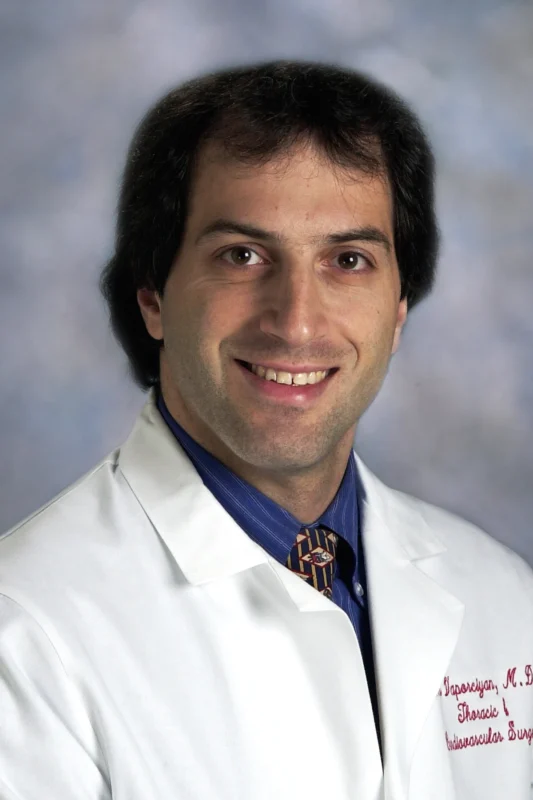
MD Anderson
When he matched into the then-young thoracic programme at MD Anderson, the specialty itself was in transition.
For years, it had stood in the shadow of cardiac surgery. But leaders like Jack Roth and Bill Putnam saw what was coming: a re-emergence, driven by oncology, by complexity, by the need for integration.
“They were visionaries,” Dr. Vaporciyan says.
They selected him. And he stayed.
From fellowship in the mid-1990s to faculty, to department chair in 2015, and more recently to a vice-presidential role, his career has unfolded largely within one institution.
But “staying” is misleading.
Within those walls, his role has continuously evolved—from surgeon to educator, from educator to leader, from leader to architect of systems.
“A passion to learn”
When asked about the key to his success, he does not hesitate.
“A passion to learn.”
It is a familiar phrase, but in his case, it is operational rather than aspirational.
“What I learned as an educator,” he says, “is that expertise is not generalizable.”
The assumption that excellence in one domain confers authority in another is, in his words, “a seminal flaw.”
And so, at each transition, he returned to first principles.
When he became chair, he confronted an uncomfortable truth:
“I didn’t understand finance.”
Within weeks, he realised that financial literacy was not peripheral—it was central to sustaining a department.
And so, characteristically, he did not outsource the problem.
He studied it.
“I dove deep,” he says.
The discipline of listening
Another turning point came not from surgery or science, but from leadership training—specifically, coaching.
At MD Anderson, a formal programme was developed to cultivate coaching skills among leaders. Dr. Vaporciyan joined one of the early cohorts.
What he took from it was deceptively simple.
“The central tenet of coaching is listening,” he says.
Then he pauses, as if to underline the distinction.
“Listening doesn’t mean you’re waiting to speak.”
It is a line that resonates beyond leadership theory. In medicine, where time is scarce and hierarchies are implicit, true listening is rare.
But for him, it became foundational.
Mentors
Over nearly four decades, he has accumulated mentors across different domains.
Bill Putnam, whom he first encountered as a medical student, remains a central figure—“two-thirds of my life,” as he puts it.
Others guided him through leadership transitions, clinical decisions, strategic thinking.
But he is precise in distinguishing roles.
“A mentor gives advice,” he explains. “A coach helps you figure it out yourself.”
Both are necessary.
Both are insufficient alone.
Training as multiplication
If surgery is an act of direct impact, training is an act of multiplication.
This idea—almost mathematical in its clarity—has shaped much of Dr. Vaporciyan’s career.
“A surgeon might touch ten thousand lives,” he says. “But if you train others, the scale changes completely.”
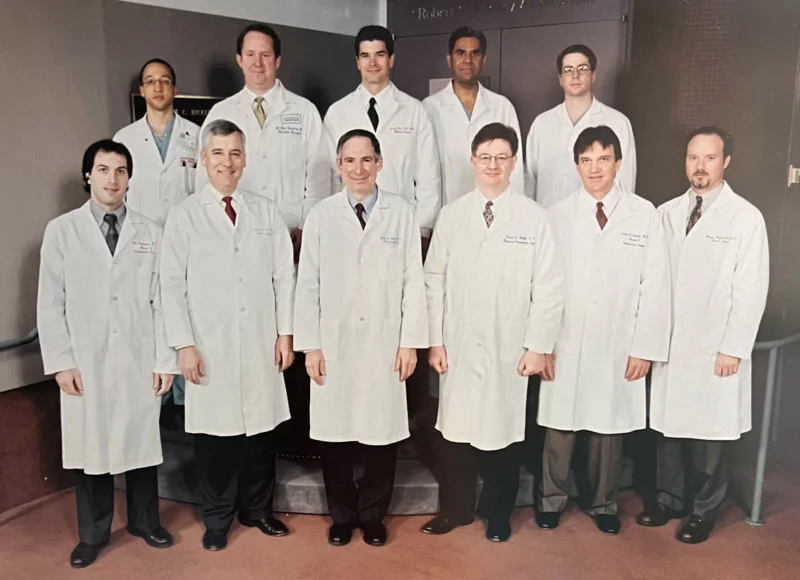
At MD Anderson, he oversaw generations of trainees, many of whom have gone on to leadership positions across the United States.
What he looks for in them is not brilliance alone.
“Emotional intelligence is key,” he says.
He breaks it down with the precision of someone who has thought about it deeply:
- Understanding one’s own triggers
- Managing those responses
- Recognising triggers in others
- Adjusting communication accordingly
“The last one is the hardest,” he admits.
But without it, teams fragment. Progress slows.
“I felt like an intern again.”
For all the external markers of success, he speaks candidly about uncertainty.
“Every new role brings imposter syndrome,” he says.
When he became chair, the experience was immediate.
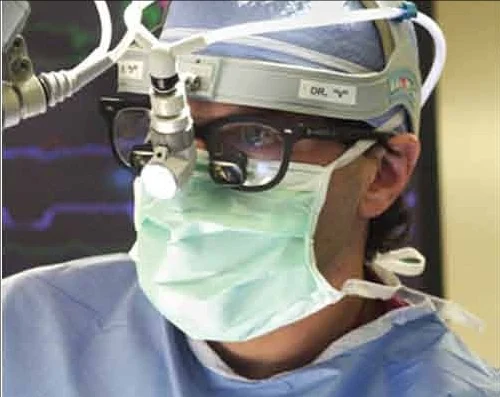
“I felt like an intern again.”
The analogy is striking. After decades of training and experience, to return psychologically to the beginning—uncertain, cautious, aware of gaps.
But instead of resisting that feeling, he uses it.
Here, he references the framework popularised in Mindset.
A fixed mindset protects identity.
A growth mindset embraces deficiency as a starting point.
“I didn’t know how to do that,” he says. “So I learned.”
Books
His thinking has been shaped, in part, by a set of books that reflect his approach to complexity.
- Thinking, Fast and Slow — understanding bias
- Think Again — intellectual flexibility
- Mindset — learning as identity
And then, unexpectedly:
- Unreasonable Hospitality
A book about restaurants.
Yet for Ara Vaporciyan, the lesson is immediately transferable.
“Do whatever it takes for the patient.”
The future
Looking ahead, he sees medicine at a crossroads.
Knowledge is expanding exponentially. Subspecialisation continues to fragment expertise.
But fragmentation has limits.
“We can’t build a system where hyper-specialists are everywhere,” he says.
The solution, in his view, is not further division—but integration.
Teams.
And increasingly, technology.
Artificial intelligence, he believes, will become unavoidable.
But he is cautious.
“Technology doesn’t fix flawed processes,” he says. “It just makes the same mistakes faster.”
The implication is clear: systems must evolve alongside tools.
A learner
At the end of the conversation, the question shifts.
Not about roles. Not about achievements.
But about identity.
Who is Ara Vaporciyan?
He answers without hesitation.
“A learner.”
Then, after a pause:
“A passionate learner who wants to help more people with every step.”
It is a simple statement.
But it contains, in compressed form, the architecture of his career.
From surgeon to educator.
From educator to leader.
From leader to builder.
Always returning to the same question:
How can this step increase impact?
The architecture of impact
There is a certain symmetry to his trajectory.
A child reading Gray’s Anatomy.
A young researcher watching blood flow return through a once-occluded artery.
A surgeon choosing not only where he can operate—but where he can think.
A leader learning to listen.
A teacher multiplying his reach through others.
Each step, individually, is understandable.
Together, they form something more deliberate.
Not a career defined by titles.
But by scale.
And by a quiet, persistent commitment to expanding the number of lives touched…
***
– Who is your role model?
“I don’t have one role model. I have many—different people for different parts of life.
My wife, for her ability to give, even to exhaustion.
Others for how they think, how they lead, how they stay grounded.
I watch, I learn, and I try to take the best from each of them.”
Interview by Gevorg Tamamyan, Editor-in-Chief of OncoDaily