
Follicular lymphoma (FL) is the most common indolent lymphoma and is characterized by recurrent relapses despite excellent initial responses to treatment. While chemoimmunotherapy is an effective frontline option for patients with advanced-stage, high-tumor-burden disease, related toxicity has prompted the development of chemo-free alternatives.
Lenalidomide combined with anti-CD20 antibodies has become an established treatment, while venetoclax has shown single-agent activity in FL. Given the near-universal presence of the t(14;18) translocation and BCL2 overexpression in FL, combining venetoclax with obinutuzumab and lenalidomide provided a strong rationale.
Before the current study, only a small Phase I trial had evaluated this combination in relapsed or refractory B-cell lymphomas, reporting promising responses but substantial hematologic toxicity. Its potential to enhance the activity of obinutuzumab and lenalidomide in frontline FL had not been established.
The Phase Ib/II LEVERAGE study was therefore designed to evaluate the safety, efficacy, and molecular response dynamics of this chemo-free triplet in treatment-naïve, high-tumor-burden FL.

Follicular Lymphoma (FL): Evolving Biology and Modern Therapeutic Paradigms
Clinical and Molecular Endpoints
Eligible patients had Grade 1-3A FL requiring treatment according to GELF criteria, measurable disease, ECOG performance status ≤2, and adequate organ function.
The study consisted of a Phase Ib dose-escalation component followed by a Phase II expansion cohort. The primary objectives were:
- Determination of the maximum tolerated dose and recommended Phase II dose of venetoclax
- Assessment of complete response rate at the end of induction therapy
Secondary endpoints included safety, ORR, PFS, OS, duration of response, and time to next treatment. Response assessment was performed using PET-CT. ctDNA-based sequencing was incorporated for genomic characterization and MRD monitoring.
Treatment Scheme and Exposure
During induction, patients received six 28-day cycles of obinutuzumab, lenalidomide, and venetoclax. Obinutuzumab was administered according to standard FL schedules, lenalidomide (20 mg) was introduced from Cycle 2, and venetoclax was administered from Cycles 1-6. Four venetoclax dose levels were explored:
- 400 mg Days 1-10
- 800 mg Days 1-10
- 400 mg continuous dosing
- 800 mg continuous dosing
For maintenance phase, patients achieving complete response received obinutuzumab every 8 weeks for 2 years
Patients achieving partial response received additional venetoclax and lenalidomide for 6 months, and obinutuzumab maintenance for 2 years.
Between September 2019 and November 2023, 50 patients were enrolled, including 18 in the dose-escalation phase and 32 in the dose-expansion phase. The median age was 60 years, with 78% presenting with Stage III-IV FL.
Treatment Delivery Challenged by Myelosuppression
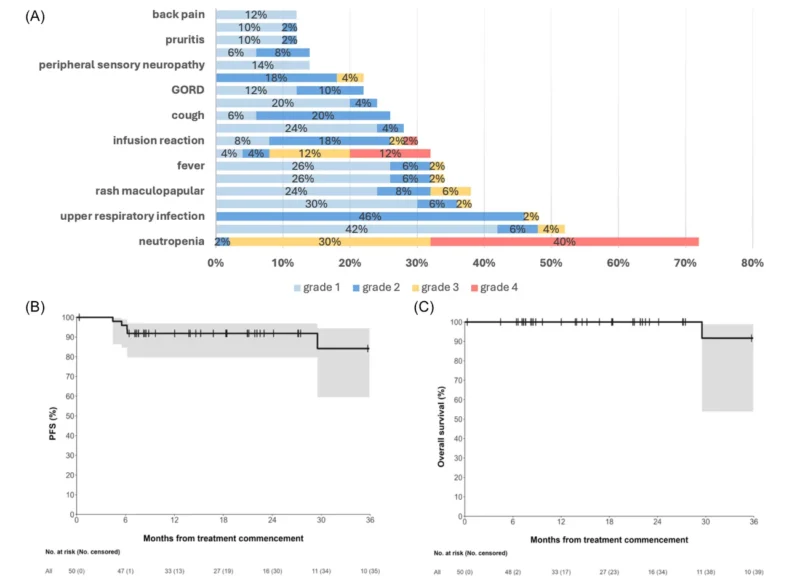
Neutropenia was the most common adverse event, with Grade 3-4 neutropenia occurring in 70% of patients. Although febrile neutropenia was uncommon (4%), hematologic toxicity frequently resulted in treatment delays, dose modifications, and treatment discontinuation.
Overall, 14% of patients discontinued treatment during induction and an additional 8% during maintenance because of toxicity. The most common non-hematologic adverse events included diarrhea, upper respiratory infections, nausea, and rash. Biochemical tumor lysis syndrome was observed in two patients, though no cases of clinical tumor lysis syndrome occurred.
Efficacy Findings
The triplet regimen demonstrated substantial clinical activity. At the RP2D, the CR rate at the end of induction was 86%, with an ORR of 92%. Across all evaluable patients, the CR and ORR were 83% and 90%, respectively.
After a median follow-up of 18.3 months, the estimated 2-year PFS was 92%, the 2-year OS rate was 100%, indicating durable disease control.
ctDNA and MRD Analyses
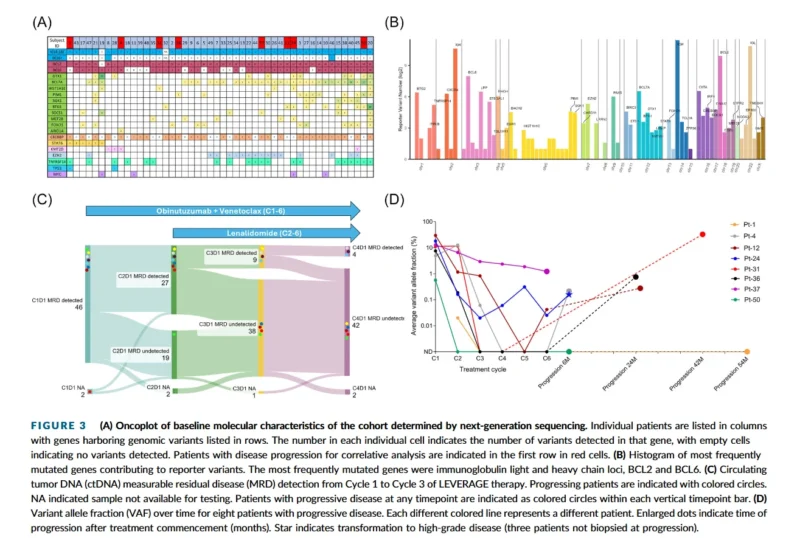
All evaluable patients had detectable ctDNA at baseline, and molecular responses occurred rapidly during treatment, with MRD negativity increasing from 41% after Cycle 1 to 91% after Cycle 3.
Early MRD clearance was strongly associated with favorable outcomes. Patients who achieved MRD negativity after the first treatment cycle had a 95% negative predictive value for relapse.
Analysis of progression samples demonstrated evidence of clonal evolution, emphasizing the dynamic biology of FL and the potential limitations of baseline tumor-informed MRD tracking. In some cases, evolving clones showed limited overlap with baseline genomics.
Discussion and Limitations
Cross-trial comparisons should be interpreted cautiously, but the efficacy observed in this study compares favorably with outcomes reported for established chemoimmunotherapy and chemotherapy-free approaches.
A key question, however, concerns the added value of venetoclax, as outcomes were broadly similar to those observed with the doublet regimen. Longer follow-up and randomized comparisons would be required to define the specific contribution of venetoclax.
Several limitations should be considered, including the modest sample size, non-randomized design, relatively short follow-up, and incomplete availability of FLIPI scores.
What Does LEVERAGE Tell Us?
The study provides important prospective data on a novel chemo-free triplet of obinutuzumab, lenalidomide, venetoclax, and incorporates comprehensive genomic profiling with tumor-informed ctDNA MRD monitoring.
The triplet showed encouraging efficacy in treatment-naïve, high-tumor-burden FL, with high response rates and durable disease control. Yet, continuous venetoclax at 800 mg daily was associated with substantial hematologic toxicity, resulting in frequent treatment modifications.
Given the emergence of highly active bispecific antibodies in FL, further development of this regimen may depend on identifying patient subsets most likely to benefit from BCL2-directed therapy.