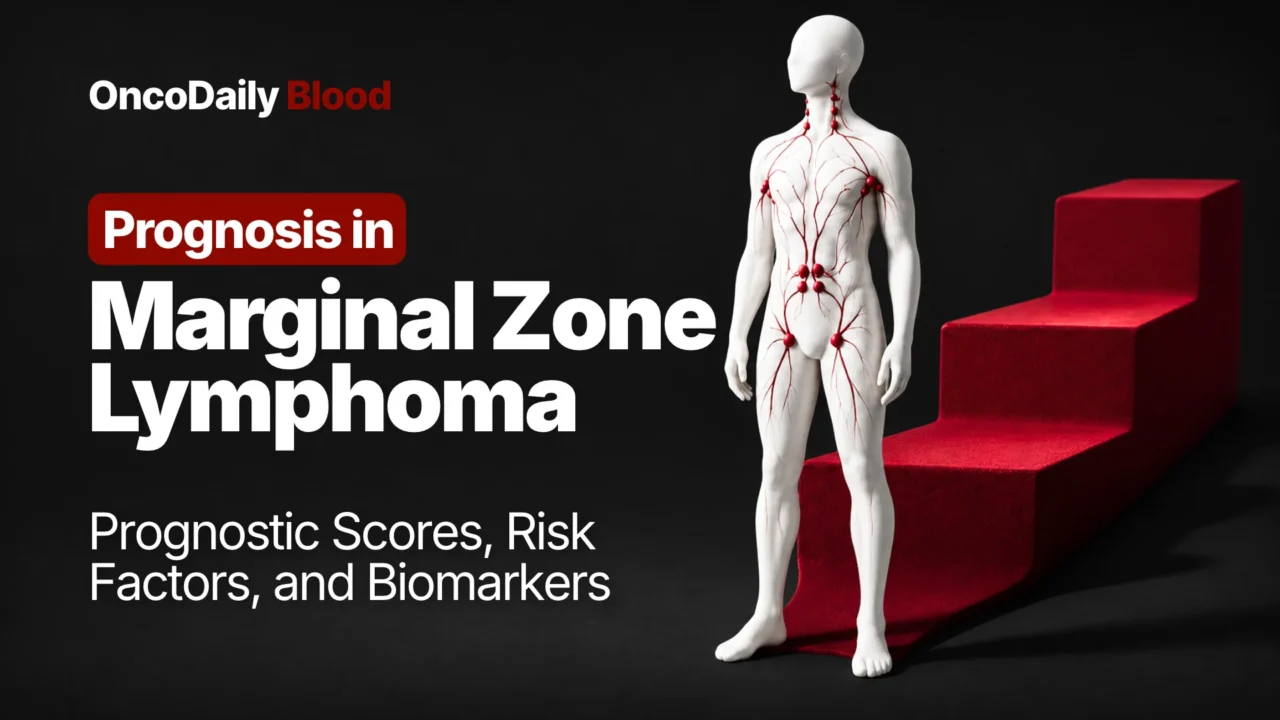
Marginal zone lymphoma (MZL) is a heterogeneous group of indolent B-cell lymphomas with generally favorable survival outcomes but considerable differences in disease progression, relapse risk, and response to treatment. Several prognostic models have been developed for individual MZL subtypes, and a recently validated international index now provides a unified approach to risk assessment.
In a comprehensive review published in Haematologica in November 2026, Annalisa Talami, and colleagues examined the clinical and biological factors influencing MZL prognosis, the performance of established prognostic scores, and emerging approaches involving molecular profiling, functional imaging, and circulating tumor DNA.
Marginal Zone Lymphoma: Survival and Prognostic Differences Across Subtypes
MZL accounts for approximately 7-8% of non-Hodgkin lymphomas and includes three major subtypes:
- extranodal marginal zone lymphoma (EMZL), also known as mucosa-associated lymphoid tissue (MALT) lymphoma
- splenic marginal zone lymphoma (SMZL)
- nodal marginal zone lymphoma (NMZL)
Median survival exceeds 10 years, but outcomes vary between subtypes and according to disease extent. Gastric and extragastric MALT lymphomas have 5-year overall survival rates exceeding 90%, with ~75-80% of patients alive at 10 years. Early-stage gastric MALT lymphoma carries a particularly favorable prognosis, with survival approaching that of the general population.
Relapse remains common in EMZL, affecting ~50-60% of patients, with a median time to recurrence of around five years. SMZL also follows an indolent course in most patients. Approximately one-third develop more aggressive disease, with median survival of around four years in this subgroup.
Reported 5-year OS rates for NMZL range from 57% to 97%, reflecting differences in populations, diagnostic classification, staging, and treatment. Overall survival is influenced by competing causes of death and subsequent treatments, making PFS, EFS, and lymphoma-specific survival useful endpoints for evaluating disease-related risk.

Prognostic Factors: Early Progression and Histological Transformation
Progression of disease within 24 months (POD24) is an important adverse prognostic marker across MZL subtypes. In a study from the Fondazione Italiana Linfomi, patients experiencing POD24 had a 3-year OS of 53%, compared with 88% among patients without early progression. The IELSG19 trial similarly reported 5-year OS of 80% vs 91% and 10-year OS of 64% vs 85% in patients with and without POD24, respectively.
Histological transformation to diffuse large B-cell lymphoma occurs in 5-10% of MZL cases, with an estimated annual incidence of 1%. A meta-analysis of 12 studies found that the cumulative incidence of transformation at five and ten years was:
- 3% and 5% in EMZL
- 7% and 13% in SMZL
- 9% and 13% in NMZL
Transformation was associated with an approximately fourfold increased risk of death (subdistribution hazard ratio 3.95). Reported clinical risk factors include elevated lactate dehydrogenase (LDH), failure to achieve complete response after initial therapy, extensive nodal or mucosal involvement, CD5 expression, and complex karyotype. Molecular studies implicate clonal evolution involving TP53, TNFAIP3, CDKN2A/B, MYC rearrangements, and alterations in cell-cycle and NF-κB signaling.
No validated prognostic score currently predicts histological transformation in MZL. Its association with POD24 also complicates the interpretation of early relapse, because a proportion of patients with rapid progression have developed aggressive histology.
MALT Lymphoma: MALT-IPI and Revised MALT-IPI
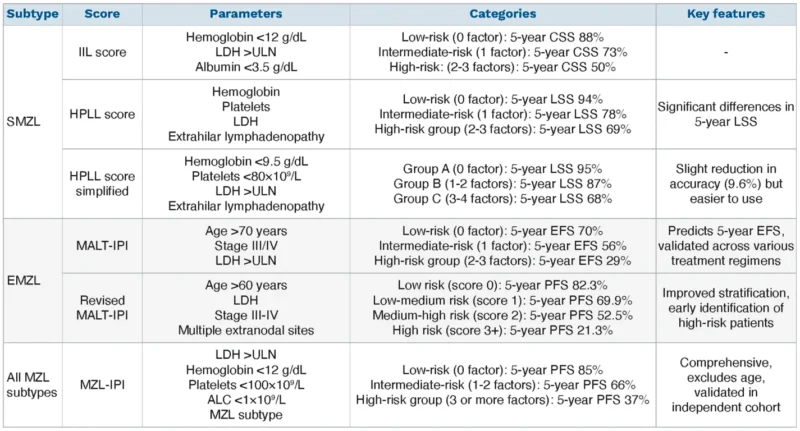
The MALT International Prognostic Index (MALT-IPI) was developed using 401 patients enrolled in the IELSG19 trial and subsequently validated in 633 patients from three independent cohorts. The score incorporates three adverse factors: age above 70 years, Ann Arbor stage III-IV disease, and elevated LDH. Patients are classified into low-, intermediate-, and high-risk groups according to the number of factors present.
Five-year EFS was 70%, 56%, and 29% across these groups, respectively. The index also differentiated patients according to PFS, OS, and cause-specific survival, with prognostic performance maintained across chlorambucil, rituximab, and combination treatment.
The Revised MALT-IPI was developed to improve PFS prediction and better characterize aggressive EMZL. This model incorporates four variables: age above 60 years, elevated LDH, stage III-IV disease, and involvement of multiple extranodal sites. Patients are distributed into four risk categories, extending the prognostic separation achieved with the original score.
The proportion of patients classified as high risk increased from 17% with the original MALT-IPI to 26% with the revised model. The revised score also identifies patients with shorter lymphoma-specific survival and increased likelihood of POD24. Geographic differences in infection-associated EMZL may influence prognostic performance.
In a study by Bommier and colleagues, complete response at 24 months accounted for ~90% of the treatment effect on 8-year PFS. Time to complete response within 24 months captured approximately 95%, supporting these measures as potential early efficacy endpoints in EMZL trials.
Splenic Marginal Zone Lymphoma: IIL and HPLL Prognostic Scores
Conventional lymphoma staging systems have limited applicability in SMZL because the disease predominantly involves the spleen, bone marrow, and peripheral blood.
The Intergruppo Italiano Linfomi (IIL) developed the first SMZL-specific prognostic model using data from 309 patients. Three independent adverse factors were identified: hemoglobin below 12 g/dL, elevated LDH, and serum albumin below 3.5 g/dL. Five-year cause-specific survival was 88% in low-risk patients, 73% in intermediate-risk patients, and 50% in high-risk patients.
A subsequent international study of 593 patients developed the HPLL score. Its four variables included hemoglobin concentration, platelet count, LDH, and the presence of extrahilar lymphadenopathy. The initial model identified three groups with 5-year lymphoma-specific survival of 94%, 78%, and 69%. In the validation cohort, corresponding survival rates were 96%, 88%, and 44%.
Because the original HPLL required continuous-variable calculations, a simplified version introduced clinically applicable thresholds: hemoglobin below 9.5 g/dL, platelets below 80 × 10⁹/L, elevated LDH, and extrahilar lymphadenopathy.
Patients with zero, one to two, or three or more adverse factors had 5-year lymphoma-specific survival rates of 95%, 87%, and 68%, respectively. Simplification reduced predictive accuracy by 9.6% but made the model easier to apply in routine practice. These models also inform discussions about treatment intensity.
Nodal Marginal Zone Lymphoma: Limited Prognostic Models
NMZL remains less extensively characterized. Retrospective studies suggest that the Follicular Lymphoma International Prognostic Index (FLIPI) can identify patients with different outcomes, but no dedicated prognostic index has achieved broad validation.
The ongoing IELSG52 study is investigating integrated clinical and molecular profiling to characterize biologically distinct NMZL subgroups, improve diagnostic classification, and identify predictors of disease progression.
MZL-IPI: A Unified Prognostic Model Across Marginal Zone Lymphoma Subtypes
The Marginal Zone Lymphoma International Prognostic Index (MZL-IPI) was developed to address the limitations of subtype-specific scores, especially in patients with extensive disease or an uncertain primary site of origin. The model was derived from the observational NF10 cohort, including 501 treated patients: 197 with EMZL, 166 with SMZL, 60 with NMZL, and 78 with disseminated MZL.
Multivariable analysis of 456 patients identified five independent prognostic factors: elevated LDH, hemoglobin below 12 g/dL, platelet count below 100 × 10⁹/L, absolute lymphocyte count below 1 × 10⁹/L, and MZL subtype. Each adverse factor contributes one point. Patients are classified as low risk with zero factors, intermediate risk with one or two, and high risk with three or more.
Five-year PFS across MZL-IPI risk groups reached 85% in low-risk patients, 66% in intermediate-risk patients, and 37% in high-risk patients. Compared with the low-risk group, the intermediate-risk group had a higher risk of progression (HR, 2.30), increasing further among high-risk patients (HR, 5.41). The score also differentiated OS and POD24. Early progression was reported in 6%, 15%, and 34% of patients in the low-, intermediate-, and high-risk categories, respectively.
External validation in two independent US cohorts confirmed separation of low- and high-risk patients for PFS and OS. The MZL-IPI excludes age, which the MALT-IPI includes. It stratifies risk consistently across MZL subtypes, including patients categorized as having disseminated disease. It may also facilitate comparison of clinical trials enrolling mixed MZL populations. The index is not intended to determine individual treatment decisions.
haematologica.org
Molecular Prognostic Markers in Marginal Zone Lymphoma
In SMZL, deletion of chromosome 7q occurs in approximately 40% of cases. Frequently altered pathways involve NOTCH, NF-κB signaling, and B-cell activation, with recurrent mutations of NOTCH2, KLF2, and TP53.
The IELSG46 study analyzed 303 SMZL spleen samples and identified two major molecular groups. The NNK cluster, representing 58% of cases, was enriched for NF-κB, NOTCH, and KLF2 alterations and was associated with inferior survival. The DMT cluster, representing 32%, was characterized by alterations involving DNA-damage response, MAPK, and Toll-like receptor pathways.
In another cohort of 175 patients, TP53 mutation independently predicted inferior OS. NOTCH2 mutation was associated with shorter time to first treatment. No molecular alteration independently predicted EFS. A subsequent international meta-analysis showed adverse prognostic associations for NOTCH2 and TNFAIP3 mutations in SMZL and ocular adnexal MZL.
In gastric MALT lymphoma, the t(11;18)(q21;q21) translocation involving BIRC3-MALT1 is associated with resistance to Helicobacter pylori eradication. Rituximab has shown activity in patients harboring this alteration, with ~46% achieving pathological and clinical complete response.
PET/CT and Circulating Tumor DNA
Historical lymphoma imaging recommendations did not routinely favor PET/CT for MZL. More recent studies have identified FDG uptake in over 75% of SMZL and NMZL cases. In a retrospective study of 152 EMZL patients encompassing 190 lesions, 79.5% of sites showed FDG uptake. Lesion size influenced uptake, supporting consideration of disease site and tumor burden when interpreting negative findings. Preliminary IELSG44 data from 156 patients suggest that complete metabolic response at the end of treatment, defined by a Deauville score of 2 or lower, is associated with longer time to progression.
Circulating tumor DNA is an investigational approach to molecular risk assessment. Early studies report high concordance between plasma-based mutation detection and tissue genotyping. Serial circulating tumor DNA analysis could eventually identify molecular persistence, monitor treatment response, and detect resistant clones. Longitudinal evidence remains limited, and clinically validated thresholds for molecular response have not been established yet.
Peripheral blood involvement is also being reconsidered as a prognostic feature. A multicenter US study found that circulating lymphoma cells detected by flow cytometry at diagnosis were not generally associated with inferior PFS across MZL subtypes. An exception was observed in EMZL patients receiving immunochemotherapy. This finding remains exploratory.
Bottom Line
The MZL-IPI provides a validated risk framework across extranodal, splenic, nodal, and disseminated MZL. The MALT-IPI, Revised MALT-IPI, IIL, and HPLL scores are relevant within their subtypes. These scores identify patients at increased risk of progression and support consistent assessment in observational studies and clinical trials.
POD24 and histological transformation mark patients with substantially inferior outcomes, yet no dedicated models exist for relapsed/refractory MZL or transformation risk. Molecular profiling, PET/CT response, and circulating tumor DNA are promising additions that need prospective validation before use in risk-adapted treatment.
Reference: Talami A, Nizzoli ME, Cappello E, Luminari S, Arcaini L. Prognosis in marginal zone lymphoma: a comprehensive review. Haematologica. November 2026;111(11). https://doi.org/10.3324/haematol.2025.300416.