In relapsed/refractory aggressive large B-cell lymphoma (LBCL), anti-CD19 CAR T-cells have shown impressive results as a 3L+ therapy, leading to the first approval of this treatment for patients with LBCL.
Subsequent ZUMA-7 and TRANSFORM phase 3 trials established axicabtagene ciloleucel and lisocabtagene maraleucel as the standard 2L for transplant-eligible patients with primary refractory disease or early relapse, while the PILOT and ALYCANTE extended their use to older or transplant-ineligible patients.
Previous registry studies have shown dismal prognosis after relapse following later-line CAR T, with median OS around 5-6 months. Until now, much less was known about patients who relapse after receiving CAR T-cells earlier, in the 2L setting. This DESCAR-T registry analysis was designed to clarify treatment patterns, outcomes, and prognostic factors in this increasingly important population.
Study Overview
This multicenter real-world study included patients with R/R LBCL who progressed after 2L axi-cel or liso-cel. Data were collected from 34 French centers between August 2022 and September 2024.
Among 893 patients treated with 2L CAR T-cell therapy, 297 patients, or 33%, developed disease progression. Of these, 231 received salvage treatment and were analyzed according to the type of post-CAR T-cell therapy received. Salvage approaches included:
- bispecific antibody monotherapy
- bispecific antibody-based combinations
- chemotherapy or chemoimmunotherapy
- targeted agents, immunomodulatory drugs, or radiotherapy
The main endpoint was overall survival after relapse. The study also assessed response rate, CR rate, progression-free survival, duration of response, and outcomes according to salvage treatment strategy. Propensity-score weighting was used to reduce imbalance between treatment groups.
Watch more on OncoDaily TV.
Patient Characteristics and Relapse Patterns
The study population represented a high-risk group from the beginning. Most patients had DLBCL, many had disease refractory to frontline therapy, and more than half had elevated LDH levels. At the time of CAR T-cell indication, 77% had disease refractory to first-line CIT , and 24% had bulky disease.
Relapse occurred early in most patients. The median time from CAR T-cell infusion to disease progression was only 2.7 months, and 88% of relapses occurred within the first 6 months.
Salvage Therapy and Response
Among the 231 treated patients, bispecific antibody-based therapy was the most commonly used salvage approach, including 52% treated with monotherapy and 13% treated with combination therapy. Chemotherapy or chemoimmunotherapy was used in 13% of patients, while 23% received other therapies.
Response to salvage therapy was limited. Among evaluable patients, the ORR was 39.1%, with a CR rate of 27.6%. Bispecific antibody monotherapy produced an ORR of 39.5% and a CR rate of 29.6%. Chemotherapy or chemoimmunotherapy showed numerically higher response rates, with an ORR of 50% and a CR rate of 41.7%, but durability remained limited.
Survival Outcomes
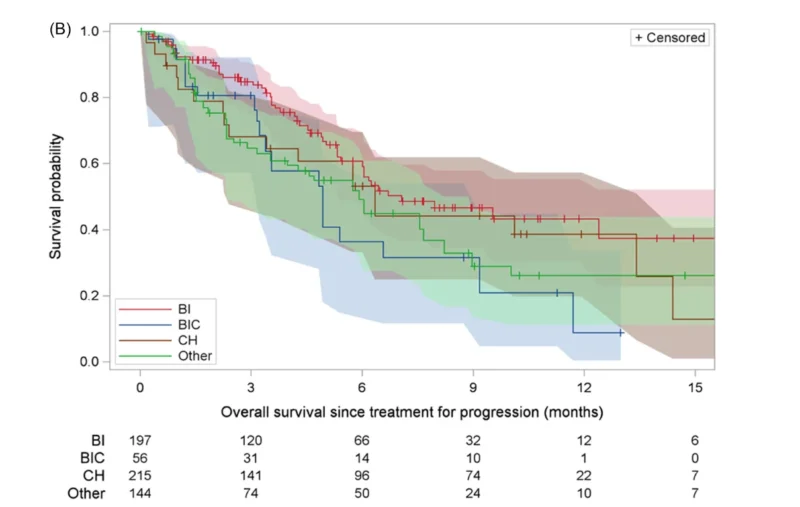
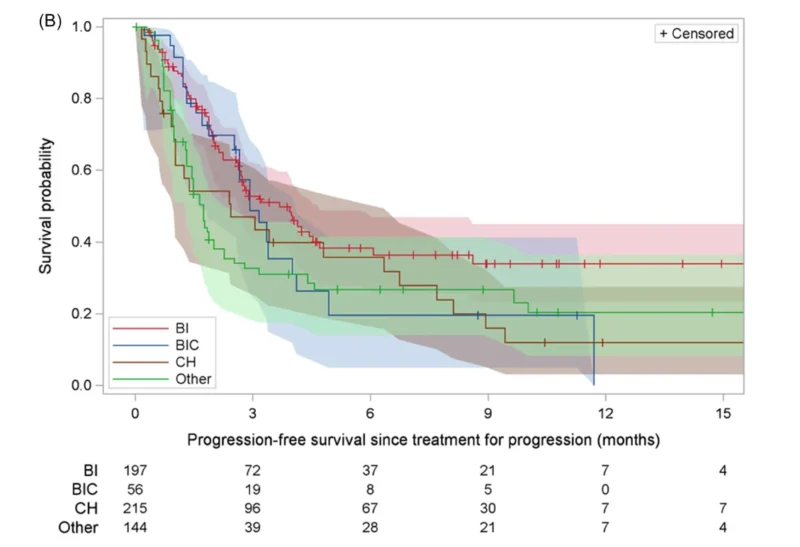
After a median follow-up of 8.4 months from the start of salvage therapy, median PFS was 3.4 months and median OS was 6.5 months.
Bispecific antibody monotherapy showed the most favorable results, although the benefit remained modest. Median PFS was 3.7 months with BsAb monotherapy versus 2.9 months with combination regimens, while median OS was 7.1 months vs 4.9 months. No significant survival differences were observed between glofitamab and epcoritamab.
Prognostic Factors
In multivariable analysis, three factors independently predicted OS after relapse: ECOG performance status below 2, CRP below 30 mg/L, and a longer interval between CAR T-cell infusion and first progression. For PFS, time from CAR T-cell infusion to progression remained the key independent predictor.
Key Takeaway Messages
The DESCAR-T registry analysis provides important real-world evidence on patients with LBCL and shows that relapse after second-line CAR T-cells is not simply a later treatment challenge moved earlier in the course. It points to a biologically aggressive, double-refractory population that has failed both frontline chemoimmunotherapy and CAR T-cell therapy.
The most important message is that outcomes remain poor despite access to modern salvage therapies. Bispecific antibodies appear to be the most active available option and were the most frequently used in this registry, but they did not overcome the poor prognosis. Simple clinical markers may help risk-stratify patients after CAR T-cell failure and may be useful for clinical trial design.
Early relapse is especially important. Most patients progressed within 6 months of CAR T-cell infusion, and this subgroup had the worst outcomes. These patients are often excluded from clinical trials, despite representing the group with the greatest unmet need. Prospective studies are urgently needed, with a focus on novel targets, early relapse detection, and biomarker-driven patient stratification.
Diffuse Large B-Cell Lymphoma (DLBCL): Molecular Heterogeneity and Progress in Therapy