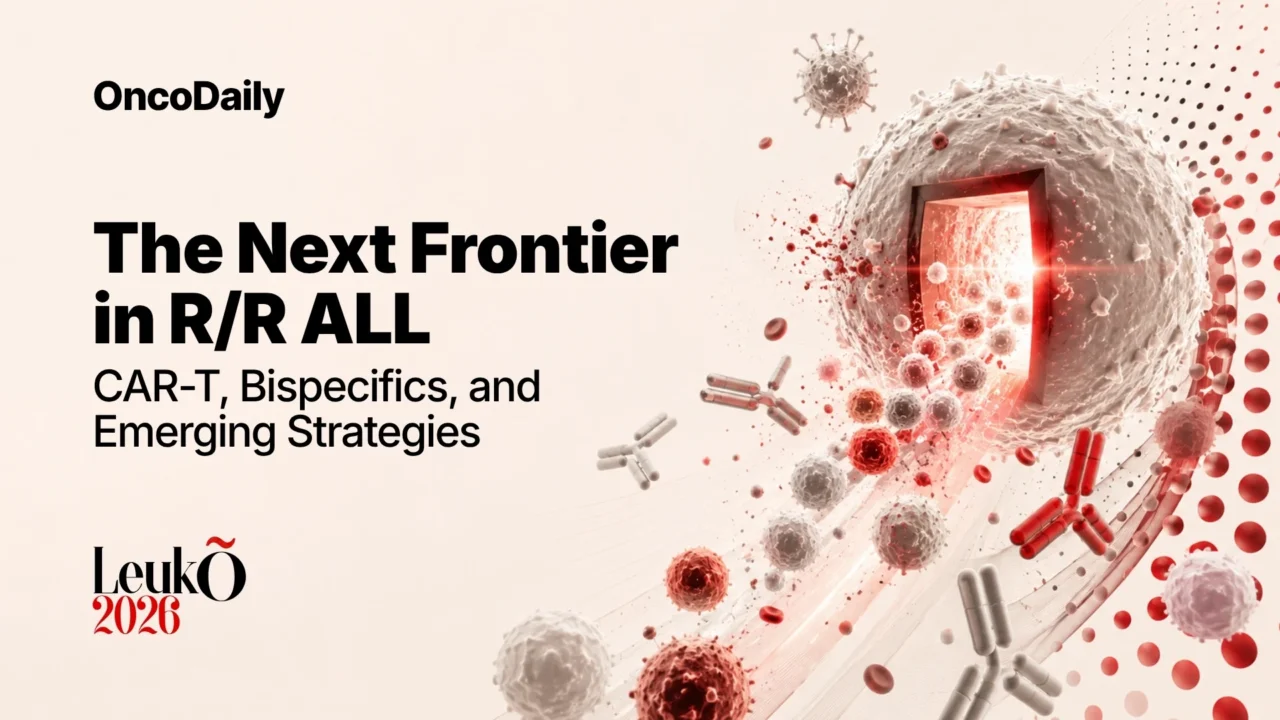
Relapsed or refractory acute lymphoblastic leukemia (R/R ALL) has long been one of the most difficult diseases to treat in hematologic oncology. Treatment revolved around a single goal: induce another remission with salvage chemotherapy and, whenever possible, proceed to allogeneic hematopoietic stem cell transplantation (allo-HSCT). The limitation was not a shortage of chemotherapy combinations, but the diminishing probability that resistant leukemia would respond deeply enough, and for long enough, to reach transplantation.
Immunotherapy has given R/R ALL treatment a new direction, making deep remissions possible even in heavily pretreated patients. Alongside targeted therapy, these approaches have pushed treatment well beyond conventional salvage chemo, giving patients options that simply didn’t exist before.
These advances and the questions they raise about treatment selection, sequencing, resistance, and relapse will be among the topics discussed at LeukO 2026, OncoDaily’s virtual global congress on leukemias, taking place September 3-4.
Relapse Is Evolution, Not a Return of the Same Leukemia
ALL at recurrence should not be viewed as an unchanged version of the disease present at diagnosis. Treatment creates selective pressure. Sensitive populations disappear while resistant subclones survive, expand, or acquire additional mechanisms that allow them to evade subsequent therapy.
The form of that selection depends partly on the treatment being applied. Cytotoxic therapy favors clones capable of surviving chemotherapy-induced stress. In molecularly defined ALL, targeted therapy can select resistant signaling variants. Immunotherapy creates another evolutionary bottleneck: leukemia must survive recognition through a particular surface antigen.
This becomes particularly apparent after CD19-directed therapy. CD19-negative relapse can occur through several ways of antigen escape: genetic and transcriptional alterations, aberrant splicing, antigen internalization or masking, trogocytosis, and lineage switch. These mechanisms may reflect either selection of pre-existing populations or adaptations arising under therapeutic pressure.
This evolutionary perspective has a direct clinical implication. Clonal architecture may change along the way, and each treatment can alter the disease encountered by the next treatment.
Blinatumomab Established T-Cell Redirection as a Treatment Strategy
As a CD19×CD3 bispecific T-cell engager, blinatumomab enables T-cell activation and leukemia-cell killing without requiring ex vivo cellular engineering.
The clinical significance of that mechanism was demonstrated in the randomized phase III TOWER trial. In adults with heavily pretreated B-cell precursor ALL, blinatumomab improved median OS to 7.7 months compared with 4.0 months with standard chemotherapy and produced higher rates of remission. The trial established T-cell redirection as a clinically superior alternative to another conventional chemo regimen in an appropriate R/R population.
The efficacy of blinatumomab, however, is not independent of disease context. High leukemic burden can make immune-mediated control more difficult and increase treatment complications. Contemporary ASH guidance for adolescents and young adults with R/R B-ALL recommends blinatumomab over chemotherapy while specifically highlighting that patients with high blast counts may require cytoreduction before treatment.
This relationship between disease burden and immune therapy has become increasingly relevant as blinatumomab has moved into earlier settings. Its activity in low-volume and MRD-positive disease illustrates: immunotherapy may be most effective when it is deployed before the leukemia has expanded into a large, heterogeneous population.
Watch more on OncoDaily TV.
Inotuzumab Opened a Second Antigenic Route to Remission
CD19 is not the only therapeutically exploitable surface antigen in B-ALL. Inotuzumab ozogamicin targets CD22 and delivers the cytotoxic agent calicheamicin after antibody binding and internalization. Unlike blinatumomab, it does not depend on redirecting endogenous T cells.
The phase III INO-VATE study demonstrated the potency of this approach. In the final analysis, CR or CR with incomplete hematologic recovery was achieved in 73.8% of patients treated with inotuzumab compared with 30.9% receiving standard chemotherapy. More patients receiving inotuzumab were consequently able to proceed to transplantation.
Yet the same feature that makes inotuzumab valuable, its ability to produce rapid and deep cytoreduction, has to be considered alongside its characteristic hepatic toxicity, particularly sinusoidal obstruction syndrome/veno-occlusive disease around subsequent allo-HSCT. Its place in R/R ALL is therefore closely linked to what clinicians intend to do after remission.
CAR-T Changed How Deep a Salvage Response Could Be
CAR-T therapy took the concept further by converting a patient’s T cells into a living therapeutic product. Once they encounter the target, CAR-T cells can proliferate and persist, creating an immune response that differs fundamentally from the pharmacokinetics of a conventional drug. Tisagenlecleucel established CD19 CAR-T as a transformative option in children and young adults, while brexucabtagene autoleucel extended the approach to adults.
Long-term ZUMA-3 data illustrate both the achievement and the remaining challenge. In adults with R/R B-ALL treated with brexucabtagene autoleucel, the three-year analysis reported a median OS of 25.6 months in the overall treated population and 38.9 months among responders, outcomes difficult to envision in the historical salvage-chemotherapy era.
Why Does ALL Relapse After CAR-T?
Broadly, relapse can occur through two biological routes. In CD19-positive relapse, the target remains present, but the immune pressure against it has weakened. Limited CAR-T persistence, impaired expansion, T-cell exhaustion, or loss of functional activity can allow CD19-positive leukemia to re-emerge. By contrast, CD19-negative relapse represents escape from target recognition itself.
Recent analyses indicate that antigen-negative relapse is particularly relevant in leukemia. A 2026 review found that among evaluable reported relapses after CD19 CAR-T across B-cell malignancies, approximately 45.5% were CD19-negative or CD19-dim, antigen-negative relapse was considerably more frequent in leukemia than lymphoma.
The mechanisms extend beyond the disappearance of a surface marker. Mutations or alternative splicing can disrupt the CD19 epitope recognized by the CAR. Transcriptional or epigenetic changes can reduce expression. Leukemic cells may internalize or redistribute antigen, while lineage switch can produce a leukemia that no longer maintains its original B-cell phenotype. Precision increases therapeutic potency, but a narrow target can also create a defined evolutionary route of escape.
What Happens When CAR-T Fails?
That observation has shaped the next generation of cellular therapy: targeting more than one antigen may raise the barrier to escape. Across early-phase studies, CD22-directed CAR-T has demonstrated activity even in populations previously exposed to CD19 CAR-T, while CD19/CD22 dual-target approaches have produced high remission rates.
A systematic review of 30 early-phase studies involving 637 patients estimated a best CR rate of 68% with CD22 CAR-T in ALL and 90% with CD19/CD22-targeted approaches, although substantial heterogeneity and the absence of randomized comparisons limit conclusions about superiority.
As CAR-T moves earlier in treatment, post-CAR-T relapse is becoming a clinically distinct state. The first step after relapse is therefore reassessment. In selected settings, another CD19-directed cellular strategy may remain plausible. CD19-negative relapse shifts attention toward CD22, dual-target cellular therapy, molecularly targeted treatment, allo-HSCT, or clinical trials.
CAR-T or Bispecific Therapy? Sequence May Matter More Than Competition
CAR-T and blinatumomab are often discussed as competing CD19-directed strategies, but their clinical roles are not interchangeable. Blinatumomab is immediately available and relies on the patient’s endogenous T cells, whereas CAR-T requires cell collection and manufacturing but provides an engineered T-cell population capable of expansion and persistence. Disease burden, previous therapy, antigen expression, urgency of treatment, and access to cellular therapy all influence which approach is feasible.
Prior exposure also matters because both therapies exert pressure on CD19. In a multicenter analysis of 420 children and young adults receiving CD19 CAR-T, previous blinatumomab exposure alone did not preclude successful CAR-T therapy. Patients who had failed to respond to blinatumomab had inferior outcomes after CAR-T, and CD19 modulation was more frequent among blinatumomab-exposed patients. These findings suggest that the biology of response to prior CD19-directed therapy may be more informative than exposure itself.
Where Does Allo-HSCT Fit After CAR-T?
CAR-T has also complicated the traditional relationship between remission and transplantation. Whether every patient achieving MRD-negative remission after CAR-T should proceed to allo-HSCT remains unresolved. The answer likely depends on:
- CAR construct
- duration of CAR persistence
- prior transplantation
- depth of response
- leukemia biology
- individual transplant risk
Long-term ZUMA-3 analyses of brexucabtagene autoleucel have demonstrated durable survival in responding adults, including patients who did not subsequently undergo allo-HSCT, although these exploratory comparisons cannot establish that transplantation is unnecessary.
MRD may ultimately help refine this decision beyond a binary “CAR-T or transplant” framework. Prospective evidence is still needed to determine how MRD, CAR kinetics, and baseline disease biology should be combined when deciding on post-CAR-T consolidation.
Precision Therapy Is Expanding Beyond Surface Antigens
The immunotherapy revolution has understandably placed CD19 and CD22 at the center of R/R B-ALL, but surface antigens represent only one layer. Philadelphia chromosome-positive (Ph+) ALL stands out as the clearest case. Successive generations of BCR::ABL1 tyrosine kinase inhibitors (TKIs), particularly ponatinib, have overhauled the approach.
Their combination with blinatumomab has further demonstrated how targeted therapy and immunotherapy can complement one another. One suppresses oncogenic signaling while the other recruits immune pressure. This becomes particularly relevant at relapse, when molecular reassessment can reveal resistant clones.
Menin Inhibition Adds Another Form of Precision Therapy
KMT2A-rearranged acute leukemias depend on an interaction between menin and the altered KMT2A transcriptional complex that maintains leukemogenic gene-expression programs. Disrupting this interaction provides a therapeutic strategy directed at the transcriptional machinery sustaining the leukemia.
In the phase II AUGMENT-101 study, patients with heavily pretreated R/R KMT2A-rearranged acute leukemia achieved clinically meaningful responses with revumenib, including patients who had undergone multiple previous lines of therapy and transplantation. The study included AML, ALL, and mixed-phenotype acute leukemia, its significance for ALL is the demonstration that KMT2A rearrangement represents an actionable dependency across acute leukemia phenotypes.
T-ALL Remains a Different Therapeutic Problem
Many of the advances discussed above depend on a favorable biological feature of B-cell malignancies: antigens such as CD19 can be eliminated along with malignant cells because B-cell aplasia can be managed clinically. The same strategy is considerably harder to reproduce in T-ALL.
Candidate targets such as CD7 and CD5 are expressed not only on leukemic blasts but also on normal T cells. Engineering T cells against a shared T-cell antigen can therefore lead to fratricide, in which CAR-T cells attack one another during manufacturing or after infusion. Successful targeting can also produce prolonged T-cell depletion, raising concerns about severe immunodeficiency and infection.
Gene editing and alternative cellular platforms are beginning to address these barriers. CD7-directed CAR-T is among the most advanced approaches, with strategies that disrupt or otherwise remove CD7 expression from therapeutic T cells before introducing the CAR.
Recent studies have demonstrated that deep remissions are possible in heavily pretreated R/R T-ALL/T-lymphoblastic lymphoma, including after previous transplantation. Prolonged immune dysfunction, infection, antigen escape, and the need for subsequent allo-HSCT remain important concerns. Contemporary 2026 analyses therefore view CD7 CAR-T, often, as a bridge to transplantation.
The Next Frontier Is Adaptive, Multi-Layered Therapy
Multi-antigen CAR constructs are being developed to make antigen escape more difficult. Humanized and redesigned CARs aim to improve persistence and reduce immune rejection. Allogeneic and other “off-the-shelf” cellular products seek to shorten the interval between treatment decision and infusion.
CAR-NK and other engineered immune-cell platforms may offer different toxicity and manufacturing profiles. Meanwhile, molecularly targeted therapies such as menin inhibitors are expanding the number of leukemias that can be treated according to genotype rather than lineage alone.
MRD provides another layer of information and allows treatment to be adjusted while the leukemic population remains small. A smaller population contains fewer opportunities for resistant subclones, while immune therapies such as blinatumomab may operate more effectively in a lower-burden environment. The long-term objective is not maximal treatment intensity. It is maximal evolutionary control.
Join the Discussion at LeukO 2026
The treatment of relapsed/refractory ALL has progressed from repeated attempts at cytotoxic salvage toward a strategy guided by immune phenotype, molecular genotype, disease burden, MRD, and previous treatment exposure.
For clinicians, treatment increasingly requires connecting these therapies rather than consider them in isolation: which target remains present, “how much” disease is present, what treatment has already shaped the leukemia, which therapy can achieve the deepest response, and which options must be preserved if relapse occurs again?
Join the discussion at LeukO 2026, where experts from around the world will explore these and other evolving questions in leukemia care.