This week in hematology, researchers and clinicians weighed in on BTK inhibitor use in mantle cell lymphoma and chronic lymphocytic leukemia, from real-world outcomes with pirtobrutinib to a comparison of zanubrutinib and acalabrutinib. Other posts addressed 3-year follow-up from the MonumenTAL-1 study in multiple myeloma, lymphoma and myeloid malignancy updates, and a revised prognostic model for advanced systemic mastocytosis.
Discussions also focused on the biological heterogeneity of TP53-mutated acute myeloid leukemia, patient selection and timing of transplantation in myelofibrosis, and long-term outcomes of autologous transplantation in mantle cell lymphoma and multiple myeloma.
Ahead of the American Society of Hematology (ASH) 2026 Annual Meeting, data from the REMNANT trial revisit the optimal dosing schedule of bortezomib in newly diagnosed multiple myeloma.
Here are 10 heme-onc posts not to miss this week.
Henrique Nunes Pêcego – Hematologist and Bone Marrow Transplantation Coordinator at the State Institute of Hematology in Rio de Janeiro, Brazil
“Does autologous transplant cure mantle cell lymphoma? After almost 25 years of follow-up, the Nordic group answers more honestly than we usually do: for most patients, no.
A research letter in the British Journal of Haematology (November 19) pools the Nordic MCL2 and MCL3 trials: 319 patients under 66 treated between 2000 and 2009 with rituximab, maxi-CHOP alternating with high-dose cytarabine, then BEAM/BEAC and autologous transplant. Pre-emptive rituximab at molecular relapse. Median follow-up 17.6 years.
What they found:
- Response 96%, complete remission 87%; median PFS 8.0 years and OS 13.6 years
- Cumulative incidence of first relapse: 36% at 5 years, 47% at 10, 54% at 15 and 61% at 20
- The relapse rate peaked in the first 2 years after transplant, then fell to about 3 per 100 person-years and never reached zero
- High-risk biology (blastoid or pleomorphic, Ki-67 30% or more, TP53): 14.7 relapses per 100 person-years at 2 years, 1.7 at 15. Low risk: 4.1 at 2 years and 5.6 at 15. One behaves like an aggressive lymphoma, the other like an indolent one
- 28% alive and still in first remission; 12.5% died in first remission
Second cancers in 18%, including 13 cases of MDS/AML - Survival of patients in remission after transplant stayed below that of the general population. Only those under 50 approached it, about 10 years after transplant
My critical reading:
This is the cleanest long-term picture we have of intensive chemoimmunotherapy plus autologous transplant, and it does not show a plateau. The authors did not even fit a cure model because the relative survival curve kept falling. The under-50 signal is real but rests on few patients at risk after 15 years. And the late relapse curve of low-risk disease matters for follow-up: these patients need surveillance for decades, not 5 years.
The regimen is also from another era. BTK inhibitors have since shown benefit in first line, even without transplant, and this study cannot tell us whether that changes the late curve.
In Brazil, a BTK inhibitor in first line is not available in the public system. For a fit patient under 65 in the SUS, cytarabine-based induction followed by autologous transplant is still what we can offer, and this paper is what to say in that consultation: a long remission is likely, a durable cure is uncommon, the risk of a second cancer is real, and follow-up never really ends.”

Enver Aydilek – Senior Consultant in Hematology and Oncology, Evangelisches Klinikum Bethel, Germany; Co-Founder of AVOR Medical Intelligence
“New scientific publication – Pirtobrutinib in mantle cell lymphoma
I am very pleased to be able to continue my scientific work in the field of mantle cell lymphoma alongside my clinical and entrepreneurial work as co-founder of AVOR Medical Intelligence .
Our current work on Pirtobrutinib has now been published in HemaSphere.
With 129 patients, we were able to analyze, according to our knowledge, the largest real-world cohort to date for the use of pirtobrutinib in relapsed/refractory mantle cell lymphoma outside the BRUIN study.
In addition to investigating efficacy and tolerability in clinical practice, we compared pirtobrutinib using Propensity Score Overlap Weighting with previous standard-of-care therapies after failure of covalent BTK inhibitors. With this work, we are pleased to contribute to better positioning of pirtobrutinib within the increasingly complex therapy sequence in mantle cell lymphoma.”
Martin (Hemasurf) Cabero-Becerra – Clinical Hematologist, Castile-La Mancha Health Service, Alcázar de San Juan, Spain
“LLC this week. Two real-practice studies provide useful information, although they still do not justify changing our treatment selection by themselves.
A multicenter Italian cohort directly compared zanubrutinib and acalabrutinib in 615 patients with CLL, both first-line and relapse. After weighting, the 12-month discontinuation was 9.0% with zanubrutinib and 28.7% with acalabrutinib; Treatment-free survival or death was 94.1% and 76.5%, respectively.
The data is striking, but it calls for caution: retrospective study, unequal groups, different follow-up, and possible residual confusion. Furthermore, toxicity represented a similar proportion of discontinuations and grade 3–4 events were comparable. It does not demonstrate randomized superiority nor does it report the change in acalabrutinib↔zanubrutinib due to intolerance.
AREVEDECY evaluated venetoclax-rituximab in 117 patients with R/R LLC: ORR of 90% among evaluable items, estimated 24-month PFS of 77.5%, and OS of 80.8%. 45% had previously received an iBTK; her 24-month PFS was numerically lower (70.0% versus 83.2%), but the study does not separate progression from iBTK intolerance and lacks a comparator.
In Spain, zanubrutinib monotherapy and a presentation of acalabrutinib monotherapy are funded for adult CLL patients. VenR is funded after at least one prior treatment, with a maximum duration of 24 months from the first rituximab cycle.
Conclusion: relevant signals for persistence and sequencing, but no definitive evidence to choose between both second-generation iBTKs or for a specific sequence after intolerance.”
Francesco Bertoni – Head of Lymphoma Genomics and Vice-Director of the Institute of Oncology Research
“Our manuscript showing that targeting FGFR signaling with infigratinib enhances the efficacy of BTK inhibition in marginal zone lymphoma cells is now out in BJC Reports.”
Andrew Portuguese – Assistant Professor at Fred Hutch
“Out today in BMT Journal. Our study of transplant outcomes in older adults with multiple myeloma grew out of a CMS review that expanded Medicare coverage to include active ISS stage I disease.”
Nihar Desai – Hematologist, Bone Marrow Transplant Physician
“Our review article attempts to answer 2 key questions – who and when to transplant in Myelofibrosis.
Grateful to Prof. Vikas Gupta for his guidance and mentorship.”
Salman Fazal – Hematology Lead at UPMC Hillman Cancer Center, Harrisburg
“Prognosis in advanced systemic mastocytosis has changed in the KIT inhibitor era. Our risk tools are now catching up.
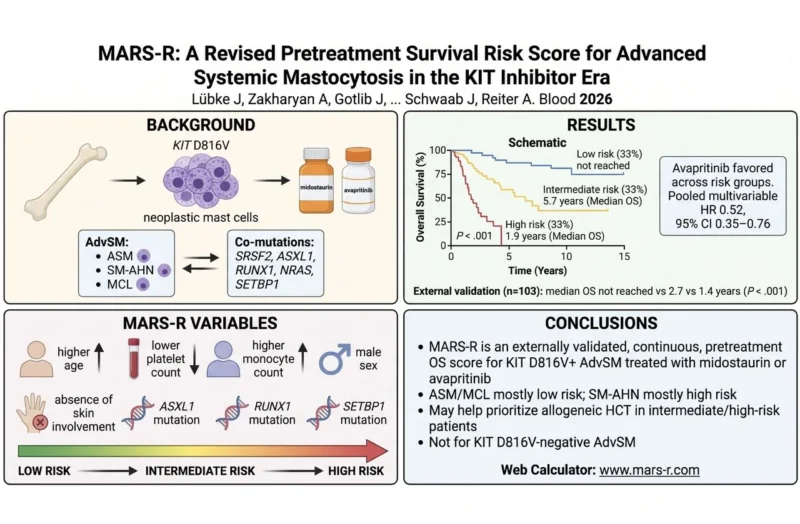
Lübke, Reiter, and colleagues have published the Revised Mutation-Adjusted Risk Score (MARS-R) in Blood. It’s a continuous, pretreatment overall survival score for KIT D816V-positive AdvSM in patients starting midostaurin or avapritinib.
Key points:
- Built from 287 patients
- Eight variables: age, platelet count, monocyte count, sex, skin involvement, and ASXL1, RUNX1, and SETBP1 mutations
- Three risk groups, with median OS not reached (low), 5.7 years (intermediate), and 1.9 years (high)
- Avapritinib was associated with better OS than midostaurin across all risk groups (adjusted HR 0.52)
- Most patients with ASM/MCL fall into low risk, while most with SM-AHN fall into high risk
- Not validated for KIT D816V-negative AdvSM
- From a transplant perspective, this is useful.
A validated, individualized score can help us decide which intermediate- and high-risk patients to consider for allogeneic HCT earlier.”
Al-Ola Abdallah – Director of Plasma Cell Disorders Care at The University of Kansas Health System and Chair of USMIRC
“Talquetamab in patients with relapsed/refractory multiple myeloma: 3-year follow-up of the phase 1/2 MonumenTAL-1 study. What does 3-year survival look like with talquetamab in relapsed/refractory myeloma?
In MonumenTAL-1, an estimated 61% of patients in the every-other-week cohort were alive at 3 years. Here’s how that result fits with response, progression and toxicity. “
Dina Khalaf – Academic Malignant Hematologist, Clinical Associate Professor, University of Florida
“TP53-mutated AML accounts for roughly 5–10% of newly diagnosed AML. It remains one of the most challenging subsets we treat. It is enriched for complex karyotype and genomic instability, and it is resistant to most standard approaches.
Intensive chemotherapy and HMA plus venetoclax can induce remission in some patients, but remissions are short lived, and long-term survival is poor. Agents that target the p53 pathway, the immune microenvironment, or metabolic vulnerabilities have not yet changed outcomes.
A new review by Zixin Chen and Lin Chen in Leukemia & Lymphoma argues that TP53 abnormalities should not be treated as a single entity. Their biological effect depends on:
• Allelic status (mono- vs multi-hit)
• Clonal evolution
• Cytogenetic background
• Immune and metabolic context
The review also covers the main open questions in allogeneic HCT for this population and the novel strategies now in development. For those of us running trials and building transplant programs, this framing matters. Better stratification by allelic state and co-occurring features would be what future studies show real benefit in a group that has seen minimal progress.”
Ankit Kansagra – Multiple Myeloma, Amyloid Oncologist; Vice President, Oncology Strategy and Network Operations, Tampa General Hospital
“Twice-weekly bortezomib is the schedule VRd was built on, and a Norwegian trial just gave us a good reason to stop treating it as the default.
REMNANT is an academic phase 2/3 study in transplant-eligible, newly diagnosed myeloma. Every patient received VRd before and after transplant. The first 200 got bortezomib on days 1, 4, 8 and 11 of each cycle. The next 181 got it on days 1 and 8. The comparison will be presented at ASH in December.
Peripheral neuropathy of any grade: 40% with once-weekly dosing, 76% with twice-weekly. Grade 2 or higher: 14% versus 41%. And in the twice-weekly group, 77% of patients needed a bortezomib dose reduction anyway. What did the extra doses buy? MRD-negative complete response was 31.5% versus 34%. Two-year progression-free survival was 78.2% versus 80.5%.
Two cautions. These were sequential cohorts, not randomized arms, and follow-up is shorter in the once-weekly group. The rate of very good partial response or better was also lower with once-weekly dosing, 80.7% versus 90.5%.
Neuropathy is the side effect patients still bring up years later, long after the induction that caused it. From my time in drug development, I also know how a schedule becomes standard: it is the one used in the registration trial, and few people fund the study that asks whether less would do. This group did.
Days 1 and 8 is where I would start.”