 Brazil
In Brazil, the first-line treatment of chronic lymphocytic leukemia (CLL) depends more on how the patient pays for care than on the biology of the disease. A patient with a private health plan can start a chemotherapy-free regimen, such as venetoclax-obinutuzumab or acalabrutinib-venetoclax, under the mandatory coverage rules of the National Supplementary Health Agency (ANS).
A patient treated in the Unified Health System (SUS), the only source of care for about three in four Brazilians, is usually offered chlorambucil or fludarabine-based chemoimmunotherapy. The Brazilian CLL Group of the Brazilian Association of Hematology and Hemotherapy (ABHH) describes access to novel therapies as “highly inequitable between public and private healthcare institutions” (Chiattone et al., 2025).
The two systems are not two separate populations. The SUS is universal, and privately insured patients also use it. The difference is that only one of them offers a reliable route to evidence-based treatment, and coverage on paper, national incorporation and actual availability at the treating center are three different steps.
No BTK inhibitor or BCL2 inhibitor has been incorporated into the SUS for CLL. In 2024, Conitec, the national health technology assessment committee, decided against ibrutinib for one defined population, patients with relapsed or refractory disease ineligible for purine analogues, and the country still has no national clinical guideline for the disease (Conitec, 2024). Over the same period, five randomized trials have moved chemoimmunotherapy to the margins of first-line care.
What does the clinical evidence support?
The current first-line standard for almost every patient with CLL who meets treatment criteria is targeted therapy, given either as continuous covalent BTK inhibition or as a fixed-duration combination built on venetoclax. Patients who do not meet treatment criteria remain under observation. Treatment choice weighs disease biology, comorbidities, drug interactions, patient preference and the monitoring each regimen demands (Chiattone et al., 2025; Soumerai et al., 2025). Chemoimmunotherapy keeps a narrow role, at most in young, fit patients with mutated IGHV and no TP53 aberration.
Continuous BTK inhibition started with ibrutinib. Second-generation inhibitors kept the efficacy and reduced cardiac toxicity: acalabrutinib was noninferior to ibrutinib in relapsed CLL with less atrial fibrillation (Byrd et al., 2021), and zanubrutinib achieved longer progression-free survival (PFS) than ibrutinib in the same setting (Brown et al., 2023). In patients with del(17p) or TP53 mutation, a second-generation covalent BTK inhibitor is the preferred first-line option (Soumerai et al., 2025).
Fixed-duration therapy rests on a series of randomized trials:
- CLL14 (older patients with comorbidities): one year of venetoclax-obinutuzumab produced a median PFS of 76.2 months, against 36.4 months with chlorambucil-obinutuzumab (Al-Sawaf et al., 2024).
- GAIA/CLL13 (fit patients): venetoclax-obinutuzumab, with or without ibrutinib, outperformed chemoimmunotherapy (Eichhorst et al., 2023).
- FLAIR: MRD-guided ibrutinib-venetoclax improved both PFS and overall survival compared with FCR (Munir et al., 2024).
- AMPLIFY: at 36 months, PFS was 76.5% with acalabrutinib-venetoclax and 83.1% with acalabrutinib-venetoclax-obinutuzumab, against 66.5% with FCR or BR (Brown et al., 2025).
- CLL17: in 909 previously untreated patients, venetoclax-obinutuzumab and venetoclax-ibrutinib were both noninferior to continuous ibrutinib, with 3-year PFS of 81.1%, 79.4% and 81.0% at a median observation of 34.2 months (Al-Sawaf et al., 2025).
CLL17 matters most for health systems. A fixed-duration regimen has a known cost and a known end date, while a continuous BTK inhibitor is paid for every month until progression or intolerance. The trial does not settle longer-term differences, nor does it compare fixed-duration therapy with continuous second-generation BTK inhibitors, and a predictable cost per course is not the same as proven cost-effectiveness in Brazil. That still has to be shown with local prices and a defined time horizon.
After failure of both drug classes, the options are the noncovalent BTK inhibitor pirtobrutinib, CAR-T cell therapy with lisocabtagene maraleucel (Siddiqi et al., 2023) and allogeneic stem cell transplantation, which remains the only approach with curative potential in double-refractory disease.
BRUIN CLL-322: Fixed-Duration Pirtobrutinib-Containing Triplet in Relapsed or Refractory CLL
What does the SUS offer patients with CLL?
The SUS offers chemotherapy and chemoimmunotherapy for CLL, and no targeted agent. The most recent incorporation for the disease was rituximab combined with fludarabine and cyclophosphamide for first-line treatment (Conitec, 2023).
Ibrutinib was evaluated for relapsed or refractory CLL in patients ineligible for purine analogues. Conitec rejected it in 2024: the incremental cost-effectiveness ratio was R$ 136,937 per QALY, above the R$ 120,000 accepted for severe diseases, with a five-year budget impact of R$ 177.8 million (Conitec, 2024). The decision concerned that indication alone, not the drug class. Acalabrutinib was still under Conitec review at the end of 2025.
The funding model explains the rest. Cancer drugs in the SUS are paid to accredited cancer centers through a fixed monthly amount per patient (APAC), defined by diagnosis and line of therapy. The amount is R$ 407.50 for first-line CLL treatment and R$ 1,800.00 for second-line treatment (SIGTAP, 2026). One month of acalabrutinib costs about R$ 22,906 at the maximum government price.
A procedure reimbursement is not an entitlement to any drug a physician prescribes: the center buys the medicine and absorbs the difference. In practice, targeted drugs reach SUS patients through court orders, clinical trials or compassionate programs, and the experience of a patient in one public center can be very different from the next.
A change is under way. The Oncology Pharmaceutical Assistance Component (AF-Onco), created in 2025 and regulated in September 2026, centralizes the purchase of very high-cost cancer drugs at the Ministry of Health and requires prior authorization based on clinical protocols (Ministry of Health, 2026). Its existence is not an entitlement to any CLL regimen. Whether a CLL drug will enter that list, for whom, and with what infrastructure, is still an open question.
What does private health care cover?
Private health plans in Brazil must cover nearly every first-line strategy tested in the trials above. Mandatory coverage is set by the ANS list of procedures (the Rol), and each oral cancer drug follows a use guideline that defines its indications and lines of therapy.
The Rol already included ibrutinib (alone or in combination), acalabrutinib with or without obinutuzumab, venetoclax-obinutuzumab, FCR, BR and chlorambucil-obinutuzumab (ANS, 2024a). Recent additions are listed below:
- ibrutinib-venetoclax for first-line treatment, with mandatory coverage from September 2024 (ANS, 2024a);
- zanubrutinib for first-line and relapsed disease, through the December 2024 regulation (ANS, 2024b);
- acalabrutinib-venetoclax for adults without del(17p) or TP53 mutation, in the 2026 coverage process (ANS, 2026).
In practice, a privately insured patient can choose between continuous and fixed-duration therapy, which is exactly the decision CLL17 was designed to inform. Coverage is not unconditional: the indication and line must match the use guideline, and formal coverage is distinct from timely authorization. After failure of both a covalent BTK inhibitor and venetoclax, pirtobrutinib, cellular therapy and allogeneic transplantation exist in international pathways, but none of them is routinely accessible for CLL in Brazil, even in the private system.
How do the two systems compare?
The table below summarizes access to CLL therapies in each system as of November 2026. Coverage in the private column is subject to each drug’s use guideline (indication and line of therapy).
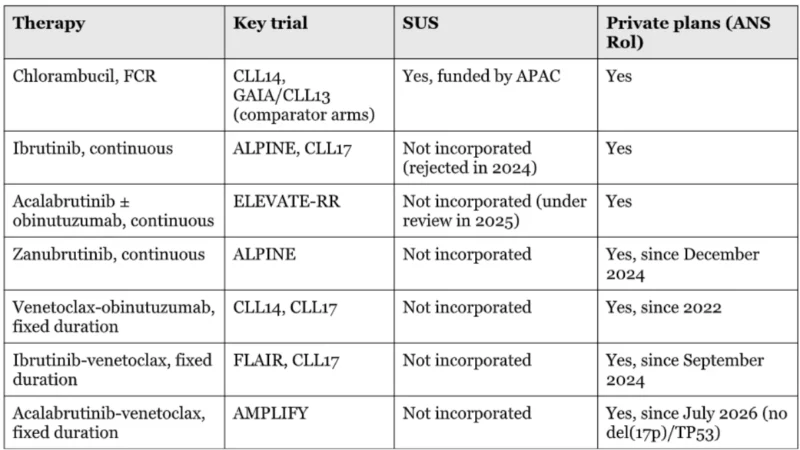
In the SUS, any targeted drug in this table is funded within the same monthly APAC of R$ 407.50 (first line) or R$ 1,800.00 (second line).
Where does the gap matter most?
The gap matters most in four groups of patients, and the first is patients with TP53 aberrations.
Patients with del(17p) or TP53 mutation. Chemoimmunotherapy has no meaningful role in this group, yet it is what the public list offers. In the Brazilian CLL Registry, 73% of first-line treatments in 55 patients with del(17p) and/or TP53 mutation were chemoimmunotherapy, and only 18% were targeted agents (Fernandes et al., 2022). The ABHH recommendations describe the same finding and call it surprising (Chiattone et al., 2025).
Patients who are never tested. A patient cannot be offered the right drug without the right test, and the SUS has no national protocol that requires FISH, TP53 sequencing or IGHV status before treatment. In the Brazilian registry, FISH for del(17p) had been performed in 45% of patients at private hospitals and 10% at public hospitals; anti-CD20 antibodies were used in 75% and 26% (Chiattone et al., 2025). In 98 patients treated in second line at a public center in São Paulo, FISH had been performed in 35% and TP53 testing in 7%, and a targeted agent was used in 8% (Marques et al., 2024). A policy that expands drug access without funding the tests will still miss the patients most likely to be harmed by the wrong choice.
Older patients with comorbidities. For this group the SUS standard is chlorambucil, while CLL14 showed that one year of venetoclax-obinutuzumab doubles median PFS over a chlorambucil-based regimen (Al-Sawaf et al., 2024). A venetoclax program also needs the capacity to assess tumor lysis risk, supervise dose escalation and deliver the infusions, which is part of what has to be funded.
Patients with relapsed disease. After chemoimmunotherapy fails, the SUS patient has a second round of chemotherapy. The private patient has at least three drug classes and, later, cellular therapy. Access has to cover a treatment sequence, not a single drug, and intolerance, progression on therapy and relapse after a treatment-free interval call for different sequences.
The outcome data follow the same line. In a registry of 4,649 patients diagnosed between 2000 and 2024 across 11 Latin American countries, median treatment-free survival was 46 months in private centers and 31 months in public centers, and 5-year overall survival was 93% and 88% (Oliver et al., 2025). These are regional, historical associations: case mix, ascertainment and follow-up differ between the two settings, and the data do not prove that drug access caused the difference. The direction is consistent with everything else in this article.
Court orders partly fill the gap, and they do so unequally: the drug reaches the patient who has a lawyer, a well-documented medical report and a judge who agrees, and the cost falls on the state budget without negotiation.
Most Oral Blood Cancer Prescriptions Face Insurance Rejection or Cost Barriers, US Study Finds
What would narrow the gap?
In my view, the SUS does not need every drug in the private list. It needs a small set of priorities chosen for clinical benefit, feasible delivery and a predictable budget.
One fixed-duration first-line regimen, evaluated with Brazilian prices. CLL17 showed that venetoclax-based fixed-duration therapy is as effective as continuous ibrutinib. A regimen with a defined end date gives Conitec a finite budget impact, and centralized purchasing through AF-Onco gives the Ministry of Health leverage in price negotiation. Affordability still has to be demonstrated with negotiated prices, infusion capacity and expected retreatment.
A BTK inhibitor for TP53-aberrant disease, with a pathway after relapse. This is a small group, about one in ten patients at diagnosis, in which the benefit over chemotherapy is the clearest and the alternative on the public list is the weakest. Eligibility should be explicit, and procurement and referral should let the patient actually receive the drug.
Testing funded alongside the drugs. FISH for del(17p), TP53 sequencing and IGHV status cost far less than one month of any targeted drug, and without them even the regimens the SUS already funds are prescribed blindly. A test that is recommended but unavailable guides nothing.
A national SUS protocol for CLL. The ABHH recommendations already exist (Chiattone et al., 2025). What is missing is a nationally implemented protocol that links testing, eligibility, funded options and monitoring, and gives AF-Onco something to authorize against.
Early referral for double-refractory disease. Patients who fail chemotherapy and the drugs obtained by court order should reach transplant and cellular therapy centers while they are still candidates, with trials and advanced options assessed by real availability.
The objective is a public pathway in which biological risk and clinical need guide treatment, and no patient depends on a lawsuit or on the purchasing capacity of the hospital that happened to receive them. CLL is, in many ways, the disease in which modern hematology has delivered most: a diagnosis that once meant years of chemotherapy and steady decline now means, for most patients, an oral drug or a one-year course and a normal life expectancy. That progress has already arrived in Brazil. It just arrived on one side of the system.
The science of CLL no longer asks whether a patient can be treated without chemotherapy; it asks which chemotherapy-free regimen suits that patient best. In the SUS, we are still asking the first question. Closing that gap does not require every drug on the private list or an unlimited budget. It requires deciding that the biology of the disease, not the patient’s insurance card, is what determines treatment, and then building the protocol, the testing and the financing that make that decision real.