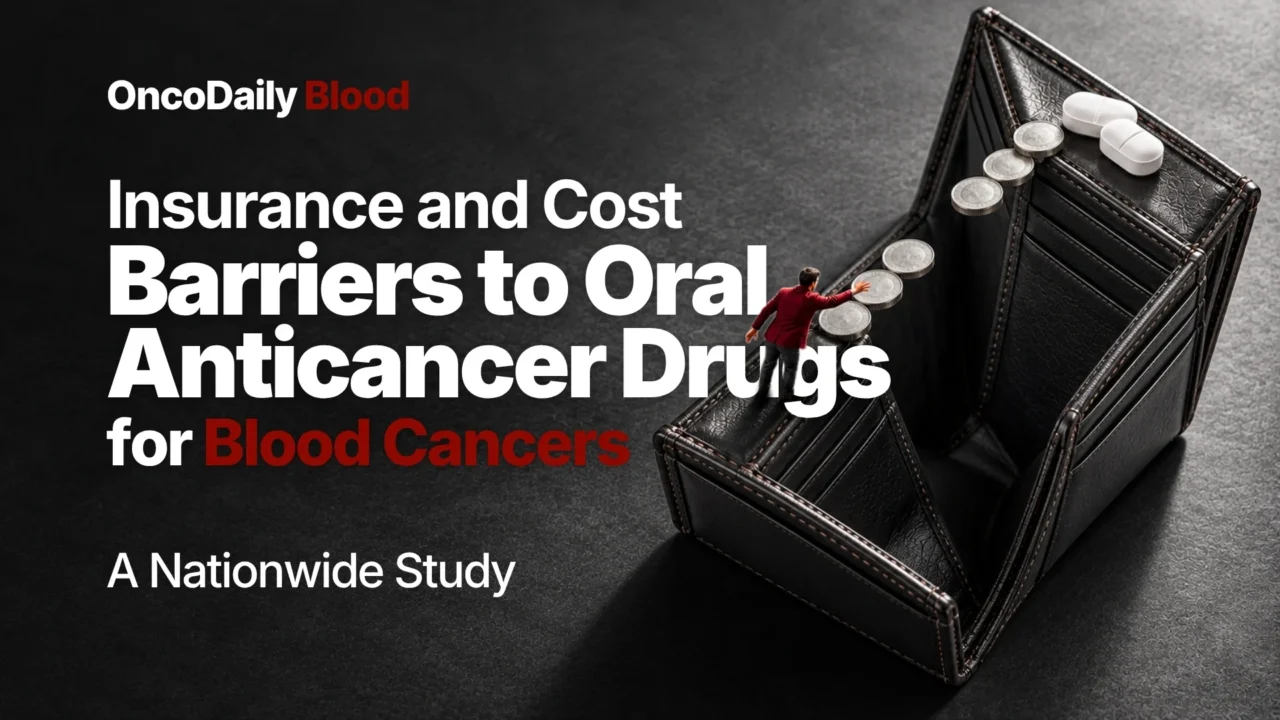
Most claims studies of oral anticancer drugs capture only what was dispensed. This nationwide analysis of 12,134 Medicare and commercially insured patients followed specialty oral blood cancer prescriptions from first pharmacy claim through insurer decision to dispensing. Within 90 days, 54.5% of Medicare and 45.5% of commercially insured patients had both obtained approval and filled the prescription (Doshi et al., 2026). Losses occurred at two points: insurer rejection before approval and out-of-pocket cost after it.
Background
Bruton tyrosine kinase (BTK) inhibitors, B-cell lymphoma 2 (BCL2) inhibitors, and immunomodulatory agents are central to treating leukemias, lymphomas, and myeloma. They spare patients infusion visits, travel costs, and time off work, which matters most for those far from specialized centers.
Many of these drugs cost more than $10,000 per month and fall under the pharmacy benefit. There, prior authorization, formulary restrictions, specialty pharmacy rules, and substantial cost-sharing are routine. Earlier work linked high out-of-pocket costs to abandonment, but rejected and approved-but-unfilled prescriptions went unseen.
Design
The retrospective analysis used the Symphony Health Solutions Integrated Dataverse. It included patients with a new 2022 prescription for a specialty oral anticancer drug indicated for a blood cancer, Medicare Part D or commercial coverage, and no fill of the same drug in the prior six months. Of 12,134 patients, 61% had Medicare and 39% commercial insurance. Immunomodulatory agents, BTK inhibitors, and BCL2 inhibitors were the most common classes.
Each prescription was classified as rejected, approved but unfilled, or approved and filled, at first submission and at 90 days. Medicare and commercial cohorts were analyzed separately with adjusted models.
Rejection: Most Prescriptions Fail at First Submission
At first submission, most prescriptions were rejected:
- Medicare: 64.9% rejected; only 9.6% approved and filled immediately.
- Commercial insurance: 84.0% rejected; only 4.0% approved and filled immediately.
By 90 days, approval reached 85.0% in Medicare and 62.8% in commercial plans.
Most patients who eventually filled did so within a week, but about one in five commercial and one in six Medicare patients waited more than two weeks. The study did not assess disease control or survival, and the clinical cost of delay likely varies by malignancy and urgency.
Prior Authorization: Most Rejections Are Overturned
Prior authorization accounted for 32.1% of initial Medicare rejections and 27.8% of commercial ones, falling to 4.6% and 6.9% by 90 days. In commercial plans, 71.3% of prescriptions rejected for prior authorization were eventually approved. Medicare approval after formulary or utilization management rejection ranged from about 75% to 86%.
Claims can’t show whether each rejection was appropriate. The reversal rate does show that substantial work, including documentation, appeals, and coordination with insurers and specialty pharmacies, preceded approval of drugs the insurers agreed to cover.
Commercial Plans: Formulary Exclusion Persists
After adjustment, commercially insured patients had about three times the odds of rejection compared with Medicare beneficiaries. For formulary exclusion, the adjusted odds were more than eight times higher at both submission and 90 days. Exclusion affected 17.1% of commercial prescriptions initially and 8.0% at 90 days, and fewer than half of these were eventually approved.
Part D treats anticancer drugs as a protected class, so plans must cover all or substantially all of them, though utilization management still applies. Commercial insurers face no equivalent federal requirement and can exclude drugs or set preferred-drug arrangements.
Approval and fill rates were relatively high for BCL2 inhibitors in both groups and particularly low for Janus kinase inhibitors in commercial patients. Indication, treatment line, generic availability, and payer rules differ across classes, so the data can’t attribute this to the drug class itself.
Cost: Fill Rates Track the Patient’s Out-of-Pocket Payment
Within 90 days, 30.5% of Medicare and 17.4% of commercial patients had approved prescriptions that were never filled.
Average out-of-pocket cost for the first approved prescription was $933 in Medicare and $775 in commercial plans. About 23% of Medicare and 10% of commercial patients owed more than $2,000 for a single prescription.
Fill rates declined sharply as out-of-pocket costs increased. Medicare patients:
- 84.9% filled at $15 or less.
- 76.7% at $15-$175.
- 38.0% at $175-$500.
- 29.2% at $500-$2,000.
Commercial patients showed the same gradient: about 80% filled at $15 or less, versus 21.6% above $2,000. Clinical changes, insurance transitions, or assistance programs may explain some unfilled prescriptions, so the association doesn’t prove cost was the cause in every case.
Medicare Reform: The Threshold Matches the New Monthly Math
The data predate Inflation Reduction Act changes to Part D. Medicare now caps annual out-of-pocket spending at $2,100 in 2026, and the Medicare Prescription Payment Plan lets beneficiaries spread costs across monthly payments. Over 12 months, $2,100 equals $175 per month, the point below which Medicare fill rates stayed high.
The study did not evaluate the payment plan or show that enrollment increases treatment initiation. The authors noted limited awareness and uptake during early implementation, so financial counseling and enrollment help may become part of treatment coordination. Commercial patients have no equivalent national program. Exploratory modeling suggested that lower out-of-pocket costs could raise commercial fill rates, pending prospective evaluation.
Implications and Limitations
The authors identify two intervention points. Before approval, electronic prior authorization and gold carding (exempting clinicians with strong guideline-concordant records from some requirements) could reduce friction. After approval, early out-of-pocket estimates, financial assistance, and payment options may prevent abandonment. Neither approach was tested here. The findings support American Society of Clinical Oncology and American Society of Hematology calls for prior authorization reform, but higher approval rates alone won’t resolve access if the copay is unaffordable.
The analysis relied on claims and lacked disease stage, treatment line, performance status, and urgency, so it could not link delays to progression, hospitalization, or survival. It excluded Medicaid patients and those starting multiple specialty oral drugs together. Manufacturer assistance outside the database may mean fill rates understate true access.
Source: Doshi JA, Li P, Geng Z, et al. Insurance and Cost-Related Access Barriers to Specialty Oral Anticancer Medications for Blood Cancers in a Nationwide Sample of Medicare and Commercially Insured Patients. Journal of Clinical Oncology. 2026. DOI: 10.1200/JCO-26-00247.