
The success of BTK inhibitors began with a simple observation: CLL cells remain highly dependent on signals from the lymph node and bone marrow microenvironments for survival. Among these, B-cell receptor (BCR) signaling proved to be the most compelling target, placing Bruton’s tyrosine kinase (BTK) at the center of a new treatment strategy.
Instead of increasing cytotoxicity, therapeutic development focused on disrupting the pathways that sustain leukemic cells.
Why BTK Became the Critical Node
In healthy B lymphocytes, the BCR is activated only when needed to recognize antigen and initiate an immune response. In CLL, this pathway remains chronically active, providing continuous signals that support survival, proliferation, migration, and resistance to apoptosis. Rather than behaving as autonomous cancer cells, CLL cells continue to rely on this signaling network throughout the course of the disease.
BTK sits at a critical junction within the BCR cascade. Signals initiated at the cell surface converge on BTK before propagating through multiple pathways. This position makes BTK an attractive therapeutic target: inhibiting a single kinase weakens several processes simultaneously.
Importantly, BTK inhibition does more than suppress intracellular signaling. It reduces the ability of CLL cells to remain within the lymph nodes and bone marrow where survival signals are most abundant. These observations led to the development of covalent BTK inhibitors, which irreversibly bind the C481 residue within the kinase domain and achieve sustained target inhibition despite relatively short plasma half-lives.
A Rare Immunodeficiency That Revealed BTK
Long before BTK became a therapeutic target in CLL, it was recognized as an essential regulator of normal B-cell development. In 1952, pediatrician Ogden Bruton described a young boy with recurrent bacterial infections and a profound deficiency of circulating immunoglobulins, a disorder later recognized as X-linked agammaglobulinemia (XLA). Decades later, the responsible gene was identified on the X chromosome, revealing BTK as a kinase essential for normal B-cell maturation.
That observation later proved equally important in malignancy. In retrospect, the discovery of BTK did more than explain a rare inherited immunodeficiency. It provided the rationale for one of the most successful targeted treatment strategies, underscoring how observations made in human genetics can reshape cancer therapy decades later.
Clinical Response to BTK Inhibition
BTK inhibitors differ from conventional anticancer therapy in one important respect: they do not eradicate CLL cells immediately. Instead, they interrupt the signals that allow the leukemic clone to survive. The earliest clinical response reflects this mechanism. Rather than disappearing, leukemic cells leave the lymph nodes and enter the peripheral blood, producing the transient lymphocytosis that characteristically follows initiation of BTK inhibition and is recognized as an expected pharmacodynamic effect. Once displaced from their supportive niches, CLL cells become progressively more susceptible to apoptosis, while lymphadenopathy typically regresses rapidly.
Although interruption of BCR signaling profoundly suppresses disease activity, it does not eliminate complementary survival pathways, particularly those mediated by BCL2. Continued treatment therefore remains necessary for most patients, while combination strategies pairing BTK and BCL2 inhibition seek to overcome this limitation.
From Target Validation to Standard of Care
When ibrutinib entered clinical practice, the goal was to determine whether continuous inhibition of BTK could outperform existing therapies. That question was answered decisively in the RESONATE trial. In patients with relapsed or refractory CLL, ibrutinib extended median progression-free survival from 8.1 months with ofatumumab to 44.1 months (HR 0.15), with benefit maintained across traditionally high-risk groups, including patients with del(17p), TP53 alterations, del(11q), and unmutated IGHV.
Patients were living longer, remaining on treatment for years, and exposing the limitations of the first available inhibitor. Off-target inhibition by ibrutinib increased the risk of bleeding, gastrointestinal toxicity, and cardiovascular complications. A meta-analysis of eight randomized studies reported a 2.8-fold higher risk of hypertension and a 4.7-fold higher risk of atrial fibrillation compared with control treatments. BTK inhibitor development became a process of solving the problems revealed by clinical experience.
In ASCEND, acalabrutinib, second-generation covalent BTK inhibitor, achieved superior disease control compared with investigator’s choice therapy, with 42-month PFS rates of 62% versus 23% and 5% for idelalisib-rituximab and bendamustine-rituximab, respectively.
The subsequent ELEVATE-RR trial addressed a different question: could greater kinase selectivity improve safety while preserving efficacy? The answer was yes. Acalabrutinib produced the same median PFS as ibrutinib (38.4 months) while reducing atrial fibrillation (9.0% vs. 15.6%) and hypertension (8.6% vs. 22.8%).
A similar pattern emerged with zanubrutinib. In the ALPINE trial, zanubrutinib not only improved efficacy, with a 36-month PFS of 65.4% versus 54.4% for ibrutinib (HR 0.68), but also reduced atrial fibrillation or flutter (7.1% vs. 17.0%). Taken together, these studies changed the criteria by which BTK inhibitors were judged. Once efficacy became consistent across the class, the choice of agent increasingly depended on long-term safety, comorbidities, and the likelihood that patients could remain on treatment for years.
Why New BTK Inhibitors Kept Appearing
Greater kinase selectivity solved many of the tolerability issues, but it did not solve the problem that ultimately limits every continuous targeted therapy: resistance. Disease progression increasingly resulted from acquired mutations. Most commonly, mutations involving the BTK C481 binding site prevented irreversible drug binding, while alterations in PLCG2 restored downstream signaling.
Pirtobrutinib, the first widely studied non-covalent BTK inhibitor, addressed this directly. In the phase III BRUIN CLL-321 trial, conducted in patients previously treated with a covalent BTK inhibitor, pirtobrutinib prolonged median PFS to 14.0 months, compared with 8.7 months with investigator’s choice of idelalisib-rituximab or bendamustine-rituximab (HR 0.54).
Importantly, this benefit was maintained regardless of previous venetoclax exposure, supporting its use after failure of both frontline and subsequent targeted therapies. The role of non-covalent BTK inhibition is already expanding beyond salvage therapy.
Can BTK Inhibition Be Time-Limited?
Long-term follow-up from RESONATE-2 showed that first-line ibrutinib maintained disease control for up to 10 years, with an estimated PFS of 59% and OS approaching 78%. Similar long-term efficacy has been observed with second-generation BTK inhibitors.
Although they provide durable disease control across high-risk subgroups, continuous treatment increases cumulative toxicity, treatment burden, and the likelihood of intolerance. In a real-world analysis of 584 patients who initiated first-line BTK inhibitor therapy, 65.9% discontinued treatment, with 38.4% of discontinuations attributed to toxicity. An important question was whether durable disease control could be maintained without indefinite BTK inhibition.
Venetoclax-based combinations provided the first effective alternative to continuous targeted therapy. In CLL13 (GAIA), fixed-duration venetoclax-obinutuzumab outperformed chemoimmunotherapy, establishing time-limited targeted therapy as a frontline strategy. Rather than replacing BTK inhibitors, these findings prompted evaluation of fixed-duration BTK inhibitor-based combinations.
In AMPLIFY, adding acalabrutinib to venetoclax-obinutuzumab further reduced the risk of progression, suggesting that BTK inhibition can also be successfully incorporated into finite treatment approaches. Studies such as SEQUOIA Arm D are evaluating time-limited zanubrutinib-based regimens, while measurable residual disease is increasingly being explored to individualize treatment duration.
Selecting and Sequencing Targeted Therapies
Treatment selection incorporates both the immediate clinical situation and the therapies most likely to remain effective if disease progresses.
Disease characteristics remain the foundation of treatment selection. TP53 abnormalities, del(17p), and unmutated IGHV support the use of targeted therapy over chemoimmunotherapy. The choice between targeted regimens is also influenced by:
- cardiovascular disease
- bleeding risk
- renal function
- potential drug-drug interactions
- history of recurrent infections
- feasibility of tumor lysis syndrome monitoring
Patient preference is equally important, particularly when choosing between continuous and a fixed-duration regimen.
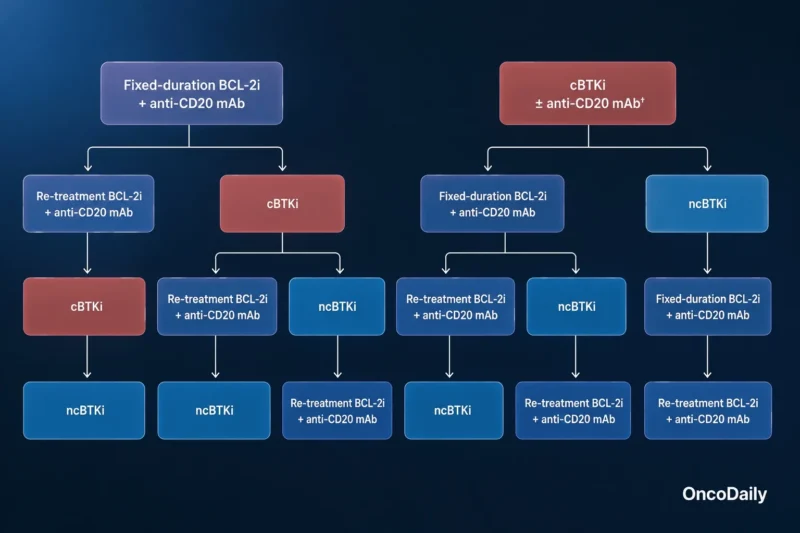
Relapsed/Refractory
Current sequencing is guided largely by available clinical evidence rather than definitive head-to-head comparisons. Patients receiving fixed-duration venetoclax-based therapy may remain eligible for retreatment after a durable remission or transition to BTK inhibition at relapse.
Patients progressing during continuous covalent BTK inhibition generally require a non-covalent BTK inhibitor or venetoclax-based therapy, depending on the mechanism of resistance. Patients who discontinue treatment because of toxicity often respond to a more selective covalent BTK inhibitor.
Treatment options become more limited after failure of both BTK inhibition and venetoclax. No standard sequencing strategy exists for this double-refractory setting, and clinical trial enrollment should be considered whenever possible. BTK degraders, CAR T-cell therapy, and bispecific antibodies are among the approaches being evaluated.
New Strategies for BTK Inhibition
Current research is focused on preventing resistance, reducing long-term toxicity, minimizing continuous treatment, and improving outcomes after failure of multiple targeted therapies.
The most important developments are strategic as much as pharmacologic. BTK inhibitors are increasingly being incorporated into fixed-duration combination regimens. In the phase III BRUIN CLL-322 trial, fixed-duration pirtobrutinib, venetoclax, and rituximab improved 24-month progression-free survival compared with venetoclax-rituximab alone (86.9% vs. 71.8%, HR 0.547) and increased rates of undetectable measurable residual disease (86.3% vs. 60.7%).
Non-covalent BTK inhibitors are also being explored in first-line therapy. The phase III BRUIN CLL-313 trial is evaluating pirtobrutinib in combination with venetoclax and obinutuzumab as first-line treatment.
Other investigational approaches are refining BTK targeting from a different angle. Nemtabrutinib has demonstrated activity in heavily pretreated CLL, while bifunctional inhibitors such as rocbrutinib are designed to retain activity against both wild-type and C481-mutated BTK.
Drug development is moving beyond kinase inhibition. BTK degraders eliminate the BTK protein itself, offering a potential option to overcome resistance to both covalent and non-covalent inhibitors. Their place within future treatment algorithms remains to be determined.

BRUIN CLL-322: A Phase 3 Trial of Fixed-Duration Pirtobrutinib-Venetoclax-Rituximab in R/R CLL/SLL
Written by Susanna Mikayelyan, MD