The American Cancer Society (ACS) has developed the Screening Disparity Atlas, an advanced geospatial dashboard designed to examine differences in cancer burden and screening across the United States. Created by its Geospatial Solutions Team in collaboration with the Early Detection Team, the Atlas brings together multiple high-quality datasets into a single platform that allows detailed exploration of patterns in cancer outcomes and access to care.
The Atlas provides data on cancer incidence and mortality alongside key population characteristics, including age distribution, race and ethnicity, and socioeconomic indicators. It also incorporates information on screening uptake for major cancer types, enabling comparisons across geographic regions and population groups. By presenting these variables together, the platform makes it possible to examine how differences in screening relate to broader patterns in cancer outcomes.
A central component of the Atlas is its integration of data on Federally Qualified Health Centers (FQHCs). These centers play an essential role in delivering primary care and preventive services to underserved populations. The Atlas includes detailed information on FQHC locations and their associated service sites, as well as patient population characteristics and screening performance. Screening rates are presented over a ten-year period from 2014 to 2024, allowing users to assess trends over time and identify areas where progress has been made or where gaps persist.
The data incorporated into the Atlas are drawn from several major national sources, including the Health Resources and Services Administration, the National Cancer Institute, and the Centers for Disease Control and Prevention. These sources provide information not only on cancer outcomes but also on factors that influence risk and access to care. Variables such as smoking prevalence, obesity, and measures of social vulnerability are included, allowing for a more complete understanding of the conditions that contribute to disparities in screening and mortality.
The Atlas is built around interactive mapping and visualization tools. Users can view data through customizable maps that display variation at the county level, with the ability to apply filters, compare regions, and examine changes over time. This structure supports both broad overviews and more detailed, localized analyses. For example, users can identify regions with high cancer mortality and then explore whether these areas also have lower screening rates, higher levels of social vulnerability, or limited access to healthcare services.
The inclusion of longitudinal screening data for FQHCs adds an important practical dimension. These data make it possible to evaluate how screening efforts have evolved within safety-net healthcare systems and to identify where additional support or intervention may be needed. By linking screening performance with demographic and geographic context, the Atlas provides a clearer picture of how healthcare delivery systems contribute to observed disparities.
This type of integrated analysis is important because differences in cancer outcomes are not explained by a single factor. Variations in screening rates, access to care, socioeconomic conditions, and behavioral risk factors all contribute to differences in incidence and mortality. By bringing these elements together, the Atlas allows users to examine how they interact and where interventions may have the greatest impact.
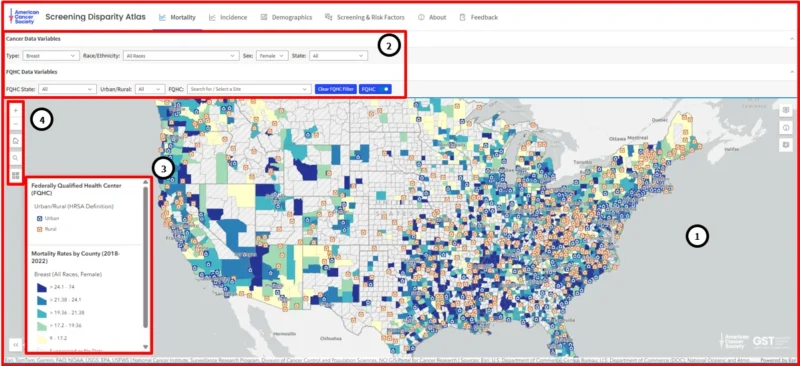
source: American Cancer Society official website
The Atlas is intended for a wide range of users, including researchers, clinicians, public health professionals, and policymakers. It supports the identification of underserved populations and geographic areas where cancer screening is lower or outcomes are worse. This information can be used to guide the development of targeted screening programs, allocate resources more effectively, and monitor progress over time.
The ability to visualize disparities at a detailed geographic level is particularly valuable for planning and evaluation. It allows stakeholders to move beyond national averages and focus on local conditions, where differences are often more pronounced. By identifying specific communities with lower screening uptake or higher mortality, interventions can be tailored more precisely to the needs of those populations.
The Screening Disparity Atlas reflects a broader effort to use data to improve cancer prevention and control. Early detection remains one of the most effective ways to reduce cancer mortality, yet access to screening is uneven. Tools that make these gaps visible are essential for addressing them. By combining data on cancer burden, healthcare access, and population characteristics, the Atlas provides a foundation for more informed and targeted action.
In this context, the Atlas serves not only as a source of information but also as a practical resource for decision-making. It enables users to identify where disparities exist, understand the factors associated with them, and track changes over time. This makes it a valuable component of ongoing efforts to improve equity in cancer screening and outcomes.
For more information, click here to access the Screening Disparity Atlas