At the ESMO Congress 2026, Arun A. Azad (Melbourne, Australia) presented a biomarker analysis from the Phase III TALAPRO-3 trial (NCT04821622), evaluating the prognostic utility of circulating tumour DNA (ctDNA) tumour fraction in patients with homologous recombination repair (HRR) gene–mutated metastatic castration-sensitive prostate cancer (mCSPC).
The analysis, presented as Rapid Oral abstract 2219RO, assessed whether baseline ctDNA tumour fraction and changes at Week 5 were associated with radiographic progression-free survival (rPFS).
Why Was This Analysis Conducted?
In TALAPRO-3, talazoparib plus enzalutamide significantly improved rPFS compared with placebo plus enzalutamide in patients with HRR-deficient mCSPC. As ctDNA tumour fraction emerges as a potential prognostic biomarker across treatments and tumour types, investigators examined its utility at baseline and during treatment.
TALAPRO-3 Study Design and Methods
Serial plasma samples collected at baseline and Week 5 were analysed using FoundationOne Liquid CDx. Tumour fraction was calculated using aneuploidy, genomic variants, and fragment information. ctDNA status was classified as positive (tumour fraction ≥1%) or negative (tumour fraction <1%). The analysis included 454 patients evaluable for baseline ctDNA tumour fraction, excluding patients in China. The data cutoff was February 18, 2026.
Key Findings from TALAPRO-3
At baseline, ctDNA-positive status was observed in 36% (83/230) of patients receiving talazoparib plus enzalutamide and 33% (75/224) receiving placebo plus enzalutamide. In the talazoparib arm, baseline ctDNA positivity was associated with a numerically higher hazard of radiographic progression or death, although the difference was not statistically significant (HR 1.59; 95% CI 0.94–2.70; nominal p=0.08). Median rPFS was not reached in either baseline group.
In the placebo arm, median rPFS was 26.7 months (95% CI 18.2–not reached) for patients with ctDNA-positive status, compared with not reached (95% CI 45.8–not reached) for those with ctDNA-negative status (HR 2.15; 95% CI 1.42–3.26; nominal p=0.0002).
Week 5 ctDNA Changes and Clinical Outcomes
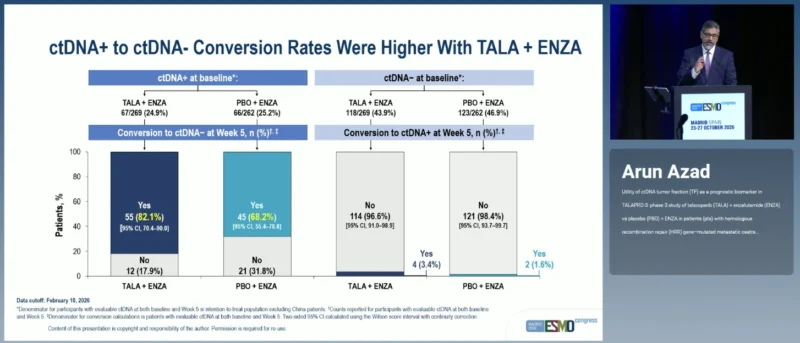
Conversion from ctDNA-positive at baseline to ctDNA-negative at Week 5 occurred in 82.1% (55/67) of patients receiving talazoparib plus enzalutamide versus 68.2% (45/66) receiving placebo plus enzalutamide.
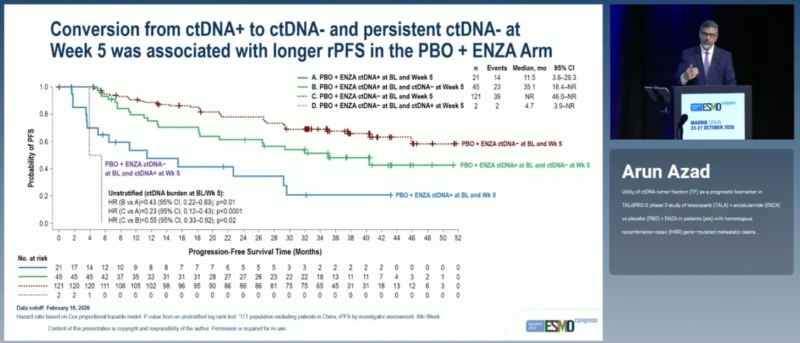
Among patients who were ctDNA-negative at baseline, 96.6% (114/118) and 98.4% (121/123), respectively, remained ctDNA-negative at Week 5. Patients with persistent ctDNA positivity had shorter investigator-assessed rPFS than those who converted to ctDNA-negative status or remained ctDNA-negative. Median rPFS was 17.3 months (95% CI 9.1–not reached; n=12) in the talazoparib arm and 11.5 months (95% CI 3.6–29.3; n=21) in the placebo arm.
For patients converting from ctDNA-positive to ctDNA-negative status, median rPFS was not reached (n=55) with talazoparib plus enzalutamide and was 35.1 months (95% CI 18.4–not reached; n=45) with placebo plus enzalutamide. Compared with persistent ctDNA positivity, conversion was associated with longer rPFS in both arms (HR 0.36; 95% CI 0.14–0.93; nominal p=0.03 and HR 0.43; 95% CI 0.22–0.83; nominal p=0.01, respectively).
Patients who remained ctDNA-negative at baseline and Week 5 had favourable rPFS outcomes, with median rPFS not reached in either treatment arm (n=114 and n=121). Compared with persistent ctDNA positivity, the HRs were 0.23 (95% CI 0.09–0.56; nominal p=0.0004) in the talazoparib arm and 0.23 (95% CI 0.12–0.43; nominal p<0.0001) in the placebo arm.
Compared with patients who converted from ctDNA-positive to ctDNA-negative status, those who remained ctDNA-negative had a numerically lower hazard of radiographic progression or death in the talazoparib arm (HR 0.72; 95% CI 0.38–1.39; nominal p=0.33), although the difference was not statistically significant. In the placebo arm, persistently ctDNA-negative patients had a lower hazard of radiographic progression or death than those who converted to ctDNA-negative status (HR 0.55; 95% CI 0.33–0.92; nominal p=0.02).
Conclusions
The TALAPRO-3 biomarker analysis showed that early changes in ctDNA tumour fraction were associated with investigator-assessed radiographic progression-free survival in patients with HRR gene–mutated metastatic castration-sensitive prostate cancer.
Conversion from ctDNA-positive to ctDNA-negative status at Week 5 was associated with longer rPFS compared with persistent ctDNA positivity in both treatment arms. Patients who remained ctDNA-negative at baseline and Week 5 also had favourable rPFS outcomes, although their outcomes were not significantly different from those of patients who converted to ctDNA-negative status in the talazoparib arm.
Conversion rates were numerically higher with talazoparib plus enzalutamide than with placebo plus enzalutamide (82.1% vs 68.2%). These findings support further evaluation of ctDNA tumour fraction and early on-treatment changes as potential prognostic biomarkers in this setting.
Source: ESMO Congress 2026 – Abstract 2219RO, TALAPRO-3

You can also read about KEYNOTE-365 at ESMO 2026 on OncoDaily.