
At the ESMO Congress 2026, Gunhild von Amsberg (Hamburg, Germany) is scheduled to present updated results from cohort I of the Phase Ib/II KEYNOTE-365 trial (NCT02861573), evaluating pembrolizumab plus carboplatin and etoposide versus chemotherapy alone in patients with metastatic neuroendocrine prostate cancer (NEPC). The updated analysis included 70 patients and assessed antitumour activity, survival outcomes, and safety.
Why Was KEYNOTE-365 Conducted?
KEYNOTE-365 cohort I evaluated pembrolizumab plus carboplatin and etoposide compared with chemotherapy alone in patients with metastatic NEPC. The trial assessed objective response and safety as primary endpoints, with duration of response, radiographic progression-free survival, and overall survival as secondary endpoints.
KEYNOTE-365 Study Design and Methods
Adults with centrally confirmed treatment-emergent or de novo metastatic NEPC, including small-cell carcinoma, large-cell neuroendocrine carcinoma, or mixed histology, were randomized 1:1, subsequently amended to 3:1. Patients could have received prior androgen deprivation therapy.
Participants received four to six cycles of carboplatin (AUC 5, every three weeks) and etoposide (100 mg/m² on days 1–3, every three weeks), with or without pembrolizumab (200 mg every three weeks for up to 35 cycles).
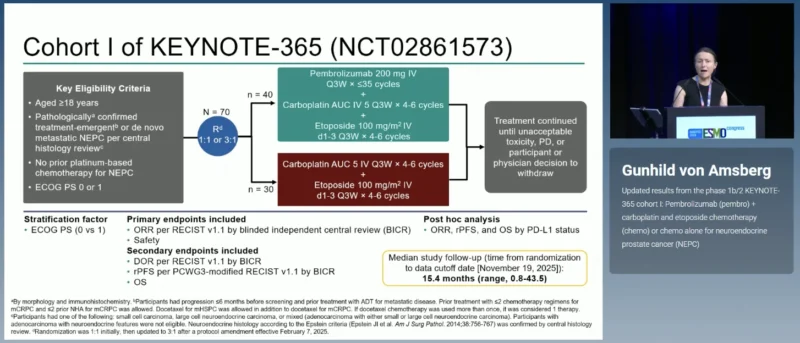
Primary endpoints included objective response rate (ORR) by blinded independent central review using RECIST v1.1 and safety. Secondary endpoints included duration of response (DOR), radiographic progression-free survival (rPFS), and overall survival (OS). Efficacy by PD-L1 status was assessed post hoc.

Key Findings from KEYNOTE-365
At the November 19, 2025 data cutoff, 70 patients had been randomized to pembrolizumab plus chemotherapy (n=40) or chemotherapy alone (n=30). Most patients had treatment-emergent NEPC (73%), while 56% had PD-L1 CPS <1. Median study follow-up was 15.4 months (range 0.8–43.5).
Efficacy in the Overall Population
Among patients with RECIST-measurable disease, the objective response rate (ORR) was 28% (10/36; 95% CI 14–45%) with pembrolizumab plus chemotherapy versus 15% (4/27; 95% CI 4–34%) with chemotherapy alone. Median duration of response (DOR) was 6.2 months (range 2.0+ to 10.2+) versus 4.1 months (range 2.8+ to 6.2), respectively.
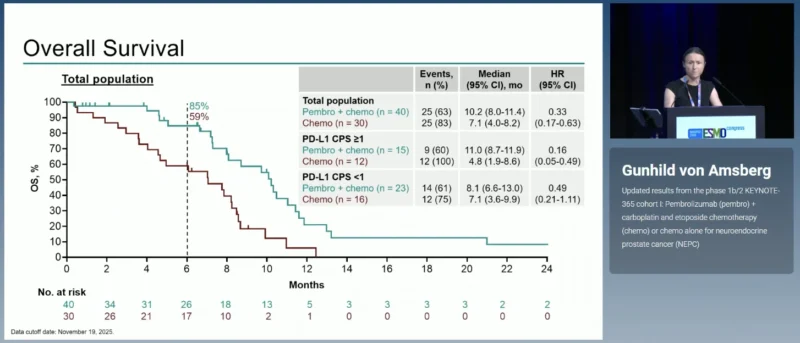
In the overall treatment population, median overall survival (OS) was 10.2 months (95% CI 8.0–11.4) with pembrolizumab plus chemotherapy compared with 7.1 months (95% CI 4.0–8.2) with chemotherapy alone (HR 0.33; 95% CI 0.17–0.63).
Outcomes by PD-L1 Status
Among patients with PD-L1 CPS ≥1 and RECIST-measurable disease, ORR was 40% (6/15; 95% CI 16–68%) with pembrolizumab plus chemotherapy versus 18% (2/11; 95% CI 2–52%) with chemotherapy alone. In the overall PD-L1 CPS ≥1 subgroup, median OS was 11.0 versus 4.8 months (HR 0.16; 95% CI 0.05–0.49).
In patients with PD-L1 CPS <1 and RECIST-measurable disease, ORR was 15% (3/20; 95% CI 3–38%) versus 13% (2/15; 95% CI 2–40%). In the overall PD-L1 CPS <1 subgroup, median OS was 8.1 versus 7.1 months (HR 0.49; 95% CI 0.21–1.11).
Numerical efficacy outcomes favoured pembrolizumab plus chemotherapy across PD-L1 subgroups, with a more pronounced difference in the CPS ≥1 subgroup. However, these were post hoc analyses involving small patient populations, and the findings should be interpreted cautiously.
Safety Outcomes
Treatment-related adverse events (TRAEs) of any grade occurred in 95% of patients receiving pembrolizumab plus chemotherapy and 90% receiving chemotherapy alone. Grade 3–5 TRAEs occurred in 63% versus 80%, respectively.
Treatment-related adverse events led to treatment discontinuation in 8% versus 10% of patients. No grade 5 TRAEs occurred with pembrolizumab plus chemotherapy, while one grade 5 event (3%), attributed to tumour lysis syndrome, occurred in the chemotherapy-alone group.
The safety profile of pembrolizumab plus chemotherapy was generally consistent with the known profiles of the individual agents, with no new or unexpected safety signals reported.
Conclusions
Updated results from KEYNOTE-365 cohort I showed encouraging efficacy outcomes, including overall survival, with pembrolizumab plus carboplatin and etoposide compared with chemotherapy alone in patients with metastatic NEPC. Numerical efficacy outcomes favoured the pembrolizumab combination across PD-L1 subgroups, while the safety profile was generally consistent with the known profiles of the individual agents.
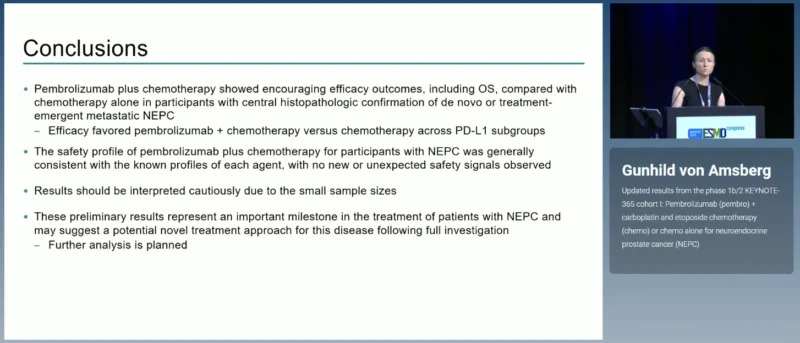
These preliminary findings should be interpreted cautiously because of the small sample sizes, particularly in the PD-L1 subgroup analyses. Further analysis is planned.
Source: ESMO Congress 2026 – Abstract 2217RO, KEYNOTE-365 Cohort I