
The third week of June brought together important updates across GU oncology, with 10 expert posts highlighting new publications, treatment advances, biomarker-driven care, bladder preservation strategies, radiation oncology approaches, surgical case management, and regulatory developments across prostate, bladder, kidney, and urothelial cancers.
This week’s selection includes updates on HDR brachytherapy plus SBRT for intermediate- and high-risk prostate cancer, induction immunotherapy followed by chemoradiotherapy in muscle-invasive bladder cancer, HER2 in urothelial carcinoma, mechanisms of resistance to androgen deprivation therapy in prostate cancer, perioperative enfortumab vedotin plus pembrolizumab in KN905/EV-303, disease-free survival as a surrogate endpoint in muscle-invasive bladder cancer, SAKK 06/19 and intravesical BCG with chemo-immunotherapy, multidisciplinary management of renal cell carcinoma with inferior vena cava tumor thrombus, FDA approval of capivasertib plus abiraterone and prednisone for PTEN-deficient metastatic prostate cancer, and ultra-hypofractionated postoperative radiotherapy in prostate cancer.
Together, these posts reflect the breadth of current GU oncology research and practice, from precision medicine and treatment intensification to bladder preservation, radiation innovation, surgical collaboration, endpoint validation, and patient-centered care.
David Büchser García — Radiation Oncologist at Hospital Universitario Cruces | Spain
“Thrilled to share that our prospective phase II study on single-fraction HDR brachytherapy combined with SBRT (BrachySABR) for intermediate and high-risk prostate cancer has just been published in Radiotherapy and Oncology!
This work evaluates the combination of single-fraction HDR brachytherapy (15 Gy) followed by SBRT (25 Gy in 5 fractions) for intermediate- and high-risk prostate cancer.
Key results:
• 4-year biochemical relapse-free survival: 91%
• 4-year metastasis-free survival: 91%
• Median PSA nadir: 0.04 ng/mL
• Median PSA at 4 years: 0.06 ng/mL
• Quality of life preserved, with no significant long-term deterioration in urinary, bowel, sexual or hormonal domains
• No grade ≥3 GI toxicity
• Only 2.6% late grade 3 GU toxicity
• No local recurrences observed
A promising, efficient dose-escalation strategy.
These results suggest that HDR brachytherapy combined with SBRT may represent an effective, well-tolerated and highly efficient dose-escalation strategy for intermediate- and high-risk prostate cancer.”
Enrique Grande — Medical Oncology Department Director at Quirónsalud Madrid | Spain
“INDIBLADE in Nature Medicine: induction ipilimumab + nivolumab followed by chemoradiotherapy in stage II/III MIBC.
Encouraging bladder-intact EFS and OS outcomes. ctDNA clearance after induction immunotherapy emerged as a strong predictor of response.
Bladder preservation with systemic induction — the field is moving fast.”
Renate Pichler, MD, PhD, FEBU — Associate Professor; Surgical Scientist, Department of Urology, Comprehensive Cancer Center Innsbruck | Austria
“Our new review article on HER2 in urothelial carcinoma has just been published in the renowned journal Cancer Treatment Reviews.
This work represents a great interdisciplinary collaboration between Urology, Pathology, Translational Science and Medical Oncology across Medizinische Universität Innsbruck, Medizinische Universität Graz, University of Augsburg and Universidad de Alcalá.
Special thanks are due to the two co-first authors Nils van Creij and Hamed Wafa, who are currently undertaking PhD studies in urothelial cancer research at Medizinische Universität Innsbruck.
Key highlights:
• HER2 expression in urothelial carcinoma is heterogeneous and varies across histological subtypes.
• Improved and standardized HER2 testing and biomarker strategies are urgently needed.
• Conventional HER2 inhibition shows limited efficacy in urothelial carcinoma.
• HER2-directed antibody–drug conjugates (ADCs) demonstrate significant activity in advanced disease.
• The clinical benefit of HER2-directed ADCs extends beyond HER2-high to HER2-low tumors.
Many thanks to all co-authors and collaborators for their outstanding contributions to this project. Looking forward to seeing how this rapidly evolving field will further shape precision medicine for patients with urothelial carcinoma.”
Read more about HER2 in Urothelial Carcinoma: Biomarker Complexity and ADC-Based Treatment on OncoDaily.
Imane Bensalim — PhD Student in Immuno-Oncology and Bioinformatics at Mohammed VI University of Sciences and Health | Morocco
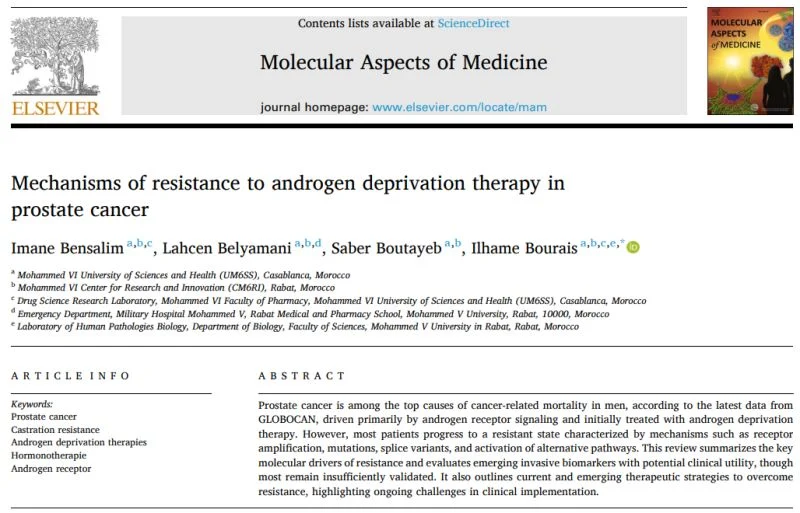
“Excited to share that our latest review has been published in a high-impact Q1 journal (IF > 10).
Cancer’s greatest strength is not how fast it grows.
It’s how effectively it adapts.
Our new review explores how prostate cancer develops resistance to androgen deprivation therapy and the emerging biomarkers and therapeutic strategies that could help address this challenge.
What fascinates me most is that every mechanism of resistance tells a story of adaptation. The more we understand these stories, the closer we get to developing smarter, more durable treatments for patient s.
A huge thank you to my supervisors, Pr. Ilhame BOURAIS and Pr. Saber Boutayeb for their expertise and commitment throughout this project.
If you’ve ever wondered why some cancers stop responding to treatment, or where the next breakthroughs in precision oncology may come from, I invite you to read the paper:
One thought I’d love to leave you with:
What if the biggest challenge in cancer treatment isn’t destroying cancer cells, but keeping them from adapting?”
Anders Ullén — MD, PhD; Professor of Clinical Oncology at Karolinska Hospital and Karolinska Institute | Sweden
“In this correspondence letter to the New England Journal of Medicine (https://lnkd.in/gEySmH6N), Christof Vulsteke and I outline our perspective on the adjuvant phase and adherence to the perioperative Enfortumab Vedotin plus Pembrolizumab regimen, as evaluated in the recently published KN905/EV-303 study. In brief, we recommend exercising caution before deviating from a protocol defined, regulatory-approved trial regimen that has demonstrated consistent and clinically meaningful improvements across all measured efficacy endpoints, including overall survival.”
Pietro Scilipoti — Urology Resident at IRCCS San Raffaele Hospital | Italy
“Which intermediate endpoint actually predicts survival in muscle-invasive bladder cancer?
In trials evaluating perioperative treatments for localized muscle-invasive bladder cancer (MIBC), overall survival (OS) remains the gold-standard endpoint, but it demands long follow-up and large samples. That’s the appeal of surrogate endpoints that could speed up trials. Until now, though, none had been formally validated.
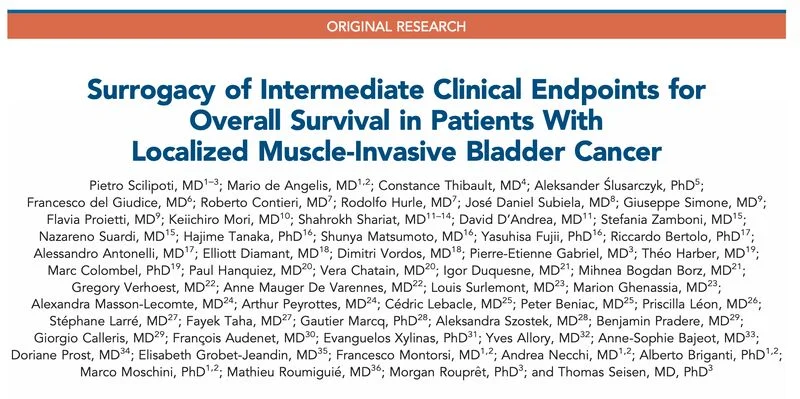
Our study, just published in JNCCN, analyzed 4,828 patients who underwent radical cystectomy (YAU and BLADRAC cohorts), with or without neoadjuvant chemotherapy, across 29 European centers (2001–2024), testing the surrogacy of three candidates: pathologic complete response (pCR; pT0N0), pathologic objective response (pOR, ≤ pT1HG), and disease-free survival (DFS; event or death).
The findings tell a clear story:
→ Under the Prentice criteria, all three looked like adequate surrogates. But more rigorous methods reshaped the picture.
→ pCR: PTE 0.42 — trial-level R² 0.22
→ pOR: PTE 0.48 — R² 0.33
→ DFS: PTE 0.84 — R² 0.83 — STE 0.82
Only DFS consistently mediated the treatment effect on OS, qualifying as a reliable surrogate for sizing future RCTs, assuming an expected recurrence/death risk reduction of ≥18%.
Takeaway for practice: pCR and pOR remain strong prognostic factors, but using them as surrogates for OS is still premature.”
Alan Reyes Mondragón, MD — Clinical Oncologist and Medical Manager GU Cancers | Mexico
“The perioperative treatment of muscle-invasive bladder cancer is changing fast.
In just a few years we’ve moved from chemotherapy alone to chemo-immunotherapy and antibody–drug conjugates — and pathologic complete response (pCR) rates have climbed with each step: from ~36–42% (VESPER) to 55.8% with EV + pembrolizumab (KN-B15/EV-304).
Now SAKK 06/19 brings something unexpected: the return of intravesical BCG, combined with chemo-immunotherapy, reaching a 57% pCR (68% on central review in cystectomy patients).
The bigger shift may be the paradigm itself: a future where response and ctDNA/utDNA dynamics — not protocol alone — decide who proceeds to cystectomy and who can pursue bladder preservation.”
Mohammed Abu Aisheh — MD; Aspiring Urologist; Palestinian Ministry of Health
“I am pleased to share the publication of our case report titled:
“Multimodal Interdisciplinary Management of Level III Renal Cell Carcinoma With Inferior Vena Cava Tumor Thrombus: The Role of Preoperative Embolization, Intracaval Balloon Control, and Radical Nephrectomy With Inferior Vena Cava Thrombectomy.”
This report presents the management of a challenging case of advanced renal cell carcinoma with Level III IVC tumor thrombus, highlighting the importance of careful preoperative planning, innovative endovascular techniques, and close collaboration between multiple specialties.
I am grateful to have contributed as the corresponding author and would like to thank all members of the team for their efforts, particularly Dr. Faris Abushamma MD, MSc(Urol), FPBU, FRCS(Urol) for his leadership and expertise throughout this complex case.
Publications like this remind us that successful outcomes in challenging oncological cases are built on teamwork, shared experience, and a commitment to advancing patient care.”
Mohit Manrao — Senior Vice President, Head of US Oncology at AstraZeneca; President, AstraZeneca Foundation | United States
“This content is intended for US audiences only.
At AstraZeneca, we are committed to transforming outcomes for people living with cancer, especially those facing the most aggressive forms of disease.
That commitment is why I’m proud to share that we have received FDA approval for our combination therapy for adult patients with PTEN-deficient metastatic androgen pathway modulation-naïve or sensitive (mAPMN/S) prostate cancer, previously known as metastatic hormone-sensitive prostate cancer (mHSPC), as detected by an FDA-authorized test.
These patients frequently develop resistance to hormone therapies, and PTEN deficiency drives tumor growth and is associated with more aggressive disease. Together, these factors contribute to progression and poorer outcomes. This approval underscores the importance of biomarker testing and advancing more personalized treatment approaches that may help slow disease progression. The CAPItello-281 regimen also represents an important step forward in our precision medicine approach as the first and only targeted treatment for this patient population.
We are pushing for more every day: more treatment options, more hope, and ultimately more time for people facing a diagnosis.”
Read more about FDA Approval of Capivasertib Plus Abiraterone and Prednisone for PTEN-Deficient Metastatic Prostate Cancer on OncoDaily.
Isidora Antonia King Mandel — Radiation Oncology | Chile
“Happy to share our recent publication in Radiation Oncology Journal.
In this retrospective study, we evaluated acute toxicity and quality of life in prostate cancer patients treated with ultra-hypofractionated postoperative radiotherapy to the prostate bed and pelvic lymph nodes.
While limited by its retrospective nature, this work provides an initial look at the outcomes of a treatment approach that has been part of our clinical practice for several years. More importantly, it helped lay the groundwork for the prospective follow-up study that is currently ongoing.
Thanks to all collaborators and, especially, to the patients who made this work possible.”

Find out 10 Must-Read Posts in GU Oncology from the second week of June on OncoDaily.