
The second week of July brought together important updates across GU oncology, with expert posts covering prostate cancer, bladder cancer, kidney cancer, and upper tract urothelial carcinoma.
This week’s selection includes updates on the FDA approval of perioperative enfortumab vedotin plus pembrolizumab in muscle-invasive bladder cancer, treatment timing and neoadjuvant chemotherapy in MIBC, SABR/MDT in metastatic castration-resistant prostate cancer, late urinary toxicity after prostate SBRT, and an AI-based biomarker for treatment intensification in mHSPC.
Other posts highlight practical guidance for [177Lu]Lu-PSMA-617 in mCRPC, ctDNA monitoring during enfortumab vedotin ± pembrolizumab in advanced urothelial carcinoma, VEGF/PD-1 bispecifics in RCC, molecular features of hyperprogressive disease during anti-PD-1/PD-L1 immunotherapy, and endoscopic kidney-sparing surgery in upper tract urothelial carcinoma.
Together, these posts reflect the continued movement of GU oncology toward more personalized treatment selection, biomarker-driven monitoring, multidisciplinary care, and treatment strategies that balance efficacy, toxicity, and quality of life.
Tom Powles — Head of Solid Tumor Research at Barts Cancer Institute | Queen Mary University of London | United Kingdom
“The FDA approval of perioperative enfortumab vedotin plus pembrolizumab in muscle-invasive bladder cancer makes platinum eligibility somewhat redundant.
It creates a paradigm shift in the disease and is a landmark moment.
The principle of “EVP first, ask questions later” becomes more relevant.
The next questions are:
• Can we cure most of these patients without surgery?
• How much systemic therapy is needed?”
Andrea Piccolini — Urology Resident at Humanitas University and IRCCS Humanitas Research Hospital; Former Research Fellow at Brigham and Women’s Hospital, Harvard Medical School | Italy
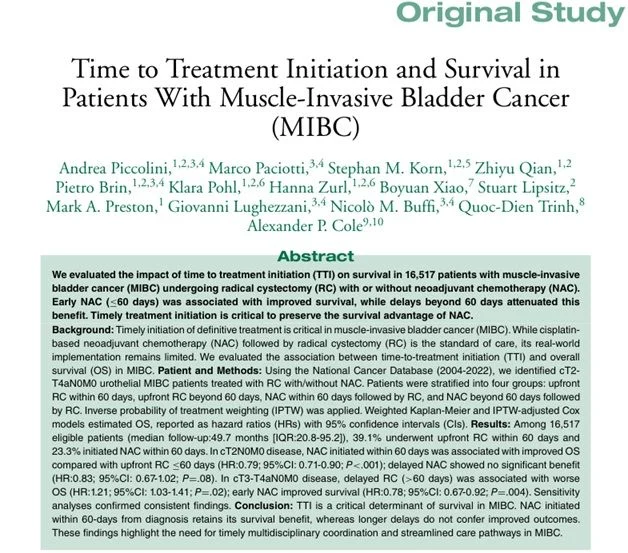
“I’m pleased to share our latest study on time to treatment initiation in muscle-invasive bladder cancer, recently published in Clinical Genitourinary Cancer.
Using a contemporary national cohort of over 16,500 patients, we evaluated how treatment timing impacts overall survival by integrating the entire treatment pathway — from diagnosis to neoadjuvant chemotherapy or upfront radical cystectomy — within a single analytical framework.
Our findings show that the survival benefit of neoadjuvant chemotherapy is preserved when initiated within 60 days of diagnosis, while longer delays attenuate this advantage, underscoring the importance of streamlined multidisciplinary care pathways.
These findings may help inform efforts to optimize muscle-invasive bladder cancer care pathways.”
Xue-Yan Jiang — Urological Cancer Specialist; Medical Educator and Speaker; Healthcare Leadership at NHS and GenesisCare UK | United Kingdom
“Impressive positive phase 2 radiotherapy trial. It reminded me of TRAP, but with overall survival benefit in a different population, with an HR of 0.55.
Both are recent SABR/MDT trials in castration-resistant prostate cancer offering useful insights. But it is important to understand them in context.
ARTO Trial — Italy
• Population: Oligometastatic mCRPC with ≤3 metastases; n=157
• Intervention: SBRT/MDT + abiraterone + ADT versus abiraterone + ADT alone
• Design: Phase 2, randomized, open-label
• Primary endpoint: 6-month PSA response, met
• Long-term finding: Overall survival benefit with MDT
• Median OS: control, 50 months; MDT arm, not reached
• Hazard ratio: 0.55, corresponding to a 45% reduction in the risk of death
• Toxicity: Similar between arms; fewer infections with MDT
• Key message: MDT may extend survival in selected patients with oligometastatic mCRPC
TRAP Trial — United Kingdom, Royal Marsden
• Study question: Can SBRT control oligoprogressive lesions in men with mCRPC on ongoing ARPI therapy and delay further progression?
• Phase 2, prospective, non-randomized, single-arm UK trial
• Men with ≤2 oligoprogressive sites developing while responding to abiraterone or enzalutamide
• n=86 men; SBRT delivered to 81
• SBRT to progressing lesions only: 30 Gy in 5 fractions, or 36 Gy in 6 fractions for prostate only
• Sites treated: bone, 59%; lymph nodes, 32%; prostate, 7%; lung, 1%
• Median follow-up: 22.9 months
• Median PFS: 6.4 months; primary endpoint met
• 39% had PFS >12 months
• Median time to next treatment or death: 27 months
• Median OS: 27.2 months
• No SBRT-related deaths; toxicity acceptable
SBRT provides meaningful disease control in oligoprogressive mCRPC, delays systemic escalation, and maintains ARPI benefit. However, no overall survival advantage was demonstrated.
These trials are often discussed together, but they are not studying the same population.
ARTO focuses on men with limited metastatic burden at the outset of ARPI therapy, whereas TRAP targets those with isolated progression despite ongoing ARPI. The biology, timing, and therapeutic intent differ substantially.
Imaging also matters. Variability in access to and use of PSMA PET versus conventional imaging inevitably shapes who is labelled “oligometastatic” or “oligoprogressive.” This affects trial eligibility, MDT targeting, and ultimately outcomes.
What both studies reinforce is that SABR/MDT is safe, precise, and clinically meaningful when used thoughtfully. ARTO suggests MDT may extend survival in selected patients; TRAP shows MDT can preserve systemic options and maintain disease control.
The challenge now is integrating SABR/MDT into pathways in a way that respects these nuances — matching the right intervention to the right disease state, with the right imaging, at the right moment.
Phase 3 trials await.”

Read more about ARTO Trial on OncoDaily.
Federica Ferrario — Radiation Oncologist at Fondazione IRCCS San Gerardo dei Tintori | Italy
“New editorial out on late genitourinary side effects after prostate SBRT in the PACE-B trial.
This editorial offers an interesting perspective on an important clinical issue: when we see late urinary side effects after prostate SBRT, how much is related to treatment precision, and how much reflects baseline patient vulnerability?
Congrats to Mohamed Shelan for leading this insightful collaboration.
A useful read for anyone interested in SBRT, patient selection, and the interpretation of urinary outcomes in localized prostate cancer.”
Trevor Royce, MD, MPH, FASCO — Chief Medical Officer at Valar Labs | United States
“New publication! One of the thorniest questions in the management of advanced prostate cancer is identifying which patients with metastatic hormone-sensitive prostate cancer (mHSPC) benefit from treatment intensification, such as adding chemotherapy to ADT + ARPI.
A newly published AI-based biomarker derived from routine pathology slides addresses this question. Now in JCO Precision Oncology.
The biomarker independently predicts survival outcomes and identifies patients with mHSPC most likely to benefit from treatment intensification. The biomarker was developed using the Valar Labs Computational Histology Artificial Intelligence (CHAI) platform.
The biomarker was developed in one prospective phase 3 randomized trial, CHAARTED, and validated in a second independent phase 3 randomized trial, ENZAMET; a rigorous design that supports Level IB evidence for biomarker studies.
Excited and energized by what work like this will ultimately mean for precision oncology and our patients.
Congratulations to the collaborators Christopher Sweeney, Ian Davis, Neeraj Agarwal, Phuoc T. Tran, Paul Nguyen, Alicia Morgans, Charles Ryan, Umang Swami, Martin Stockler, and the amazing minds at Valar Labs.”
Read more about CHAI Biomarker in mHSPC on OncoDaily.
Jose L. Vercher Conejero — Nuclear Medicine Specialist, PET/CT, PET/MR and Therapeutics at Hospital Universitari de Bellvitge; Vice-President of ESHIᴹᵀ; Ambassador for The Oncidium Foundation | Spain
“I’m very pleased to share that our article has just been published:
“Practical consensus document on the use of [177Lu]Lu-PSMA-617 in metastatic castration-resistant prostate cancer.”
This consensus document provides practical guidance for the implementation of [177Lu]Lu-PSMA-617 radioligand therapy in patients with metastatic castration-resistant prostate cancer, with a focus on real-world clinical practice, patient selection, multidisciplinary coordination, treatment workflow, safety, follow-up, and toxicity management.
As theranostics continues to expand, harmonizing protocols and sharing practical experience across centers will be essential to ensure safe, effective, and equitable access to these treatments.
The English version of the article is expected to be available very soon.
I’m grateful to all co-authors for the collaborative work behind this document and for the opportunity to contribute to this important area of nuclear medicine and precision oncology.”
Enrique Grande — Medical Oncologist; Director of the Cancer Program at Quirónsalud Madrid | Spain
“Tumor-informed ctDNA monitoring as a real-time prognostic biomarker in locally advanced or metastatic urothelial carcinoma treated with enfortumab vedotin ± pembrolizumab, published in European Urology Oncology.
The study included 110 patients and 545 plasma samples.
On-treatment ctDNA positivity was consistently associated with inferior PFS and OS across all time intervals.
Early ctDNA clearance was enriched among radiographic responders.”
Read more about ctDNA Monitoring During EV ± Pembrolizumab in Advanced Urothelial Carcinoma on OncoDaily.
Brian Rini — Professor of Medicine at Vanderbilt University Medical Center | United States
“Ben Garmezy and I discuss and debate the emerging role of VEGF/PD1 bispecifics in the RCC drug development landscape.
Mehmet Sarımahmut — Associate Professor at Bursa Uludag University | Turkey
“I am pleased to share that our article has been published in the Journal of Clinical Medicine.
In this work, we explored promoter methylation and somatic mutations in cancer-related genes associated with hyperprogressive disease in patients with malignant melanoma and renal cell carcinoma receiving anti-PD-1/PD-L1 immunotherapy.
Grateful to my co-authors Adem Deligönül, Ahmet Bilgehan Sahin, Elif Ertürk, Engin Atlı, Hazal Sezginer Güler, Erdem Çubukçu, Hülya Öztürk Nazlıoğlu, Şaduman Balaban Adım, Türkkan Evrensel, and Ferda Arı for their valuable contributions.”
Pietro Scilipoti — Urology Resident at IRCCS San Raffaele Hospital | Italy
“Check out our latest study on endoscopic kidney-sparing surgery for upper tract urothelial carcinoma, just published in European Urology Oncology.
This work reflects the outstanding effort of the team at Tenon Hôpital, a leading referral center for endourological kidney-sparing surgery, carried out during my fellowship with Prof. Olivier Traxer.
We analyzed one of the largest and longest single-center cohorts on this topic — 254 patients treated over a period spanning 30 years, with a median follow-up of 67 months.
Key findings:
• Recurrence was common, 55% at 7 years, but rarely lethal on its own — only 22% of patients ultimately needed radical nephroureterectomy
• High-risk disease according to EAU criteria was not linked to more recurrences, but was independently associated with higher radical nephroureterectomy conversion, metastatic progression, and cancer-specific mortality
• Renal function was well preserved, with a median eGFR decline of just 9 ml/min/1.73 m², and only 15% progressing to CKD ≥IIIB at 5 years
• High-risk patients with only “weak” risk factors behaved like low-risk patients, suggesting that risk stratification is not binary and that more refined, dynamic risk models are needed
Why this matters: endoscopic kidney-sparing surgery remains a safe, kidney-sparing option even for many EAU-defined high-risk patients, provided it is performed in expert centers with rigorous, long-term endoscopic surveillance.
Recurrence alone should not be the metric that scares patients away from a nephron-sparing approach; what matters is timely escalation when needed.”

Find out 10 Must-Read Posts in GU Oncology from the first week of July on OncoDaily.