
The last few days of June and the first week of July, from June 29 to July 5, brought important updates across GU oncology, with expert posts covering kidney, prostate, bladder, penile, and urinary tract tumours.
This week’s selection highlights LITESPARK-022 in high-risk clear-cell renal cell carcinoma, the CISTO study in recurrent high-grade non-muscle-invasive bladder cancer, DUTRENEO in muscle-invasive bladder cancer, PROTEUS and ARTO in prostate cancer, focal boosting in prostate radiotherapy, PSMA PET/CT staging, postoperative venous thromboembolism after penile cancer surgery, the WCT EVI MAP project, and new diagnostic and therapeutic perspectives in bladder cancer.
Together, these posts show how GU oncology continues to move toward more precise patient selection, stronger integration of systemic and local therapies, and better evidence mapping to guide future research and clinical care.
Jad Chahoud, MD, MPH-MHA — Chief Scientific and Innovation Officer, Orlando Health Cancer Institute | United States
“Proud to see the phase 3 LITESPARK-022 trial published in the The New England Journal of Medicine NEJM Group
Even more meaningful is knowing that my 24 patients had access to this combination through our clinical trials program many years before it became a new standard of care!!
This study showed that adjuvant Pembrolizumab + Belzutifan significantly improved disease-free survival after nephrectomy for patients with high-risk clear-cell renal cell carcinoma:
28% reduction in the risk of recurrence or death (HR 0.72)
24-month disease-free survival: 80.7% vs. 73.7%The FDA approval last month is another reminder of why clinical trials matter.
Tomorrow’s treatments are available today through clinical trials Orlando Health
Grateful to our patients and families who place their trust in research, our outstanding clinical research teams, and all of the investigators worldwide who made this advance possible.”
Read more about LITESPARK-022 on OncoDaily.
Roberto Contieri — Urologist at IRCCS Istituto Nazionale Tumori | Italy
“Pleased to share our Words of Wisdom comment in European Urology on the 12-month results of the CISTO study.
CISTO provides an important and somewhat counterintuitive message for recurrent high-grade non-muscle-invasive bladder cancer: bladder preservation should not be assumed to automatically translate into better patient-reported outcomes.
At the same time, these observational data should not be overinterpreted as evidence that radical cystectomy is superior to bladder-sparing therapy.
The real challenge is not to choose sides, but to identify which strategy serves each patient best, and when continued bladder-sparing therapy no longer provides meaningful benefit.
Preserving the bladder does not necessarily mean preserving function or quality of life.
Many thanks to Toine van der Heijden and Laura Mertens for the collaboration.”
Thomas Willigenburg — Resident (AIOS) Radiation Oncology; MD, PhD; Clinical Epidemiologist; UMC Utrecht | Netherlands
“Focal boosting in prostate cancer radiotherapy is hot!
Our new paper, “How to focal boost in prostate cancer radiotherapy: ESTRO clinical practice consensus recommendations,” is out now in Radiotherapy and Oncology.
Focal boosting in prostate cancer has already shown promising outcomes, resulting in improved oncological outcomes while preserving the low side effect rates of radiotherapy treatments.
Together with a group of international prostate cancer radiotherapy experts, we aimed to provide a set of clinical and technical recommendations to support the integration of focal boosting in prostate cancer into current-day clinical practice.
The recommendations cover the following topics:
• Patient selection for focal boosting
• Definition and delineation of the Gross Tumour Volume (GTV) for focal boosting
• Planning and treatment techniques to deliver a focal boost
• Image guidance and motion management during focal boosting”
Michael Hofman — Director, Prostate Cancer Theranostics and Imaging Centre of Excellence (ProSTIC); Head of PET/CT at Peter MacCallum Cancer Centre | Australia
“I remember when PSMA PET was not recommended — what do we do with all the findings that standard CT, MRI, or bone scan could not see?
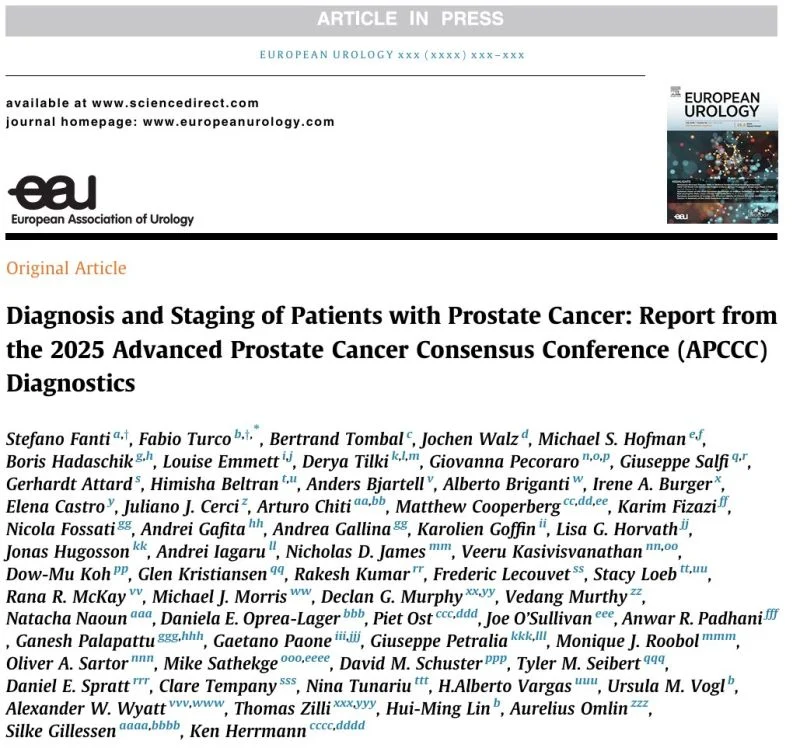
Now, 95% of the international panel agreed that PSMA PET/CT should be the staging tool in high-risk prostate cancer, representing strong consensus, and 85% would not substitute whole-body MRI for it.
From investigational to strong consensus: ProPSMA
The flip side is just as important. Zero of 18 questions on monitoring metastatic disease reached consensus. More evidence is needed.
Advanced Prostate Cancer Consensus Conference Diagnostics 2025 is out in European Urology.”
Enrique Grande — Medical Oncologist; One Oncology Madrid Program Director at Quirónsalud | Spain
“Some studies answer the question we ask. Others teach us to ask better questions.
Muscle-invasive bladder cancer is evolving at an extraordinary pace. New perioperative treatment strategies are rapidly changing our daily practice, but one of our greatest challenges remains exactly the same: identifying which patient will benefit from which treatment.
Today, I am very pleased to share the publication of the DUTRENEO study in Cell Reports Medicine.
DUTRENEO was, to our knowledge, one of the first prospective randomized trials designed to test whether a previously validated immune gene signature could guide treatment selection for patients with muscle-invasive bladder cancer. The study did not confirm the clinical utility of that biomarker, but sometimes that is precisely how science moves forward.
Rather than stopping there, we asked why.
By combining the clinical trial with one of the largest spatial transcriptomics analyses performed in bladder cancer, we found that the answer may not simply lie in which immune cells are present, but where they are located and how they interact within the tumor microenvironment. These findings may help pave the way toward a new generation of spatial biomarkers that could eventually improve patient selection for immunotherapy.
This work would never have been possible without an exceptional multidisciplinary team of clinicians, pathologists, molecular biologists, computational scientists and translational researchers. I feel incredibly fortunate to have worked alongside colleagues who continuously challenged ideas, improved the science and shared the same commitment to our patients.
The journey toward precision medicine in bladder cancer is far from over. But every carefully conducted study—even those that challenge our initial hypotheses—brings us one step closer.”

Read more about DUTRENEO Study on OncoDaily.
Aishwarya Kaur — Surgical Oncologist, Pelvic Oncology; The Christie NHS Foundation Trust | India
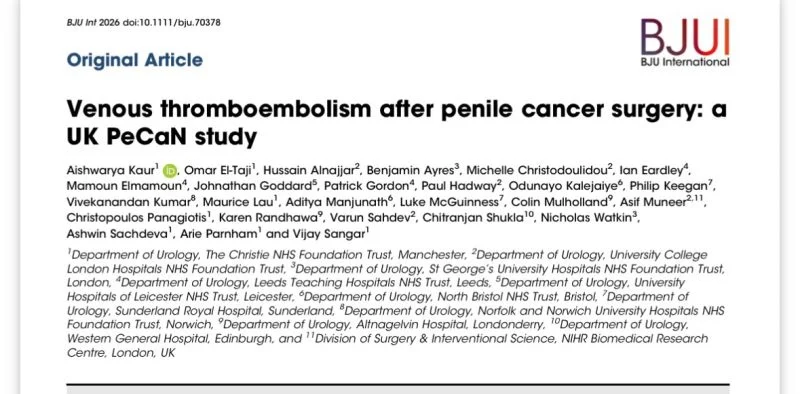
“Very pleased to share this original article in BJU International:
“Venous thromboembolism after penile cancer surgery: a UK PeCaN study.”Thankful to all collaborators across the UK PeCaN network for their contribution to this first of its kind study to analyse 9 year healthcare data on postoperative VTE incidence after penile cancer surgery and compare with institutional practice protocols.”
Chiara Mercinelli — Medical Oncologist, Genito-Urinary Medical Oncology, PhD Candidate in Molecular Medicine, San Raffaele Hospital, Milan | Italy
“PROTEUStrial: landmark Phase 3 RCT, first to demonstrate both pathological response and survival benefit with neoadjuvant therapy in prostate cancer.
But are we really facing a revolution?
We tried to answer in our Editorial, out now on European Urology Oncology
Honoured to have worked alongside an exceptional European team within European Association of Urology Oncology Section on Prostate Cancer Working Group”

Read more about PROTEUS Trial on OncoDaily.
Felipe Couñago, MD, PhD — Medical Director at GenesisCare Spain; Radiation Oncologist; Clinical Researcher; Professor | Spain
“Congratulations to Giulio Francolini and all the ARTO co-authors on this outstanding publication in The Lancet Oncology
The long-term results of the randomized ARTO trial mark an important milestone in the management of oligometastatic castration-resistant prostate cancer (omCRPC).
Adding SBRT to abiraterone + ADT significantly improved:
Overall Survival (HR 0.55; p=0.021)
Radiological Progression-Free Survival (44 vs 17 months)This is the first randomized study to demonstrate an overall survival benefit with metastasis-directed radiotherapy in this disease setting, further strengthening the role of SBRT within multidisciplinary prostate cancer care.
Congratulations again to Giulio Francolini and all the ARTO co-authors for this landmark contribution, which will undoubtedly influence future clinical practice and stimulate the development of phase III trials.”
Karolina Worf — Bioinformatician, Data Scientist and Online Content Manager | Germany
“It’s finally here: our first evidence gap map from the WCT EVI MAP project has been published and is available to everyone as an open-access paper in Open Research Europe.
The publication maps the evidence base of kidney, prostate and urinary tract tumours to inform the WHO Classification of Tumours (WCT), the standard reference used by pathologists and clinicians worldwide for cancer diagnosis.
To create it, we reviewed nearly 66,000 studies and included just over 4,000 of them, which we organised into a single visual map covering 30 tumour types. The aim is simple: to show at a glance where the evidence is robust and where it is scarce or missing.
The picture is uneven. Common tumour types, such as clear cell renal cell carcinoma, are underpinned by a fairly solid research base, while rarer and newly defined tumours are based on only a handful of studies. Only about a third of the map is supported by solid evidence, and research into whether a treatment is likely to be effective is almost entirely absent.
One finding in particular caught our attention: much of the research is virtually invisible, not because it does not exist, but because the abstracts of the scientific articles often do not use the WHO’s standard tumour names, meaning the studies cannot be found and included on the map. Better reporting alone would close some of these gaps.
Why it matters: this map will be incorporated directly into the next edition of the WCT and will help to direct research towards the gaps that most urgently need to be filled, as this is ultimately what leads to a more accurate diagnosis for patients.
A big thank you to the entire WCT EVI MAP team and our coordinators at the IARC – International Agency for Research on Cancer / World Health Organization. It took a while to reach this stage, so it feels great to finally be able to present the results and share them with everyone.”
Alireza Ghoreifi, MD — Society of Urologic Oncology Fellow at Duke University | United States
“Excited to share a recent publication featured in our special issue, “Novel Diagnostic and Therapeutic Prospects in Bladder Cancer,” which I am co-editing with my esteemed colleague, Mazyar Zahir, for Therapeutic Advances in Urology (Sage Journals).

Find out 10 Must-Read Posts in GU Oncology from the forth week of June on OncoDaily.