GU Oncology is represented in the WHO 2026 Global Cancer Report through three main themes: the global burden of prostate cancer, the preventable risk profile of bladder cancer, and the obesity- and detection-related challenges of kidney cancer. The report does not present GU cancers as one combined category; instead, it highlights how different GU malignancies expose different weaknesses across the cancer-control continuum.
In 2024, there were 20.6 million new cancer cases worldwide, including non-melanoma skin cancers, and an estimated 9.7 million cancer deaths. By 2050, annual new cancer diagnoses are projected to reach 35 million. For GU oncology, the report’s message is not only about disease burden. Prostate cancer shows the challenge of screening, overdiagnosis, risk stratification, and unequal survival. Bladder cancer reinforces the importance of tobacco control and timely diagnosis. Kidney cancer brings obesity, physical inactivity, incidental detection, and access to modern treatment into focus.
Together, prostate, bladder, and kidney cancers show that progress in GU oncology depends on more than therapeutic innovation. It requires risk-adapted screening, timely diagnostic pathways, high-quality pathology, access to surgery, radiotherapy and systemic therapy, active surveillance where appropriate, and stronger financial protection for patients.
Bladder Cancer
Bladder cancer appears in the report as a preventable GU cancer shaped strongly by tobacco exposure. It does not receive the same detailed disease-specific global burden section as prostate cancer, but it is explicitly included in the report’s discussion of declining premature cancer mortality, where tobacco control is identified as a driver of progress for lung, head and neck, and bladder cancers.
This makes bladder cancer part of one of the clearest prevention stories in the report. Tobacco control is not only a lung cancer intervention; it is also GU cancer control. For oncology systems, that means smoking prevention and cessation should remain part of bladder cancer strategy, not a separate public health discussion.
Prevention Beyond The Lung Cancer Story
The prevention message is broader than tobacco alone. Physical inactivity is described as a worsening global trend, with 31.3% of adults insufficiently active in 2022 and 80% of adolescents insufficiently active. Bladder cancer is included among the cancers for which physical activity is linked to reduced incidence, and in some settings, reduced recurrence.
That matters clinically because bladder cancer prevention is often reduced to smoking. The WHO report places physical activity in the same prevention conversation, making lifestyle intervention relevant across the bladder cancer continuum, even though the report does not provide bladder-specific intervention outcomes.
No Population Screening Signal, But Diagnosis Still Matters
The report does not describe a population-based screening programme for bladder cancer. It also does not place bladder cancer in the same screening-benefit discussion as prostate cancer or colorectal cancer.
For bladder cancer, the practical issue is timely diagnosis. Symptom recognition, referral, cystoscopy, pathology, staging, and access to definitive treatment remain the key pathway. The report’s broader diagnostic warning applies directly here: nearly 47% of the world’s population has little to no access to basic diagnostic services, including pathology and diagnostic imaging. In bladder cancer, delayed diagnostic access can mean later-stage presentation and fewer curative options.
Treatment Access Defines The Modern Urothelial Cancer Gap
The treatment section does not provide bladder-cancer-specific outcomes, but the access data are highly relevant. Availability of priority cancer medicines ranged from only 9–54% in low-income and lower-middle-income countries, compared with 68–94% in high-income countries. Fewer than half of LMICs sufficiently reimburse some WHO Essential Medicines List cancer medicines, including nivolumab, illustrating how modern systemic therapy access remains income-dependent.
Compounding this, only 28% of countries include a minimum cancer management package in their UHC benefit packages — meaning the majority of the world’s population still lacks access to even basic cancer care, let alone the full bladder cancer treatment pathway.
Kidney Cancer
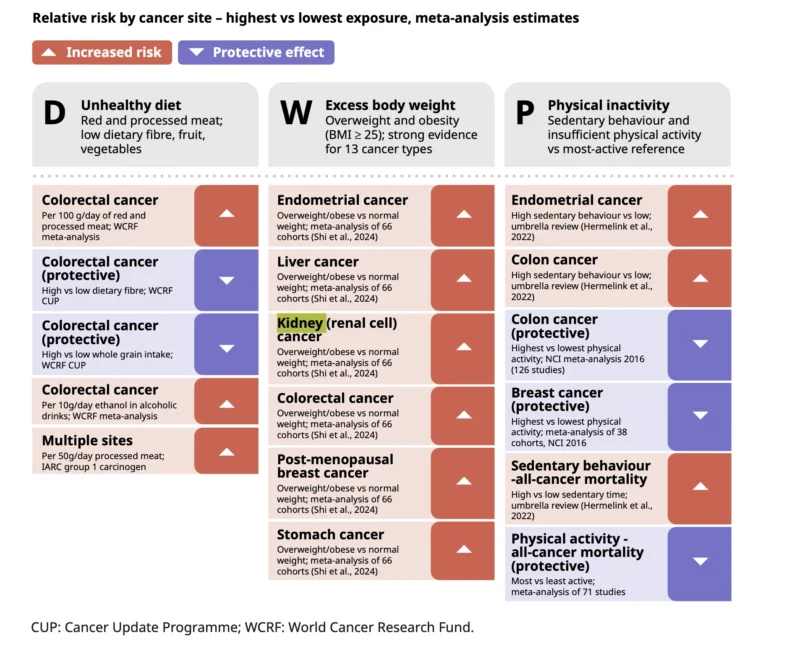
Kidney cancer is one of the clearest GU examples of obesity-linked cancer risk in the report. Renal cell cancer appears in the obesity-risk figure, and excess body fat is causally linked to at least 13 cancer types. The report states that excess body weight is implicated in 19% of kidney cancer deaths globally.
This changes the framing of kidney cancer. It is not only a disease of surgery, imaging, systemic therapy, and surveillance. It is also part of the obesity-driven cancer burden, making weight control a legitimate cancer prevention priority.
Physical Activity And Weight Control Matter For Future Risk
he strongest kidney cancer prevention signal is excess body fat. In 2022, approximately 2.5 billion adults, or 43%, were living with overweight, including about 890 million adults with obesity. Excess body fat is causally linked to at least 13 cancer types, and the report states that it is implicated in 19% of kidney cancer deaths globally.
The obesity trend is moving in the wrong direction. Adult obesity has more than doubled since 1990, while obesity among children and adolescents has roughly quadrupled. For kidney cancer, this is not a distant population-health issue; it is part of the future case mix that urologists, medical oncologists, surgeons, and health systems will face. The projected 66.7% rise in global cancer incidence by 2050, driven substantially by population ageing and rising obesity prevalence, means renal cell carcinoma volumes will grow in settings that are already ill-equipped to manage them.
Physical inactivity adds another modifiable risk layer. The report describes physical inactivity as worsening globally, with nearly one-third of adults not meeting activity recommendations. Kidney cancer is included among cancers for which physical activity is associated with reduced incidence and, in some settings, reduced recurrence.
Incidental Detection Raises The Overdiagnosis Question
Kidney cancer appears in one of the report’s most important screening cautions. In the table on risks associated with cancer screening programmes, kidney cancer is linked to incidental detection on abdominal CT, with overdiagnosis identified as a potential harm. The report’s broader message is clear: earlier detection can help only when the system can distinguish clinically meaningful disease from indolent findings and avoid unnecessary treatment.
No population-based kidney cancer screening programme is recommended or discussed. For kidney cancer, the overdiagnosis issue is not PSA-like population testing, but incidental radiologic detection. This distinction matters because the clinical pathway after incidental detection can vary widely depending on access to expert radiology, urologic oncology, surveillance protocols, nephron-sparing surgery, ablation, and systemic therapy.
Innovation Is Moving Faster Than Access
The report does not provide kidney-cancer-specific treatment outcomes. Still, its general treatment-access data are highly relevant to renal cell carcinoma, where modern care often depends on surgery, targeted therapy, immunotherapy, imaging, and long-term surveillance. High-income countries are far more likely than low- and lower-middle-income countries to include oncology medicines in health benefit packages, and the availability of priority cancer medicines remains much higher in high-income settings.
This creates a practical paradox. Kidney cancer is increasingly shaped by advanced diagnostics and systemic therapy innovation, but the report’s access data show that many countries still struggle to deliver even essential cancer medicines. The result is a widening gap between what is possible and what is available.
Prostate Cancer: The Dominant GU Burden In Men
Prostate cancer is the dominant GU cancer in the WHO report. In 2024, it was the second most common cancer in men worldwide after lung cancer, with 1,546,112 new cases, representing 15.6% of male cancer diagnoses. It ranked ahead of colorectal, stomach, and liver cancer in the male incidence profile.
Mortality tells a different story. Prostate cancer caused 419,849 deaths in 2024, accounting for 7.7% of male cancer deaths. It was not the leading cause of male cancer mortality, but the absolute number of deaths remains large enough to make prostate cancer one of the most important global oncology challenges.
A Survival Gap That Mirrors Health-System Strength
The prostate cancer survival gap is one of the clearest GU equity findings in the report. In CONCORD survival trends for 2010–2014, five-year net survival was approximately 90% in high-income countries, 80% in upper-middle-income countries, and 59% in lower-middle-income countries.
That gap is not explained by biology alone. It reflects differences in early diagnosis, PSA use, access to pathology, radiotherapy, surgery, hormonal therapy, systemic therapy, and survivorship care. The report’s broader point is that cancer outcomes increasingly depend on where a patient lives and whether the health system can deliver the full pathway.
The early-diagnosis section adds another prostate-specific warning. Delayed evaluation of cancer-related symptoms can lead to emergency presentation and higher excess mortality, with ratios in one setting ranging from 4.0 for lung cancer to 20.8 for prostate cancer. For clinicians, this reinforces that prostate cancer control cannot be reduced to PSA policy alone; the route to diagnosis also matters.
PSA Screening: Benefit, Harm And Risk Stratification
The prostate screening data are deliberately balanced. Screening for prostate cancer has demonstrated mortality reduction when delivered through quality-assured, organized, population-based programmes in high-income countries. At the same time, the report places prostate cancer in the screening-harm table, with PSA testing associated with overdiagnosis and potential overtreatment.
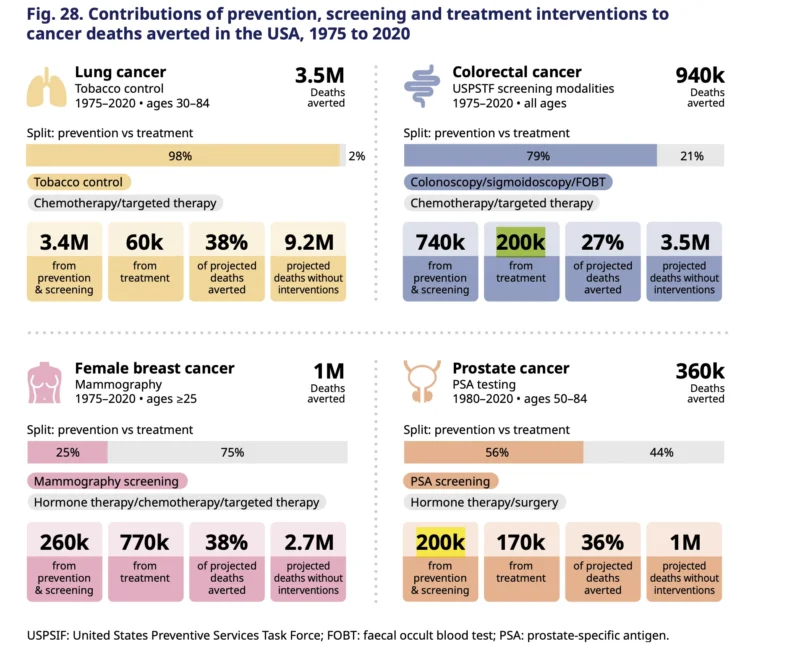
The US modelling figure gives the scale of benefit. Between 1980 and 2020, among men aged 50–84 years, PSA testing and treatment were associated with 360,000 prostate cancer deaths averted. The figure attributes 200,000 deaths averted to prevention and screening and 170,000 to treatment, corresponding to 36% of projected deaths averted.
The tension is familiar to every GU oncologist. PSA can reduce mortality when embedded in a high-quality pathway, but unstructured testing can expose men to diagnosis and treatment they may never have needed. The report’s discussion of active surveillance for indolent prostate cancers fits directly into this problem: prostate cancer is already a model for managing some early cancers by risk rather than reflexively treating every diagnosis.
Active Surveillance, AI Pathology And The Value Question
The report uses prostate cancer as an example of how cancer control is changing from “detect and treat” toward “detect, stratify, and manage according to risk.” Active surveillance for indolent prostate cancers is already part of current practice, and the report raises the question of whether similar models could extend to other cancer types as early detection technologies improve.
Prostate cancer also has one of the clearest AI examples in the report. Deep learning models applied to prostate digital pathology achieved an AUC up to approximately 0.99 for cancer detection and classification, including Gleason scoring and histologic grading. In prostate cancer, this is not just a technical improvement. Grading directly determines whether a patient enters surveillance, surgery, radiotherapy, systemic treatment, or closer follow-up.
Treatment Access Remains The Global Divider
The treatment section places hormonal therapy within systemic therapy for hormone-driven cancers such as breast and prostate cancer. Yet access depends heavily on financing and national policy alignment. Across countries with available data, the median national essential medicines list included 28 of 50 antineoplastic medicines from the WHO Model List of Essential Medicines, and high-income countries were nearly four times more likely to cover all essential oncology medicines in health benefit packages than low- and lower-middle-income countries.
For prostate cancer, this affects the entire pathway. A patient may be diagnosed, staged, and risk-stratified, but without access to radiotherapy, surgery, ADT, or newer systemic therapy, the system still fails to convert diagnosis into survival benefit.
Penile Cancer And Other Rare GU Malignancies
Penile cancer appears only briefly in the report. It is not given a dedicated incidence section, survival estimate, screening section, risk-factor discussion, or treatment-access analysis. The report’s limited treatment of penile cancer is itself informative: rare GU tumours remain underrepresented in global cancer monitoring.
For testicular cancer, upper tract urothelial cancers, urethral cancer, and adrenal malignancies, the report does not provide dedicated disease-specific data in the extracted GU-relevant sections. These cancers should therefore not be expanded beyond what the report supports. Their absence points to a broader surveillance gap for rare urological malignancies in global cancer reporting — and given that 90% of trials are HIC-based, the evidence gap for these rarer tumours in LMIC populations is likely even wider.
The Registry Gap Is Part Of The Message
The absence of detailed data for rare GU tumours is itself important. It shows where global cancer monitoring remains thin and where population-based cancer registries still need strengthening. For rare urological cancers, better registry coverage is not academic. It is the foundation for understanding burden, regional variation, access gaps, and survival outcomes.
What This Means For The GU Oncologist
Grouped by cancer type, the GU message becomes clearer. Bladder cancer control is inseparable from tobacco prevention, physical activity, symptom recognition, diagnostic capacity, and treatment access. Kidney cancer brings obesity prevention and overdiagnosis into the same discussion, because rising risk and incidental detection are moving together. Prostate cancer remains the dominant GU burden, but its outcome gap is an equity problem: PSA screening, active surveillance, AI-supported pathology, radiotherapy, surgery, and systemic therapy only improve survival when the full pathway is available. For rare GU malignancies, the lack of detailed data should push stronger registry development and more deliberate global monitoring.
Takeaway
The WHO 2026 Global Cancer Report places GU cancers within a broader implementation challenge.
Progress depends not only on scientific advances, but on whether health systems can apply existing evidence consistently: prevention where risk is modifiable, early diagnosis where symptoms emerge, screening where benefit outweighs harm, and treatment where access remains unequal.
The central message is clear: GU cancer outcomes will be shaped by delivery. Better registries, stronger prevention policies, risk-adapted detection, and equitable access to essential cancer care are now as important as innovation itself.
The full report is available on the official WHO website.
Find more similar articles on OncoDaily.