At ASCO 2026, Thomas Powles, MD, PhD, from Barts Cancer Centre, Queen Mary University of London, presented updated findings from the phase 3 EV-302/KEYNOTE-A39 trial evaluating enfortumab vedotin plus pembrolizumab in patients with previously untreated locally advanced or metastatic urothelial carcinoma.
With a median follow-up now reaching 3.5 years, the trial continues to show durable clinical benefit with the combination compared with platinum-based chemotherapy. The updated analysis also looked more closely at patients who achieved a complete response, including those who initially had a partial response and later converted with continued treatment.
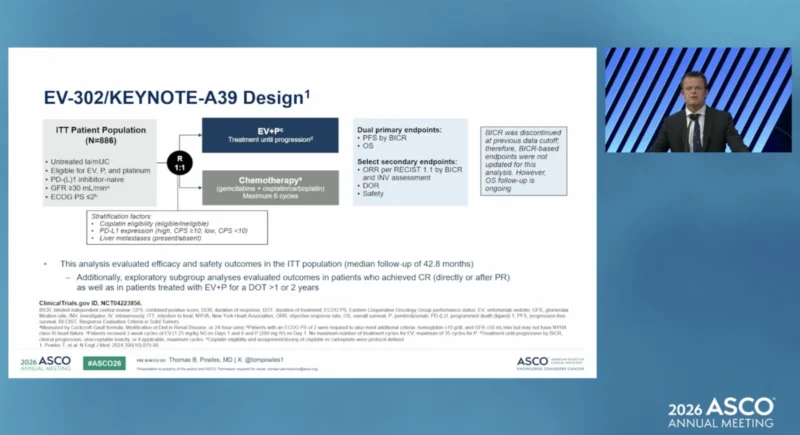
EV-302 Trial Design and Treatment Approach
Patients with previously untreated locally advanced or metastatic urothelial carcinoma were randomized 1:1 to receive enfortumab vedotin plus pembrolizumab or gemcitabine with cisplatin or carboplatin. Enfortumab vedotin was given on days 1 and 8 of each 3-week cycle, while pembrolizumab was given on day 1. Treatment continued until disease progression, toxicity, or completion of the maximum number of cycles. The dual primary endpoints were progression-free survival by blinded independent central review and overall survival. The secondary endpoints were ORR per RECIST 1.1 by BICR and INV assessment, DOR and safety.
Results of EV-302 at 3.5 Years
At a median follow-up of 42.8 months, the overall survival benefit with enfortumab vedotin plus pembrolizumab remained consistent. Median overall survival was 33.6 months with the combination compared with 15.9 months with chemotherapy. The 42-month overall survival rate was 44.0% with enfortumab vedotin plus pembrolizumab versus 24.6% with chemotherapy, with a hazard ratio of 0.53. The objective response rate was 67.5% with enfortumab vedotin plus pembrolizumab compared with 44.2% with chemotherapy. The complete response rate was 30.4% versus 14.5%, approximately twice as high with the combination.
Complete Responses Continued to Deepen Over Time
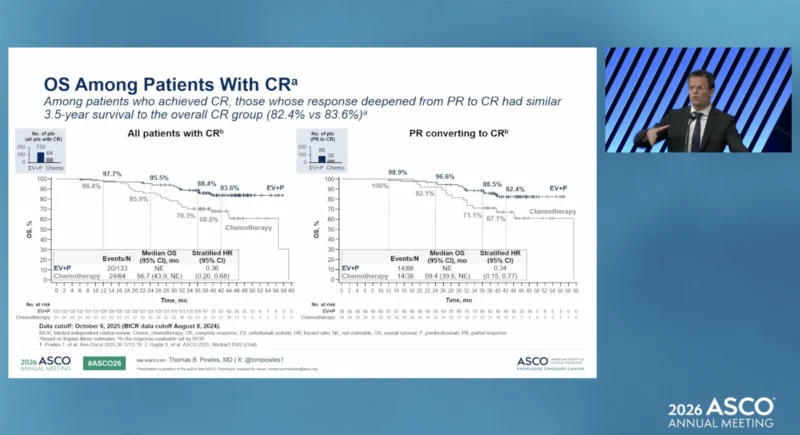
One of the notable findings from the updated analysis was that many complete responses developed gradually over the course of treatment. Among patients with confirmed complete response in the enfortumab vedotin plus pembrolizumab arm, 66.2% first achieved a partial response and then later converted to complete response.
Median overall survival was not estimable both in the overall complete response group and in the subgroup that converted from partial response. The 42-month overall survival rate was 83.6% among all patients with complete response and 82.4% among those who converted from partial response.
Median time to complete response was 4.3 months overall. For patients who converted from partial response, median time to complete response was 6.6 months, including 2.1 months to partial response. Longer treatment duration did not lead to new safety concerns.
Subsequent Treatment Patterns
After enfortumab vedotin plus pembrolizumab, the most common first subsequent treatment was platinum-based chemotherapy, used in 30.5% of patients. In the chemotherapy arm, the most common subsequent treatment was a PD-L1 inhibitor, received by 59.7% of patients. Among evaluable patients who received platinum chemotherapy after enfortumab vedotin plus pembrolizumab, investigator-assessed responses were reported in 20.7%, with a median overall survival of 10.9 months from the start of platinum-based chemotherapy.
Previous Results of EV-302 From ASCO 2025
Previous results from EV-302/KEYNOTE-A39 were presented at ASCO 2025 by Dr. Shilpa Gupta from Cleveland Clinic Taussig Cancer Institute. The exploratory analysis focused on patients with locally advanced or metastatic urothelial carcinoma who achieved a confirmed complete response. In this analysis, enfortumab vedotin plus pembrolizumab showed a confirmed complete response rate of 30.4%, compared with 14.5% with chemotherapy.
Among patients with a confirmed complete response, median progression-free survival was not reached with enfortumab vedotin plus pembrolizumab, compared with 26.9 months with chemotherapy. At 24 months, the sustained confirmed complete response rate was 74.3% versus 43.2%, respectively.
The safety profile was consistent with prior findings. Grade 3 or higher treatment-related adverse events occurred in 61.7% of patients receiving enfortumab vedotin plus pembrolizumab and 71.9% receiving chemotherapy, with no treatment-related deaths reported in this subgroup.
Read more about EV-302 Updates at ASCO 2025 on OncoDaily.
Key Takeaways
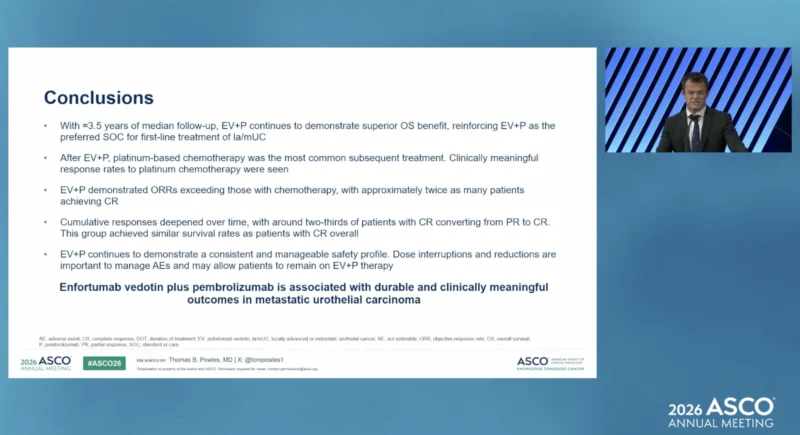
The updated EV-302 analysis presented at ASCO 2026 provides the longest phase 3 follow-up reported so far for enfortumab vedotin plus pembrolizumab in locally advanced or metastatic urothelial carcinoma. After 3.5 years, EV+P continues to demonstrate superior overall survival benefit, reinforcing its role as the preferred standard of care for first-line treatment of locally advanced or metastatic urothelial carcinoma.
Cumulative responses deepened over time, with around two-thirds of patients with complete response converting from partial response, achieving similar survival rates to the overall complete response group. EV+P also demonstrated approximately twice the complete response rate compared with chemotherapy.
After EV+P, platinum-based chemotherapy was the most common subsequent treatment, with clinically meaningful response rates observed. EV+P continues to demonstrate a consistent and manageable safety profile, with dose interruptions and reductions playing an important role in managing adverse events and allowing patients to remain on therapy.
The full abstract is available on the official ASCO website.
Find more videos on OncoDaily Youtube TV.