At the ESMO Congress 2026, Ruixing Zhang (Shijiazhuang, China) presented updated results from the Phase III KC-WISE trial (NCT05427383), evaluating anbenitamab plus chemotherapy versus placebo plus chemotherapy in patients with HER2-positive gastric or gastroesophageal junction carcinoma (GC/GEJC) who had progressed on previous trastuzumab-containing therapy.
The second interim overall survival (OS) analysis, presented as Late-Breaking Abstract LBA80, reported updated survival outcomes alongside progression-free survival (PFS), tumour response, and safety findings.
Why Was KC-WISE Conducted?
At the first interim PFS analysis of KC-WISE, anbenitamab plus chemotherapy significantly prolonged independent review committee-assessed PFS compared with chemotherapy alone (7.1 vs 2.7 months; HR 0.25; 95% CI 0.17–0.39; p<0.0001). Overall survival data were immature at that time, with median OS of 19.6 versus 11.5 months (HR 0.29; 95% CI 0.17–0.50). The updated analysis evaluated OS with longer follow-up, alongside updated efficacy and safety outcomes.
KC-WISE Study Design and Methods
KC-WISE was a multicentre, randomized, double-blind Phase III trial conducted at 51 sites in China (NCT05427383). Eligible patients had centrally confirmed HER2-positive gastric or gastroesophageal junction carcinoma, disease progression on previous trastuzumab-containing therapy, and ECOG performance status 0–1.
Patients were randomized 1:1 to receive anbenitamab 30 mg/kg every three weeks plus chemotherapy or placebo plus chemotherapy. Stratification factors included chemotherapy type (paclitaxel/docetaxel or irinotecan), HER2 expression, and the number of previous treatment lines.
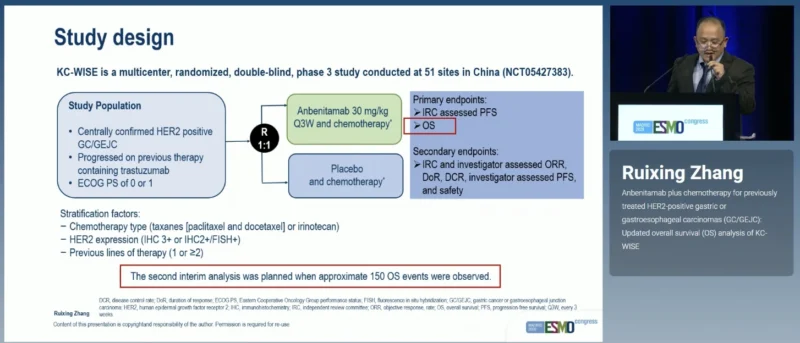
The co-primary endpoints were independent review committee (IRC)-assessed progression-free survival (PFS) and overall survival (OS). Secondary endpoints included objective response rate (ORR), duration of response (DoR), disease control rate (DCR), investigator-assessed PFS, and safety. The second interim OS analysis was planned after approximately 150 OS events. The data cutoff was July 15, 2026.
Key Findings from KC-WISE
A total of 246 patients were randomized to the anbenitamab group (n=125) or control group (n=121). Median follow-up was 22.8 months in the anbenitamab group and 22.3 months in the control group.
Updated Overall Survival
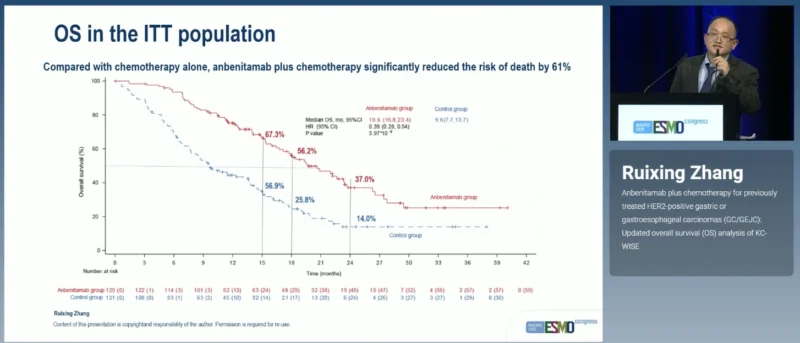
At the data cutoff, 157 deaths had occurred, including 66 patients (52.8%) in the anbenitamab group and 91 patients (75.2%) in the control group. Median OS was 19.6 months with anbenitamab compared with 9.6 months in the control group, representing a statistically significant survival improvement (HR 0.39; 95% CI 0.28–0.54; p<0.0001). OS hazard ratios generally favoured anbenitamab across the reported subgroups, although confidence intervals crossed 1 in some smaller subgroups.
Progression-Free Survival
At the July 15, 2026 data cutoff, median PFS by independent review committee was 7.1 months (95% CI 5.4–9.0) with anbenitamab plus chemotherapy versus 2.7 months (95% CI 1.5–3.0) in the control group. Investigator-assessed median PFS was 8.8 months (95% CI 6.9–10.3) versus 2.8 months (95% CI 2.5–3.0), respectively.
Safety Outcomes
In the safety population (anbenitamab, n=124; control, n=121), grade 3 or higher treatment-emergent adverse events (TEAEs) occurred in 74.2% versus 54.5% of patients. The most frequently reported grade 3 or higher TEAEs included neutropenia (33.1% vs 24.8%), leukopenia (27.4% vs 25.6%), and anemia (25.8% vs 14.0%).
Serious adverse events occurred in 44.4% versus 31.4% of patients, while TEAEs leading to treatment discontinuation occurred in 16.9% versus 5.0%, respectively. TEAEs leading to death were reported in two patients (1.6%) in the anbenitamab group and eight (6.6%) in the control group.
Conclusions
The second interim OS analysis of the Phase III KC-WISE trial demonstrated a statistically significant improvement in overall survival with anbenitamab plus chemotherapy compared with placebo plus chemotherapy in patients with HER2-positive gastric or gastroesophageal junction carcinoma who had progressed following trastuzumab-containing treatment.
Median OS was 19.6 versus 9.6 months (HR 0.39; 95% CI 0.28–0.54; p<0.0001). Updated efficacy results also showed longer IRC-assessed median PFS (7.1 vs 2.7 months) and a higher objective response rate (56.0% vs 14.0%) with anbenitamab plus chemotherapy. Grade 3 or higher treatment-emergent adverse events were more frequent with anbenitamab plus chemotherapy (74.2% vs 54.5%).
These findings demonstrate improved overall survival with anbenitamab plus chemotherapy in this previously treated HER2-positive GC/GEJ population, accompanied by a higher incidence of grade 3 or higher TEAEs.
Source: ESMO Congress 2026 – LBA80, KC-WISE
You can also read about FORTITUDE-101 and FORTITUDE-102 at ESMO 2026 on OncoDaily.