At the ESMO Congress 2026, Zev A. Wainberg (Los Angeles, USA) presented an exploratory biomarker analysis from the Phase III FORTITUDE-101 (NCT05052801) and FORTITUDE-102 (NCT05111626) trials, evaluating the association between FGFR2 amplification and bemarituzumab efficacy in patients with advanced gastric or gastroesophageal junction (GC/GEJ) cancer.
The analysis, presented as Rapid Oral abstract 2883RO, examined FGFR2 amplification, FGFR2b protein expression, and survival outcomes.
Why Was This Analysis Conducted?
Bemarituzumab, a monoclonal antibody targeting FGFR2b, was evaluated in the Phase III FORTITUDE-101 and FORTITUDE-102 studies in patients with FGFR2b-overexpressing advanced gastric or gastroesophageal junction cancer. Exploratory survival analyses were conducted in patients with evaluable biomarker samples to assess outcomes according to FGFR2 amplification status.
FORTITUDE-101 and FORTITUDE-102: Biomarker Analysis
FGFR2b protein expression was assessed by immunohistochemistry, while FGFR2 amplification was evaluated using tissue next-generation sequencing (Tempus xT; ≥8 copies, tumour purity ≥30%) and/or circulating tumour DNA (Guardant360 Liquid; ≥2.2 copies).
FGFR2b overexpression was defined as moderate (2+) to strong (3+) membrane staining in at least 10% of tumour cells by immunohistochemistry. The reported analysis focused on patients with FGFR2b overexpression in at least 10% of tumour cells. Assessable samples from patients outside China and Brazil were evaluated for FGFR2 amplification.

Key Findings from FORTITUDE-101 and FORTITUDE-102
FGFR2 amplification was detected in 18.9% (35/185) of patients in FORTITUDE-101 and 15.9% (47/296) in FORTITUDE-102. Patients with FGFR2 amplification had higher FGFR2b protein expression than those without amplification. However, the correlation between FGFR2 copy number and FGFR2b protein expression was weak (Kendall’s τ=0.12; P=0.083 in FORTITUDE-101 and τ=0.19; P<0.001 in FORTITUDE-102).
Survival Outcomes in FORTITUDE-101
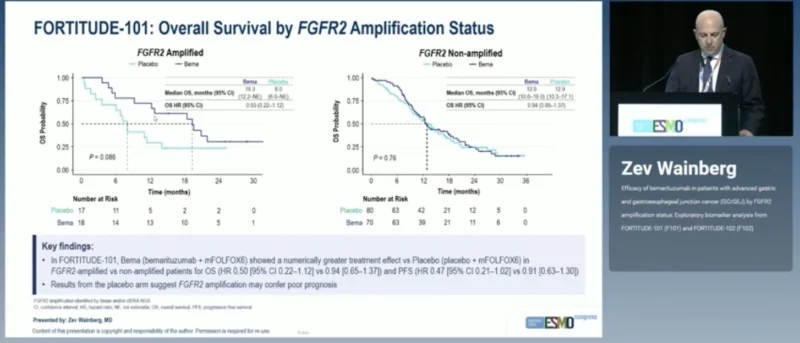
Among patients with FGFR2 amplification, median OS was 19.3 months with bemarituzumab (n=18) versus 8.0 months with placebo (n=17; HR 0.50; 95% CI 0.22–1.12). The PFS HR was 0.47 (95% CI 0.21–1.02). In patients without FGFR2 amplification, median OS was 12.9 months in both arms (HR 0.94; 95% CI 0.65–1.37), while the PFS HR was 0.91 (95% CI 0.63–1.30).
Survival Outcomes in FORTITUDE-102
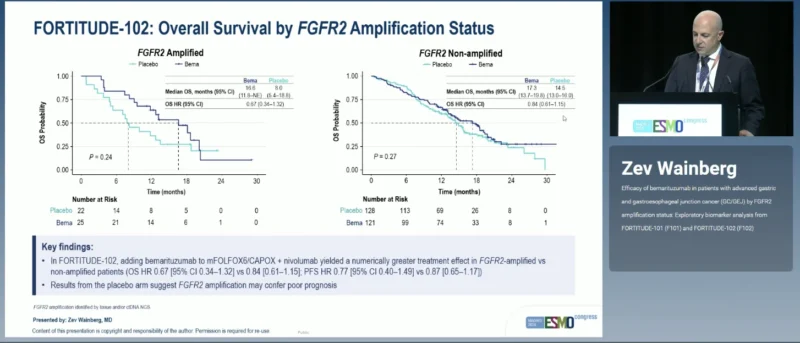
In patients with FGFR2 amplification, median OS was 16.6 months with bemarituzumab (n=25) versus 8.0 months with placebo (n=22; HR 0.67; 95% CI 0.34–1.32). The PFS HR was 0.77 (95% CI 0.40–1.49). Among patients without FGFR2 amplification, median OS was 17.3 versus 14.5 months (HR 0.84; 95% CI 0.61–1.15), while the PFS HR was 0.87 (95% CI 0.65–1.17).
Across both studies, survival outcomes showed a more favourable numerical trend with bemarituzumab in FGFR2-amplified tumours, although the reported confidence intervals for these subgroup hazard ratios included 1.
Conclusions
The exploratory analysis of FORTITUDE-101 and FORTITUDE-102 showed a numerically greater treatment effect with bemarituzumab in patients with FGFR2-amplified, FGFR2b-overexpressing advanced gastric or gastroesophageal junction cancer compared with patients without FGFR2 amplification.
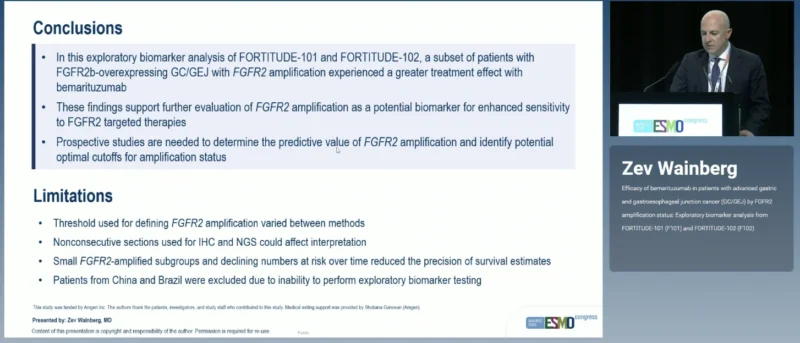
These findings support further evaluation of FGFR2 amplification as a potential biomarker for enhanced sensitivity to FGFR2-targeted therapies. However, the small FGFR2-amplified subgroups, differences in amplification thresholds between testing methods, and declining numbers at risk over time limit the precision of these estimates. The investigators concluded that prospective studies are needed to establish the predictive value of FGFR2 amplification and determine optimal amplification thresholds.
Source: ESMO Congress 2026 – Abstract 2883RO, FORTITUDE-101 and FORTITUDE-102
Read more about RAMIRIS Trial at ESMO 2026 on OncoDaily.