


Sorafenib (Nexavar): Understanding Its Mechanism, Dosing, Clinical Uses, and Role in HCC, RCC, and Differentiated Thyroid Cancer
Key takeaways
- Sorafenib is an oral multikinase inhibitor with both antiproliferative and antiangiogenic activity.
- It targets RAF, VEGFR-1/2/3, PDGFR-β, KIT, FLT3 and RET.
- Standard dosing is 400 mg twice daily without food.
- It is FDA approved for unresectable HCC, advanced RCC, and radioactive iodine-refractory progressive DTC.
- SHARP demonstrated median OS of 10.7 vs 7.9 months in advanced HCC, HR 0.69. PubMed
- TARGET showed approximately a doubling of PFS compared with placebo in advanced RCC.
- DECISION demonstrated median PFS of 10.8 vs 5.8 months in radioactive iodine-refractory DTC, HR 0.59.
- Hand-foot skin reaction is a characteristic toxicity.
- Other major risks include hypertension, cardiac ischemia, hemorrhage, QT prolongation, hepatotoxicity and impaired wound healing.
- Blood pressure should be monitored weekly for the first 6 weeks.
- Sorafenib should be withheld 10 days before elective surgery and for at least 2 weeks after major surgery, until adequate healing.
- In 2026, its role is more selective in HCC and RCC because newer regimens have transformed both diseases, while it remains a recognized option in radioactive iodine-refractory DTC.
Sorafenib (Nexavar) is an oral multikinase inhibitor with both antiangiogenic and antiproliferative activity. It inhibits signaling through several kinases involved in tumor growth and angiogenesis, including RAF kinases, VEGFR-1/2/3, PDGFR-β, KIT, FLT3, and RET. Through these actions, sorafenib suppresses MAPK signaling, tumor-cell proliferation, and tumor vascularization.
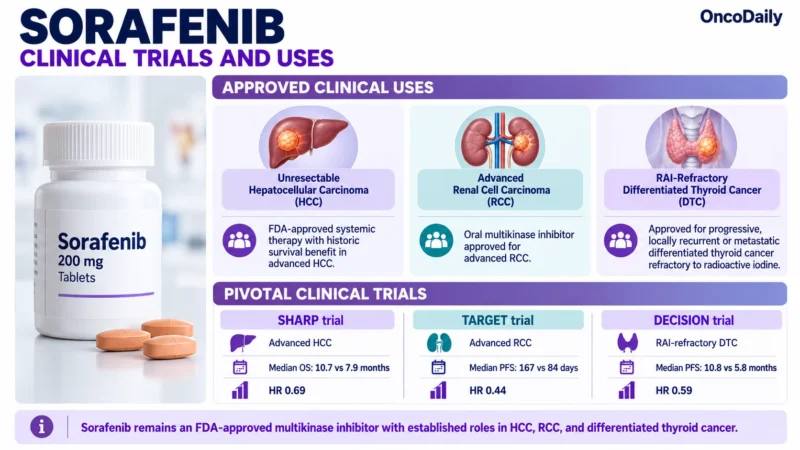
Sorafenib was one of the first oral targeted therapies to transform systemic treatment of advanced hepatocellular carcinoma and renal cell carcinoma. It remains FDA approved for unresectable hepatocellular carcinoma (HCC), advanced renal cell carcinoma (RCC), and progressive locally recurrent or metastatic differentiated thyroid carcinoma (DTC) refractory to radioactive iodine.
Key Facts
- Generic name: Sorafenib
- Brand name: Nexavar
- Drug class: Multikinase tyrosine kinase inhibitor
- Major targets: RAF kinases, VEGFR-1/2/3, PDGFR-β, KIT, FLT3, RET
- Route: Oral
- Initial US approval: 2005
- Tablet strength: 200 mg
- Standard dose: 400 mg twice daily
- Total daily dose: 800 mg
- Administration: Without food — at least 1 hour before or 2 hours after a meal
- FDA-approved cancers: HCC, advanced RCC, radioactive iodine-refractory DTC
- Major toxicities: Hand-foot skin reaction, hypertension, diarrhea, cardiovascular toxicity, hemorrhage, hepatotoxicity, QT prolongation
- Major interaction concern: Strong CYP3A4 inducers
- Important surgical consideration: Impaired wound healing.
What Is Sorafenib?
Sorafenib is a small-molecule inhibitor of several intracellular and receptor tyrosine kinases.
Its effects can broadly be divided into two components:
Antiproliferative activity
Sorafenib inhibits RAF-family signaling involved in the:
RAS → RAF → MEK → ERK
pathway.
This pathway regulates:
- Cell proliferation
- Survival
- Differentiation
- Tumor growth
Antiangiogenic activity
Sorafenib also inhibits:
- VEGFR-1
- VEGFR-2
- VEGFR-3
- PDGFR-β
thereby reducing tumor-associated angiogenesis.
Additional targets include:
- KIT
- FLT3
- RET
making sorafenib a multitargeted kinase inhibitor rather than a highly selective single-target therapy.
What Is the Mechanism of Action of Sorafenib?
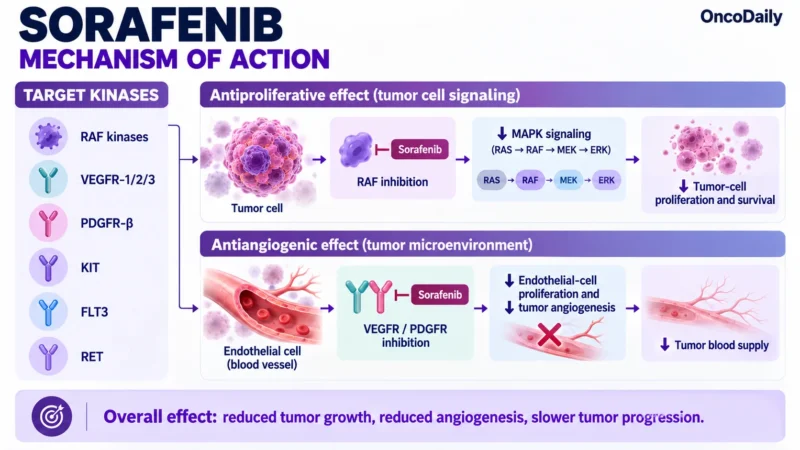
1. Tumor Growth Pathways Become Activated
Many cancers depend on abnormal activation of intracellular signaling pathways such as:
RAS → RAF → MEK → ERK
Activation promotes:
- Tumor-cell proliferation
- Survival
- Growth
2. Sorafenib Inhibits RAF Signaling
Sorafenib inhibits RAF-family kinases and thereby suppresses downstream:
MEK → ERK signaling.
This reduces proliferative signaling within malignant cells.
3. Sorafenib Blocks VEGF Signaling
Sorafenib inhibits:
- VEGFR-1
- VEGFR-2
- VEGFR-3
on vascular endothelial cells.
This reduces:
- Endothelial-cell proliferation
- New blood-vessel formation
- Tumor vascular supply
4. PDGFR and Other RTKs Are Also Inhibited
Sorafenib inhibits additional signaling through:
- PDGFR-β
- KIT
- FLT3
- RET
which may contribute to both stromal and tumor-cell effects.
5. Tumor Angiogenesis and Proliferation Decline
The overall result is:
- Reduced tumor blood supply
- Reduced proliferation
- Reduced survival signaling
- Slower tumor progression
The mechanism can be summarized as:
Sorafenib → RAF + VEGFR/PDGFR and other kinase inhibition → ↓MAPK signaling + ↓angiogenesis → reduced tumor growth and survival.
What Is the Dose of Sorafenib?
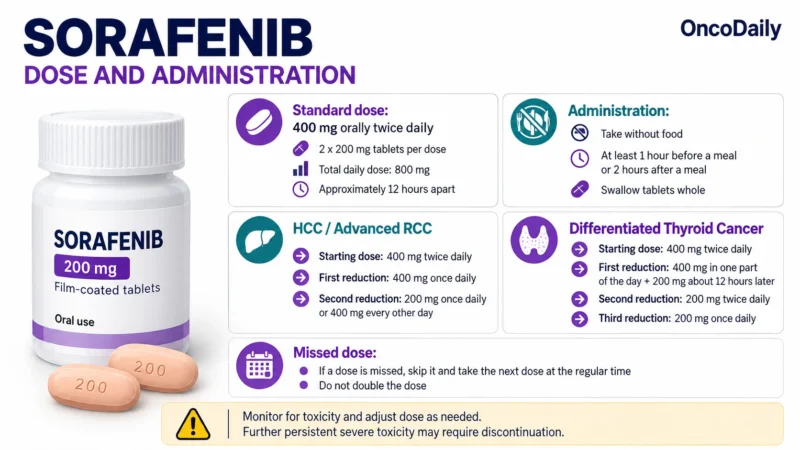
The standard recommended dose is:
400 mg orally twice daily
which equals:
Two 200 mg tablets per dose
for a total daily dose of:
800 mg.
Treatment continues until:
- The patient is no longer clinically benefiting
- Unacceptable toxicity develops.
How Should Sorafenib Be Taken?
Sorafenib should be taken:
Without food.
Specifically:
- At least 1 hour before a meal, or
- At least 2 hours after a meal
The doses are generally administered approximately:
12 hours apart.
What If a Dose Is Missed?
If a dose is missed:
- Do not take an extra dose
- Take the next dose at the regularly scheduled time
- Do not double the dose.
How Are Sorafenib Dose Reductions Made?
Dose reduction differs somewhat between HCC/RCC and DTC.
HCC and RCC
- Starting dose: 400 mg twice daily
- First reduction: 400 mg once daily
- Second reduction: 200 mg once daily or 400 mg every other day
Further persistent severe toxicity generally requires treatment discontinuation.
Differentiated Thyroid Cancer
- Starting dose: 400 mg twice daily
- First reduction: 400 mg in one part of the day and 200 mg approximately 12 hours later
- Second reduction: 200 mg twice daily
- Third reduction: 200 mg once daily.
Dose Modification for Hand-Foot Skin Reaction
Palmar-plantar erythrodysesthesia, or hand-foot skin reaction, is one of the most characteristic toxicities of sorafenib.
Management can include:
- Supportive skin care
- Treatment interruption
- Dose reduction
- Permanent discontinuation for severe or recurrent toxicity
Early recognition is important because HFSR frequently occurs during the first several weeks of treatment.
Dose Modification for Cardiovascular Toxicity
For:
Grade ≥2 cardiac ischemia or myocardial infarction
sorafenib should be:
Permanently discontinued.
For Grade 3 congestive heart failure:
- Interrupt treatment
- Allow recovery to Grade ≤1
- Resume at a reduced dose if appropriate
Grade 4 heart failure requires:
Permanent discontinuation.
Dose Modification for Drug-Induced Liver Injury
Sorafenib should be permanently discontinued for clinically significant drug-induced liver injury, including:
- Grade ≥3 ALT elevation without another explanation, or
- AST/ALT >3× ULN with bilirubin >2× ULN in the absence of another cause.
What Are the Important Drug Interactions With Sorafenib?
Strong CYP3A4 Inducers
Strong CYP3A4 inducers can reduce sorafenib exposure and potentially reduce antitumor efficacy.
Examples include:
- Rifampin
- Carbamazepine
- Phenytoin
- Phenobarbital
- St. John’s wort
Concomitant use should generally be:
Avoided whenever possible.
Neomycin
Neomycin can reduce sorafenib exposure.
The prescribing information recommends:
Avoiding concomitant neomycin.
Warfarin
Patients receiving concomitant warfarin require increased vigilance because sorafenib can increase the risk of:
- Bleeding
- INR abnormalities
Monitor anticoagulation carefully if the drugs are used together.
QT-Prolonging Drugs
Sorafenib itself may prolong the QT interval.
Use caution when combining it with other QT-prolonging drugs, particularly in patients with:
- Congenital long-QT syndrome
- Bradycardia
- Electrolyte abnormalities
- Significant cardiovascular disease.
Does Sorafenib Require Renal or Hepatic Dose Adjustment?
Renal Impairment
No starting-dose adjustment is required for:
- Mild renal impairment
- Moderate renal impairment
- Severe renal impairment
in patients who are:
Not receiving dialysis.
Sorafenib pharmacokinetics have not been adequately studied in patients on dialysis.
Hepatic Impairment
No starting-dose adjustment is required for:
- Child-Pugh A
- Child-Pugh B
The pharmacokinetics of sorafenib have not been adequately studied in:
Severe Child-Pugh C hepatic impairment.
This is especially clinically important in HCC because many patients have underlying cirrhosis.
What Is the Pharmacokinetic Profile of Sorafenib?
Absorption
Sorafenib is administered orally and reaches systemic circulation with variable bioavailability.
Food can affect absorption, which is why the recommended administration is:
At least 1 hour before or 2 hours after food.
Steady State
Repeated administration results in approximately:
2.5- to 7-fold accumulation.
Steady-state concentrations are generally reached within:
7 days.
Protein Binding
Sorafenib is:
Highly protein bound
in plasma.
Metabolism
Sorafenib undergoes hepatic metabolism, principally through:
- CYP3A4-mediated oxidation
- UGT1A9-mediated glucuronidation
This explains the clinical relevance of strong enzyme inducers.
Elimination
Sorafenib and its metabolites are eliminated predominantly through:
Fecal excretion
with a smaller proportion recovered in urine.
What Are the Clinical Uses of Sorafenib?
1. Unresectable Hepatocellular Carcinoma
Sorafenib is FDA approved for:
Unresectable HCC.
Historically, sorafenib was the first systemic therapy to demonstrate an overall-survival benefit in advanced HCC and fundamentally changed the treatment of this disease.
2. Advanced Renal Cell Carcinoma
Sorafenib is FDA approved for:
Advanced RCC.
It became one of the earliest VEGF-pathway-targeted oral therapies in RCC.
3. Radioactive Iodine-Refractory Differentiated Thyroid Cancer
Sorafenib is FDA approved for:
Locally recurrent or metastatic, progressive differentiated thyroid carcinoma refractory to radioactive iodine.
What Did the SHARP Trial Show?
The pivotal SHARP trial established sorafenib in advanced HCC.
Patients with unresectable advanced HCC received:
- Sorafenib 400 mg twice daily
- Placebo
The study demonstrated a significant improvement in overall survival.
Median Overall Survival
- Sorafenib: 10.7 months
- Placebo: 7.9 months
Hazard ratio:
0.69
95% CI:
0.55–0.87
P < 0.001.
Time to Radiologic Progression
- 5.5 months
- 2.8 months
respectively.
P < 0.001.
SHARP established sorafenib as the first systemic agent to provide a meaningful survival benefit in advanced HCC.
What Did the TARGET Trial Show?
The phase III TARGET trial evaluated sorafenib in patients with previously treated advanced RCC.
Approximately:
903 patients
were randomized to:
- Sorafenib 400 mg twice daily
- Placebo.
Progression-Free Survival
The FDA review reported median PFS of approximately:
- 167 days with sorafenib
- 84 days with placebo
Hazard ratio:
0.44
95% CI:
0.35–0.55
P < 0.000001.
Overall Survival in TARGET
Final median OS was:
- 17.8 months with sorafenib
- 15.2 months with placebo
HR:
0.88
P = 0.146.
Interpretation was complicated by crossover from placebo to sorafenib.
When post-crossover placebo survival was censored:
- Sorafenib: 17.8 months
- Placebo: 14.3 months
HR:
0.78
P = 0.029.
What Did the DECISION Trial Show?
The phase III DECISION trial evaluated sorafenib in:
Progressive radioactive iodine-refractory differentiated thyroid cancer.
A total of:
417 patients
were randomized:
- Sorafenib: 207
- Placebo: 210.
Median Progression-Free Survival
- Sorafenib: 10.8 months
- Placebo: 5.8 months
Hazard ratio:
0.59
95% CI:
0.45–0.76
P < 0.0001.
The PFS benefit was observed across prespecified clinical and molecular subgroups and did not depend on BRAF or RAS mutation status.
DECISION Safety Findings
Common adverse events with sorafenib included:
- Hand-foot skin reaction: 76.3%
- Diarrhea: 68.6%
- Alopecia: 67.1%
- Rash/desquamation: 50.2%.
Is Sorafenib FDA Approved?
Yes.
Current FDA-approved indications include:
Hepatocellular Carcinoma
Unresectable HCC
Renal Cell Carcinoma
Advanced RCC
Differentiated Thyroid Cancer
Locally recurrent or metastatic, progressive DTC refractory to radioactive iodine.
What Is the Current Clinical Role of Sorafenib in 2026?
Sorafenib remains an FDA-approved and historically important multikinase inhibitor, but its role has evolved considerably.
Hepatocellular Carcinoma
Sorafenib was once the dominant first-line systemic therapy for advanced HCC.
The treatment landscape now includes multiple immune-checkpoint inhibitor–based and targeted regimens, so sorafenib is generally used more selectively than in the past.
It remains clinically relevant when:
- Contemporary preferred regimens are contraindicated
- Immune checkpoint inhibition is unsuitable
- Specific patient characteristics favor a TKI-based approach
- Access to newer therapies is limited
Renal Cell Carcinoma
Sorafenib’s role in advanced RCC has become substantially narrower.
Modern RCC therapy relies heavily on:
- Immune-checkpoint inhibitor combinations
- ICI + VEGF-TKI combinations
- Newer targeted agents
Sorafenib therefore has a limited contemporary role, despite remaining FDA approved.
Differentiated Thyroid Cancer
Sorafenib remains an established oral TKI option for:
Progressive radioactive iodine-refractory DTC.
The presence of other effective multikinase and molecularly targeted agents means treatment selection now depends on:
- Tumor biology
- Disease burden
- Molecular alterations
- Prior therapy
- Toxicity profile
- Patient comorbidities
Read more: Sorafenib (Nexavar): Uses in Cancer, Side Effects, Dosage, Expectations, and More — it covers sorafenib across HCC, RCC, and differentiated thyroid cancer, including the pivotal SHARP and DECISION data.
What Are the Major Side Effects of Sorafenib?
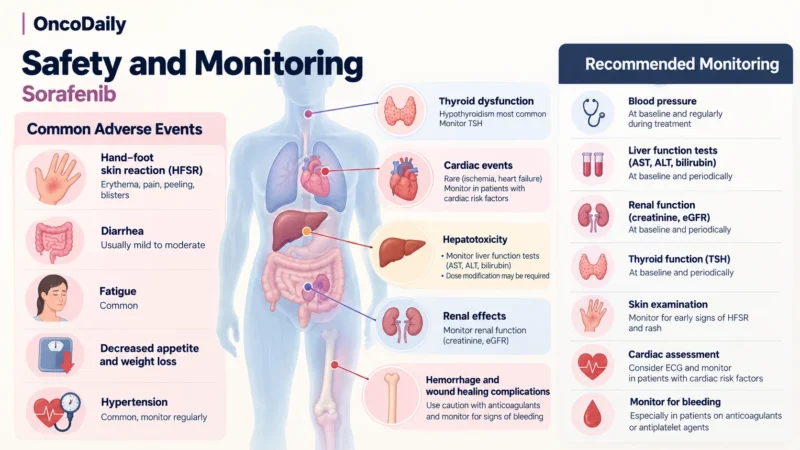
The most common adverse reactions include:
- Diarrhea
- Fatigue
- Infection
- Alopecia
- Hand-foot skin reaction
- Rash
- Weight loss
- Reduced appetite
- Nausea
- Abdominal/GI pain
- Hypertension
- Hemorrhage.
Important serious toxicities include:
- Cardiovascular ischemia/infarction
- Heart failure
- Severe hemorrhage
- Hypertension
- Severe dermatologic toxicity
- Gastrointestinal perforation
- Impaired wound healing
- QT prolongation
- Drug-induced liver injury
- Embryo-fetal toxicity.
Hand-Foot Skin Reaction
Hand-foot skin reaction is one of the hallmark toxicities of sorafenib.
Symptoms may include:
- Pain
- Erythema
- Swelling
- Hyperkeratosis
- Blistering or peeling of palms and soles
Preventive strategies include:
- Removal of calluses
- Moisturizers
- Avoidance of friction and heat
- Early management of pressure areas
Moderate or severe cases may require:
- Treatment interruption
- Dose reduction.
Hypertension
Sorafenib can cause significant hypertension through VEGF-pathway inhibition.
Blood pressure should be checked:
- Before treatment
- Weekly during the first 6 weeks
- Periodically thereafter.
Persistent severe hypertension despite appropriate antihypertensive therapy may require:
- Interruption
- Dose reduction
- Permanent discontinuation.
Cardiovascular Toxicity
Sorafenib may cause:
- Myocardial ischemia
- Myocardial infarction
- Congestive heart failure
In clinical trials, cardiac ischemia/infarction occurred more frequently with sorafenib than placebo, including 2.7% vs 1.3% in SHARP and 2.9% vs 0.4% in TARGET.
Hemorrhage
Sorafenib may increase the risk of bleeding.
Monitor patients for:
- Epistaxis
- GI bleeding
- Tumor-associated hemorrhage
- Other clinically important bleeding
Severe hemorrhage may require permanent treatment discontinuation.
Gastrointestinal Perforation
GI perforation is uncommon but potentially life-threatening.
Patients should be evaluated urgently for:
- Severe abdominal pain
- Fever
- Nausea
- Vomiting
- Signs of peritonitis.
QT Prolongation
Sorafenib may prolong:
QT/QTc interval.
For patients at increased risk:
- Monitor ECG
- Monitor potassium
- Monitor magnesium
- Correct electrolyte abnormalities
Treatment should be interrupted if QTc becomes:
>500 ms
or increases:
>60 ms from baseline.
Drug-Induced Liver Injury
Sorafenib can cause hepatitis and potentially:
Hepatic failure.
Liver-function tests should be monitored regularly.
Sorafenib should be permanently discontinued for significant unexplained drug-induced liver injury.
Impaired Wound Healing
Because VEGF-pathway inhibition can impair vascular repair:
Sorafenib should be withheld:
At least 10 days before elective surgery.
Following major surgery:
Do not restart for at least 2 weeks and until adequate wound healing has occurred.
Thyroid Monitoring in DTC
Sorafenib can interfere with adequate suppression of:
TSH
in patients treated for thyroid cancer.
For DTC:
Monitor TSH monthly
and adjust thyroid-hormone replacement as needed.
Embryo-Fetal Toxicity
Sorafenib can cause fetal harm.
Patients of reproductive potential require counseling regarding effective contraception.
Male patients with partners of reproductive potential should use effective contraception during treatment and for:
3 months after the final dose.
Breastfeeding should be avoided during treatment and for:
2 weeks after the last dose.
What Monitoring Is Required?
Monitoring during sorafenib therapy should include:
- Blood pressure
- Weekly BP during the first 6 weeks
- ALT
- AST
- Bilirubin
- CBC when clinically appropriate
- Electrolytes
- Potassium
- Magnesium
- Serum calcium
- Renal function
- Signs of bleeding
- Hand-foot skin reaction
- Rash and other dermatologic toxicity
- Cardiac symptoms
- ECG in patients at increased QT risk
- Nutritional status and weight
- GI symptoms suggesting perforation
- Wound healing before and after surgery
- Drug interactions
- Monthly TSH in DTC
- Pregnancy status when appropriate.
FAQ
What Is Sorafenib Used For?
- Unresectable HCC
- Advanced RCC
- Progressive radioactive iodine-refractory differentiated thyroid cancer.
What Is the Standard Sorafenib Dose?
How Many Tablets Is One Dose?
200 mg tablets.
Should Sorafenib Be Taken With Food?
Take it:
At least 1 hour before or 2 hours after a meal.
How Does Sorafenib Work?
RAF, VEGFR, PDGFR, KIT, FLT3 and RET
thereby reducing both tumor-cell proliferation and angiogenesis.
What Did the SHARP Trial Show?
7.9 to 10.7 months
with sorafenib.
HR:
0.69.
What Did TARGET Show?
167 vs 84 days
HR 0.44.
What Did DECISION Show?
10.8 vs 5.8 months
HR 0.59.