





Repotrectinib (Augtyro): Understanding Its Mechanism, Dosing, Clinical Uses, and Role in ROS1-Positive NSCLC and NTRK Fusion-Positive Tumors
Key takeaways
- Repotrectinib is a next-generation CNS-active ROS1/TRK inhibitor.
- It has a compact macrocyclic structure designed to overcome kinase-domain resistance.
- Standard dosing is 160 mg once daily for 14 days, then 160 mg twice daily.
- It can be taken with or without food.
- FDA approved it for ROS1-positive locally advanced or metastatic NSCLC in 2023.
- FDA added an accelerated tumor-agnostic NTRK fusion-positive indication for patients ≥12 years in 2024.
- In ROS1 TKI-naïve TRIDENT-1 patients, ORR was 79%, median DoR 34.1 months, and median PFS 35.7 months.
- After one prior ROS1 TKI, ORR was 38%, DoR 14.8 months, and PFS 9.0 months.
- In ROS1 G2032R-positive disease, ORR was approximately 59%.
- In NTRK fusion-positive disease, ORR was 59% in TKI-naïve and 48% in TKI-pretreated patients in the more mature analysis.
- Major safety priorities include CNS toxicity, ILD/pneumonitis, hepatotoxicity, CPK elevation, hyperuricemia, and skeletal fractures.
- In 2026, repotrectinib is an important targeted option both before and after previous ROS1/TRK therapy, especially when CNS disease or resistance mutations are clinically relevant.
Repotrectinib (Augtyro) is an oral, next-generation, CNS-active tyrosine kinase inhibitor targeting ROS1 and TRKA/TRKB/TRKC, encoded by NTRK1, NTRK2, and NTRK3. Its compact macrocyclic structure was specifically designed to retain activity against difficult kinase-domain resistance mutations, including the important ROS1 G2032R solvent-front mutation, while also providing meaningful intracranial activity. New England Journal of Medicine
Repotrectinib is FDA approved for adults with locally advanced or metastatic ROS1-positive NSCLC and, under accelerated approval, for adults and pediatric patients aged 12 years and older with qualifying NTRK fusion-positive solid tumors. In Europe, Augtyro received conditional marketing authorization in January 2025 for ROS1-positive advanced NSCLC and NTRK fusion-positive advanced solid tumors.
Key Facts
- Generic name: Repotrectinib
- Brand name: Augtyro
- Drug class: Next-generation ROS1/TRK tyrosine kinase inhibitor
- Primary targets: ROS1, TRKA, TRKB, TRKC
- Route: Oral
- Initial US approval: November 15, 2023
- FDA ROS1 indication: Adults with locally advanced or metastatic ROS1-positive NSCLC
- FDA NTRK indication: Adults and pediatric patients ≥12 years with qualifying NTRK fusion-positive solid tumors
- Starting dose: 160 mg once daily for 14 days
- Maintenance dose: 160 mg twice daily
- Administration: With or without food
- Capsule strengths: 40 mg and 160 mg
- Key resistance activity: ROS1 G2032R and NTRK solvent-front mutations
- Major safety issues: CNS effects, ILD/pneumonitis, hepatotoxicity, CPK elevation/myalgia, hyperuricemia, skeletal fractures
- Common adverse effects: Dizziness, dysgeusia, peripheral neuropathy, constipation, dyspnea, fatigue, ataxia, cognitive impairment, muscular weakness, nausea
- Major metabolic interaction: CYP3A
- Current US status: FDA approved
- Current EU status: Conditionally authorized.
What Is Repotrectinib?
Repotrectinib is a small-molecule kinase inhibitor developed for tumors driven by:
- ROS1 rearrangements
- NTRK1 fusions
- NTRK2 fusions
- NTRK3 fusions
These rearrangements create abnormal fusion proteins with constitutively active kinase domains that continuously transmit proliferative and survival signals.
Repotrectinib differs from some earlier ROS1 and TRK inhibitors because of its compact macrocyclic structure. This smaller kinase-binding interface reduces steric interference from certain resistance mutations, allowing continued binding when larger inhibitors may lose activity.
This is particularly important for:
ROS1 G2032R
which is a clinically important solvent-front resistance mutation that can develop after earlier ROS1-directed therapy.
What Is the Mechanism of Action of Repotrectinib?
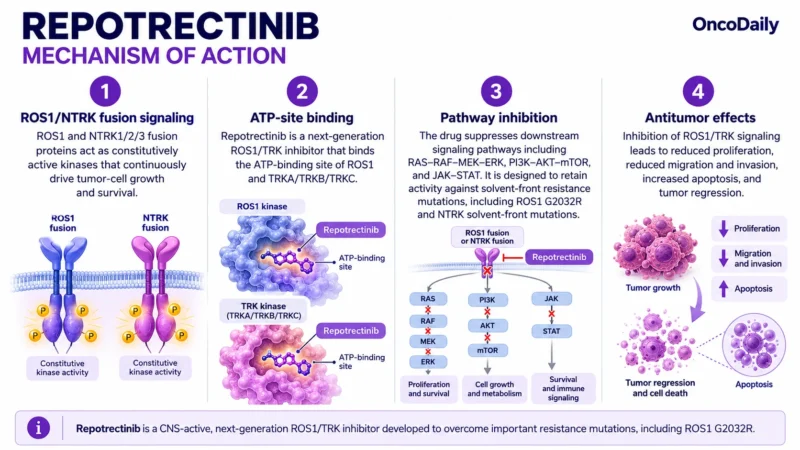
1. ROS1 and NTRK Fusions Create Constitutively Active Kinases
Genomic rearrangements involving ROS1 or NTRK genes produce abnormal fusion proteins with persistent kinase activity.
Examples include:
- ROS1 fusion proteins
- TRKA fusion proteins
- TRKB fusion proteins
- TRKC fusion proteins
These activate pathways supporting:
- Cancer-cell proliferation
- Cell survival
- Migration
- Invasion
- Resistance to apoptosis
2. Repotrectinib Binds the ATP-Binding Region
Repotrectinib acts as an:
ATP-competitive ROS1/TRK tyrosine kinase inhibitor.
It binds to the kinase domain and prevents ATP-dependent phosphorylation.
3. Its Compact Macrocyclic Structure Helps Overcome Resistance
A defining feature of repotrectinib is its:
small macrocyclic kinase-binding interface.
This design helps reduce steric hindrance caused by mutations within the kinase domain.
Repotrectinib therefore retains activity against important resistance alterations including:
ROS1 G2032R
and several:
NTRK solvent-front mutations.
4. Fusion-Protein Phosphorylation Is Suppressed
Inhibition of ROS1 or TRK kinase activity reduces:
Autophosphorylation
and downstream signaling.
5. Downstream Signaling Pathways Are Suppressed
Important pathways include:
RAS–RAF–MEK–ERK
PI3K–AKT–mTOR
and:
JAK–STAT.
6. Tumor Growth Is Inhibited
The downstream consequences include:
- Reduced proliferation
- Reduced survival
- Increased apoptosis
- Reduced migration and invasion
- Tumor regression
The mechanism can be summarized as:
Repotrectinib → ROS1/TRK inhibition → reduced phosphorylation → suppression of MAPK, PI3K/AKT and JAK/STAT signaling → reduced tumor proliferation and survival.
What Is the Dose of Repotrectinib?
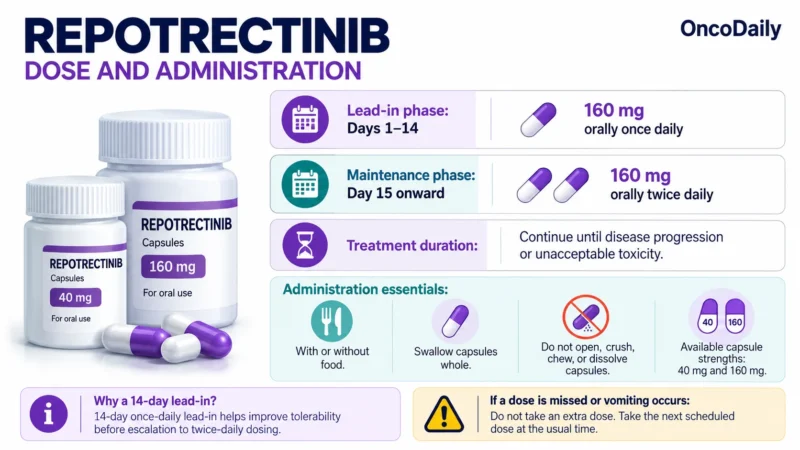
The recommended dose for adults and eligible pediatric patients aged 12 years and older is:
Days 1–14
160 mg orally once daily
then:
Day 15 onward
160 mg orally twice daily.
Treatment continues until:
- Disease progression
- Unacceptable toxicity.
Repotrectinib may be taken:
With or without food.
Why Is Repotrectinib Started Once Daily?
The initial:
160 mg once-daily lead-in for 14 days
helps improve tolerability before escalation to:
160 mg twice daily.
This is especially relevant because early neurologic adverse effects such as:
- Dizziness
- Ataxia
- Cognitive effects
are characteristic of TRK inhibition.
In TRIDENT-1, some patients remained on once-daily treatment longer because of CNS adverse effects.
What If a Dose Is Missed?
If a dose is missed or vomiting occurs after taking repotrectinib:
Do not take an additional dose to make up for it.
Take the next scheduled dose at the usual time.
How Are Repotrectinib Dose Reductions Made?
Dose reductions depend on whether the patient is receiving:
- 160 mg once daily
- 160 mg twice daily
and on the type and severity of toxicity.
Dose interruption and reduction may be required for:
- CNS toxicity
- ILD/pneumonitis
- Hepatotoxicity
- CPK elevation
- Hyperuricemia
- Other clinically significant adverse reactions
The prescribing information provides toxicity-specific restart and reduction instructions rather than one universal reduction sequence for every adverse event.
How Is Repotrectinib Administered?
Repotrectinib is supplied as oral capsules:
- 40 mg
- 160 mg
Capsules should be:
Swallowed whole.
They should not be:
- Opened
- Crushed
- Chewed
- Dissolved
Repotrectinib can be taken:
With or without food.
What Are the Important Drug Interactions With Repotrectinib?
Strong or Moderate CYP3A Inhibitors
Repotrectinib is affected by CYP3A-mediated metabolism.
Before starting treatment:
Strong and moderate CYP3A inhibitors should be discontinued for approximately 3–5 elimination half-lives whenever possible.
Strong or moderate CYP3A inhibitors can increase repotrectinib exposure and toxicity.
Examples may include:
- Clarithromycin
- Itraconazole
- Ketoconazole
- Certain antiviral agents
CYP3A Inducers
Strong or moderate CYP3A inducers can reduce repotrectinib exposure and should generally be avoided.
Examples include:
- Rifampin
- Carbamazepine
- Phenytoin
- St. John’s wort
Hormonal Contraceptives
Repotrectinib may reduce the effectiveness of some hormonal contraceptives.
Women of reproductive potential are therefore advised to use:
Effective non-hormonal contraception.
Does Repotrectinib Require Renal or Hepatic Dose Adjustment?
Renal Impairment
No dose modification is recommended for:
Mild or moderate renal impairment
with:
eGFR 30–90 mL/min.
The recommended dose has not been established in:
- Severe renal impairment
- Kidney failure
- Patients receiving dialysis.
Hepatic Impairment
No dosage modification is recommended for:
Mild hepatic impairment.
The recommended dosage has not been established in:
- Moderate hepatic impairment
- Severe hepatic impairment.
What Are the Clinical Uses of Repotrectinib?
ROS1-Positive NSCLC
Repotrectinib is FDA approved for:
Adults with locally advanced or metastatic ROS1-positive NSCLC.
Importantly, the approval includes both:
- ROS1 TKI-naïve patients
- Patients previously treated with a ROS1 TKI
This was clinically significant because repotrectinib became the first FDA-approved ROS1 treatment explicitly encompassing previously ROS1-TKI-treated disease.
NTRK Fusion-Positive Solid Tumors
Repotrectinib is also FDA approved for:
Adults and pediatric patients aged 12 years and older with solid tumors harboring an NTRK gene fusion that are locally advanced or metastatic, or where surgery would likely cause severe morbidity, and that have progressed following treatment or have no satisfactory alternative therapy.
This is a:
Tumor-agnostic indication.
The indication remains under:
Accelerated approval
with confirmatory evidence still required. As of 2026, FDA continues to list this accelerated approval as ongoing.
What Did Repotrectinib Clinical Trials Show?
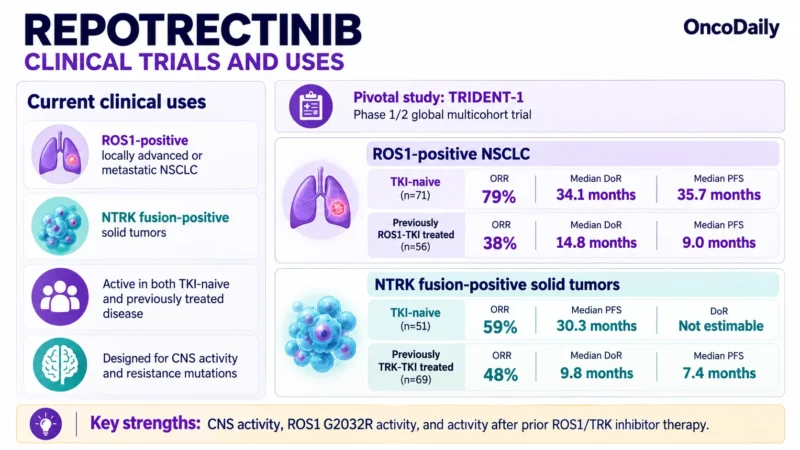
TRIDENT-1
The pivotal study supporting repotrectinib was:
TRIDENT-1 — NCT03093116
an international phase I/II, multicohort trial evaluating repotrectinib in advanced cancers harboring:
- ROS1 fusions
- NTRK fusions
- Other targetable kinase alterations. New England Journal of Medicine
TRIDENT-1 — ROS1 TKI-Naïve NSCLC
The pivotal efficacy population included:
71 patients
with ROS1-positive NSCLC who had not previously received a ROS1 TKI.
Objective Response Rate
ORR was:
79%
95% CI:
68%–88%.
Median Duration of Response
Median DoR was:
34.1 months.
Median Progression-Free Survival
Median PFS was:
35.7 months.
These results demonstrated deep and durable activity in untreated ROS1-driven disease.
TRIDENT-1 — Previously ROS1-TKI-Treated NSCLC
Among:
56 patients
who had received one previous ROS1 TKI but had not received chemotherapy in the advanced setting:
Objective Response Rate
ORR was:
38%.
Median Duration of Response
Median DoR was:
14.8 months.
Median Progression-Free Survival
Median PFS was:
9.0 months.
This demonstrated clinically meaningful activity in a treatment-resistant population.
What About ROS1 G2032R Resistance?
One of repotrectinib’s most important features is activity against:
ROS1 G2032R.
This solvent-front mutation is a major resistance mechanism after earlier-generation ROS1 inhibitors.
In TRIDENT-1:
10 of 17 patients
with ROS1 G2032R responded.
This corresponds to an ORR of approximately:
59%.
This activity is directly related to repotrectinib’s compact molecular structure and reduced susceptibility to steric interference.
What About Brain Metastases?
Repotrectinib was specifically designed for:
CNS penetration and intracranial activity.
TRIDENT-1 demonstrated responses among patients with measurable brain metastases.
The drug’s intracranial activity is particularly important because CNS progression is a common clinical challenge in ROS1-positive NSCLC.
In preclinical models, repotrectinib also demonstrated stronger intracranial activity than earlier-generation approaches.
TRIDENT-1 — NTRK Fusion-Positive Solid Tumors
Repotrectinib was also evaluated in patients with advanced:
NTRK fusion-positive solid tumors.
More mature published data reported:
TKI-Naïve Cohort
n = 51
ORR:
59%.
Median PFS:
30.3 months.
Median duration of response:
Not estimable at the time of analysis.
Previously TRK-TKI-Treated Cohort
n = 69
ORR:
48%.
Median DoR:
9.8 months.
Median PFS:
7.4 months.
Activity Against NTRK Resistance Mutations
Among:
30 previously TRK-TKI-treated patients
with NTRK solvent-front mutations:
16 responded.
This corresponds to an ORR of:
53%.
This supports the rationale for repotrectinib after resistance to earlier TRK inhibitors.
Intracranial Activity in NTRK Fusion-Positive Disease
Among patients with measurable intracranial disease:
- Responses occurred in 2 of 3 TKI-naïve patients
- Responses occurred in 4 of 6 TKI-pretreated patients.
Although the numbers are small, they support meaningful CNS activity.
Is Repotrectinib FDA Approved?
Yes.
FDA approved repotrectinib on:
November 15, 2023
for:
Adult patients with locally advanced or metastatic ROS1-positive NSCLC.
On:
June 13, 2024
FDA granted accelerated approval for:
Adult and pediatric patients aged 12 years and older with qualifying NTRK fusion-positive solid tumors.
Is Repotrectinib Approved in Europe?
Yes.
Augtyro received conditional EU marketing authorization on:
January 13, 2025.
The European indications include:
- Adults with ROS1-positive advanced NSCLC
- Adults and adolescents ≥12 years with advanced NTRK fusion-positive solid tumors under specified treatment conditions.
What Is the Current Clinical Role of Repotrectinib?
ROS1-Positive NSCLC
Repotrectinib has become an important modern therapy for ROS1-positive NSCLC because it addresses two major weaknesses of earlier ROS1 inhibitors:
- CNS progression
- On-target resistance mutations
Its substantial activity in:
- TKI-naïve disease
- Previously TKI-treated disease
- ROS1 G2032R-positive disease
- Brain metastases
makes it an important option across the ROS1 treatment continuum.
Watch more: Explore OncoDaily’s discussion on targeted therapies in lung cancer and the evolving treatment landscape for oncogene-driven NSCLC.
NTRK Fusion-Positive Tumors
Repotrectinib is particularly notable in NTRK-driven tumors after resistance to earlier TRK inhibitors because it retains activity against:
NTRK solvent-front resistance mutations.
Its role therefore extends beyond first-line tumor-agnostic therapy into treatment of selected patients with acquired kinase-domain resistance.
Read more: OncoDaily’s update on the ASCO Living Guideline 2026.3.0, which includes repotrectinib among first-line options for ROS1-positive NSCLC and also discusses its role after prior ROS1 TKI therapy.
What Are the Major Side Effects of Repotrectinib?
The most common adverse reactions include:
- Dizziness
- Dysgeusia
- Peripheral neuropathy
- Constipation
- Dyspnea
- Fatigue
- Ataxia
- Cognitive impairment
- Muscular weakness
- Nausea.
Central Nervous System Effects
CNS toxicity is one of the most characteristic safety issues with repotrectinib.
Across TRIDENT-1:
77%
of patients experienced some form of CNS adverse reaction.
Grade 3–4 CNS events occurred in approximately:
4.5%.
Dizziness
Dizziness or vertigo occurred in approximately:
65%.
Grade 3 dizziness occurred in:
2.8%.
Median onset was approximately:
7 days.
Ataxia
Ataxia, gait disturbance, or balance disorder occurred in approximately:
28%.
Cognitive Effects
Cognitive impairment occurred in approximately:
25%.
This may include:
- Memory impairment
- Attention disturbance
- Confusion
Management
Depending on severity:
- Withhold repotrectinib
- Resume at same or reduced dose after improvement
- Permanently discontinue for severe or persistent toxicity
Patients experiencing neurologic effects should avoid driving or operating machinery.
Interstitial Lung Disease/Pneumonitis
Repotrectinib can cause:
ILD/pneumonitis.
Patients should be monitored for:
- New cough
- Dyspnea
- Wheezing
- New pulmonary symptoms
If suspected:
Immediately withhold repotrectinib.
If treatment-related ILD/pneumonitis is confirmed:
Permanently discontinue repotrectinib.
Hepatotoxicity
Repotrectinib can cause clinically significant elevations in:
- ALT
- AST
- Bilirubin
Liver function should be checked:
Before treatment
and:
Every 2 weeks during the first month
then as clinically indicated.
Dose interruption, reduction, or permanent discontinuation may be required depending on severity.
Myalgia and CPK Elevation
Repotrectinib can cause:
- Myalgia
- Muscle weakness
- Creatine phosphokinase elevation
Myalgia occurred in approximately:
13%
of patients.
Patients developing unexplained:
- Muscle pain
- Tenderness
- Weakness
should undergo:
CPK testing.
Hyperuricemia
Repotrectinib can increase:
Serum uric acid.
Hyperuricemia was reported in approximately:
5%
of patients.
Serum uric acid should be assessed:
- Before treatment
- Periodically during treatment
Urate-lowering therapy may be required.
Skeletal Fractures
Repotrectinib can increase the risk of:
Skeletal fractures.
Among adults in the clinical development program, fractures occurred in approximately:
2.3%.
Sites included:
- Ribs
- Feet
- Spine
- Acetabulum
- Sternum
- Ankles
Patients with:
- Bone pain
- Changes in mobility
- Deformity
should be evaluated promptly.
This issue is particularly relevant in:
Pediatric and adolescent patients.
Embryo-Fetal Toxicity
Repotrectinib can cause fetal harm.
Females of reproductive potential should use:
Effective non-hormonal contraception
during treatment and for:
2 months after the last dose.
Men with female partners of reproductive potential should use effective contraception during treatment and for:
4 months after the last dose.
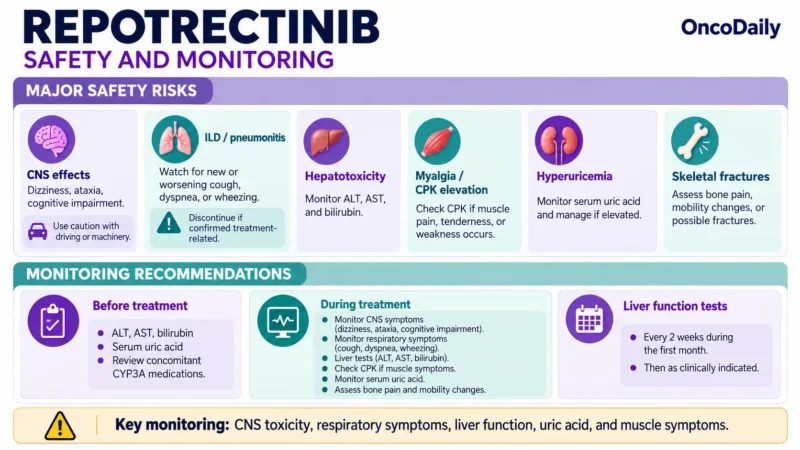
What Monitoring Is Required?
Before starting repotrectinib, evaluate:
- ALT
- AST
- Bilirubin
- Serum uric acid
- Concomitant CYP3A medications.
During treatment monitor:
- CNS symptoms
- Dizziness
- Balance and gait
- Cognition
- Mood and sleep disturbance
- Respiratory symptoms
- ALT
- AST
- Bilirubin
- CPK if muscle symptoms occur
- Serum uric acid
- Bone pain or mobility changes
- Renal function
- Drug interactions
Liver function tests should be obtained:
Every 2 weeks during the first month
and afterward as clinically indicated.
FAQ
What Is Repotrectinib Used For?
What Is the Standard Repotrectinib Dose?
Can Repotrectinib Be Taken With Food?
It can be taken:
With or without food.
Does Repotrectinib Work After Previous ROS1 Therapy?
Does Repotrectinib Work Against ROS1 G2032R?
Does Repotrectinib Work in Brain Metastases?
Is Repotrectinib Tumor-Agnostic?
Can Repotrectinib Be Used in Children?
Patients aged 12 years and older.
What Are the Most Common Side Effects?
Dizziness, dysgeusia, peripheral neuropathy, ataxia, cognitive effects, fatigue, constipation, dyspnea, muscular weakness, and nausea.
What Should Be Checked Before Starting Repotrectinib?
- Liver function
- Bilirubin
- Serum uric acid
- Concomitant medications, especially CYP3A inhibitors.