
The American Society of Clinical Oncology has released the 2026.3.0 update of its living guideline for therapy in stage IV non-small cell lung cancer with driver alterations, reflecting the rapidly expanding role of precision oncology in metastatic lung cancer.
Published in the Journal of Clinical Oncology, the ASCO living guideline provides evidence-based recommendations for patients with stage IV NSCLC whose tumors harbor actionable alterations, including EGFR, ALK, ROS1, BRAF V600E, MET exon 14 skipping, RET, NTRK, HER2, KRAS G12C, and NRG1 fusions.
The update consolidates all prior versions and incorporates new evidence from randomized trials and key published studies identified through the latest literature review. The recommendations address both first-line therapy and treatment after progression.
The major message is clear: in stage IV NSCLC, treatment selection should begin with comprehensive biomarker testing, and targeted therapy should be matched to the driver alteration whenever possible.
Why This Guideline Matters
The treatment landscape for metastatic NSCLC with driver alterations has changed substantially in recent years.
For many patients, targeted therapies now offer rapid tumor responses, longer progression-free survival, improved central nervous system control, and better tolerability compared with older chemotherapy-based approaches. However, treatment decisions have also become more complex.
The guideline highlights several major shifts.
First, combination strategies are now preferred in selected EGFR-mutated NSCLC settings. Second, new targeted agents have entered the field for ROS1, HER2-mutant NSCLC, EGFR exon 20 insertions, and acquired MET amplification. Third, antibody-drug conjugates and bispecific antibodies are becoming part of later-line treatment algorithms for specific molecular subsets.
At the same time, the guideline emphasizes that precision medicine only works if testing is done early and comprehensively.
Biomarker Testing Comes First
ASCO strongly recommends that biomarker testing with a validated tissue and/or blood-based broad multigene panel should be universally accessible for all patients diagnosed with NSCLC.
The guideline also recommends validated tissue immunohistochemistry testing for PD-L1, HER2, and MET protein expression.
The preferred approach is comprehensive next-generation sequencing, ideally including RNA-based NGS to better detect gene fusions. The guideline notes that a combination of tissue and blood testing may maximize the chance of identifying actionable alterations.
This is clinically important because treatment should not be selected by PD-L1 status alone when a driver alteration may be present. In patients who need urgent treatment before molecular results are available, ASCO notes that histology-appropriate chemotherapy without immunotherapy can be considered while awaiting testing.
This is a key practical point. Starting immunotherapy before identifying EGFR or ALK alterations can expose patients to ineffective treatment and may increase toxicity when switching to targeted therapy.
EGFR-Mutated NSCLC: Combination Therapy Moves Forward
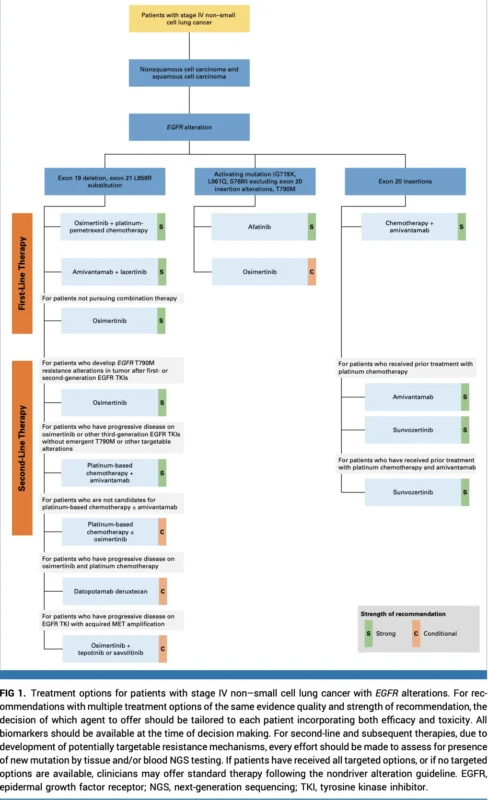
For patients with stage IV NSCLC harboring classical EGFR mutations, including exon 19 deletion or exon 21 L858R substitution, ASCO now recommends first-line osimertinib with platinum-pemetrexed chemotherapy or amivantamab plus lazertinib.
Osimertinib monotherapy remains an option for patients who do not pursue combination therapy.
This recommendation reflects the impact of FLAURA2 and MARIPOSA.
In FLAURA2, first-line osimertinib plus platinum-pemetrexed chemotherapy improved progression-free survival compared with osimertinib alone. The study also showed an overall survival advantage, although the combination increased toxicity.
In MARIPOSA, amivantamab plus lazertinib improved progression-free survival compared with osimertinib and later demonstrated an overall survival advantage. This regimen also has a distinct toxicity profile, including infusion-related reactions, rash, paronychia, edema, and thromboembolic events.
ASCO’s interpretation is balanced. Combination strategies are preferred because of superior efficacy, but osimertinib alone remains appropriate for selected patients who prioritize tolerability, convenience, or lower treatment burden.
EGFR Exon 20 Insertions: Amivantamab Plus Chemotherapy Up Front
For patients with EGFR exon 20 insertion-positive stage IV NSCLC, ASCO recommends chemotherapy plus amivantamab as first-line therapy.
This recommendation is based on data showing improved progression-free survival and response rate with amivantamab plus carboplatin-pemetrexed compared with chemotherapy alone.
After prior platinum chemotherapy, ASCO recommends amivantamab or sunvozertinib. If patients have already received platinum chemotherapy and amivantamab, sunvozertinib may be offered.
This reflects a growing treatment pathway for EGFR exon 20 insertion disease, where both antibody-based and oral targeted options are now available.
ALK-Positive NSCLC: Alectinib, Brigatinib, or Lorlatinib
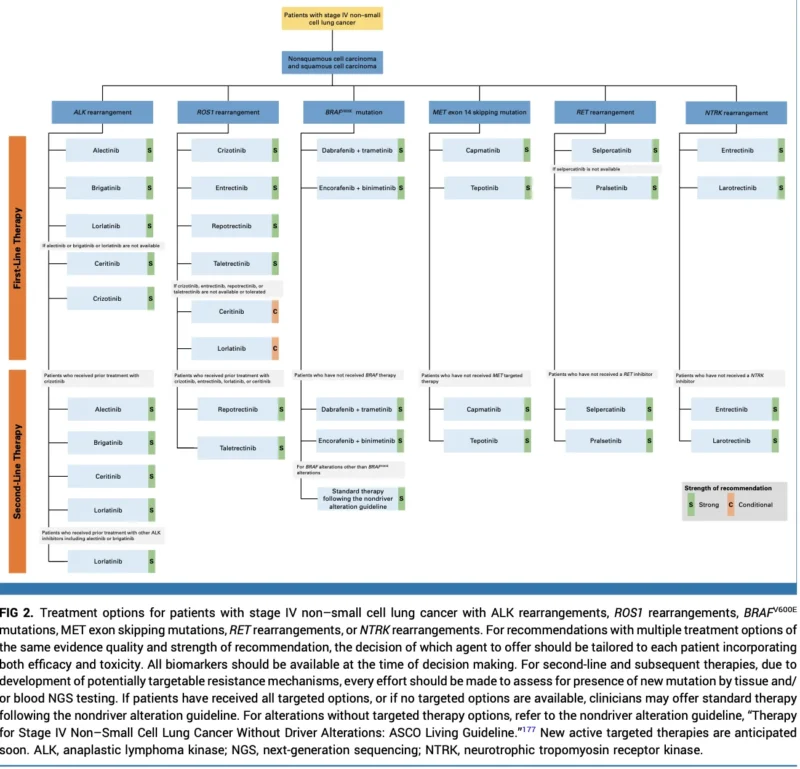
For ALK-rearranged stage IV NSCLC, ASCO recommends first-line alectinib, brigatinib, or lorlatinib.
If these agents are not available, ceritinib or crizotinib may be offered.
The guideline does not select one preferred ALK inhibitor for every patient. Instead, treatment should be individualized based on systemic efficacy, CNS activity, toxicity profile, comorbidities, and patient preference.
Alectinib has long-term efficacy and favorable tolerability. Brigatinib provides systemic and intracranial activity but requires attention to pulmonary and cardiovascular toxicities. Lorlatinib offers highly durable systemic and CNS control but requires proactive management of metabolic and neurocognitive adverse events.
The guideline also emphasizes the role of repeat molecular testing at progression, because ALK resistance mutations can influence the choice of next ALK inhibitor.
ROS1-Positive NSCLC: Taletrectinib Added
For ROS1 rearrangement-positive NSCLC, ASCO now includes crizotinib, entrectinib, repotrectinib, or taletrectinib as first-line options.
This is one of the important updates in the guideline.
Taletrectinib is a next-generation ROS1 inhibitor with systemic and intracranial activity. In TKI-naïve ROS1-positive NSCLC, it showed high response rates and durable disease control. It also demonstrated activity in patients previously treated with ROS1 TKIs, including those with the G2032R resistance mutation.
After prior ROS1 TKI therapy, repotrectinib or taletrectinib may be offered. Selection between these agents should consider prior TKI exposure, CNS disease, toxicity profile, drug-drug interactions, and availability.
RET Fusion-Positive NSCLC: Selpercatinib Remains Preferred
For RET fusion-positive stage IV NSCLC, ASCO recommends selpercatinib as first-line therapy.
If selpercatinib is not available, pralsetinib may be offered.
The guideline highlights the strong efficacy and intracranial activity of selpercatinib in RET fusion-positive NSCLC. Selpercatinib improved progression-free survival compared with platinum-based chemotherapy with or without pembrolizumab and showed high response rates, including in patients with brain metastases.
Pralsetinib remains an option, but the guideline notes safety concerns from emerging data, including higher rates of severe and fatal infections in the pralsetinib arm of the AcceleRET-Lung study.
MET Exon 14 Skipping: Capmatinib or Tepotinib
For patients with MET exon 14 skipping mutation-positive stage IV NSCLC, ASCO recommends capmatinib or tepotinib.
Both agents have shown clinically meaningful activity, including intracranial responses. The guideline notes that common toxicities include peripheral edema and gastrointestinal adverse events.
In patients who did not receive MET-targeted therapy in the first-line setting, capmatinib or tepotinib may also be offered later.
The guideline also emphasizes that immunotherapy outcomes in MET exon 14 NSCLC are not always reliable, and targeted therapy remains an important option when the alteration is identified.
BRAF V600E, NTRK, and Other Actionable Drivers
For BRAF V600E-mutated NSCLC, ASCO recommends dabrafenib plus trametinib or encorafenib plus binimetinib.
For NTRK fusion-positive NSCLC, entrectinib or larotrectinib may be offered.
For BRAF alterations other than BRAF V600E, ASCO recommends standard therapy following the nondriver alteration guideline, because current evidence does not support use of BRAF-targeted regimens in those non-V600E subtypes.
HER2-Mutant NSCLC: T-DXd, Zongertinib, and Sevabertinib
The HER2-mutant NSCLC section includes important updates.
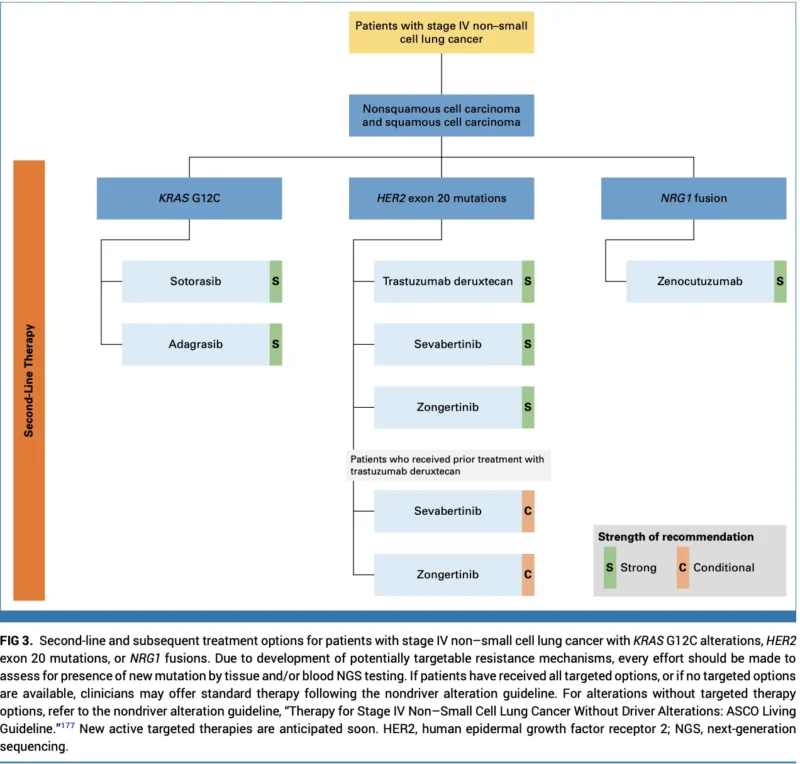
For patients with HER2 exon 20 mutation-positive NSCLC, ASCO states that clinicians may offer trastuzumab deruxtecan, zongertinib, or sevabertinib.
Trastuzumab deruxtecan has established activity in previously treated HER2-mutant metastatic NSCLC, but interstitial lung disease remains a key toxicity requiring careful monitoring.
Zongertinib and sevabertinib are oral HER2-targeted TKIs that have shown promising response rates, including activity after prior HER2-directed antibody-drug conjugate therapy.
For patients previously treated with trastuzumab deruxtecan, sevabertinib or zongertinib may be offered.
This is an important sign of where the field is moving. HER2-mutant NSCLC is transitioning from a setting dominated by antibody-drug conjugates alone to one where oral HER2-selective TKIs may become part of sequencing strategies.
KRAS G12C: Sotorasib or Adagrasib After Prior Therapy
For KRAS G12C-mutated NSCLC, ASCO recommends sotorasib or adagrasib after prior treatment.
The guideline notes that these agents are not recommended as first-line therapy. Patients with KRAS G12C-positive NSCLC should receive standard first-line treatment with immune checkpoint inhibitor therapy and/or chemotherapy according to the nondriver alteration guideline.
Sotorasib and adagrasib both offer oral targeted options after prior platinum-based chemotherapy and immunotherapy, with improved response rates and progression-free survival compared with docetaxel in randomized studies. However, overall survival benefit has not been consistently demonstrated.
NRG1 Fusions: Zenocutuzumab Added
For NRG1 fusion-positive NSCLC, ASCO recommends zenocutuzumab.
NRG1 fusions are rare, and data for standard chemotherapy-immunotherapy are limited. The guideline notes that retrospective evidence suggests suboptimal response to standard regimens.
Zenocutuzumab, a bispecific antibody targeting HER2 and HER3, showed activity in NRG1 fusion-positive solid tumors, including NSCLC. Although the evidence comes from a single-arm phase II study, ASCO supports its use because of the rarity of the alteration and unmet treatment need.
Treatment After Progression Requires Re-Testing
A central theme of the guideline is that progression on targeted therapy should trigger reassessment.
ASCO recommends that every effort should be made to assess for histologic transformation by tissue biopsy when feasible. Acquired resistance mutations can be evaluated by tissue and/or blood NGS.
This applies especially to EGFR-, ALK-, ROS1-, and MET-driven disease, where resistance mechanisms may guide the next treatment choice.
For example, acquired MET amplification after osimertinib may support osimertinib plus a MET inhibitor such as tepotinib or savolitinib. ROS1 resistance mutations such as G2032R may support use of repotrectinib or taletrectinib. ALK resistance mutations may inform selection of lorlatinib or other ALK inhibitors.
Local Therapy For Oligoprogression
The guideline also discusses oligometastatic disease and oligoprogression.
In patients with oncogene-driven stage IV NSCLC treated with TKIs, local ablative therapy may be considered for extracranial oligoprogression or oligoresidual disease while continuing the same TKI.
This strategy may prolong systemic disease control in selected patients, especially in EGFR- or ALK-driven disease.
Patient selection should be multidisciplinary, with careful attention to additive toxicity, including pneumonitis risk when radiation is combined with targeted therapy.
Special Populations: Older Adults, Frailty, Pregnancy, and Poor Performance Status
ASCO emphasizes that age alone should not prevent targeted therapy.
Older adults should be assessed using geriatric assessment tools when appropriate. Treatment decisions should consider frailty, comorbidities, drug-drug interactions, functional status, patient goals, and toxicity risk.
For patients with poor performance status, the guideline notes that TKIs may still be considered when the benefit outweighs the risk. This reflects the fact that oncogene-driven lung cancers can sometimes respond rapidly to targeted therapy, improving cancer-related symptoms and performance status.
Pregnancy and fertility are also addressed. TKIs should generally be avoided during pregnancy because of potential fetal risk. If treatment is unavoidable in life-threatening disease, decisions should be made through multidisciplinary discussion, with careful counseling and documentation.
Patient Access Remains A Major Barrier
The guideline strongly addresses access to biomarker testing and targeted therapy.
Precision oncology has improved survival in metastatic NSCLC, but these benefits are not equally available to all patients. ASCO highlights disparities in biomarker testing by race, insurance coverage, geography, rural residence, language, and global healthcare infrastructure.
The guideline notes that in many low- and middle-income countries, molecular testing remains limited by laboratory capacity, cost, and lack of reimbursement. In some settings, treatment may be started before biomarker results are available, which can lead to missed opportunities for targeted therapy.
The message is clear: universal biomarker testing is not only a scientific issue, but also an equity issue.
Clinical Meaning
The ASCO Living Guideline 2026.3.0 reflects a new era in stage IV NSCLC with driver alterations.
Treatment is no longer organized only by histology. It is increasingly defined by molecular subtype, resistance mechanism, CNS involvement, patient fitness, access, and shared decision-making.
For clinicians, the update reinforces several practical principles.
Test early and broadly. Avoid single-agent immunotherapy in EGFR-mutated disease. Use targeted therapy first when a driver alteration is present. Consider combination approaches in selected EGFR-mutated patients. Re-test at progression. Use local therapy selectively for oligoprogression. Discuss treatment burden, toxicity, goals of care, and financial barriers with patients.
For patients, the guideline reflects a hopeful but complex reality. Many driver-positive lung cancers now have multiple lines of targeted therapy. However, the right treatment depends on getting the right test at the right time.
Key Takeaway
ASCO’s 2026.3.0 Living Guideline for stage IV NSCLC with driver alterations updates the treatment roadmap for precision lung cancer care.
The guideline prioritizes broad molecular testing, recommends intensified first-line strategies for selected EGFR-mutated disease, adds newer options for ROS1-positive and HER2-mutant NSCLC, supports targeted therapy sequencing after progression, and highlights the importance of equitable access to biomarker testing and targeted medicines.
The future of metastatic NSCLC treatment is increasingly molecular, adaptive, and patient-centered.