


Isatuximab (Sarclisa, Sarclisa Escena): Mechanism of Action, Dosing, Clinical Uses, Trials, and Side Effects
Key takeaways
- Isatuximab is a CD38-directed chimeric IgG1κ monoclonal antibody.
- Its antimyeloma mechanisms include ADCC, ADCP, CDC, direct apoptosis, and immunomodulation.
- The first FDA approval occurred in March 2020.
- IV Sarclisa is administered at 10 mg/kg.
- SC Sarclisa Escena was approved in July 2026 at a fixed 1,400 mg dose.
- ICARIA-MM demonstrated improved PFS with Isa-Pd.
- IKEMA demonstrated median PFS of 35.7 versus 19.2 months with Isa-Kd versus Kd.
- IMROZ established improved progression-free survival with Isa-VRd in newly diagnosed transplant-ineligible myeloma.
- GMMG-HD7 and IsKia demonstrated deeper responses in transplant-eligible populations.
- Major risks include infections, neutropenia, administration reactions, and laboratory interference.
- Correct formulation selection, infection surveillance, and blood-bank communication are essential.
Isatuximab-irfc (Sarclisa, Sarclisa Escena) is a chimeric IgG1 monoclonal antibody targeting CD38, a transmembrane glycoprotein highly expressed on malignant plasma cells. By binding CD38, isatuximab promotes cancer-cell destruction through immune-mediated cytotoxicity, complement activation, direct apoptosis, and modulation of the immune microenvironment.
First approved by the FDA in March 2020, isatuximab became an important targeted treatment for relapsed or refractory multiple myeloma. Its indications subsequently expanded to earlier treatment lines, including newly diagnosed transplant-ineligible multiple myeloma.
A major development occurred on July 9, 2026, when the FDA approved Sarclisa Escena, a fixed-dose subcutaneous formulation of isatuximab. This introduced a new administration option alongside intravenous Sarclisa.
The two formulations differ in their dosing and administration:
- Sarclisa IV: 10 mg/kg intravenously.
- Sarclisa Escena SC: 1,400 mg subcutaneously, administered using the CirCLIQ on-body delivery system or a manual infusion set.
Isatuximab’s clinical efficacy has been demonstrated in pivotal studies including ICARIA-MM, IKEMA, and IMROZ, with additional evidence from GMMG-HD7 and IsKia.
Key Facts
- Generic name: Isatuximab-irfc
- Brand names: Sarclisa; Sarclisa Escena
- Drug class: CD38-directed monoclonal antibody
- Antibody type: Chimeric IgG1κ
- Molecular target: CD38
- Mechanism: ADCC, ADCP, CDC, direct apoptosis, and immunomodulation
- Initial FDA approval: March 2020
- Subcutaneous FDA approval: July 9, 2026
- IV dose: 10 mg/kg
- SC dose: 1,400 mg fixed dose
- IV strengths: 100 mg/5 mL and 500 mg/25 mL
- SC strength: 1,400 mg/10 mL
- Administration: Intravenous infusion or subcutaneous injection
- Primary indication: Multiple myeloma
- Key regimens: Isa-Pd, Isa-Kd, Isa-VRd
- Pivotal trials: ICARIA-MM, IKEMA, IMROZ
- Additional trials: GMMG-HD7, IsKia
- Common adverse reactions: Infusion reactions, upper respiratory tract infections, pneumonia, diarrhea, fatigue
- Serious risks: Infections, neutropenia, severe hypersensitivity, second primary malignancies
- Important precautions: Interference with blood-bank compatibility testing and myeloma response assessment
- Monitoring: CBC, infection status, disease response, immunoglobulins when indicated, and transfusion compatibility
- Metabolism: Proteolytic catabolism
What Is Isatuximab?
Isatuximab is a monoclonal antibody that selectively binds CD38 on malignant plasma cells.
CD38 is a type II transmembrane glycoprotein with several functions, including:
- Cellular signaling
- Cell adhesion
- Calcium regulation
- NAD⁺ metabolism
- Immune-cell regulation
CD38 is expressed at high levels on multiple myeloma cells, making it an attractive therapeutic target.
Isatuximab acts through immune effector mechanisms and direct effects on malignant plasma cells.
It differs from daratumumab, another anti-CD38 antibody, in its binding epitope, capacity for direct cell-death induction, and certain laboratory and pharmacological characteristics.
Both agents are effective anti-CD38 therapies, but they are not automatically interchangeable.
What Is the Mechanism of Action of Isatuximab?
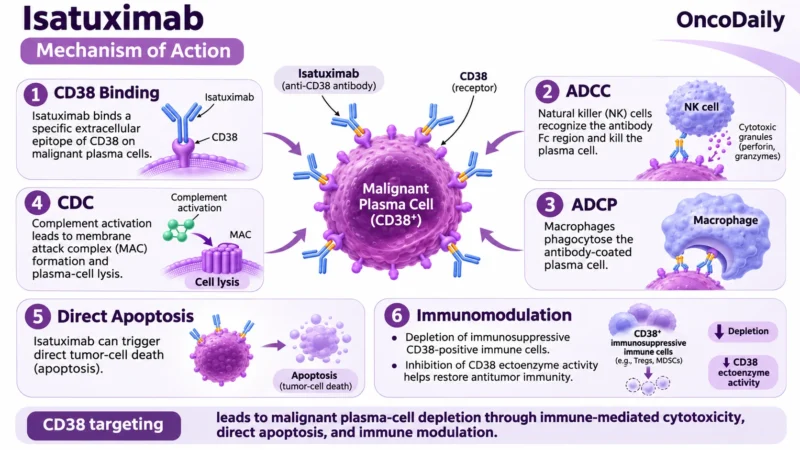
1. Isatuximab Binds CD38
Isatuximab recognizes a specific extracellular epitope of CD38 on malignant plasma cells.
Antibody binding initiates multiple antitumor mechanisms.
2. Antibody-Dependent Cellular Cytotoxicity (ADCC)
The Fc portion of isatuximab interacts with Fcγ receptors on immune effector cells, particularly natural killer cells.
This promotes the release of:
- Perforin
- Granzymes
The resulting cytotoxic response contributes to malignant plasma-cell destruction.
3. Antibody-Dependent Cellular Phagocytosis (ADCP)
Macrophages recognize antibody-coated plasma cells through Fcγ receptors.
This promotes phagocytosis and removal of malignant cells.
4. Complement-Dependent Cytotoxicity (CDC)
Isatuximab can activate the complement cascade, leading to membrane attack complex formation and cell lysis.
The extent of complement-mediated killing depends on biological factors, including CD38 density.
5. Direct Apoptosis
A distinctive feature of isatuximab is its ability to induce direct cell death under certain experimental conditions without requiring secondary antibody-mediated cross-linking.
This distinguishes aspects of its mechanism from daratumumab.
6. Immunomodulation
Isatuximab can reduce CD38-expressing immunosuppressive cell populations.
These include subsets of regulatory T cells and other immune cells that suppress antitumor immunity.
It also inhibits CD38-associated ectoenzyme activity, potentially modifying extracellular NAD⁺ metabolism and immunoregulatory signaling.
Overall mechanism:
Isatuximab → CD38 binding → ADCC + ADCP + CDC + direct apoptosis + immunomodulation → malignant plasma-cell depletion.
What Is the Recommended Dose of Isatuximab?
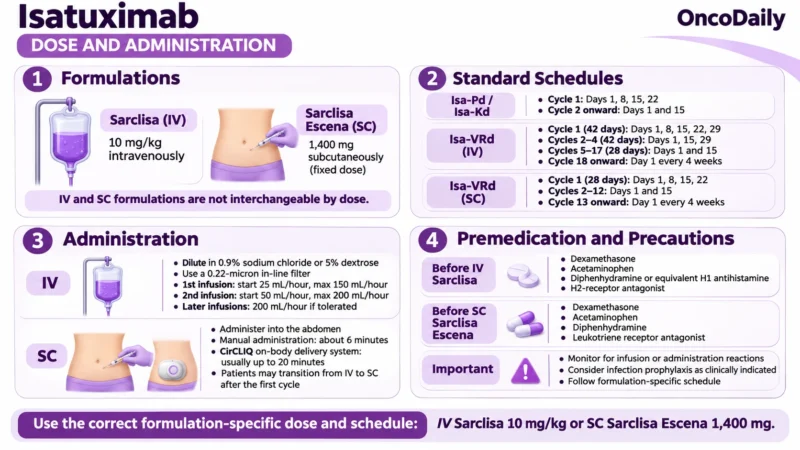
Intravenous Sarclisa
The recommended dose is:
10 mg/kg IV, based on actual body weight.
Treatment schedules depend on the accompanying regimen.
Subcutaneous Sarclisa Escena
The recommended dose is:
1,400 mg SC, independent of body weight.
The subcutaneous product has its own administration instructions and must not be administered intravenously.
Isa-Pd — Isatuximab + Pomalidomide + Dexamethasone
For both IV and SC formulations:
Cycle 1 (28 Days)
- Days 1, 8, 15, and 22
Cycle 2 Onward
- Days 1 and 15 of each 28-day cycle
Treatment continues until progression or unacceptable toxicity.
Important regulatory distinction: The IV formulation is indicated following at least two prior therapies including lenalidomide and a proteasome inhibitor. The SC formulation has a broader indication after at least one prior treatment line containing both drug classes.
Isa-Kd — Isatuximab + Carfilzomib + Dexamethasone
For patients with relapsed or refractory multiple myeloma after one to three prior treatment lines:
Cycle 1 (28 Days)
- Days 1, 8, 15, and 22
Cycle 2 Onward
- Days 1 and 15
Treatment continues until progression or unacceptable toxicity.
Isa-VRd — Isatuximab + Bortezomib + Lenalidomide + Dexamethasone
For newly diagnosed transplant-ineligible multiple myeloma, the approved schedules differ by formulation.
Intravenous Sarclisa
Cycle 1 (42 days):
Days 1, 8, 15, 22, and 29.
Cycles 2–4 (42 days each):
Days 1, 15, and 29.
Cycles 5–17 (28 days each):
Days 1 and 15.
Cycle 18 onward:
Day 1 every four weeks.
Subcutaneous Sarclisa Escena
Cycle 1 (28 days):
Days 1, 8, 15, and 22.
Cycles 2–12 (28 days each):
Days 1 and 15.
Cycle 13 onward:
Day 1 every four weeks.
The associated VRd backbone must follow the appropriate formulation-specific regimen.
How Should Isatuximab Be Administered?
Intravenous Administration
Sarclisa IV is diluted in an appropriate infusion solution, including:
- 0.9% sodium chloride
- 5% dextrose
A compatible infusion set with a 0.22-micron in-line filter is used.
Infusion Rates
For the standard 250-mL infusion volume:
First infusion:
- Start at 25 mL/hour.
- Increase gradually if tolerated.
- Maximum 150 mL/hour.
Second infusion:
- Start at 50 mL/hour.
- Increase according to protocol.
- Maximum 200 mL/hour.
Subsequent infusions:
- 200 mL/hour if tolerated.
Monitor carefully for infusion-related reactions.
Subcutaneous Administration
Sarclisa Escena is administered into the abdomen by a healthcare professional.
Two delivery methods are available:
- Manual administration: Approximately 6 minutes
- CirCLIQ on-body delivery system: Usually up to 20 minutes
Sarclisa Escena does not require dilution.
Patients may transition from intravenous isatuximab to subcutaneous Sarclisa Escena after completion of the first treatment cycle, according to the product label.
Premedication
For Intravenous Sarclisa
Premedicate 15–60 minutes before treatment with:
- Dexamethasone
- Acetaminophen
- Diphenhydramine or equivalent H1 antihistamine
- H2-receptor antagonist
For Subcutaneous Sarclisa Escena
Premedication includes:
- Dexamethasone
- Acetaminophen
- Diphenhydramine
- Leukotriene receptor antagonist
Premedication may be reassessed in subsequent SC cycles if no systemic administration reactions occur, according to labeling and clinical judgment.
Infection Prophylaxis
Consider antimicrobial prophylaxis based on regimen, infection history, and institutional guidance.
Herpes zoster prophylaxis is commonly indicated in patients receiving proteasome inhibitor-based myeloma therapy.
What Should You Do If an Isatuximab Dose Is Missed?
If a planned dose is missed:
- Administer it as soon as clinically possible.
- Adjust subsequent treatment dates.
- Maintain the appropriate interval between doses.
- Do not double the next dose.
How Are Isatuximab Dose Modifications Managed?
Routine dose reductions are not recommended.
Infusion-Related Reactions
For Grade 2–3 IV infusion reactions:
- Interrupt treatment.
- Provide appropriate supportive care.
- Resume at a reduced infusion rate if symptoms resolve sufficiently and the label permits.
Permanently discontinue for anaphylaxis, life-threatening Grade 4 reactions, or reactions meeting the other label-defined permanent discontinuation criteria.
Neutropenia
For Grade 4 neutropenia:
Delay treatment until neutrophil recovery to at least 1.0 × 10⁹/L.
Consider granulocyte colony-stimulating factor when appropriate.
Serious Infections
Evaluate the need to interrupt treatment during serious active infections.
Restart according to clinical recovery and treatment tolerance.
Cytopenias
Monitor neutropenia, thrombocytopenia, and anemia.
Adjust associated chemotherapy or immunomodulatory agents when indicated.
What Drug Interactions Are Important With Isatuximab?
Combination Antimyeloma Therapy
Isatuximab is used with:
- Pomalidomide
- Carfilzomib
- Bortezomib
- Lenalidomide
- Dexamethasone
These combinations can increase hematologic toxicity, infections, and treatment-specific adverse effects.
Blood Transfusion Testing
Isatuximab binds CD38 on red blood cells and can interfere with indirect antiglobulin testing.
This may cause positive indirect Coombs tests and complicate compatibility testing.
Perform blood typing and antibody screening before starting isatuximab.
Notify the blood bank that the patient is receiving anti-CD38 therapy.
DTT-treated reagent red blood cells may be used, with appropriate precautions concerning Kell antigens.
Serum Protein Testing
Because isatuximab is an IgGκ monoclonal antibody, it may interfere with:
- Serum protein electrophoresis
- Immunofixation
- Complete response assessment
Drug-specific immunofixation assays can help distinguish therapeutic antibody from residual myeloma protein.
CYP450 Interactions
Isatuximab is not principally metabolized by CYP450 enzymes.
Clinically important CYP-mediated interactions are not expected.
Does Isatuximab Require Dose Adjustment in Renal or Hepatic Impairment?
Renal Impairment
Routine isatuximab dose adjustment is not required solely on the basis of renal impairment.
However, accompanying drugs such as lenalidomide require renal dose assessment.
Hepatic Impairment
Mild hepatic impairment does not generally require dose adjustment.
Clinical data in moderate or severe hepatic impairment are more limited.
What Is the Pharmacokinetic Profile of Isatuximab?
Distribution
Isatuximab distributes mainly in vascular and extracellular compartments.
Metabolism
It undergoes proteolytic catabolism into amino acids and small peptides.
Clearance
Clearance involves target-mediated CD38 binding and nonspecific monoclonal antibody catabolism.
Target-mediated clearance decreases as receptor binding approaches saturation and the malignant plasma-cell burden declines.
Half-Life
The effective terminal half-life varies with treatment duration, dose, formulation, and target-mediated clearance.
Population pharmacokinetic modeling estimates a terminal half-life of approximately 28 days under relevant treatment conditions.
The fixed-dose SC formulation has different absorption kinetics from intravenous administration.
What Are the Clinical Uses of Isatuximab?
Newly Diagnosed Transplant-Ineligible Multiple Myeloma
Isatuximab with VRd is an FDA-approved treatment for adults with newly diagnosed multiple myeloma who are not eligible for autologous stem cell transplantation.
The IMROZ trial demonstrated significantly improved progression-free survival and deeper responses with the addition of isatuximab.
This regimen is particularly relevant for patients who can tolerate quadruplet therapy.
Relapsed or Refractory Multiple Myeloma
Isa-Pd
Isatuximab with pomalidomide and dexamethasone is an established option after prior lenalidomide and proteasome inhibitor exposure, subject to formulation-specific approval criteria.
Isa-Kd
Isatuximab with carfilzomib and dexamethasone is approved after one to three prior treatment lines.
Selection depends on:
- Prior therapies and refractoriness
- Renal function
- Cardiovascular status
- Peripheral neuropathy
- Infection risk
- Prior anti-CD38 exposure
Transplant-Eligible Newly Diagnosed Multiple Myeloma
Isatuximab-containing quadruplets have demonstrated promising results in clinical trials, including GMMG-HD7 and IsKia.
However, these induction and consolidation approaches should be distinguished from the FDA-approved transplant-ineligible Isa-VRd indication.
What Molecular Testing Is Required Before Isatuximab?
No specific oncogenic mutation is required to prescribe isatuximab.
Baseline Myeloma Assessment
Recommended investigations include:
Bone marrow aspirate and biopsy
- Flow cytometry
- Serum protein electrophoresis and immunofixation
- Serum free light chains
- Quantitative immunoglobulins
- Appropriate whole-body imaging
- Cytogenetic testing and FISH
Myeloma Cytogenetics
Risk stratification should evaluate relevant abnormalities, including:
- del(17p)/TP53
- t(4;14)
- t(14;16)
- 1q gain or amplification
These abnormalities guide prognosis and treatment strategy rather than serving as mandatory predictors of isatuximab responsiveness.
CD38 Expression
CD38 is highly expressed on malignant plasma cells.
Routine quantitative CD38 expression testing is not required for FDA-approved treatment.
Blood Bank Preparation
Obtain blood type and antibody screen before treatment because of anti-CD38-associated test interference.
What Did the Pivotal Clinical Trials Show?
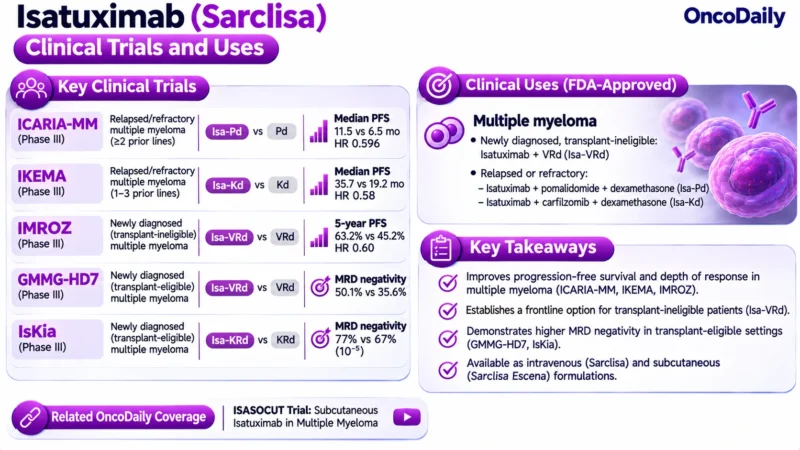
ICARIA-MM — Isatuximab Plus Pomalidomide and Dexamethasone
The phase III ICARIA-MM trial evaluated:
- Isatuximab + pomalidomide + dexamethasone (Isa-Pd)
- Pomalidomide + dexamethasone (Pd)
A total of 307 patients with relapsed or refractory multiple myeloma were randomized.
Median Progression-Free Survival
- Isa-Pd: 11.5 months
- Pd: 6.5 months
HR: 0.596
Overall Response Rate
- Isa-Pd: approximately 60%
- Pd: approximately 35%
The trial demonstrated a significant progression-free survival benefit from adding isatuximab to pomalidomide and dexamethasone.
IKEMA — Isatuximab Plus Carfilzomib and Dexamethasone
The phase III IKEMA trial evaluated:
- Isatuximab + carfilzomib + dexamethasone (Isa-Kd)
- Carfilzomib + dexamethasone (Kd)
A total of 302 patients were randomized.
Updated Median Progression-Free Survival
- Isa-Kd: 35.7 months
- Kd: 19.2 months
HR: 0.58
MRD Negativity
- Isa-Kd: 33.5%
- Kd: 15.4%
Complete Response or Better
- Isa-Kd: 44.1%
- Kd: 28.5%
The trial established Isa-Kd as an effective regimen in relapsed or refractory multiple myeloma.
Watch More: IKEMA Trial Update: Isatuximab in Multiple Myeloma.
IMROZ — First-Line Isatuximab Plus VRd
The phase III IMROZ trial compared:
- Isatuximab + VRd
- VRd alone
in transplant-ineligible patients with newly diagnosed multiple myeloma.
A total of 446 patients were randomized.
Five-Year Progression-Free Survival
- Isa-VRd: 63.2%
- VRd: 45.2%
HR: 0.60
Complete Response or Better
- Isa-VRd: 74.7%
- VRd: 64.1%
MRD-Negative Complete Response
- Isa-VRd: 55.5%
- VRd: 40.9%
The trial demonstrated that adding isatuximab significantly improved disease control and depth of response.
These findings supported the September 2024 FDA approval of Isa-VRd for transplant-ineligible newly diagnosed multiple myeloma.
GMMG-HD7 — Transplant-Eligible Multiple Myeloma
This phase III trial investigated the addition of isatuximab to VRd induction therapy in patients eligible for autologous stem cell transplantation.
MRD Negativity After Induction
- Isa-VRd: 50.1%
- VRd: 35.6%
Isatuximab significantly increased the proportion of patients achieving MRD negativity.
The study also provided evidence of improved disease control with CD38-directed quadruplet induction.
IsKia — Isatuximab Plus KRd
The phase III IsKia study evaluated isatuximab added to:
- Carfilzomib
- Lenalidomide
- Dexamethasone
in newly diagnosed transplant-eligible multiple myeloma.
MRD Negativity After Consolidation
At a sensitivity threshold of 10⁻⁵:
- Isa-KRd: 77%
- KRd: 67%
The trial demonstrated deeper responses with the addition of isatuximab to KRd.
This approach remains distinct from the currently approved frontline transplant-ineligible Isa-VRd regimen.
Does Isatuximab Have CNS Activity?
Isatuximab is a large monoclonal antibody with limited penetration across an intact blood–brain barrier.
Its role in CNS-involved multiple myeloma remains investigational.
There is no established evidence supporting isatuximab as a standalone CNS-directed treatment.
Management of CNS myeloma generally requires individualized multimodal treatment, including systemic therapy and local approaches when appropriate.
Is Isatuximab FDA Approved?
Yes.
Important FDA milestones include:
- March 2020: Initial approval of IV isatuximab with pomalidomide and dexamethasone.
- March 2021: Approval of IV isatuximab with carfilzomib and dexamethasone.
- September 20, 2024: Approval of IV isatuximab with VRd for transplant-ineligible newly diagnosed myeloma.
- July 9, 2026: Approval of subcutaneous isatuximab, Sarclisa Escena, for specified myeloma combinations.
The SC formulation also expanded eligibility for Isa-Pd to patients with at least one prior treatment line including lenalidomide and a proteasome inhibitor.
What Is the Current Clinical Role of Isatuximab in 2026?
Frontline Multiple Myeloma
Isa-VRd is an established FDA-approved quadruplet treatment for transplant-ineligible patients.
It provides an important alternative to other anti-CD38-containing frontline strategies.
Relapsed Multiple Myeloma
Isa-Kd and Isa-Pd are established options according to previous therapy, refractoriness, and clinical characteristics.
Prior anti-CD38 exposure is an important consideration because of possible cross-resistance within the therapeutic class.
Subcutaneous Administration
The July 2026 approval of Sarclisa Escena introduced an important administration option.
Subcutaneous delivery reduces the need for prolonged intravenous infusions while retaining CD38-directed treatment.
The two formulations must be prescribed and administered according to their separate labels.
Read More: ISASOCUT: Subcutaneous Isatuximab With On-Body Injector in Newly Diagnosed Multiple Myeloma by OncoDaily.
What Are the Major Side Effects of Isatuximab?
Infusion and Administration-Related Reactions
Intravenous isatuximab can cause infusion-related reactions, particularly during the first administration.
Symptoms include:
- Dyspnea
- Cough
- Chills
- Nasal congestion
- Bronchospasm
- Hypotension
- Hypertension
Severe hypersensitivity and anaphylaxis can occur.
Subcutaneous administration generally reduces systemic administration-reaction frequency, but reactions remain possible.
Infections
Isatuximab increases the risk of serious infections, including:
- Pneumonia
- Upper respiratory tract infections
- Opportunistic infections
- Viral reactivation
Serious and fatal infections have been reported.
Neutropenia
Neutropenia is a major hematologic toxicity.
It may increase susceptibility to bacterial and fungal infections.
In clinical trials of IV isatuximab-containing regimens, Grade 3–4 laboratory neutropenia occurred in approximately 52%of patients.
Thrombocytopenia and Anemia
Cytopenias can occur, especially when isatuximab is combined with myelosuppressive antimyeloma agents.
Gastrointestinal and General Adverse Reactions
Common events include:
- Diarrhea
- Nausea
- Fatigue
- Reduced appetite
Some toxicities reflect the combined treatment regimen rather than isatuximab alone.
Second Primary Malignancies
Second primary malignancies have been reported in patients receiving isatuximab-containing therapies.
Patients should undergo routine clinical surveillance and age-appropriate cancer screening.
Laboratory Test Interference
Isatuximab can interfere with:
- Indirect antiglobulin testing
- Blood compatibility testing
- Serum protein electrophoresis
- Immunofixation
These effects must be considered when interpreting laboratory results.
Embryo-Fetal Toxicity
Isatuximab can cause fetal harm.
Females of reproductive potential should use effective contraception during treatment and for five months after the final dose.
Additional reproductive precautions apply to lenalidomide and pomalidomide.
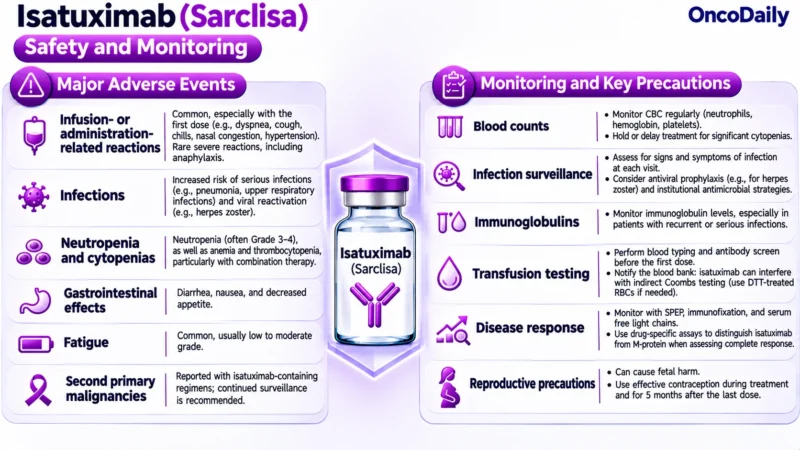
What Monitoring Is Required During Isatuximab Treatment?
Complete Blood Count
Regularly monitor:
- Neutrophils
- Platelets
- Hemoglobin
- Leukocyte counts
Adjust treatment schedules and provide supportive measures when necessary.
Infection Monitoring
Assess for fever, respiratory symptoms, and other signs of infection before and during therapy.
Consider antiviral and antibacterial prophylaxis according to patient risk and institutional protocols.
Infusion and Administration Reactions
Monitor for hypersensitivity and cardiopulmonary symptoms.
Intravenous treatment requires monitoring during infusion.
Subcutaneous treatment requires attention to systemic reactions and injection-site complications.
Immunoglobulin Levels
Consider monitoring immunoglobulin concentrations in patients with recurrent or serious infections.
Myeloma Response
Monitor:
- Serum protein electrophoresis
- Serum immunofixation
- Serum free light chains
- Quantitative immunoglobulins
- Urine studies when indicated
- Bone marrow MRD when clinically appropriate
Consider assay interference from isatuximab when interpreting complete response.
Transfusion Compatibility
Obtain blood typing and antibody screening before the first dose.
Notify the transfusion service of anti-CD38 treatment.
Renal and Hepatic Function
Monitor organ function according to the accompanying regimen and comorbidities.
Pregnancy Monitoring
Assess pregnancy status when appropriate.
Provide counseling regarding contraception and fetal risk.