


Imatinib (Gleevec): Understanding Its Mechanism, Dosing, Clinical Uses, and Role in CML, GIST, and Other KIT/PDGFR-Driven Malignancies
Key takeaways
- Imatinib is the prototypical targeted tyrosine kinase inhibitor.
- Its major targets are BCR::ABL1, KIT, and PDGFR-α/β.
- Standard chronic-phase CML dosing is 400 mg once daily.
- Standard advanced GIST dosing is 400 mg once daily, with escalation to 800 mg/day possible in selected progressive disease.
- Imatinib should be taken with food and a large glass of water.
- IRIS demonstrated approximately 83% 10-year overall survival among patients initially assigned to imatinib.
- In advanced GIST, objective responses exceed 50%, median PFS is approximately 20 months, and median OS approximately 49 months in pivotal analyses. PubMed
- Three years of adjuvant imatinib improves long-term outcomes in appropriately selected high-risk GIST.
- GIST genotype matters greatly; PDGFRA D842V is resistant to imatinib.
- Characteristic toxicities include edema, cytopenias, nausea, diarrhea, muscle cramps, rash, hepatotoxicity, and renal dysfunction.
- In 2026, imatinib remains a foundational drug in CML and GIST and an enduring example of genotype-directed cancer therapy.
Imatinib (Gleevec) is an oral small-molecule tyrosine kinase inhibitor that transformed modern targeted cancer therapy. It inhibits BCR::ABL1, KIT, and platelet-derived growth factor receptors (PDGFR-α and PDGFR-β), allowing it to treat malignancies driven by these signaling pathways. Its development fundamentally changed the prognosis of chronic myeloid leukemia (CML) and gastrointestinal stromal tumor (GIST).
As of 2026, imatinib remains FDA approved across several hematologic and solid-tumor indications, including Philadelphia chromosome-positive CML, Ph+ acute lymphoblastic leukemia (ALL), KIT-positive GIST, selected PDGFR-driven myeloid disorders, hypereosinophilic syndrome/chronic eosinophilic leukemia, aggressive systemic mastocytosis, and dermatofibrosarcoma protuberans (DFSP).
Key Facts
- Generic name: Imatinib
- Brand name: Gleevec
- Drug class: Tyrosine kinase inhibitor
- Major targets: BCR::ABL1, KIT, PDGFR-α, PDGFR-β
- Route: Oral
- Initial US approval: 2001
- Tablet strengths: 100 mg and 400 mg
- Adult chronic-phase CML dose: 400 mg once daily
- Accelerated/blast-phase CML dose: 600 mg once daily
- Adult Ph+ ALL dose: 600 mg once daily
- Advanced GIST dose: 400 mg once daily
- Adjuvant GIST dose: 400 mg once daily
- DFSP dose: 800 mg/day
- Administration: With a meal and a large glass of water
- Major toxicities: Edema/fluid retention, cytopenias, nausea, diarrhea, muscle cramps, rash, hepatotoxicity, renal dysfunction
- Major interaction pathway: CYP3A4.
What Is Imatinib?
Imatinib is a targeted kinase inhibitor that blocks abnormal intracellular signaling driven by several clinically important oncogenic kinases.
Its most important targets include:
BCR::ABL1
The Philadelphia chromosome, t(9;22), creates the:
BCR::ABL1 fusion gene
which encodes a constitutively active tyrosine kinase.
This abnormal kinase drives:
- Proliferation
- Reduced apoptosis
- Abnormal hematopoietic-cell survival
- CML development and progression
KIT
Activating KIT mutations are major oncogenic drivers in many:
Gastrointestinal stromal tumors.
PDGFR-α and PDGFR-β
Abnormal PDGFR signaling occurs in selected:
- Myeloid neoplasms
- Hypereosinophilic disorders
- DFSP-related signaling contexts
Imatinib inhibits these kinases and reduces downstream proliferative signaling.
What Is the Mechanism of Action of Imatinib?
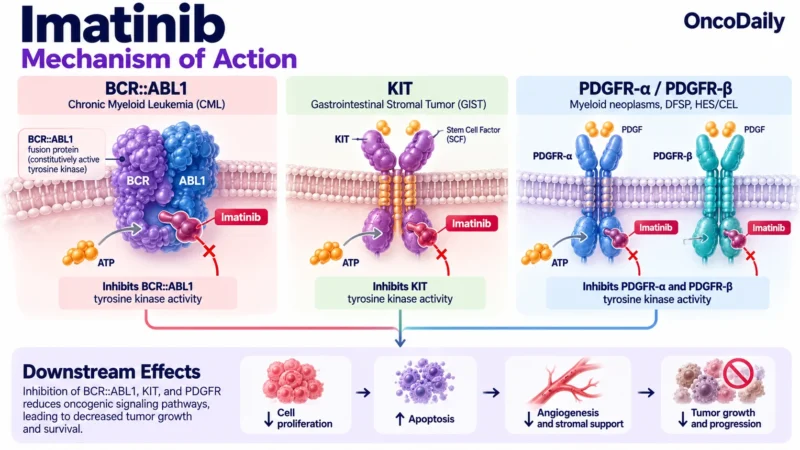
1. An Oncogenic Kinase Becomes Constitutively Active
In CML:
BCR::ABL1 continuously signals without normal regulatory control.
In GIST:
Activating mutations commonly affect:
KIT
or, less commonly:
PDGFRA.
2. Kinase Activation Drives Downstream Signaling
These abnormal kinases activate pathways such as:
- RAS–RAF–MEK–ERK
- PI3K–AKT
- JAK/STAT-related signaling
leading to:
- Increased proliferation
- Enhanced survival
- Reduced apoptosis
3. Imatinib Binds the ATP-Binding Site
Imatinib binds the inactive conformation of susceptible kinases and prevents:
ATP-dependent phosphorylation.
This inhibits:
- BCR::ABL1
- KIT
- PDGFR-α/β
4. Downstream Signaling Falls
Kinase inhibition reduces:
- Cellular proliferation
- Survival signaling
- Oncogenic transcription
- Tumor-cell persistence
5. Malignant Cells Undergo Growth Arrest and Apoptosis
The overall mechanism can be summarized as:
Imatinib → BCR::ABL1 / KIT / PDGFR inhibition → reduced phosphorylation → ↓oncogenic signaling → growth arrest and apoptosis.
What Is the Dose of Imatinib?
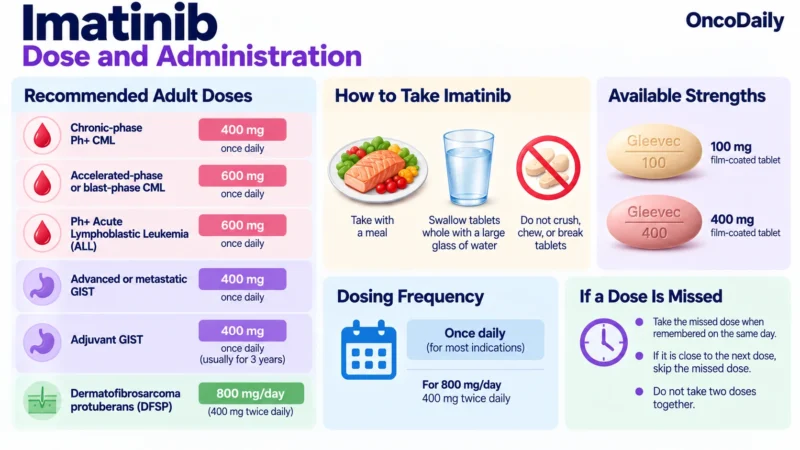
Imatinib dosing varies significantly by indication.
Chronic-Phase Ph+ CML
Recommended adult dose:
400 mg orally once daily.
Dose escalation to:
600 mg once daily
may be considered in selected patients with inadequate response or disease progression.
Accelerated-Phase or Blast-Crisis CML
Recommended dose:
600 mg orally once daily.
If appropriate and tolerated, escalation to:
800 mg/day
given as:
400 mg twice daily
may be considered for inadequate response or progression.
Pediatric Ph+ CML
Recommended dose:
340 mg/m²/day
with a maximum of:
600 mg/day.
The daily dose can be given once daily or divided into morning and evening doses.
Adult Ph+ Acute Lymphoblastic Leukemia
Recommended dose:
600 mg orally once daily.
Pediatric Ph+ ALL
When combined with chemotherapy:
340 mg/m²/day
up to:
600 mg/day.
Advanced or Metastatic GIST
Recommended starting dose:
400 mg orally once daily.
For patients with clear disease progression on 400 mg/day and no prohibitive toxicity, escalation to:
800 mg/day
given as:
400 mg twice daily
may be considered.
Adjuvant GIST
Recommended dose after complete gross resection of KIT-positive GIST:
400 mg orally once daily.
Clinical trials evaluated both:
- 1 year
- 3 years
of treatment.
For high-risk patients represented in the pivotal SSGXVIII/AIO population, 3 years is recommended in the US prescribing information, although optimal duration remains an area of ongoing research.
Dermatofibrosarcoma Protuberans
Recommended adult dose:
800 mg/day
usually administered as:
400 mg twice daily.
Hypereosinophilic Syndrome / Chronic Eosinophilic Leukemia
Standard dose:
400 mg once daily.
For patients with documented:
FIP1L1–PDGFRA
fusion kinase:
100 mg once daily
may be used initially, with escalation to 400 mg if response is insufficient and treatment is tolerated.
How Should Imatinib Be Taken?
Imatinib should be taken:
With a meal and a large glass of water.
This helps reduce gastrointestinal irritation.
Doses of:
- 400 mg
- 600 mg
are generally administered once daily.
A daily dose of:
800 mg
should generally be divided as:
400 mg twice daily.
For patients unable to swallow tablets, the tablets may be dispersed in:
- Water
- Apple juice.
What If a Dose Is Missed?
If a dose is missed:
- Skip the missed dose
- Take the next dose at the regularly scheduled time
- Do not take two doses together.
How Are Imatinib Dose Reductions Made?
Dose modifications depend heavily on:
- Indication
- Starting dose
- Type of toxicity
- Hematologic versus nonhematologic adverse reaction
For a patient receiving 400 mg/day, a common reduction for recurrent clinically significant toxicity is:
400 mg → 300 mg once daily.
For patients receiving 600 mg/day, dose reduction may proceed to:
400 mg/day
and, when necessary:
300 mg/day.
Because cytopenia management differs between chronic-phase CML, advanced CML, ALL, and GIST, dose modification should follow the indication-specific prescribing algorithm rather than a single universal sequence.
What Are the Important Drug Interactions With Imatinib?
Imatinib is substantially affected by:
CYP3A4.
Strong CYP3A4 Inducers
These can decrease imatinib exposure.
Examples include:
- Rifampin
- Carbamazepine
- Phenytoin
- Phenobarbital
- Rifabutin
They should generally be avoided.
If unavoidable, the prescribing information notes that imatinib dosage may need to be increased by at least:
50%
with close monitoring of clinical response.
CYP3A4 Inhibitors
Strong CYP3A4 inhibitors may increase imatinib exposure.
Examples include:
- Clarithromycin
- Ketoconazole
- Itraconazole
- Ritonavir
Patients should also avoid:
Grapefruit and grapefruit juice
because they can inhibit CYP3A4 and increase drug exposure.
Drugs Metabolized by CYP3A4 or CYP2D6
Imatinib can alter exposure to other medications metabolized through:
- CYP3A4
- CYP2D6
Medication review is therefore important.
The prescribing information also specifically highlights potential interactions with drugs such as:
Warfarin.
Does Imatinib Require Renal Dose Adjustment?
Renal dysfunction can increase imatinib exposure, and renal function may decline during prolonged treatment.
The label recommends caution in patients with renal impairment and emphasizes:
Baseline and ongoing renal-function assessment.
Long-term clinical data showed median eGFR declining from approximately:
85 mL/min/1.73 m² at baseline
to:
75 at 12 months
and:
69 at 60 months
in pooled CML/GIST populations.
Does Imatinib Require Hepatic Dose Adjustment?
For:
- Mild hepatic impairment
- Moderate hepatic impairment
the label permits doses up to:
400 mg/day.
For:
Severe hepatic impairment
the recommended dose is reduced to:
300 mg/day.
Liver-function monitoring is important because clinically significant hepatotoxicity can occur.
What Is the Pharmacokinetic Profile of Imatinib?
Imatinib is well absorbed after oral administration.
Its oral bioavailability is approximately:
98%.
Peak plasma concentrations generally occur within approximately:
2–4 hours.
Imatinib is highly protein bound and is metabolized predominantly by:
CYP3A4.
Its major active metabolite also contributes to pharmacologic activity.
The terminal half-life of imatinib is approximately:
18 hours
which supports once-daily dosing in most indications.
What Are the Clinical Uses of Imatinib?
1. Chronic Myeloid Leukemia
Imatinib fundamentally changed the natural history of:
Philadelphia chromosome-positive CML.
It remains FDA approved for:
- Newly diagnosed chronic-phase CML
- Chronic-phase CML after interferon failure
- Accelerated-phase disease
- Blast crisis.
2. Philadelphia Chromosome-Positive ALL
Imatinib is approved for:
Ph+ ALL
in adults and children in appropriate treatment settings.
3. Advanced GIST
Imatinib remains the foundational first-line targeted therapy for:
KIT-positive unresectable or metastatic GIST.
Tumor genotype is critical.
Particularly important molecular considerations include:
- KIT exon 11: generally highly imatinib-sensitive
- KIT exon 9: may benefit from higher-dose imatinib in advanced disease
- PDGFRA D842V: intrinsically resistant to imatinib and should be treated with alternative targeted therapy rather than imatinib
Mutation testing is therefore essential in modern GIST management.
4. Adjuvant GIST
Imatinib is FDA approved after complete resection of:
KIT-positive GIST.
For patients with high-risk, imatinib-sensitive disease, randomized evidence supports:
3 years of adjuvant therapy
rather than 1 year.
5. DFSP
Imatinib is approved for adults with:
Unresectable, recurrent, or metastatic dermatofibrosarcoma protuberans.
6. PDGFR-Driven Myeloid Disorders
Imatinib also has important roles in selected:
- MDS/MPD with PDGFR rearrangements
- HES/CEL
- Aggressive systemic mastocytosis
particularly when an imatinib-sensitive molecular alteration is present.
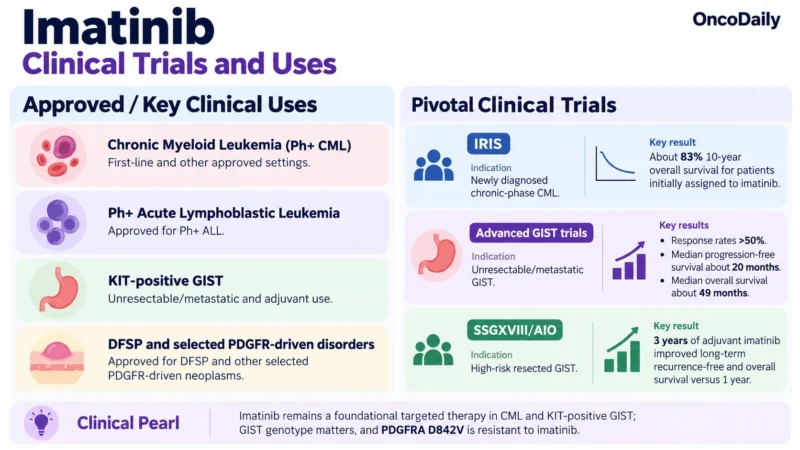
What Did the IRIS Trial Show?
The landmark IRIS trial compared imatinib with:
Interferon alfa + cytarabine
in newly diagnosed chronic-phase CML.
Long-term follow-up confirmed extraordinary disease control.
At approximately:
10 years
estimated overall survival among patients originally assigned to imatinib was:
83.3%.
These results established imatinib as one of the defining successes of precision oncology.
Long-Term CML Outcomes
CML Study IV also demonstrated excellent long-term survival with imatinib.
At 10 years:
- Overall survival: 82%
- Progression-free survival: 80%
- Relative survival: 92%.
These data illustrate how BCR::ABL1 inhibition transformed CML from a frequently fatal leukemia into a chronic disease for many patients.
What Did the Advanced GIST Trials Show?
Large randomized studies compared:
Imatinib 400 mg/day
with:
800 mg/day
in unresectable or metastatic GIST.
Across studies:
- Objective responses occurred in more than 50%
- Median PFS was approximately 20 months
- Median OS was approximately 49 months.
Long-term follow-up showed that a subset of patients remained progression-free for many years.
What Did SSGXVIII/AIO Show?
The pivotal randomized SSGXVIII/AIO trial compared:
- 1 year
- 3 years
of adjuvant imatinib 400 mg/day in patients with high-risk resected GIST.
Long-term analysis demonstrated improved recurrence-free survival and overall survival with longer therapy.
In patients with KIT exon 11 deletion/indel mutations:
10-Year Overall Survival
- 86% with 3 years
- 64% with 1 year
HR:
0.34
P = 0.007.
10-Year Recurrence-Free Survival
- 47%
- 29%
HR:
0.48
P < 0.001.
Is Imatinib FDA Approved?
Yes.
Current FDA-approved indications include:
- Ph+ CML
- Ph+ ALL
- PDGFR-associated MDS/MPD
- Aggressive systemic mastocytosis in selected patients
- HES/CEL
- DFSP
- Unresectable/metastatic KIT-positive GIST
- Adjuvant treatment after resection of KIT-positive GIST.
What Is the Current Clinical Role of Imatinib in 2026?
Chronic Myeloid Leukemia
Imatinib remains an effective first-line BCR::ABL1 inhibitor and retains enormous clinical importance because of:
- Long-term efficacy
- Extensive safety experience
- Generic availability
- Global accessibility
However, newer-generation TKIs can achieve faster and deeper molecular responses in selected patients.
Treatment choice therefore depends on:
- Disease risk
- Comorbidities
- Treatment-free-remission goals
- Mutation profile
- Toxicity considerations
- Cost and access.
Read more: 200 Most Influential Cancer Papers Suggested by Sendurai Mani: Imatinib for CML by OncoDaily.
Watch more: A lecture on imatinib (Gleevec), BCR-ABL, and the development of targeted therapy in chronic myeloid leukemia, including the biology of CML and the clinical development of imatinib.
Gastrointestinal Stromal Tumor
Imatinib remains the foundational first-line systemic therapy for imatinib-sensitive GIST.
Its role includes:
- Neoadjuvant treatment in selected locally advanced disease
- Adjuvant treatment after high-risk resection
- First-line treatment of unresectable/metastatic disease
Mutation testing is essential because response varies considerably by genotype.
For PDGFRA D842V-mutant GIST, imatinib should not be relied upon because this mutation is resistant.
For selected KIT exon 9-mutant metastatic GIST, higher-dose treatment may improve disease control.
Ph+ ALL
Although modern Ph+ ALL treatment increasingly incorporates more potent TKIs and immunotherapy-based strategies, imatinib retains regulatory approval and remains clinically relevant in some treatment settings, particularly where newer agents are unavailable or contraindicated.
Rare PDGFR-Driven Malignancies
Imatinib can produce dramatic responses in selected diseases driven by susceptible PDGFR alterations, particularly:
FIP1L1–PDGFRA-positive HES/CEL.
Molecular testing is therefore central to patient selection.
What Are the Major Side Effects of Imatinib?
Common adverse effects include:
- Edema
- Periorbital edema
- Nausea
- Diarrhea
- Muscle cramps
- Musculoskeletal pain
- Rash
- Fatigue
- Abdominal discomfort
- Cytopenias.
Important serious toxicities include:
- Severe fluid retention
- Cytopenias
- Congestive heart failure
- Hepatotoxicity
- Hemorrhage
- Gastrointestinal toxicity
- Severe dermatologic reactions
- Tumor lysis syndrome
- Renal toxicity.
Fluid Retention and Edema
Fluid retention is one of imatinib’s most characteristic toxicities.
It can present as:
- Periorbital edema
- Peripheral edema
- Pleural effusion
- Pericardial effusion
- Ascites
- Pulmonary edema
Patients should be:
Weighed and monitored regularly.
Unexpected rapid weight gain should prompt evaluation and may require:
- Diuretics
- Treatment interruption
- Dose modification.
Hematologic Toxicity
Imatinib can cause:
- Anemia
- Neutropenia
- Thrombocytopenia
The prescribing information recommends CBC monitoring:
- Weekly during the first month
- Every 2 weeks during the second month
- Periodically thereafter.
Severe cytopenias may require:
- Treatment interruption
- Dose reduction
- Discontinuation.
Hepatotoxicity
Imatinib can cause:
- ALT elevation
- AST elevation
- Hyperbilirubinemia
- Rare severe hepatic failure
Monitor:
- ALT
- AST
- Bilirubin
before and during treatment.
Clinically significant toxicity may require interruption or dose reduction.
Cardiac Toxicity
Congestive heart failure and left ventricular dysfunction have been reported, particularly in patients with:
- Advanced age
- Pre-existing cardiovascular disease
- Other cardiac risk factors.
Patients with relevant risk should be monitored for:
- Dyspnea
- Edema
- Weight gain
- Cardiac symptoms.
Renal Toxicity
Long-term imatinib can be associated with progressive reduction in renal function.
Monitor:
- Serum creatinine
- eGFR
- Renal risk factors
at baseline and periodically during treatment.
Dermatologic Toxicity
Common effects include:
- Rash
- Pruritus
- Dry skin
Rare severe reactions may occur and require urgent evaluation.
Tumor Lysis Syndrome
Tumor lysis syndrome has been reported, particularly in patients with:
- High tumor burden
- Rapidly responsive disease
Correct:
- Dehydration
- Hyperuricemia
before starting therapy when clinically indicated.
Pregnancy and Breastfeeding
Imatinib can cause fetal harm.
Women of reproductive potential should use highly effective contraception:
During treatment and for 14 days after the final dose.
Breastfeeding should be avoided:
During treatment and for 1 month after the final dose.
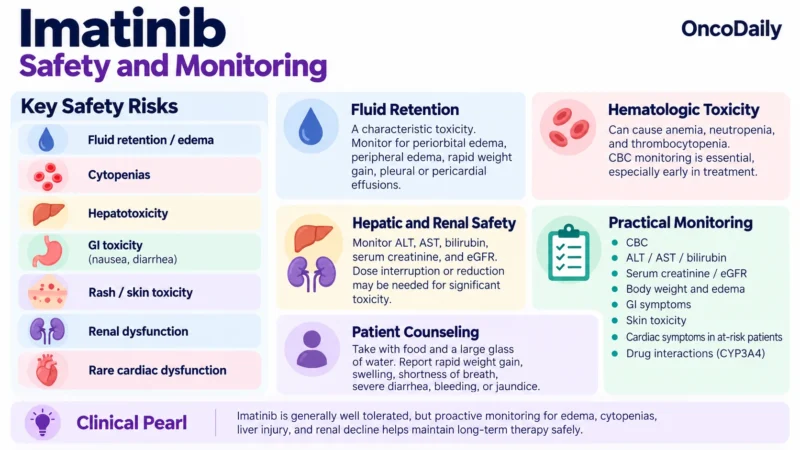
What Monitoring Is Required?
Monitoring during imatinib treatment should include:
- CBC
- Hemoglobin
- Neutrophils
- Platelets
- ALT
- AST
- Bilirubin
- Renal function
- Serum creatinine / eGFR
- Body weight
- Signs of edema or fluid retention
- GI symptoms
- Skin toxicity
- Cardiac symptoms in at-risk patients
- Drug interactions
- Disease-specific molecular monitoring
For CML, this additionally includes:
Serial BCR::ABL1 quantitative PCR monitoring.
For GIST, monitoring should include:
- Imaging response
- Tumor mutation profile
- Signs of progression or secondary resistance.
FAQ
What Is Imatinib Used For?
- Ph+ CML
- Ph+ ALL
- KIT-positive GIST
- Selected PDGFR-driven disorders
- DFSP.
What Is the Standard Dose for Chronic-Phase CML?
What Is the Standard GIST Dose?
Can the GIST Dose Be Increased?
In selected patients with progression:
800 mg/day, usually as 400 mg twice daily, may be considered.
Should Imatinib Be Taken With Food?
Take it:
With a meal and a large glass of water.
How Does Imatinib Work?
BCR::ABL1, KIT, and PDGFR
and thereby blocks oncogenic kinase signaling.
What Did IRIS Show?
83.3%.
What Is the Standard Adjuvant GIST Duration?
3 years is the established standard based on randomized evidence, although optimal duration remains under investigation.