Sendurai Mani, Associate Director of Translational Oncology at the Legorreta Cancer Center, is presenting a series exploring some of the most influential scientific papers that have shaped the field of cancer research on LinkedIn:
Paper 5 of 200: Imatinib for CML – The Paper That Helped Launch the Targeted Therapy Era
I recently shared an AI-generated (Claude) list of the top 200 papers that have shaped cancer research on LinkedIn. Today, I share more about Paper 5.
What if cancer treatment could target the specific molecular abnormality driving a tumor rather than broadly killing rapidly dividing cells?
In 2001, Brian Druker and colleagues published a landmark New England Journal of Medicine study showing the remarkable clinical activity of imatinib (STI571) in chronic myeloid leukemia (CML).
CML had already provided one of the clearest molecular stories in cancer biology.
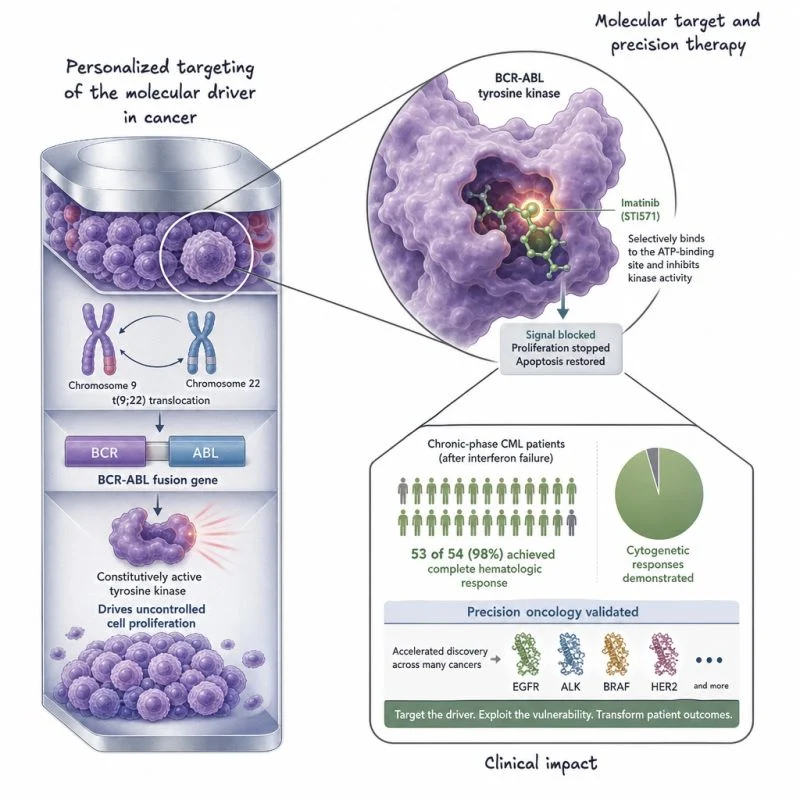
The Philadelphia chromosome, created by the t(9;22) translocation, encodes the BCR-ABL fusion protein, a constitutively active tyrosine kinase that drives disease.
Imatinib was designed to inhibit this abnormal kinase.
In patients with chronic-phase CML in whom interferon therapy had failed, the results were striking: 53 of 54 patients achieved a complete hematologic response, and cytogenetic responses were also observed.
This was more than a successful drug trial.
It provided powerful clinical proof of a new therapeutic philosophy: Identify the molecular driver – understand its biology – design a drug that selectively inhibits it – treat the cancer based on that vulnerability.
Imatinib helped transform CML from a life-threatening leukemia into a disease that, for many patients, can be controlled for years with targeted therapy.
Its impact also extended far beyond CML.
The success of imatinib strengthened the concept of precision oncology and accelerated the search for actionable molecular alterations across cancer, including EGFR, ALK, BRAF, HER2, and many others.
The enduring lesson: understanding what drives a cancer can reveal its Achilles’ heel. Modern targeted oncology owes an enormous debt to this principle.
Authors: Brian J. Druker, Moshe Talpaz, Debra J. Resta, Bin Peng, Elisabeth Buchdunger, John M. Ford, Nicholas B. Lydon, Hagop Kantarjian, Renaud Capdeville, Sayuri Ohno-Jones, and Charles L. Sawyers