


Gemtuzumab Ozogamicin (Mylotarg): Mechanism of Action, Dosing, Clinical Uses, Trials, and Side Effects
Key takeaways
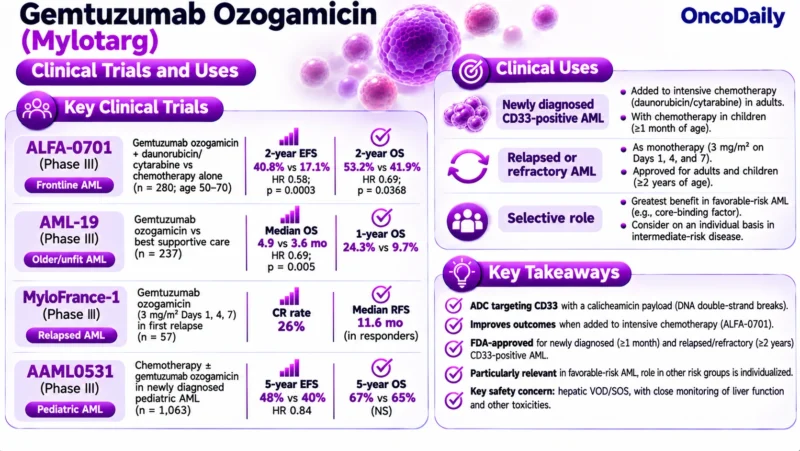
- Gemtuzumab ozogamicin is a CD33-directed antibody–drug conjugate.
- It carries a calicheamicin payload, which causes DNA double-strand breaks.
- It was initially FDA approved in 2000 and reapproved in 2017.
- The principal fractionated schedule is 3 mg/m² on Days 1, 4, and 7, with a 4.5-mg maximum per dose in specified regimens.
- It is approved for newly diagnosed and relapsed/refractory CD33-positive AML.
- ALFA-0701 demonstrated improved event-free survival with the addition of Mylotarg to intensive chemotherapy.
- AML-19 supported its use as monotherapy in older adults unsuitable for intensive chemotherapy.
- MyloFrance-1 supported its fractionated salvage regimen.
- AAML0531 established improved event-free survival in pediatric AML.
- The most important serious adverse reaction is hepatic VOD/SOS.
- Close CBC, liver-function, infection, and bleeding surveillance is essential.
Gemtuzumab ozogamicin (Mylotarg) is a CD33-directed antibody–drug conjugate (ADC) used to treat CD33-positive acute myeloid leukemia (AML). It combines a humanized monoclonal antibody with calicheamicin, a highly potent cytotoxic agent that produces DNA double-strand breaks.
After binding CD33 on leukemic blasts, gemtuzumab ozogamicin is internalized. Intracellular cleavage of its linker releases a calicheamicin derivative, causing DNA damage, cell-cycle arrest, and apoptosis.
Mylotarg initially received FDA approval in May 2000. It was voluntarily withdrawn from the U.S. market in 2010 following safety concerns and unfavorable outcomes with the earlier high-dose regimen. In September 2017, the FDA reapproved gemtuzumab ozogamicin using lower, fractionated dosing supported by new clinical evidence.
Its subsequent approvals expanded treatment to pediatric patients.
Gemtuzumab ozogamicin remains an important therapeutic option for selected patients with newly diagnosed or relapsed/refractory CD33-positive AML, particularly those with favorable- or intermediate-risk disease.
Major clinical trials include ALFA-0701, AML-19, MyloFrance-1, and AAML0531.
Key Facts
- Generic name: Gemtuzumab ozogamicin
- Brand name: Mylotarg
- Drug class: Antibody–drug conjugate
- Target: CD33 (SIGLEC-3)
- Antibody type: Humanized IgG4κ
- Cytotoxic payload: N-acetyl gamma calicheamicin derivative
- Linker: Acid-labile, hydrolytically cleavable linker
- Mechanism: CD33 binding, internalization, payload release, DNA double-strand breaks, and apoptosis
- Initial FDA approval: May 2000
- FDA reapproval: September 2017
- Administration: Intravenous infusion over two hours
- Common fractionated dose: 3 mg/m² on Days 1, 4, and 7, with a maximum of 4.5 mg per dose
- Additional dosing: 6 mg/m² on Day 1 and 3 mg/m² on Day 8 for selected newly diagnosed adults receiving monotherapy
- FDA indications: Newly diagnosed and relapsed/refractory CD33-positive AML
- Pediatric indications: Newly diagnosed AML from one month of age; relapsed/refractory AML from two years of age
- Pivotal trials: ALFA-0701, AML-19, MyloFrance-1, AAML0531
- Important biomarker: CD33 expression
- Major adverse reactions: Cytopenias, hemorrhage, infections, fever, mucositis, and liver-enzyme elevations
- Boxed warning: Hepatotoxicity, including hepatic veno-occlusive disease/sinusoidal obstruction syndrome (VOD/SOS)
- Monitoring: CBC, liver function, bleeding, infections, infusion reactions, and signs of VOD/SOS
- Available strength: 4.5-mg single-dose vial
What Is Gemtuzumab Ozogamicin?
Gemtuzumab ozogamicin is a targeted cytotoxic therapy designed to deliver calicheamicin to CD33-expressing leukemic cells.
It consists of three principal components:
1. Anti-CD33 Monoclonal Antibody
The humanized IgG4κ antibody recognizes CD33 on the surface of myeloid cells.
CD33 is commonly expressed on AML blasts, although expression varies among patients and molecular subtypes.
2. Cleavable Linker
A hydrolytically cleavable linker connects the antibody with the cytotoxic payload.
The linker permits intracellular release of calicheamicin following ADC internalization.
3. Calicheamicin Payload
Calicheamicin is an extremely potent DNA-damaging agent.
Unlike the MMAE payload in brentuximab vedotin, which inhibits microtubules, calicheamicin causes DNA double-strand breaks.
This activates DNA-damage responses and ultimately leads to apoptosis.
What Is the Mechanism of Action of Gemtuzumab Ozogamicin?
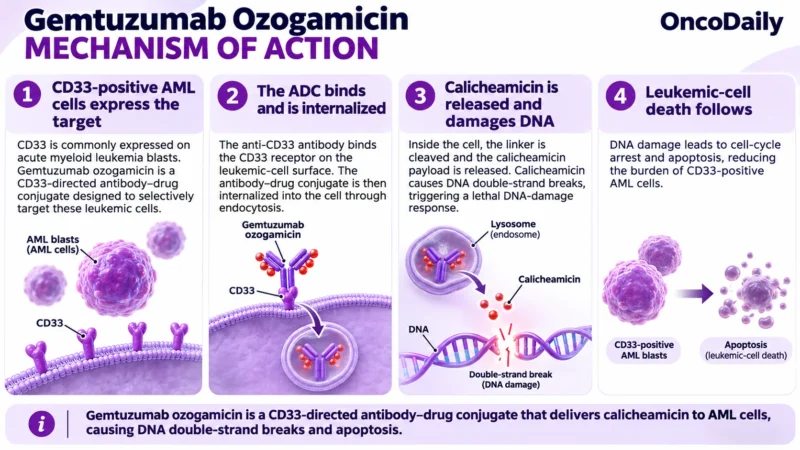
1. CD33 Recognition
Gemtuzumab ozogamicin binds CD33 on AML cells.
CD33 belongs to the sialic acid-binding immunoglobulin-like lectin family.
It is expressed on many normal myeloid cells and leukemic myeloblasts.
2. ADC Internalization
Following antibody binding, the CD33–ADC complex undergoes receptor-mediated internalization.
The complex is transported into intracellular endosomal and lysosomal compartments.
3. Calicheamicin Release
Intracellular processing and hydrolytic linker cleavage release the calicheamicin derivative.
The payload becomes activated within the cell.
4. DNA Double-Strand Breaks
Activated calicheamicin binds DNA and causes double-strand breaks.
These lesions interfere with DNA integrity and activate cellular damage-response pathways.
5. Cell-Cycle Arrest
Severe DNA damage prevents leukemic cells from progressing normally through the cell cycle.
6. Apoptosis
The accumulation of DNA damage results in programmed cell death.
This reduces the population of CD33-expressing leukemic cells.
Overall mechanism:
Gemtuzumab ozogamicin → CD33 binding → internalization → calicheamicin release → DNA double-strand breaks → cell-cycle arrest → apoptosis.
What Is the Recommended Dose of Gemtuzumab Ozogamicin?
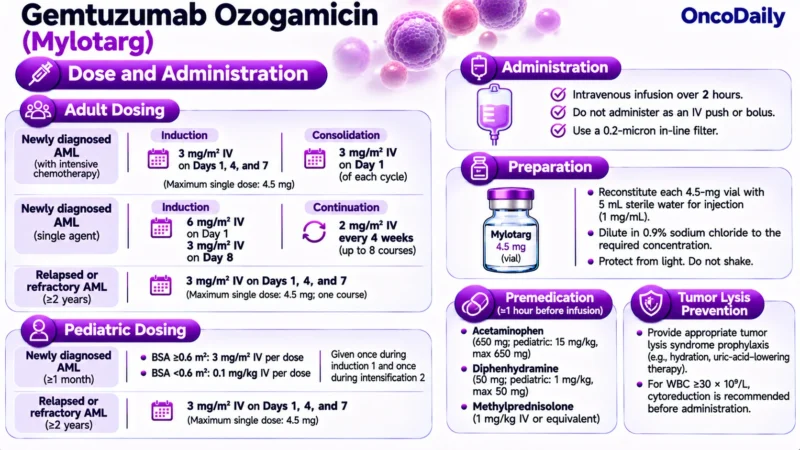
Dosing depends on age, disease status, and whether Mylotarg is administered alone or with chemotherapy.
Newly Diagnosed De Novo AML — Adult Combination Regimen
Gemtuzumab ozogamicin is administered with:
Daunorubicin
Cytarabine
Induction
3 mg/m² IV on Days 1, 4, and 7.
Maximum single dose: 4.5 mg.
If a second induction cycle is required, do not administer additional gemtuzumab ozogamicin during that cycle.
Consolidation
3 mg/m² IV on Day 1 of each consolidation cycle.
Maximum single dose: 4.5 mg.
The FDA-labeled combination course includes one induction cycle and up to two consolidation cycles containing gemtuzumab ozogamicin.
Newly Diagnosed AML — Adult Single-Agent Regimen
Induction
- Day 1: 6 mg/m² IV
- Day 8: 3 mg/m² IV
These doses are not limited to a single 4.5-mg vial.
Continuation
For patients without progression following induction:
2 mg/m² IV on Day 1 every four weeks, for up to eight continuation courses.
Relapsed or Refractory AML — Adults and Children Aged Two Years or Older
3 mg/m² IV on Days 1, 4, and 7.
Maximum single dose: 4.5 mg.
The FDA-labeled regimen consists of one course.
Newly Diagnosed Pediatric AML — From One Month of Age
Gemtuzumab ozogamicin is administered with standard chemotherapy.
Body Surface Area at Least 0.6 m²
3 mg/m² IV per scheduled dose.
Body Surface Area Below 0.6 m²
0.1 mg/kg IV per scheduled dose.
The drug is administered once during the first induction cycle and may be administered once during the second intensification cycle, according to the protocol.
It is not given during the second induction cycle or the first and third intensification cycles.
How Should Gemtuzumab Ozogamicin Be Administered?
Intravenous Administration
Mylotarg is administered as an intravenous infusion over:
2 hours.
It must not be administered as an IV push or bolus.
Preparation
Each vial contains 4.5 mg of gemtuzumab ozogamicin.
Reconstitute with:
5 mL sterile water for injection.
The resulting concentration is:
1 mg/mL, with a deliverable volume of 4.5 mL.
Dilute in 0.9% sodium chloride to the concentration specified in the prescribing information.
Use a 0.2-micron polyethersulfone in-line filter.
Protect the reconstituted and diluted solution from light. Do not shake.
Premedication
Adults
Approximately one hour before infusion:
- Acetaminophen 650 mg orally
- Diphenhydramine 50 mg orally or intravenously
Within 30 minutes before infusion:
- Methylprednisolone 1 mg/kg IV or an equivalent corticosteroid
Pediatric Patients
- Acetaminophen 15 mg/kg, maximum 650 mg
- Diphenhydramine 1 mg/kg, maximum 50 mg
- Methylprednisolone 1 mg/kg or equivalent
Tumor Lysis Prevention
Provide appropriate tumor lysis syndrome prophylaxis and monitoring.
For patients with a white blood cell count of 30 × 10⁹/L or higher, cytoreduction is recommended before administration.
What Should You Do If a Gemtuzumab Ozogamicin Dose Is Missed?
If a scheduled dose is delayed:
- Reassess the cause of the delay.
- Review CBC and liver function.
- Administer or omit the dose according to the protocol and product label.
- Do not double subsequent doses.
For certain toxicities, if a scheduled dose in a fractionated course is delayed by more than two days, the label recommends omitting that dose.
How Are Gemtuzumab Ozogamicin Dose Modifications Managed?
Hepatic Veno-Occlusive Disease/Sinusoidal Obstruction Syndrome
Permanently discontinue Mylotarg if VOD/SOS develops.
Provide urgent supportive care and specialist management.
Elevated Liver Enzymes or Bilirubin
Delay treatment if:
- Total bilirubin exceeds 2 × ULN, or
- AST or ALT exceeds 2.5 × ULN.
Resume only after recovery to the specified thresholds.
Persistent Thrombocytopenia
In adult combination treatment, discontinue Mylotarg from planned consolidation cycles if platelet recovery remains inadequate beyond the protocol-defined interval.
Persistent Neutropenia
Similarly, omit further Mylotarg from consolidation if neutrophil recovery remains inadequate according to the labeled criteria.
Infusion Reactions
Interrupt the infusion and provide appropriate supportive treatment.
For a non-life-threatening reaction that resolves, carefully consider restarting at a reduced infusion rate according to the label.
Severe or life-threatening infusion reactions can require permanent discontinuation.
What Drug Interactions Are Important With Gemtuzumab Ozogamicin?
Myelosuppressive Chemotherapy
Combination with daunorubicin and cytarabine can increase:
- Neutropenia
- Thrombocytopenia
- Infection risk
- Bleeding
- Delayed hematologic recovery
Hepatotoxic Medications
Concomitant hepatotoxic drugs may complicate liver injury or increase clinical risk.
Use caution and monitor hepatic function.
Hematopoietic Stem Cell Transplantation
The risk of VOD/SOS is particularly important in patients undergoing hematopoietic stem cell transplantation (HSCT).
Before transplantation, consider the cumulative dose, hepatic status, and interval since the last Mylotarg dose.
The ALFA-0701 protocol recommended approximately two months between the last Mylotarg dose and HSCT; individual transplant planning requires specialist assessment.
QT-Prolonging Medications
Mylotarg carries a warning concerning QT-interval prolongation.
Review concurrent QT-prolonging medications and correct electrolyte disturbances.
Does Gemtuzumab Ozogamicin Require Dose Adjustment in Renal or Hepatic Impairment?
Renal Impairment
No standard dose adjustment is established for mild or moderate renal impairment.
Data in severe renal impairment are limited.
Monitor renal function and metabolic complications according to the patient’s condition and chemotherapy regimen.
Hepatic Impairment
Hepatic function is particularly important because of VOD/SOS risk.
Patients with baseline hepatic impairment require individualized assessment and close monitoring.
Delay dosing for liver-test abnormalities exceeding the product-label thresholds.
What Is the Pharmacokinetic Profile of Gemtuzumab Ozogamicin?
Distribution
The antibody–drug conjugate circulates in plasma before binding CD33-positive cells.
Metabolism
The antibody component undergoes proteolytic degradation.
Intracellular linker cleavage permits release and activation of the calicheamicin derivative.
Clearance
Gemtuzumab ozogamicin exhibits target-mediated and nonspecific clearance.
Clearance can change after repeated dosing as circulating leukemic blasts are depleted.
Half-Life
Pharmacokinetics are nonlinear and depend on the dose, disease burden, and treatment schedule.
The conjugated antibody has a prolonged elimination phase, while exposure to released calicheamicin varies with intracellular processing and systemic clearance.
A single fixed terminal half-life should not be assumed for all dosing schedules.
What Are the Clinical Uses of Gemtuzumab Ozogamicin?
Newly Diagnosed CD33-Positive AML in Adults
Gemtuzumab ozogamicin can be added to intensive daunorubicin/cytarabine chemotherapy in appropriately selected patients.
Evidence is particularly favorable for patients with favorable-risk cytogenetics, including certain core-binding factor AML subtypes.
Benefit is less consistent in adverse-risk disease.
Treatment selection must consider cytogenetic and molecular findings, fitness for intensive chemotherapy, hepatic status, and transplantation plans.
Newly Diagnosed AML in Patients Unsuitable for Intensive Chemotherapy
Single-agent Mylotarg has an FDA-approved dosing regimen, supported by the AML-19 trial in older adults unsuitable for intensive chemotherapy.
However, modern treatment commonly includes hypomethylating agent–venetoclax combinations or mutation-directed treatments.
Consequently, single-agent gemtuzumab ozogamicin has a more limited role in current practice.
Relapsed or Refractory AML
Fractionated Mylotarg monotherapy may be considered in selected patients with CD33-positive disease.
The MyloFrance-1 trial demonstrated antileukemic responses.
The choice of treatment depends on:
- Prior therapy
- Cytogenetic and molecular abnormalities
- Eligibility for HSCT
- Hepatic function
- Available alternative therapies
Pediatric AML
Mylotarg is approved with chemotherapy for newly diagnosed CD33-positive AML in patients aged one month or older.
It is also approved as monotherapy for relapsed or refractory disease from two years of age.
What Molecular Testing Is Required Before Gemtuzumab Ozogamicin?
CD33 Expression
The primary requirement is confirmation of CD33-positive AML.
CD33 is usually assessed through multiparameter flow cytometry during diagnostic immunophenotyping.
Routine testing generally also evaluates:
- CD13
- CD34
- CD117
- Myeloperoxidase
- HLA-DR
- Other markers appropriate to the leukemia phenotype
There is no universal CD33-expression percentage threshold required for every approved setting.
Cytogenetic Risk Assessment
Baseline AML evaluation should include conventional cytogenetics and relevant molecular testing.
Important findings include:
- RUNX1::RUNX1T1
- CBFB::MYH11
- NPM1 mutation
- FLT3 alterations
- CEBPA mutations
- TP53 alterations
- Other abnormalities relevant to ELN risk stratification
Favorable-risk disease generally derives the clearest benefit from adding gemtuzumab ozogamicin, although the individual treatment decision remains dependent on the complete clinical picture.
Baseline Organ Assessment
Before starting treatment, assess:
- CBC and platelet count
- AST, ALT, bilirubin
- Renal function
- Electrolytes
- Infection status
- Prior liver disease or HSCT
- Planned transplantation
What Did the Pivotal Clinical Trials Show?
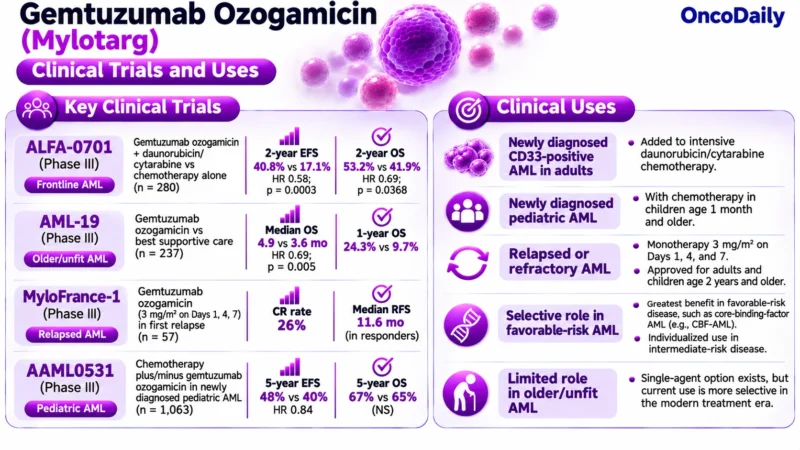
ALFA-0701 — Frontline CD33-Positive AML
ALFA-0701 was a randomized phase III trial evaluating gemtuzumab ozogamicin added to daunorubicin and cytarabine in adults aged 50–70 years with newly diagnosed de novo AML.
A total of 280 patients were randomized.
The experimental regimen included:
Gemtuzumab ozogamicin 3 mg/m² on Days 1, 4, and 7.
Two-Year Event-Free Survival
- Mylotarg + chemotherapy: 40.8%
- Chemotherapy alone: 17.1%
HR: 0.58; p = 0.0003
Two-Year Overall Survival
- Mylotarg + chemotherapy: 53.2%
- Chemotherapy alone: 41.9%
HR: 0.69; p = 0.0368
Two-Year Relapse-Free Survival
- Mylotarg + chemotherapy: 50.3%
- Chemotherapy alone: 22.7%
HR: 0.52
The trial demonstrated that lower fractionated doses could improve disease-control outcomes, although prolonged thrombocytopenia and hepatic toxicity remained important concerns.
These figures are from the original analysis; longer follow-up yielded additional efficacy estimates.
AML-19 — Monotherapy in Older Patients
The randomized phase III AML-19 trial compared:
- Single-agent gemtuzumab ozogamicin
- Best supportive care
in older patients considered unsuitable for intensive induction chemotherapy.
A total of 237 patients were randomized.
Median Overall Survival
- Gemtuzumab ozogamicin: 4.9 months
- Best supportive care: 3.6 months
HR: 0.69; p = 0.005
One-Year Overall Survival
- Gemtuzumab ozogamicin: 24.3%
- Best supportive care: 9.7%
The trial supported the single-agent indication, although its historical comparator does not reflect the full range of modern lower-intensity AML treatments.
MyloFrance-1 — Relapsed CD33-Positive AML
MyloFrance-1 was a phase II study evaluating fractionated gemtuzumab ozogamicin in adults with CD33-positive AML in first relapse.
57 patients received:
3 mg/m² on Days 1, 4, and 7.
Complete Remission Rate
26%
Median Relapse-Free Survival Among Responders
11.6 months
The study supported the fractionated regimen for relapsed/refractory AML.
No VOD/SOS events were reported in this study population, although the risk is well established across other settings.
AAML0531 — Pediatric AML
The randomized Children’s Oncology Group AAML0531 study evaluated the addition of gemtuzumab ozogamicin to standard chemotherapy in children and young adults with newly diagnosed AML.
The study enrolled 1,063 patients.
Five-Year Event-Free Survival
- Mylotarg + chemotherapy: 48%
- Chemotherapy alone: 40%
HR: 0.84
No significant overall survival improvement was demonstrated.
Although adding gemtuzumab ozogamicin reduced relapse risk, toxicity, including prolonged cytopenias and transplant-associated VOD/SOS, remained clinically important.
These findings supported pediatric expansion of the FDA indication in June 2020.
Does Gemtuzumab Ozogamicin Have CNS Activity?
Gemtuzumab ozogamicin is not established as a CNS-directed treatment.
Its antibody component has limited penetration across the intact blood–brain barrier.
Although CD33 may be expressed on leukemic cells involving the CNS, the clinical evidence does not support using Mylotarg alone to treat CNS leukemia.
Patients with CNS AML require appropriate CNS-directed treatment, potentially including intrathecal therapy and systemic approaches selected for the specific clinical setting.
Is Gemtuzumab Ozogamicin FDA Approved?
Yes.
Important regulatory milestones include:
- May 2000: Initial FDA approval for CD33-positive AML.
2010: Voluntary withdrawal from the U.S. market. - September 2017: FDA reapproval using revised, lower-dose regimens.
- June 2020: Expansion to newly diagnosed pediatric AML from one month of age.
Current U.S. indications include:
1. Newly diagnosed CD33-positive AML: Adults and pediatric patients aged one month or older.
2. Relapsed or refractory CD33-positive AML: Adults and pediatric patients aged two years or older.
What Is the Current Clinical Role of Gemtuzumab Ozogamicin in 2026?
Favorable-Risk AML
Mylotarg remains particularly relevant in selected patients with favorable-risk AML receiving intensive induction chemotherapy.
Its use may help reduce relapse risk and improve event-free survival.
Watch More: Treating CD33-Positive AML With Gemtuzumab Ozogamicin.
Intermediate-Risk AML
Treatment may be considered depending on clinical characteristics, cytogenetic findings, and the overall therapeutic strategy.
Adverse-Risk AML
The survival benefit is less certain, and routine use is generally less compelling.
Older or Unfit Patients
Single-agent gemtuzumab ozogamicin remains an approved option, but contemporary treatments with more substantial evidence in many molecular and fitness-defined populations have reduced its prominence.
Relapsed or Refractory AML
Mylotarg may be considered for selected patients, including those requiring a CD33-targeted salvage strategy.
However, its role must be weighed against targeted agents, contemporary salvage regimens, clinical trials, and transplant plans.
What Are the Major Side Effects of Gemtuzumab Ozogamicin?
Hepatic Veno-Occlusive Disease/Sinusoidal Obstruction Syndrome
VOD/SOS is the most important serious toxicity and the subject of Mylotarg’s FDA boxed warning.
It involves injury to hepatic sinusoidal endothelial cells, potentially resulting in impaired hepatic blood flow and liver dysfunction.
Clinical manifestations include:
- Rapid weight gain
- Right upper quadrant abdominal pain
- Hepatomegaly
- Ascites
- Hyperbilirubinemia
- Fluid retention
- Liver failure
In ALFA-0701, VOD/SOS was reported in approximately 5% of patients receiving gemtuzumab ozogamicin.
Risk is increased in patients with substantial hepatic impairment, previous HSCT, or subsequent transplantation.
Severe and fatal cases have occurred.
Read More: Zhemal Rakhmanova at LeukO 2026: SOS/VOD – The Deadly Complication of Life-Saving Treatment by OncoDaily.
Thrombocytopenia and Hemorrhage
Severe thrombocytopenia may lead to:
- Gastrointestinal bleeding
- Epistaxis
- Intracranial hemorrhage
- Pulmonary hemorrhage
- Other clinically significant bleeding
Fatal hemorrhage has been reported.
Neutropenia and Infections
Gemtuzumab ozogamicin can cause prolonged myelosuppression.
Complications include:
- Febrile neutropenia
- Bacterial infections
- Pneumonia
- Sepsis
- Opportunistic infections
Infusion-Related Reactions
Reactions may occur during or shortly after infusion.
Symptoms include:
- Fever
- Chills
- Hypotension
- Dyspnea
- Bronchospasm
- Rash
- Anaphylaxis
Hepatotoxicity
Elevated AST, ALT, and bilirubin may occur without clinically established VOD/SOS.
Significant hepatic abnormalities require treatment interruption and assessment.
Gastrointestinal Toxicity
Common adverse reactions include:
- Nausea
- Vomiting
- Constipation
- Diarrhea
- Mucositis
- Reduced appetite
QT-Interval Prolongation
Patients with cardiac risk factors, electrolyte disturbances, or exposure to QT-prolonging medications may require additional ECG monitoring.
Tumor Lysis Syndrome
Rapid destruction of leukemic cells may cause metabolic disturbances, including:
- Hyperkalemia
- Hyperphosphatemia
- Hypocalcemia
- Hyperuricemia
Acute kidney injury
Embryo-Fetal Toxicity
Mylotarg can cause fetal harm.
The prescribing information recommends effective contraception:
- Females: During treatment and for at least six months after the last dose.
- Males: During treatment and for at least three months after the last dose.
What Monitoring Is Required During Gemtuzumab Ozogamicin Treatment?
Complete Blood Count
Monitor:
- Neutrophils
- Hemoglobin
- Platelets
- Total leukocytes
Blood counts should be followed frequently during treatment and recovery.
The prescribing information recommends monitoring blood counts and chemistry parameters at least three times weekly through recovery from treatment-related toxicities.
Liver Function
Monitor before and during treatment:
- AST
- ALT
- Bilirubin
- Alkaline phosphatase
- Other parameters according to clinical condition
Investigate abnormalities promptly, particularly when accompanied by fluid retention or abdominal symptoms.
VOD/SOS Surveillance
Assess for:
- Rapid weight gain
- Right upper quadrant pain
- Hepatomegaly
- Ascites
- Rising bilirubin
- New fluid retention
Monitoring is particularly important around HSCT.
Hemorrhage Monitoring
Evaluate for bleeding and maintain appropriate platelet transfusion support.
Infection Surveillance
Monitor for fever, respiratory symptoms, and other signs of infection.
In patients with prolonged neutropenia, use antimicrobial prophylaxis according to AML protocols and institutional guidance.
Infusion Monitoring
Monitor patients during infusion and for at least one hour afterward.
Provide premedication before each dose.
Tumor Lysis Monitoring
Assess:
- Potassium
- Phosphate
- Calcium
- Uric acid
- Creatinine
- LDH
Monitoring intensity depends on tumor burden and treatment-related risk.
Cardiac Monitoring
Consider ECG and electrolyte monitoring in patients with QT-prolongation risk factors.
Pregnancy Monitoring
Confirm pregnancy status when appropriate and provide reproductive counseling.