


Dasatinib (Sprycel): Understanding Its Mechanism, Dosing, Clinical Uses, and Role in CML and Philadelphia Chromosome-Positive ALL
Key takeaways
- Dasatinib is a potent second-generation BCR::ABL1 and SRC-family TKI.
- Adult chronic-phase CML dosing is 100 mg once daily.
- Advanced-phase CML and adult Ph+ ALL dosing is 140 mg once daily.
- It can be taken with or without food.
- Strong CYP3A4 inhibitors and inducers require avoidance or dose-management strategies.
- PPIs and H2 blockers should generally not be coadministered because they markedly reduce dasatinib exposure.
- DASISION demonstrated cumulative 5-year MMR of 76% vs 64% versus imatinib.
- CA180-034 confirmed durable efficacy of 100 mg once daily after imatinib resistance/intolerance.
- Pleural effusion is the most characteristic toxicity.
- Other important risks include myelosuppression, bleeding, PAH, cardiovascular toxicity, QT prolongation, and hepatotoxicity.
- Dasatinib is ineffective against BCR::ABL1 T315I.
- In 2026, dasatinib remains an established option in CML and Ph+ ALL, with TKI choice increasingly individualized according to molecular goals and comorbidity profile.
Dasatinib (Sprycel) is an oral second-generation tyrosine kinase inhibitor (TKI) with potent activity against BCR::ABL1 and several additional kinases, including the SRC family kinases, KIT, EPHA2, and PDGFR-β. It was developed to overcome several mechanisms of resistance to imatinib and can inhibit both imatinib-sensitive and many imatinib-resistant BCR::ABL1 variants.
As of 2026, dasatinib remains FDA approved for newly diagnosed Philadelphia chromosome-positive chronic myeloid leukemia (Ph+ CML) in chronic phase, for CML resistant or intolerant to prior therapy, and for Ph+ acute lymphoblastic leukemia (ALL) in appropriate adult and pediatric settings. The current Sprycel label was revised in September 2026.
Key Facts
- Generic name: Dasatinib
- Brand name: Sprycel
- Drug class: Second-generation BCR::ABL1 tyrosine kinase inhibitor
- Major targets: BCR::ABL1, SRC-family kinases, KIT, EPHA2, PDGFR-β
- Route: Oral
- Initial US approval: 2006
- Adult chronic-phase CML dose: 100 mg once daily
- Adult accelerated/blast-phase CML dose: 140 mg once daily
- Adult Ph+ ALL dose: 140 mg once daily
- Food: With or without food
- Major characteristic toxicity: Pleural effusion
- Other important risks: Myelosuppression, bleeding, pulmonary arterial hypertension, cardiovascular toxicity, QT prolongation, hepatotoxicity
- Major interaction concerns: CYP3A4 inhibitors/inducers and gastric acid-reducing agents.
What Is Dasatinib?
Dasatinib is a potent small-molecule TKI developed primarily to inhibit:
BCR::ABL1
the constitutively active fusion kinase created by the Philadelphia chromosome:
t(9;22) → BCR::ABL1.
BCR::ABL1 drives:
- Leukemic-cell proliferation
- Survival
- Reduced apoptosis
- Abnormal hematopoietic signaling
Dasatinib also inhibits:
- SRC
- LCK
- YES
- FYN
- KIT
- EPHA2
- PDGFR-β.
Its broader kinase profile is one reason it can retain activity in some cases of resistance to imatinib.
What Is the Mechanism of Action of Dasatinib?
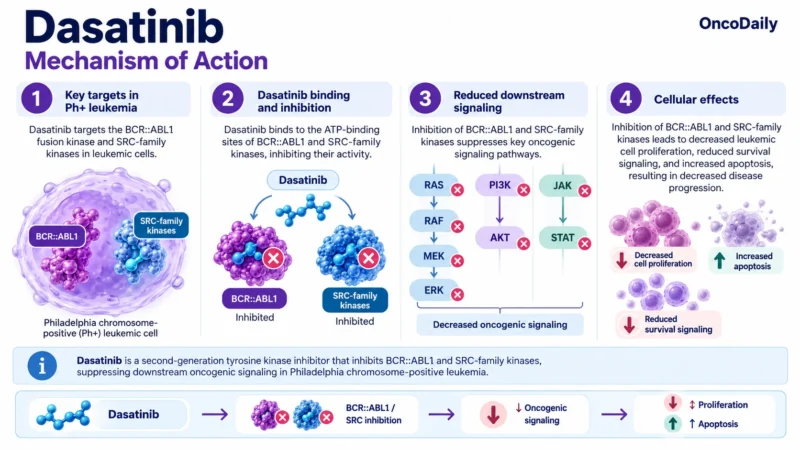
1. BCR::ABL1 Becomes Constitutively Active
In Philadelphia chromosome-positive leukemia, the:
BCR::ABL1 fusion kinase
is continuously active.
This drives several downstream pathways involved in:
- Proliferation
- Cell survival
- Resistance to apoptosis
- Leukemic progression
2. ATP-Dependent Kinase Signaling Continues Unchecked
BCR::ABL1 phosphorylates downstream proteins and activates pathways such as:
- RAS–RAF–MEK–ERK
- PI3K–AKT
- JAK/STAT-associated signaling
3. Dasatinib Binds BCR::ABL1
Dasatinib inhibits BCR::ABL1 at nanomolar concentrations and can bind multiple conformations of the ABL kinase.
It also inhibits SRC-family kinases and several other receptor tyrosine kinases.
4. Kinase Phosphorylation Is Suppressed
This reduces downstream oncogenic signaling and limits:
- Leukemic-cell proliferation
- Survival signaling
- Clone expansion
5. Leukemic Cells Undergo Growth Arrest and Apoptosis
The overall mechanism is:
Dasatinib → BCR::ABL1 + SRC-family inhibition → ↓oncogenic phosphorylation → ↓proliferation and survival → increased leukemic-cell death.
Dasatinib can overcome several mechanisms of imatinib resistance, although it is not active against BCR::ABL1 T315I.
What Is the Dose of Dasatinib?
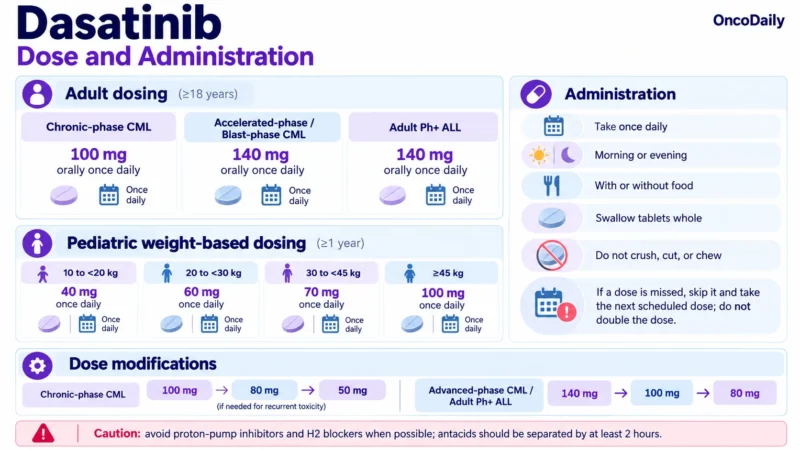
Adult Chronic-Phase CML
Recommended starting dose:
100 mg orally once daily.
Adult Accelerated-Phase or Blast-Phase CML
For:
- Accelerated-phase CML
- Myeloid blast-phase CML
- Lymphoid blast-phase CML
the recommended dose is:
140 mg orally once daily.
Adult Ph+ ALL
For adults with Ph+ ALL resistant or intolerant to prior therapy:
140 mg orally once daily.
Pediatric CML and Ph+ ALL
For pediatric patients aged 1 year and older, tablet dosing is based on body weight:
- 10 to <20 kg: 40 mg once daily
- 20 to <30 kg: 60 mg once daily
- 30 to <45 kg: 70 mg once daily
- ≥45 kg: 100 mg once daily
The dose should be recalculated at least every:
3 months
as body weight changes.
For pediatric Ph+ ALL, dasatinib is used in combination with chemotherapy.
Can the Dose Be Increased?
In adults who do not achieve an adequate hematologic or cytogenetic response, dose escalation may be considered.
Chronic-phase CML
100 mg → 140 mg once daily
Advanced-phase CML or Ph+ ALL
140 mg → 180 mg once daily.
Dose escalation is not recommended for pediatric Ph+ ALL when dasatinib is used with chemotherapy.
How Should Dasatinib Be Taken?
Dasatinib should be taken:
- Once daily
- In the morning or evening
- With or without food
Tablets should be:
Swallowed whole.
Do not:
- Crush
- Cut
- Chew.
What If a Dose Is Missed?
If a dose is missed:
- Skip the missed dose
- Take the next dose at the normal scheduled time
- Do not double the dose
This is the standard patient-instruction approach for Sprycel.
How Are Dasatinib Dose Reductions Made?
Dose reductions depend on:
- Disease phase
- Hematologic toxicity
- Nonhematologic toxicity
- Treatment history
Chronic-Phase CML
For recurrent neutropenia or thrombocytopenia, the adult label allows reduction from:
- 100 mg once daily → 80 mg once daily
- Further recurrence may require 50 mg once daily in newly diagnosed patients.
Advanced-Phase CML or Ph+ ALL
For recurrent treatment-related cytopenias:
- 140 mg once daily → 100 mg once daily
- Then 80 mg once daily if necessary.
For severe nonhematologic toxicity, dasatinib should generally be:
- Withheld
- Allowed to recover
- Restarted at a reduced dose depending on severity and recurrence.
What Are the Important Drug Interactions With Dasatinib?
Strong CYP3A4 Inhibitors
Strong CYP3A4 inhibitors can substantially increase dasatinib exposure.
Examples include:
- Ketoconazole
- Itraconazole
- Clarithromycin
- Ritonavir
Avoid these combinations where possible.
The current label suggests, if unavoidable:
- 140 mg daily → 40 mg daily
- 100 mg daily → 20 mg daily
- 70 mg daily → 20 mg daily.
Also avoid:
Grapefruit and grapefruit juice.
Strong CYP3A4 Inducers
These can reduce dasatinib exposure.
Examples include:
- Rifampin
- Carbamazepine
- Phenytoin
- Phenobarbital
- St. John’s wort
They should generally be avoided.
Gastric Acid-Reducing Agents
Dasatinib absorption is highly dependent on gastric acidity.
Do not routinely combine Sprycel with:
- Proton-pump inhibitors
- H2-receptor antagonists
because they can reduce dasatinib exposure and potentially decrease efficacy.
For example, omeprazole reduced:
- Dasatinib AUC by 43%
- Cmax by 42%.
If an antacid is required:
Administer it at least:
2 hours before or 2 hours after dasatinib.
Does Dasatinib Require Renal Dose Adjustment?
Renal impairment across the studied range did not have a clinically meaningful effect on dasatinib pharmacokinetics.
Therefore, a routine starting-dose adjustment based solely on renal impairment is generally not required.
Does Dasatinib Require Hepatic Dose Adjustment?
Pharmacokinetic studies showed somewhat lower exposure in moderate and severe hepatic impairment rather than drug accumulation.
The FDA label does not specify a routine starting-dose reduction based solely on hepatic impairment.
However, liver function should still be monitored because dasatinib itself can cause hepatotoxicity.
What Is the Pharmacokinetic Profile of Dasatinib?
Absorption
Peak plasma concentrations occur approximately:
0.5–6 hours
after oral administration.
Food Effect
A high-fat meal increased dasatinib AUC by approximately:
14%.
This is not considered clinically significant enough to require fasting administration.
Protein Binding
Dasatinib is approximately:
96% protein bound
in plasma.
Its active metabolite is approximately:
93% protein bound.
Half-Life
The mean terminal half-life is:
3–5 hours.
Despite the relatively short plasma half-life, once-daily administration provides effective sustained BCR::ABL1inhibition.
What Are the Clinical Uses of Dasatinib?
1. Newly Diagnosed Chronic-Phase CML
Dasatinib is FDA approved for adults with:
Newly diagnosed Ph+ chronic-phase CML.
It is also approved for pediatric patients aged ≥1 year with chronic-phase Ph+ CML.
2. CML Resistant or Intolerant to Prior Therapy
Dasatinib is approved for adults with:
- Chronic-phase CML
- Accelerated-phase CML
- Myeloid blast-phase CML
- Lymphoid blast-phase CML
with resistance or intolerance to prior therapy, including imatinib.
3. Philadelphia Chromosome-Positive ALL
Dasatinib is approved for:
Adult Ph+ ALL resistant or intolerant to prior therapy.
It is also approved for:
Newly diagnosed pediatric Ph+ ALL in combination with chemotherapy.
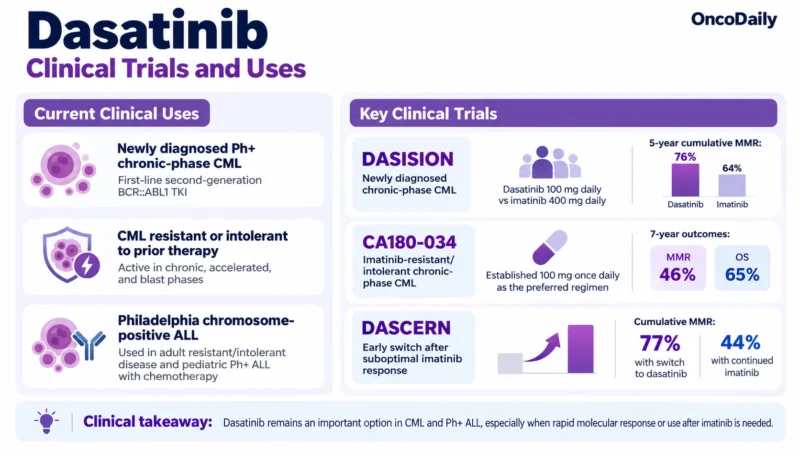
What Did the DASISION Trial Show?
The pivotal phase III DASISION trial compared:
- Dasatinib 100 mg once daily
- Imatinib 400 mg once daily
in 519 patients with newly diagnosed chronic-phase CML.
At 5 years, cumulative:
Major Molecular Response
- Dasatinib: 76%
- Imatinib: 64%
P = 0.0022
MR4.5
- 42%
- 33%
P = 0.0251.
Early molecular response was also more frequent:
BCR::ABL1 ≤10% at 3 months
occurred in:
- 84% with dasatinib
- 64% with imatinib.
Five-year progression-free and overall survival remained high and broadly similar between the two arms.
Transformation to accelerated/blast phase occurred in:
- 5% with dasatinib
- 7% with imatinib.
What Did CA180-034 Show?
The phase III CA180-034 dose-optimization study evaluated dasatinib in:
Imatinib-resistant or imatinib-intolerant chronic-phase CML.
A total of:
670 patients
were enrolled.
For the now-standard:
100 mg once-daily regimen
at 7 years:
- MMR: 46%
- PFS: 42%
- OS: 65%.
The trial helped establish 100 mg once daily as the preferred chronic-phase dose because it retained efficacy with improved tolerability compared with alternative schedules.
What Did the Advanced-Phase CML / Ph+ ALL Dose-Optimization Study Show?
In patients receiving:
Dasatinib 140 mg once daily
major hematologic response rates included:
- Accelerated-phase CML: 66%
- Myeloid blast-phase CML: 28%
- Lymphoid blast-phase CML: 42%
- Ph+ ALL: 38%.
Major cytogenetic response in Ph+ ALL was:
70%.
What Did GIMEMA LAL1205 Show?
In adults with newly diagnosed Ph+ ALL, dasatinib plus steroids and CNS prophylaxis produced:
100% complete hematologic remission
among evaluable patients.
At 20 months:
- Overall survival: 69.2%
- Disease-free survival: 51.1%.
This study helped establish dasatinib as a highly active TKI backbone in Ph+ ALL, although contemporary regimens increasingly combine potent TKIs with immunotherapy-based strategies.
Is Dasatinib FDA Approved?
Yes.
Current FDA-approved indications include:
Adults
- Newly diagnosed Ph+ chronic-phase CML
- Chronic, accelerated, or blast-phase CML resistant/intolerant to prior therapy
- Ph+ ALL resistant/intolerant to prior therapy
Pediatrics ≥1 Year
- Ph+ chronic-phase CML
- Newly diagnosed Ph+ ALL in combination with chemotherapy.
What Is the Current Clinical Role of Dasatinib in 2026?
Chronic Myeloid Leukemia
Dasatinib remains an established BCR::ABL1 TKI for chronic-phase CML.
It can produce:
- Faster early molecular responses than imatinib
- Higher cumulative MMR rates
- Higher rates of deep molecular response.
Treatment selection among available TKIs now depends on:
- CML risk category
- Comorbidities
- Mutation profile
- Desire for deep molecular response
- Treatment-free remission goals
- Toxicity profile
- Access
The main clinical limitation of dasatinib is its pulmonary toxicity profile, particularly pleural effusion and rare PAH.
Read more: BCR::ABL1-Rearranged Chronic Myeloid Leukemia: Molecular Basis, TKI Resistance and Emerging Therapies by OncoDaily.
Watch more: A lecture on BCR-ABL–driven chronic myeloid leukemia and targeted kinase inhibition, relevant to second-generation TKIs such as dasatinib.
Treatment-Free Remission
For carefully selected CML patients who achieve a sustained deep molecular response, discontinuation may be considered within formal TFR criteria and intensive molecular monitoring programs.
In DASFREE, the 5-year treatment-free remission rate after dasatinib discontinuation was:
44%.
All evaluable patients who molecularly relapsed and restarted dasatinib regained MMR rapidly.
After Suboptimal Imatinib Response
The randomized DASCERN study showed that switching to dasatinib after failure to achieve early molecular response at 3 months improved molecular outcomes.
At 5 years, cumulative MMR was:
- 77% with switch to dasatinib
- 44% with continued imatinib
P < 0.001.
Ph+ ALL
Dasatinib remains an important TKI backbone in Ph+ ALL.
Its ability to achieve rapid molecular responses and its greater potency versus imatinib have made it useful in:
- TKI + chemotherapy regimens
- TKI + steroid induction
- TKI + blinatumomab-based strategies
More recent data continue to support dasatinib-based approaches, especially when integrated with immunotherapy and CNS-directed treatment.
What Are the Major Side Effects of Dasatinib?
Common adverse reactions include:
- Myelosuppression
- Pleural effusion
- Diarrhea
- Headache
- Fatigue
- Dyspnea
- Rash
- Musculoskeletal pain
- Nausea
- Hemorrhage
Important serious toxicities include:
- Severe cytopenias
- Bleeding
- Pleural and pericardial effusions
- Cardiovascular events
- Pulmonary arterial hypertension
- QT prolongation
- Hepatotoxicity
- Severe dermatologic reactions
- Tumor lysis syndrome.
Myelosuppression
Dasatinib can cause:
- Neutropenia
- Thrombocytopenia
- Anemia
CBC monitoring differs by disease phase.
Chronic-Phase CML
CBC:
- Every 2 weeks for the first 12 weeks
- Then every 3 months
- Or as clinically indicated
Advanced CML / Ph+ ALL
CBC:
- Weekly for the first 2 months
- Then monthly.
Myelosuppression is usually reversible with:
- Temporary interruption
- Dose reduction.
Pleural Effusion and Fluid Retention
Pleural effusion is the most characteristic toxicity of dasatinib.
In the 5-year DASISION analysis, pleural effusion occurred in approximately:
28% of dasatinib-treated patients versus 0.8% with imatinib.
Patients presenting with:
- Dyspnea
- Dry cough
- Pleuritic chest pain
- Reduced exercise tolerance
should be evaluated promptly, often with:
Chest imaging.
Management may include:
- Dasatinib interruption
- Dose reduction
- Diuretics
- Short-course corticosteroids
- Thoracentesis for severe cases.
Pulmonary Arterial Hypertension
Dasatinib can cause PAH, sometimes after more than a year of treatment.
Symptoms include:
- Dyspnea
- Fatigue
- Hypoxia
- Fluid retention
PAH may improve after dasatinib discontinuation.
If PAH is confirmed:
Dasatinib should be permanently discontinued.
Bleeding
Dasatinib can cause serious and occasionally fatal bleeding.
Across adult CML and Ph+ ALL studies:
- Grade 3/4 hemorrhage occurred in approximately 5.8%
- Grade 5 hemorrhage occurred in 0.4%.
Bleeding risk is increased by:
- Severe thrombocytopenia
- Platelet dysfunction
- Anticoagulants
- Antiplatelet agents.
Cardiovascular Toxicity
Dasatinib may cause:
- Ischemic cardiac events
- Arrhythmia
- Palpitations
- Cardiac-related fluid retention
- TIA-like events
In the 5-year newly diagnosed CML study:
- Cardiac ischemic events: 3.9%
- Cardiac-related fluid retention: 8.5%
- Conduction abnormalities: 7.0%.
QT Prolongation
Dasatinib can prolong the QT interval.
Use additional caution in patients with:
- Congenital long-QT syndrome
- Hypokalemia
- Hypomagnesemia
- Concomitant QT-prolonging drugs
- Significant cardiac disease
Correct:
- Potassium
- Magnesium
before and during therapy.
Hepatotoxicity
Dasatinib can increase:
- ALT
- AST
- Bilirubin
- Alkaline phosphatase
Monitor liver enzymes:
- At baseline
- Monthly
- Or more frequently when clinically indicated.
Treatment may require:
- Interruption
- Dose reduction
- Permanent discontinuation
depending on severity.
Pregnancy and Breastfeeding
Dasatinib can cause fetal harm.
Patients of reproductive potential should use effective contraception:
During treatment and for 30 days after the last dose.
Breastfeeding is not recommended during treatment.
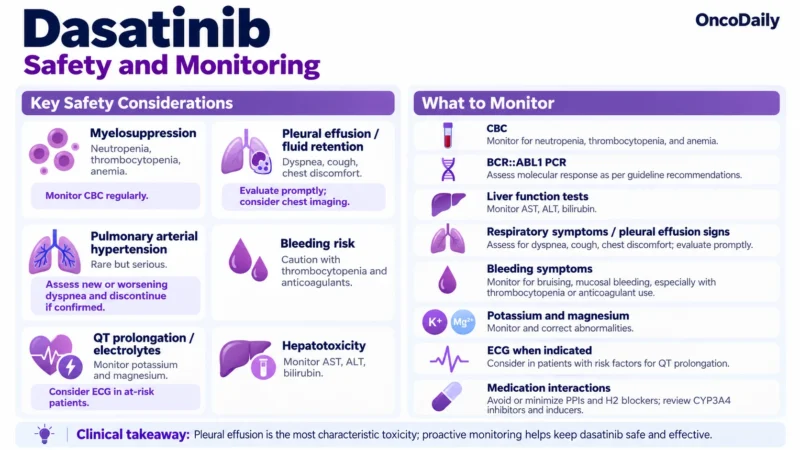
What Monitoring Is Required?
Monitoring during dasatinib therapy should include:
- CBC
- BCR::ABL1 quantitative PCR
- Liver-function tests
- Signs of pleural effusion
- Respiratory symptoms
- Symptoms of pulmonary hypertension
- Blood pressure and cardiovascular symptoms
- Signs of bleeding
- Electrolytes
- Potassium
- Magnesium
- ECG when QT risk exists
- Drug interactions
- Use of PPIs/H2 blockers
- Growth and bone development in pediatric patients.
FAQ
What Is Dasatinib Used For?
- Newly diagnosed chronic-phase Ph+ CML
- CML resistant/intolerant to prior therapy
- Adult Ph+ ALL resistant/intolerant to prior therapy
- Pediatric chronic-phase CML
- Newly diagnosed pediatric Ph+ ALL with chemotherapy.
What Is the Standard Chronic-Phase CML Dose?
What Is the Dose for Advanced CML or Adult Ph+ ALL?
Can Dasatinib Be Taken With Food?
It can be taken:
With or without food.
How Does Dasatinib Work?
BCR::ABL1 and SRC-family kinases
along with KIT, EPHA2, and PDGFR-β.
What Did DASISION Show?
- 76% with dasatinib
- 64% with imatinib.
What Is the Most Characteristic Toxicity?
Can Dasatinib Cause Pulmonary Hypertension?
Dasatinib is associated with pulmonary arterial hypertension, which can occur even after prolonged exposure.
Can Dasatinib Be Taken With Omeprazole?
PPIs and H2 blockers significantly reduce dasatinib absorption and should be avoided.
Is Dasatinib Active Against T315I?
BCR::ABL1 T315I is resistant to dasatinib.