





Dactinomycin: Mechanism of Action, Dose, Administration, Clinical Uses, and Side Effects
Key takeaways
- Dactinomycin binds DNA and inhibits RNA synthesis, interfering with transcription and cancer-cell proliferation.
- It remains an established component of treatment for Wilms tumor, rhabdomyosarcoma, Ewing sarcoma, and gestational trophoblastic neoplasia.
- Dosing is highly indication-specific, ranging from weight-based daily dosing to single doses given every several weeks.
- Dactinomycin is administered by IV injection or infusion, generally over 10–15 minutes after dilution.
- It is a vesicant-like cytotoxic agent capable of causing severe local tissue damage after extravasation.
- The label specifically states not to use in-line filters with a cellulose ester membrane.
- Dactinomycin can potentiate radiation toxicity and radiation recall; its dose should be reduced by 50% during concomitant radiation.
- Serious hepatic complications, including veno-occlusive disease, can occur, particularly in younger children and with concomitant radiotherapy.
Dactinomycin, also known as actinomycin D, is an antineoplastic antibiotic used in several pediatric and adult cancers, particularly Wilms tumor, rhabdomyosarcoma, Ewing sarcoma, gestational trophoblastic neoplasia, and metastatic nonseminomatous testicular cancer. It is administered intravenously and is usually incorporated into multi-agent chemotherapy regimens. Dactinomycin is FDA approved.
This article aims to review dactinomycin mechanism of action, dose, administration, clinical-trial evidence, pharmacokinetics, safety profile, and current role in cancer treatment.
Dactinomycin Key Facts
- Generic name: Dactinomycin
- Other name: Actinomycin D
- Brand name: Cosmegen
- Drug class: Cytotoxic actinomycin; antineoplastic antibiotic
- Administration: Intravenous
- Major FDA-approved uses: Wilms tumor, rhabdomyosarcoma, Ewing sarcoma, metastatic nonseminomatous testicular cancer, gestational trophoblastic neoplasia, and regional perfusion for selected locally recurrent solid tumors
- Wilms tumor dose: 45 mcg/kg IV once every 3–6 weeks
- Rhabdomyosarcoma dose: 15 mcg/kg IV daily for 5 days every 3–9 weeks
- Ewing sarcoma dose: 1,250 mcg/m² IV every 3 weeks
- Major toxicities: Myelosuppression, mucositis, hepatotoxicity, hepatic veno-occlusive disease, severe tissue injury after extravasation, and radiation-recall toxicity
- Approval status: FDA approved.
What Is Dactinomycin?
Dactinomycin is a cytotoxic actinomycin antibiotic that binds DNA and inhibits RNA synthesis. It was originally derived from Streptomyces species and is one of the longest-established chemotherapy agents still used in pediatric oncology.
Its FDA-approved uses include:
- Wilms tumor
- Rhabdomyosarcoma
- Ewing sarcoma
- Metastatic nonseminomatous testicular cancer
- Gestational trophoblastic neoplasia
- Regional perfusion for selected locally recurrent or locoregional solid malignancies.
Dactinomycin is generally used as part of multi-agent chemotherapy, although it can also be used as a single agent in selected low-risk gestational trophoblastic neoplasia.
Dactinomycin Mechanism of Action
Dactinomycin acts primarily by interfering with DNA-dependent RNA synthesis.
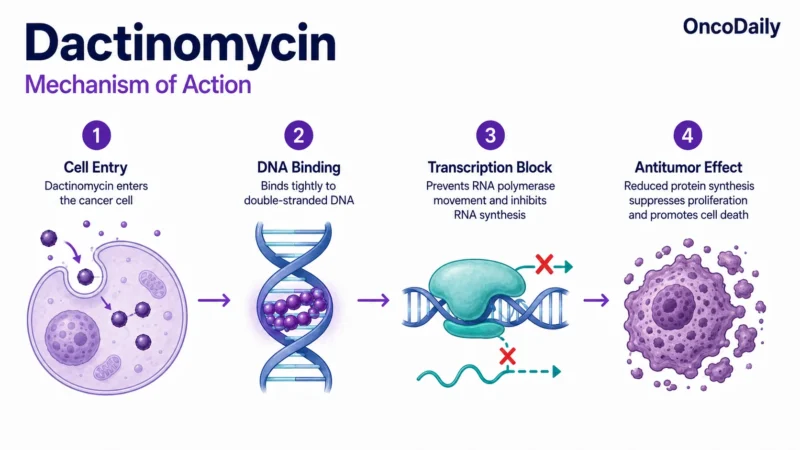
Its mechanism can be summarized in four stages:
- Dactinomycin enters the cancer cell.
- The molecule binds tightly to double-stranded DNA.
- DNA binding interferes with movement of RNA polymerase and suppresses RNA transcription.
- Reduced RNA synthesis disrupts protein production and ultimately limits proliferation and survival of malignant cells.
Dactinomycin can also contribute to DNA damage, which further supports its cytotoxic activity.
Watch more: Explore dactinomycin’s pharmacology, mechanism of action, clinical uses, and toxicity in Pharmacology of Dactinomycin (Actinomycin D).
What Is the Dose of Dactinomycin?
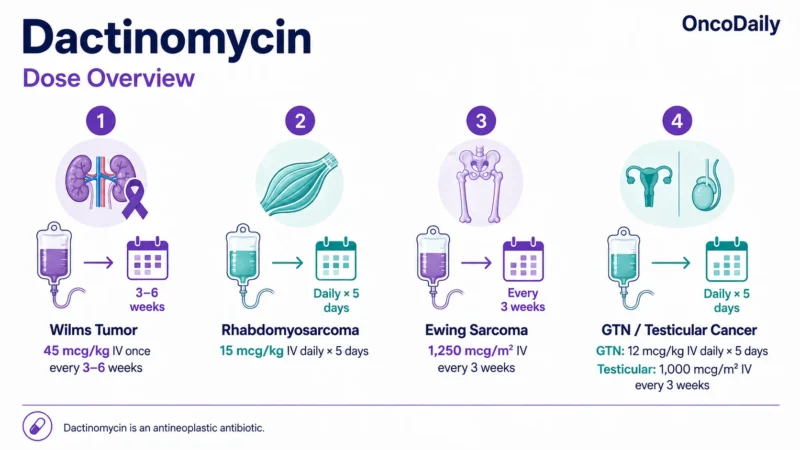
Dactinomycin dosing depends substantially on the disease and treatment protocol.
Wilms Tumor
The FDA-labeled dose is:
45 mcg/kg IV once every 3–6 weeks
as part of multi-agent chemotherapy, for up to 26 weeks.
Rhabdomyosarcoma
The recommended labeled regimen is:
15 mcg/kg IV once daily for 5 consecutive days
repeated every 3–9 weeks, depending on the treatment program.
Ewing Sarcoma
The FDA-labeled dose is:
1,250 mcg/m² IV once every 3 weeks
as part of combination chemotherapy.
Metastatic Nonseminomatous Testicular Cancer
The recommended dose is:
1,000 mcg/m² IV once every 3 weeks
as part of a cisplatin-based multi-agent regimen.
Gestational Trophoblastic Neoplasia
For nonmetastatic or low-risk metastatic disease:
12 mcg/kg IV daily for 5 days as monotherapy.
For high-risk metastatic disease:
500 mcg IV on Days 1 and 2 every 2 weeks, incorporated into multi-agent therapy.
These doses are indication-specific and should not be interchanged across protocols.
How Is Dactinomycin Administered?
Dactinomycin is administered intravenously.
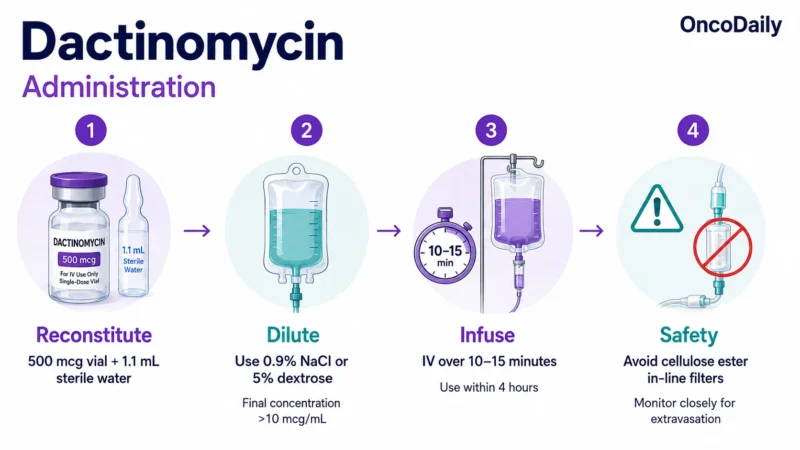
The current label instructs:
- Reconstitute the 500-mcg vial with 1.1 mL preservative-free sterile water
- Further dilute with 5% dextrose or 0.9% sodium chloride
- Maintain a final concentration greater than 10 mcg/mL
- Administer intravenously over 10–15 minutes
- Complete administration within 4 hours of reconstitution.
Because dactinomycin can produce severe tissue injury after extravasation, careful venous access and continuous observation of the injection site are important.
Does Dactinomycin Require an In-Line Filter?
The current prescribing information does not establish a universal requirement for an in-line filter.
Importantly, however, it specifically states:
Do not use in-line filters with a cellulose ester membrane.
Administration should therefore follow the exact product label and institutional chemotherapy procedures.
Is Premedication Required?
Dactinomycin does not have a universal drug-specific premedication regimen.
Supportive treatment may include:
- Antiemetic prophylaxis
- Hydration when clinically appropriate
- Infection prophylaxis according to the complete regimen
- Blood-product support when myelosuppression develops.
Premedication requirements are therefore driven mainly by the overall chemotherapy protocol and patient-specific risk.
Are Dose Reductions Used?
Yes.
Dactinomycin may need to be delayed, reduced, or discontinued because of:
- Prolonged myelosuppression
- Hepatic veno-occlusive disease
- Hepatotoxicity
- Renal toxicity
- Severe mucocutaneous reactions
- Extravasation
- Radiation-associated toxicity.
One particularly important label recommendation is:
Reduce the dactinomycin dose by 50% during concomitant radiation therapy.
Why Is Radiation Exposure Important With Dactinomycin?
Dactinomycin can potentiate radiation toxicity.
When administered with radiotherapy, it can increase:
- Gastrointestinal toxicity
- Myelosuppression
- Skin erythema and blistering
- Mucosal injury.
It can also trigger radiation recall, producing inflammation in previously irradiated tissue. The risk appears greatest when dactinomycin is given within approximately 2 months of radiation exposure.
What Is Known About Dactinomycin Pharmacokinetics?
Available pharmacokinetic data are limited compared with many modern anticancer drugs.
Radiolabeled studies show that dactinomycin:
- Concentrates in nucleated cells
- Does not meaningfully cross the blood-brain barrier
- Is eliminated slowly
- Has approximately 30% of administered radioactivity recovered in urine and feces within one week.
In pediatric populations, systemic clearance tends to increase as body weight increases.
Are Renal or Hepatic Dose Adjustments Required?
The current label does not provide a single standardized renal- or hepatic-impairment dose table.
However, dactinomycin can cause both renal and hepatic toxicity, so renal function, electrolytes, transaminases, alkaline phosphatase, and bilirubin should be monitored before and during treatment.
Dose modification should therefore follow:
- Organ function
- Toxicity severity
- The underlying disease
- The specific chemotherapy protocol.
What Did Dactinomycin Clinical Trials Show?
Wilms Tumor
Dactinomycin has been a cornerstone of Wilms tumor chemotherapy for decades, commonly combined with agents such as vincristine and, in higher-risk disease, additional drugs.
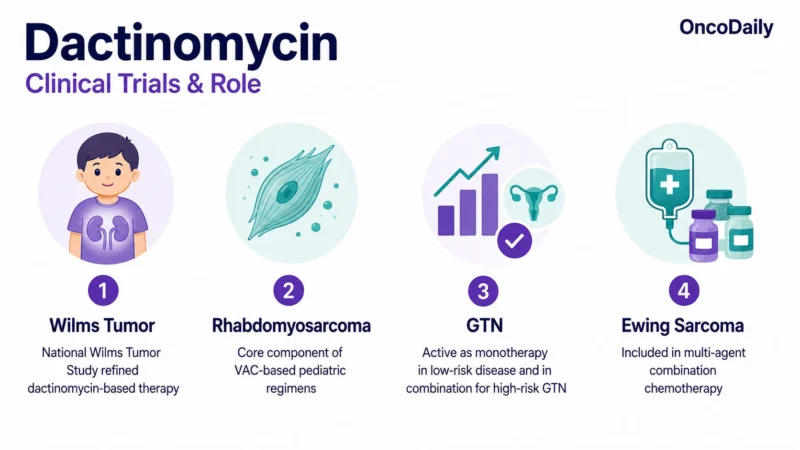
The National Wilms Tumor Study-4 evaluated different administration strategies for dactinomycin and doxorubicin and helped refine chemotherapy delivery in children with Wilms tumor.
NCT00352534 — Phase 3 study incorporating vincristine, dactinomycin, and doxorubicin, with or without radiation therapy, in Wilms tumor.
Rhabdomyosarcoma
Dactinomycin remains a core component of many pediatric rhabdomyosarcoma regimens, commonly combined with vincristine and cyclophosphamide in VAC-based therapy. Its contribution is supported by decades of cooperative-group studies and risk-adapted protocols.
Gestational Trophoblastic Neoplasia
Dactinomycin is FDA approved both as single-agent treatment for selected low-risk GTN and as part of multi-agent chemotherapy for high-risk disease.
In modern practice, actinomycin D remains particularly important when methotrexate is ineffective or when treatment protocols favor actinomycin-based therapy.
Ewing Sarcoma
Dactinomycin is also incorporated into multi-agent chemotherapy for Ewing sarcoma, with the FDA label specifying 1,250 mcg/m² IV every 3 weeks as part of combination treatment.
Is Dactinomycin FDA Approved?
Yes.
Dactinomycin has been FDA approved since 1964 and currently carries indications for:
- Wilms tumor
- Rhabdomyosarcoma
- Ewing sarcoma
- Metastatic nonseminomatous testicular cancer
- Gestational trophoblastic neoplasia
- Regional perfusion for selected locally recurrent solid tumors.
What Is the Current Role of Dactinomycin?
Dactinomycin remains an important chemotherapy agent despite its long history.
Its most important contemporary roles include:
- Wilms tumor
- Rhabdomyosarcoma
- Ewing sarcoma
- Gestational trophoblastic neoplasia
- Selected germ-cell tumor regimens
- Regional perfusion strategies for selected localized malignancies.
Its use is especially prominent in pediatric oncology, where it remains integrated into several curative combination regimens.
Read more: Explore current approaches to Wilms tumor treatment on OncoDaily.
What Are the Side Effects of Dactinomycin?
Important adverse effects include:
- Neutropenia
- Thrombocytopenia
- Anemia
- Infection
- Nausea and vomiting
- Mucositis
- Diarrhea
- Alopecia
- Rash
- Hepatotoxicity
- Hepatic veno-occlusive disease
- Renal toxicity
- Severe mucocutaneous reactions
- Radiation recall
- Severe tissue injury after extravasation.
Myelosuppression
Dactinomycin may cause severe or fatal bone-marrow suppression. Neutrophil nadirs generally occur approximately 14–21 days after treatment, and CBC monitoring is required before each treatment cycle.
Hepatic Veno-Occlusive Disease
Dactinomycin can cause severe and occasionally fatal hepatic veno-occlusive disease.
Risk factors include:
- Age younger than 4 years
- Concomitant radiotherapy.
Extravasation
Extravasation can cause:
- Blistering
- Ulceration
- Persistent pain
- Extensive tissue necrosis
- Need for surgical excision or skin grafting.
If extravasation is suspected, administration should be stopped immediately and ice applied according to the product label.
Severe Mucocutaneous Toxicity
Rare severe reactions including Stevens-Johnson syndrome and toxic epidermal necrolysis have been reported. Dactinomycin should be permanently discontinued if a severe mucocutaneous reaction occurs.