





Ceritinib (Zykadia): Understanding Its Mechanism, Dosing, Clinical Uses, and Role in ALK-Positive Lung Cancer
Key takeaways
- Ceritinib is a second-generation ALK inhibitor used for metastatic ALK-positive NSCLC.
- The current standard dose is 450 mg orally once daily with food.
- Dose reductions follow the sequence 450 mg → 300 mg → 150 mg once daily.
- The modern 450 mg with-food regimen replaced the older 750 mg fasting regimen because it provides similar exposure with substantially better GI tolerability.
- ASCEND-4 demonstrated first-line median PFS of 16.6 months versus 8.1 months with chemotherapy.
- ASCEND-5 demonstrated median PFS of 5.4 months versus 1.6 months with chemotherapy after prior crizotinib and platinum chemotherapy.
- Ceritinib has meaningful CNS activity but is generally less CNS-active than newer ALK inhibitors.
- Important toxicities include GI toxicity, hepatotoxicity, ILD/pneumonitis, QT prolongation, hyperglycemia, bradycardia, and pancreatitis.
- Ceritinib remains FDA and EMA approved.
- In 2026, alectinib, brigatinib, and lorlatinib are preferred first-line ALK inhibitors, while ceritinib remains an alternative when those options are unavailable.
Ceritinib (Zykadia) is an oral, second-generation anaplastic lymphoma kinase (ALK) tyrosine kinase inhibitor developed for ALK-positive metastatic non-small cell lung cancer (NSCLC). It was designed to provide more potent ALK inhibition than crizotinib and to retain activity against several resistance mechanisms that can emerge during earlier ALK-directed therapy. Ceritinib received its initial FDA approval in 2014 and remains FDA approved for adults with metastatic ALK-positive NSCLC.
Ceritinib demonstrated clinically meaningful systemic and intracranial activity in the ASCEND clinical development program. In the first-line phase III ASCEND-4 trial, ceritinib significantly prolonged progression-free survival compared with platinum-pemetrexed chemotherapy, while ASCEND-5 established efficacy after prior crizotinib and chemotherapy. However, in contemporary 2026 practice, newer-generation ALK inhibitors such as alectinib, brigatinib, and lorlatinib are preferred first-line options because of stronger CNS efficacy and overall treatment profiles.
Key Facts
- Generic name: Ceritinib
- Brand name: Zykadia
- Drug class: Second-generation ALK tyrosine kinase inhibitor
- Route: Oral
- Initial US approval: 2014
- FDA-approved indication: Adult patients with metastatic ALK-positive NSCLC
- Current recommended dose: 450 mg orally once daily with food
- Dose reductions: 300 mg → 150 mg once daily
- Dosage forms: 150 mg capsules and 150 mg tablets
- Major target: ALK
- Other kinase activity: ROS1, IGF-1R, and insulin receptor in preclinical studies
- Major toxicities: Diarrhea, nausea, abdominal pain, vomiting, fatigue, decreased appetite, and weight loss
- Important serious toxicities: Hepatotoxicity, ILD/pneumonitis, QT prolongation, hyperglycemia, bradycardia, and pancreatitis
- Major drug interaction: Strong CYP3A inhibitors and inducers
- Half-life: Approximately 41 hours
- Current US status: FDA approved
- European status: Authorized in the EU as Zykadia.
What Is Ceritinib?
Ceritinib is a small-molecule tyrosine kinase inhibitor developed primarily to inhibit abnormal ALK signaling.
ALK rearrangements, most commonly involving:
EML4–ALK
create constitutively active fusion proteins that continuously stimulate downstream pathways involved in:
- Tumor-cell proliferation
- Survival
- Growth
- Migration
- Invasion
- Resistance to apoptosis
Ceritinib was developed after recognition that many patients treated with crizotinib eventually developed resistance.
It has activity against several ALK alterations associated with acquired resistance to earlier ALK inhibitors.
What Is the Mechanism of Action of Ceritinib?
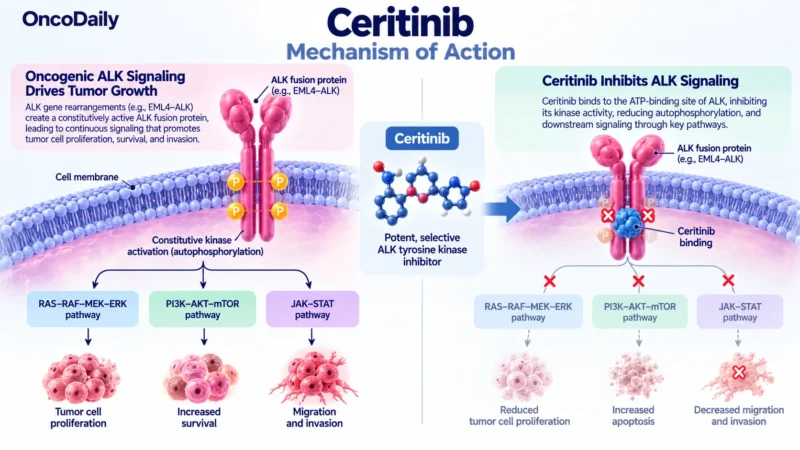
1. ALK Fusion Proteins Drive Persistent Tumor Signaling
ALK rearrangements create abnormal fusion proteins with constitutive kinase activity.
These proteins continuously activate intracellular pathways promoting malignant-cell survival and proliferation.
2. Ceritinib Inhibits ALK Kinase Activity
Ceritinib is an:
ATP-competitive ALK tyrosine kinase inhibitor.
It binds to the ALK kinase domain and inhibits ATP-dependent phosphorylation.
Ceritinib also inhibits several other kinases in vitro, including:
- ROS1
- IGF-1R
- Insulin receptor
but its principal clinical role is inhibition of oncogenic ALK signaling.
3. ALK Autophosphorylation Is Reduced
Inhibition of ALK kinase activity suppresses:
ALK autophosphorylation
and therefore reduces activation of the fusion protein.
4. Downstream Signaling Is Suppressed
Key pathways affected include:
RAS–RAF–MEK–ERK
PI3K–AKT–mTOR
and:
JAK–STAT.
5. Tumor-Cell Growth Is Inhibited
Reduced ALK signaling leads to:
- Reduced tumor-cell proliferation
- Decreased survival
- Increased apoptosis
- Tumor regression in sensitive ALK-driven cancers
The mechanism can therefore be summarized as:
Ceritinib → ALK inhibition → reduced ALK phosphorylation → suppression of MAPK, PI3K/AKT, and JAK/STAT signaling → decreased tumor-cell proliferation and survival.
What Is the Dose of Ceritinib?
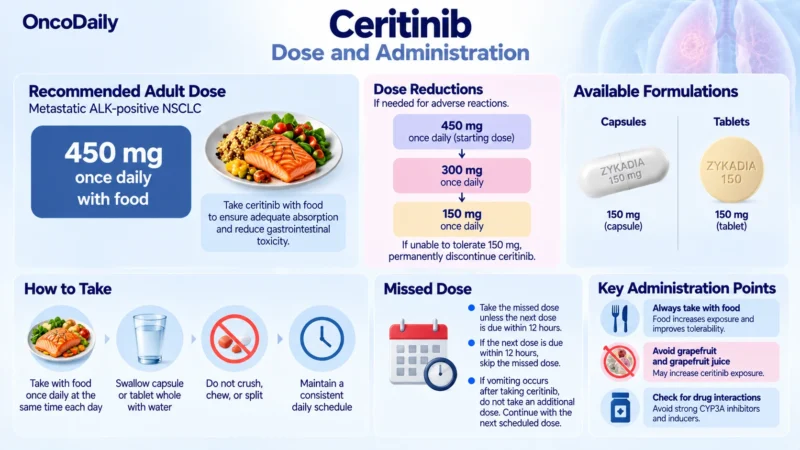
The current recommended dose is:
450 mg orally once daily with food.
Treatment continues until:
- Disease progression
- Unacceptable toxicity
The current 450 mg with-food regimen replaced the older:
750 mg once-daily fasting regimen
because it provides comparable exposure with substantially improved gastrointestinal tolerability.
What If a Dose Is Missed?
If a dose is missed:
Take it when remembered unless the next dose is due within 12 hours.
If the next scheduled dose is due within 12 hours:
Skip the missed dose.
If vomiting occurs after taking ceritinib:
Do not take an additional dose.
Continue with the next scheduled dose.
How Are Ceritinib Dose Reductions Made?
The standard dose is:
450 mg once daily with food.
The first dose reduction is:
300 mg once daily with food.
The second dose reduction is:
150 mg once daily with food.
If the patient cannot tolerate:
150 mg once daily
ceritinib should be permanently discontinued.
Dose interruption or reduction may be required for:
- Severe gastrointestinal toxicity
- Hepatotoxicity
- QT prolongation
- Hyperglycemia
- Bradycardia
- Pancreatic enzyme elevation
- Other clinically significant toxicity
Treatment-related ILD/pneumonitis requires:
Permanent discontinuation.
How Is Ceritinib Administered?
Ceritinib is available as:
- 150 mg capsules
- 150 mg tablets
The current standard regimen is:
Three 150 mg units = 450 mg once daily.
Ceritinib should be taken:
With food.
Administration with food is important because food substantially increases drug exposure.
The recommended 450 mg with-food regimen was established through ASCEND-8, which showed comparable steady-state exposure to the older 750 mg fasting regimen with considerably less gastrointestinal toxicity.
What Are the Important Drug Interactions With Ceritinib?
Strong CYP3A Inhibitors
Ceritinib is extensively metabolized through:
CYP3A.
Strong CYP3A inhibitors can markedly increase exposure.
Ketoconazole increased ceritinib:
AUC approximately 2.9-fold.
Strong CYP3A inhibitors should therefore generally be:
Avoided.
If unavoidable, reduce the ceritinib dose by approximately:
One-third
rounded to the nearest 150 mg dose level.
Grapefruit
Patients should avoid:
- Grapefruit
- Grapefruit juice
because they may increase ceritinib exposure.
Strong CYP3A Inducers
Strong CYP3A inducers can substantially reduce ceritinib exposure.
Rifampin decreased:
- AUC by approximately 70%
- Cmax by approximately 44%.
Strong CYP3A inducers should be avoided.
CYP3A Substrates
Ceritinib can significantly increase exposure to sensitive CYP3A substrates.
Midazolam AUC increased approximately:
5.4-fold.
Sensitive CYP3A substrates should therefore generally be avoided or adjusted appropriately.
CYP2C9 Substrates
Ceritinib also affects CYP2C9 substrates.
S-warfarin exposure increased approximately:
54%.
More frequent INR monitoring is recommended when warfarin is unavoidable.
QT-Prolonging Drugs
Because ceritinib can prolong QTc, concomitant QT-prolonging drugs should be avoided when possible.
Bradycardia-Producing Drugs
Use caution with drugs such as:
- Beta-blockers
- Non-dihydropyridine calcium-channel blockers
- Clonidine
- Digoxin
because they may increase the risk of clinically significant bradycardia.
Does Ceritinib Require Renal or Hepatic Dose Adjustment?
Renal Impairment
No clinically meaningful change in exposure has been identified with:
Mild-to-moderate renal impairment
defined approximately as:
CrCl 30 to <90 mL/min.
Patients with:
CrCl <30 mL/min
were not adequately represented in clinical studies, so evidence is limited in severe renal impairment.
Hepatic Impairment
No routine dose adjustment is required for:
- Child-Pugh A
- Child-Pugh B
For:
Child-Pugh C
the dose should be reduced by approximately:
One-third
rounded to the nearest 150 mg dose level.
In severe hepatic impairment, total ceritinib exposure increased approximately:
66%
and unbound exposure increased approximately:
108%.
What Is the Pharmacokinetic Profile of Ceritinib?
Absorption
Peak plasma concentrations are generally reached approximately:
4–6 hours
after oral administration.
Food Effect
Food substantially increases ceritinib exposure.
Compared with fasting conditions, a high-fat meal increased exposure substantially, while ASCEND-8 demonstrated that:
450 mg with food
achieves exposure comparable to:
750 mg fasting.
This is the basis of the modern recommended dosing strategy.
Distribution
Ceritinib is approximately:
97% protein bound.
Its apparent volume of distribution is very large:
Approximately 4,230 L
indicating extensive tissue distribution.
Metabolism
Ceritinib is primarily metabolized by:
CYP3A4.
Half-Life
The apparent terminal half-life is approximately:
41 hours.
Elimination
Ceritinib undergoes predominantly:
Fecal elimination
with relatively limited renal excretion.
What Are the Clinical Uses of Ceritinib?
ALK-Positive Metastatic NSCLC
Ceritinib is FDA approved for:
Adults with metastatic NSCLC whose tumors are ALK-positive, detected by an FDA-approved test.
The current indication is not restricted to patients previously treated with crizotinib.
However, its contemporary clinical role differs from its historical role because more potent and CNS-active ALK inhibitors are now preferred.
What Did Ceritinib Clinical Trials Show?
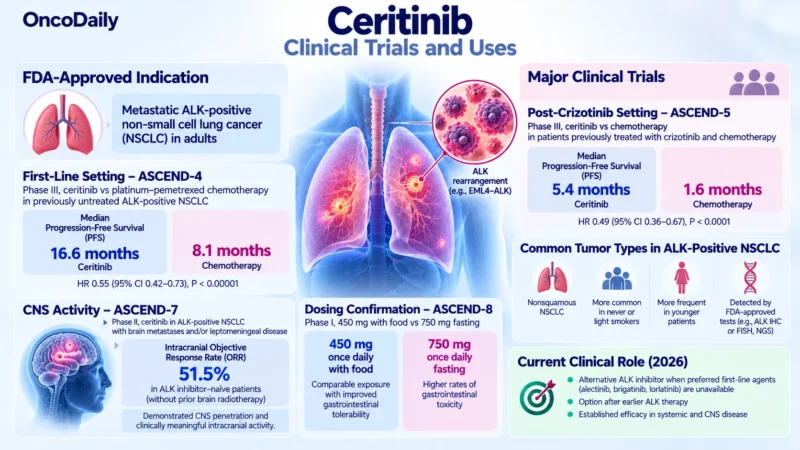
ASCEND-4 — First-Line Ceritinib Versus Chemotherapy
The phase III ASCEND-4 trial evaluated previously untreated patients with advanced ALK-rearranged nonsquamous NSCLC.
A total of:
376 patients
were randomized to:
- Ceritinib: 189
- Platinum-pemetrexed chemotherapy: 187.
Progression-Free Survival
Median PFS by blinded independent review was:
- Ceritinib: 16.6 months
- Chemotherapy: 8.1 months
Hazard ratio:
0.55
95% CI:
0.42–0.73
P < 0.00001.
This established ceritinib as superior to platinum-based chemotherapy in the first-line setting.
What About Brain Metastases?
Ceritinib has meaningful intracranial activity, although its CNS performance is generally less robust than that of newer ALK inhibitors such as alectinib, brigatinib, and lorlatinib.
The phase II ASCEND-7 trial specifically evaluated patients with:
- Active brain metastases
- Leptomeningeal disease
Intracranial ORR varied by prior treatment group.
In ALK-inhibitor-naïve patients without prior radiotherapy, intracranial ORR reached approximately:
51.5%.
In previously ALK inhibitor–treated cohorts, intracranial responses were lower but still clinically meaningful.
Ceritinib was also shown to penetrate the human blood-brain barrier.
ASCEND-5 — Ceritinib After Crizotinib and Chemotherapy
ASCEND-5 was a phase III trial in patients with advanced ALK-positive NSCLC whose disease had progressed after:
- Crizotinib
- Platinum-based chemotherapy
A total of:
231 patients
were randomized to:
- Ceritinib: 115
- Chemotherapy: 116.
Progression-Free Survival
Median PFS was:
- Ceritinib: 5.4 months
- Chemotherapy: 1.6 months
Hazard ratio:
0.49
95% CI:
0.36–0.67
P < 0.0001.
The 2026 ASCO guideline also highlights an intracranial ORR of approximately:
36%
in this post-crizotinib setting.
These results demonstrated that ceritinib could overcome some mechanisms of crizotinib resistance and was superior to single-agent chemotherapy.
ASCEND-8 — Why Did the Ceritinib Dose Change?
The original ceritinib regimen was:
750 mg once daily while fasting.
However, gastrointestinal toxicity was substantial.
ASCEND-8 evaluated:
450 mg once daily with food
versus:
750 mg once daily fasting.
The 450 mg with-food regimen achieved:
Comparable steady-state exposure
while substantially improving GI tolerability.
At 450 mg with food:
- Diarrhea occurred in approximately 59%
- Nausea in 43%
- Vomiting in 38%
with severe Grade ≥3 GI events occurring in only about:
1.9%.
This led to the modern recommended regimen:
450 mg once daily with food.
Is Ceritinib FDA Approved?
Yes.
Ceritinib received its initial FDA approval in:
2014.
It remains FDA approved for:
Adults with metastatic ALK-positive NSCLC.
Is Ceritinib Approved in Europe?
Yes.
Zykadia received European marketing authorization on:
May 6, 2015.
Its initial conditional authorization was converted to:
Full marketing authorization in 2017.
The EMA continues to list Zykadia as an authorized treatment for ALK-positive advanced NSCLC.
What Is the Current Clinical Role of Ceritinib?
Ceritinib remains an active ALK inhibitor, but it is no longer among the preferred first-line treatments when newer-generation agents are available.
The 2026 ASCO Living Guideline recommends first-line:
- Alectinib
- Brigatinib
- Lorlatinib
for metastatic ALK-positive NSCLC.
If those therapies are unavailable, clinicians should offer:
- Ceritinib
- Crizotinib
Therefore, ceritinib’s contemporary role is primarily as:
- An alternative ALK inhibitor when preferred agents are unavailable
- A treatment option in selected patients after earlier ALK therapy
- A historically important second-generation ALK inhibitor that established the value of overcoming crizotinib resistance
Its use has declined largely because newer ALK inhibitors provide:
- Longer disease control
- Stronger intracranial efficacy
- More favorable treatment sequencing options
Read more: OncoDaily’s overview of Targeted Therapy in Advanced NSCLC: From Driver Matching to Adaptive Precision Oncology.
Watch more: Explore OncoDaily’s discussion on targeted therapies in oncogene-driven lung cancer.
What Are the Major Side Effects of Ceritinib?
The most common adverse reactions with the current 450 mg with-food regimen include:
- Diarrhea
- Nausea
- Abdominal pain
- Vomiting
- Fatigue.
Gastrointestinal Toxicity
GI toxicity is one of the most characteristic adverse effects of ceritinib.
Across earlier studies using 750 mg fasting, gastrointestinal events occurred in the majority of patients.
The current:
450 mg with-food regimen
substantially reduces the incidence and severity of these toxicities.
Management may include:
- Antidiarrheals
- Antiemetics
- Fluid replacement
- Dose interruption
- Dose reduction
Severe or intolerable GI toxicity despite supportive care may require treatment interruption.
Hepatotoxicity
Ceritinib can cause clinically significant liver injury.
Across clinical studies:
- ALT >5× ULN occurred in approximately 28%
- AST >5× ULN occurred in approximately 16%.
Liver tests should include:
- ALT
- AST
- Total bilirubin
and should be checked:
Monthly
and more frequently when abnormalities develop.
Interstitial Lung Disease/Pneumonitis
ILD/pneumonitis occurred in approximately:
2.4%
of patients.
Grade 3–4 events occurred in:
1.3%.
Fatal events were reported in approximately:
0.2%.
Patients developing:
- New or worsening dyspnea
- Cough
- Fever
- Hypoxia
- New pulmonary infiltrates
require immediate evaluation.
Confirmed treatment-related ILD/pneumonitis requires:
Permanent discontinuation.
QT Interval Prolongation
Ceritinib can cause clinically significant QT prolongation.
Approximately:
6%
of patients had a QTc increase greater than 60 milliseconds from baseline.
Approximately:
1.3%
had QTc values exceeding:
500 milliseconds.
Patients at risk should undergo:
- ECG monitoring
- Potassium monitoring
- Magnesium monitoring
- Calcium monitoring
QT-prolonging medications should be minimized whenever possible.
Hyperglycemia
Ceritinib can cause clinically significant hyperglycemia.
Grade 3–4 hyperglycemia occurred in approximately:
13%
of patients.
Fasting glucose should be checked:
- Before treatment
- Periodically during treatment
Antihyperglycemic medications may require initiation or adjustment.
Bradycardia
Ceritinib can reduce heart rate.
Heart rates below:
50 beats per minute
were observed in approximately:
1.1%
of patients.
Patients should have:
- Heart rate
- Blood pressure
monitored regularly.
Concomitant medications that also cause bradycardia should be reviewed carefully.
Pancreatitis and Pancreatic Enzyme Elevation
Ceritinib can cause:
- Elevated lipase
- Elevated amylase
- Pancreatitis
Pancreatitis occurred in:
<1%
of patients, including rare fatal events.
Grade 3–4 elevations occurred in approximately:
- Amylase: 7%
- Lipase: 14%.
Lipase and amylase should be checked:
- Before treatment
- Periodically during therapy
Treatment interruption or dose reduction may be required.
Photosensitivity
Ceritinib may increase sensitivity to sunlight.
Patients should:
- Limit excessive sun exposure
- Use sunscreen
- Wear protective clothing
during treatment.
Embryo-Fetal Toxicity
Ceritinib can cause fetal harm.
Patients of reproductive potential should receive counseling regarding effective contraception.
Breastfeeding is not recommended during treatment.
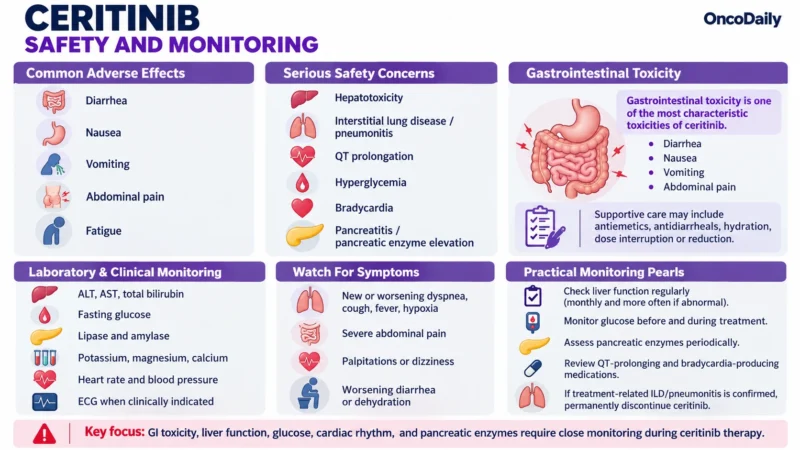
What Monitoring Is Required?
Monitoring during ceritinib therapy should include:
- ALT
- AST
- Total bilirubin
- Respiratory symptoms for ILD/pneumonitis
- ECG when clinically indicated
- Potassium
- Magnesium
- Calcium
- Fasting glucose
- Heart rate
- Blood pressure
- Lipase
- Amylase
- Gastrointestinal toxicity
- Hydration status
- Weight and nutritional status
- Concomitant CYP3A inhibitors
- Concomitant CYP3A inducers
- QT-prolonging medications
- Bradycardia-producing medications
Particular attention should be given to:
Liver function, GI toxicity, glucose, cardiac rhythm, and pancreatic enzymes.
FAQ
What Is Ceritinib Used For?
How Does Ceritinib Work?
What Is the Standard Ceritinib Dose?
Why Must Ceritinib Be Taken With Food?
What Are the Dose Reductions?
Does Ceritinib Work in Brain Metastases?
What Did ASCEND-4 Show?
- 16.6 months with ceritinib
- 8.1 months with chemotherapy.
What Did ASCEND-5 Show?
- 5.4 months with ceritinib
- 1.6 months with chemotherapy.