


Brentuximab Vedotin (Adcetris): Mechanism of Action, Dosing, Clinical Uses, Trials, and Side Effects
Key takeaways
- Brentuximab vedotin is a CD30-directed antibody–drug conjugate.
- Its cytotoxic payload, MMAE, inhibits microtubule polymerization.
- The mechanism involves CD30 binding, internalization, linker cleavage, mitotic arrest, and apoptosis.
- It received initial FDA approval in 2011.
- Dosing is generally 1.2 mg/kg or 1.8 mg/kg IV, depending on indication.
- ECHELON-1 demonstrated improved overall survival with BV-AVD versus ABVD.
- ECHELON-2 established BV-CHP in eligible CD30-positive PTCL.
- AETHERA established post-transplant consolidation in high-risk cHL.
- ALCANZA demonstrated benefit in CD30-expressing cutaneous lymphoma.
- ECHELON-3 supported the 2025 approval in relapsed/refractory LBCL.
- SWOG S1826 demonstrated superior PFS with nivolumab–AVD compared with BV-AVD in advanced cHL.
- Major risks include neuropathy, neutropenia, serious infections, pulmonary toxicity, and PML.
- Concomitant bleomycin is contraindicated.
Brentuximab vedotin (Adcetris) is a CD30-directed antibody–drug conjugate (ADC) used to treat several types of lymphoma, including classical Hodgkin lymphoma (cHL), systemic anaplastic large cell lymphoma (sALCL), other CD30-expressing peripheral T-cell lymphomas (PTCL), and selected cutaneous T-cell lymphomas.
Unlike conventional monoclonal antibodies, brentuximab vedotin combines a CD30-targeting antibody with a potent cytotoxic payload, monomethyl auristatin E (MMAE), a microtubule-disrupting agent.
After binding CD30 on malignant cells, the antibody–drug conjugate undergoes internalization and intracellular processing, releasing MMAE. This disrupts microtubules, arrests cells in mitosis, and induces apoptosis.
First FDA-approved in August 2011, brentuximab vedotin became one of the earliest successful ADCs in hematologic oncology.
Its clinical applications expanded from relapsed Hodgkin lymphoma and sALCL into frontline lymphoma treatment, post-transplant consolidation, and pediatric Hodgkin lymphoma.
Most recently, on February 11, 2025, the FDA approved brentuximab vedotin combined with lenalidomide and rituximab for selected adults with relapsed or refractory large B-cell lymphoma after at least two previous systemic therapies.
Major clinical studies include ECHELON-1, ECHELON-2, ECHELON-3, AETHERA, ALCANZA, and AHOD1331.
Key Facts
- Generic name: Brentuximab vedotin
- Brand name: Adcetris
- Drug class: Antibody–drug conjugate
- Target: CD30 (TNFRSF8)
- Antibody: Chimeric IgG1
- Cytotoxic payload: Monomethyl auristatin E (MMAE)
- Linker: Protease-cleavable valine–citrulline linker
- Mechanism: CD30 binding, internalization, MMAE release, microtubule disruption, and apoptosis
- Initial FDA approval: August 2011
- Administration: Intravenous infusion over 30 minutes
- Common doses: 1.2 mg/kg or 1.8 mg/kg, depending on indication
- Major indications: cHL, sALCL, CD30-expressing PTCL, cutaneous T-cell lymphoma, and selected relapsed/refractory large B-cell lymphoma
- Pivotal studies: ECHELON-1, ECHELON-2, ECHELON-3, AETHERA, ALCANZA, AHOD1331
- Common adverse reactions: Peripheral neuropathy, neutropenia, fatigue, nausea, diarrhea, and infections
- Boxed warning: Progressive multifocal leukoencephalopathy (PML)
- Important contraindication: Concomitant bleomycin
- Monitoring: CBC, peripheral neuropathy, liver function, infections, pulmonary symptoms, and infusion reactions
- Drug interactions: Strong CYP3A4 inhibitors and inducers can affect MMAE exposure
- Available strength: 50-mg single-dose vial
What Is Brentuximab Vedotin?
Brentuximab vedotin is an ADC composed of three principal components:
- Anti-CD30 monoclonal antibody: Recognizes CD30 on malignant cells.
- Cleavable linker: Connects the antibody to the cytotoxic drug.
- MMAE payload: Inhibits microtubule polymerization.
CD30 is strongly expressed on Hodgkin and Reed–Sternberg cells in classical Hodgkin lymphoma and on malignant cells in systemic ALCL.
It may also be expressed in other T-cell lymphomas and some large B-cell lymphomas.
The antibody component provides targeted delivery, while MMAE produces the principal cytotoxic effect.
Brentuximab vedotin is not a conventional immune checkpoint inhibitor or an unconjugated monoclonal antibody. It is a targeted delivery system for cytotoxic chemotherapy.
What Is the Mechanism of Action of Brentuximab Vedotin?
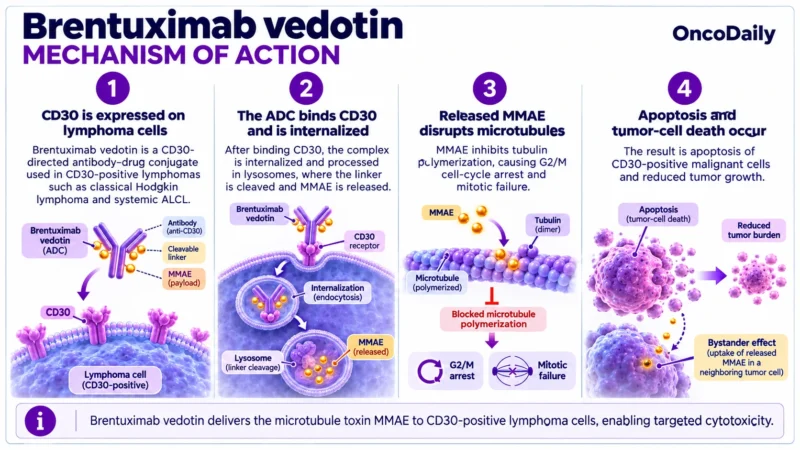
1. CD30 Recognition
The monoclonal antibody binds CD30 expressed on the surface of lymphoma cells.
CD30 belongs to the tumor necrosis factor receptor superfamily.
Its expression varies among lymphoma subtypes.
2. Internalization
Following CD30 binding, the ADC–receptor complex is internalized through endocytosis.
The complex then undergoes intracellular trafficking toward lysosomal compartments.
3. MMAE Release
Lysosomal proteases cleave the linker.
This releases the cytotoxic payload, MMAE, inside the malignant cell.
4. Microtubule Disruption
MMAE binds tubulin and inhibits microtubule polymerization.
This disrupts mitotic spindle formation and prevents normal cell division.
5. Cell-Cycle Arrest and Apoptosis
Microtubule disruption induces:
- G2/M cell-cycle arrest
- Mitotic failure
- Apoptotic cell death
6. Bystander Antitumor Effect
Released MMAE may diffuse into nearby cells and contribute to the destruction of adjacent malignant cells.
This may help explain activity in some tumors with heterogeneous CD30 expression.
Overall mechanism:
Brentuximab vedotin → CD30 binding → internalization → lysosomal linker cleavage → MMAE release → microtubule inhibition → G2/M arrest → apoptosis.
What Is the Recommended Dose of Brentuximab Vedotin?
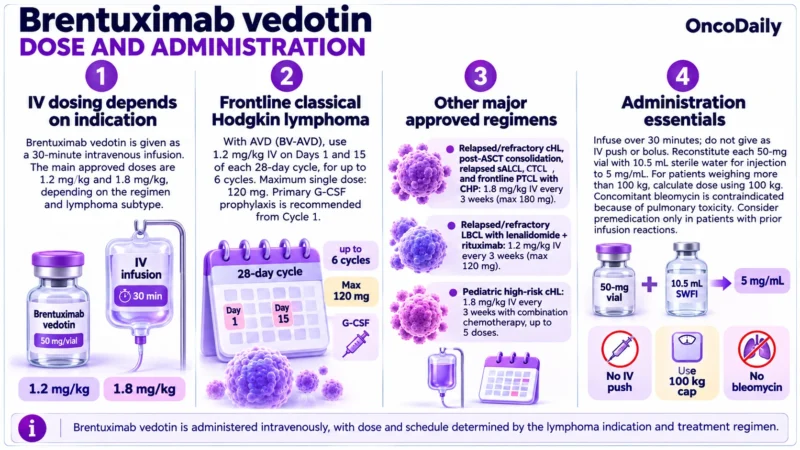
The dose depends on the cancer indication and combination regimen.
Previously Untreated Stage III–IV Classical Hodgkin Lymphoma
Brentuximab vedotin is administered with:
- Doxorubicin
- Vinblastine
- Dacarbazine
This regimen is known as BV-AVD or A+AVD.
Recommended Dose
1.2 mg/kg IV on Days 1 and 15 of each 28-day cycle.
Maximum single dose: 120 mg.
Duration
Up to six cycles (12 doses).
Administer primary G-CSF prophylaxis beginning with Cycle 1.
Relapsed or Refractory Classical Hodgkin Lymphoma
Recommended Dose
1.8 mg/kg IV every three weeks.
Maximum dose: 180 mg.
Continue until progression or unacceptable toxicity.
Post-Autologous Stem Cell Transplant Consolidation in cHL
Recommended Dose
1.8 mg/kg IV every three weeks.
Maximum dose: 180 mg.
Begin approximately 4–6 weeks after autologous transplantation, or after appropriate recovery.
Duration
Up to 16 cycles.
Previously Untreated CD30-Expressing Peripheral T-Cell Lymphoma
Brentuximab vedotin is administered with:
- Cyclophosphamide
- Doxorubicin
- Prednisone
The combination is called BV-CHP or A+CHP.
Recommended Dose
1.8 mg/kg IV every three weeks
Maximum dose: 180 mg.
Duration
Six to eight cycles.
Primary G-CSF prophylaxis is recommended beginning with Cycle 1.
Relapsed Systemic Anaplastic Large Cell Lymphoma
1.8 mg/kg IV every three weeks, up to 180 mg.
Continue until progression or unacceptable toxicity.
Relapsed Cutaneous T-Cell Lymphoma
For relapsed primary cutaneous ALCL or CD30-expressing mycosis fungoides:
1.8 mg/kg IV every three weeks.
Maximum of 16 cycles.
Relapsed or Refractory Large B-Cell Lymphoma
Brentuximab vedotin is administered with:
- Lenalidomide
- Rituximab
Recommended Dose
1.2 mg/kg IV every three weeks.
Maximum dose: 120 mg.
Treatment continues until progression or unacceptable toxicity.
Primary G-CSF prophylaxis is recommended beginning with Cycle 1.
Pediatric High-Risk Classical Hodgkin Lymphoma
For patients aged two years or older receiving the approved chemotherapy combination:
1.8 mg/kg IV every three weeks.
Maximum dose: 180 mg.
Administer for up to five doses with the chemotherapy protocol.
The regimen includes doxorubicin, vincristine, etoposide, prednisone, and cyclophosphamide.
How Should Brentuximab Vedotin Be Administered?
Intravenous Administration
Brentuximab vedotin is administered as an IV infusion over:
30 minutes.
It must not be administered as an IV push or bolus.
Preparation
Each 50-mg vial is reconstituted with:
10.5 mL sterile water for injection.
The resulting concentration is:
5 mg/mL.
The reconstituted solution is further diluted in a compatible infusion solution according to the prescribing information.
Avoid shaking the vial.
Weight-Based Dosing
For patients weighing more than 100 kg, the dose is calculated using a maximum dosing weight of:
100 kg.
Premedication
Routine antihistamine or corticosteroid premedication is not required for every patient.
For patients with previous infusion reactions, premedication may include:
- Acetaminophen
- Antihistamine
- Corticosteroid
Growth-Factor Support
Primary G-CSF prophylaxis should begin with Cycle 1 when brentuximab vedotin is administered in the approved combinations for frontline advanced-stage cHL, frontline PTCL, pediatric high-risk cHL, or relapsed/refractory LBCL.
What Should You Do If a Brentuximab Vedotin Dose Is Missed?
If a dose is missed:
- Contact the oncology team.
- Administer the delayed dose when clinically appropriate.
- Adjust the remaining treatment schedule.
- Assess whether toxicity caused the delay.
Do not double the next dose.
How Are Brentuximab Vedotin Dose Modifications Managed?
Peripheral Neuropathy
Peripheral neuropathy is a major dose-limiting toxicity.
For monotherapy at 1.8 mg/kg:
Grade 2–3 Neuropathy
Withhold treatment until improvement to Grade 1 or baseline.
Then resume at:
1.2 mg/kg every three weeks.
Grade 4 Neuropathy
Permanently discontinue treatment.
Different modification schedules apply to BV-AVD, BV-CHP, and other combinations.
Neutropenia
Monitor CBC before each dose.
Grade 3–4 neutropenia may require:
- Treatment delay
- G-CSF support
- Dose modification
- Infection management
Infusion Reactions
For significant infusion reactions:
- Interrupt the infusion.
- Provide supportive care.
- Resume according to clinical severity and treatment tolerance.
For anaphylaxis:
Permanently discontinue brentuximab vedotin.
Progressive Multifocal Leukoencephalopathy
Suspected PML requires immediate treatment interruption and diagnostic evaluation.
If confirmed:
Permanently discontinue brentuximab vedotin.
What Drug Interactions Are Important With Brentuximab Vedotin?
Bleomycin
Concomitant brentuximab vedotin and bleomycin are contraindicated.
The combination increases the risk of serious pulmonary toxicity.
This is why BV-AVD does not contain bleomycin.
Strong CYP3A4 Inhibitors
Examples include:
- Ketoconazole
- Clarithromycin
- Itraconazole
- Certain antiviral protease inhibitors
These agents may increase MMAE exposure and toxicity.
Monitor closely for adverse reactions.
Strong CYP3A4 Inducers
Examples include:
- Rifampin
- Carbamazepine
- Phenytoin
These agents may decrease MMAE exposure.
Other Neurotoxic Agents
Concurrent neurotoxic chemotherapy may increase the risk of peripheral neuropathy.
Immunosuppressive Treatments
Combining brentuximab vedotin with immunosuppressive chemotherapy may increase infection and hematologic toxicity.
Does Brentuximab Vedotin Require Dose Adjustment in Renal or Hepatic Impairment?
Renal Impairment
Mild or Moderate Impairment
No routine dose adjustment is required for creatinine clearance of at least 30 mL/min.
Severe Impairment
Avoid brentuximab vedotin when CrCl is below 30 mL/min.
MMAE exposure may increase substantially.
Hepatic Impairment
Mild Impairment
Dose reduction is required.
For example:
- BV-AVD: 0.9 mg/kg every two weeks
- Relapsed/refractory LBCL combination: 0.9 mg/kg every three weeks
- Most other indications: 1.2 mg/kg every three weeks
Moderate or Severe Impairment
Avoid treatment, because MMAE exposure and severe adverse reactions may increase.
What Is the Pharmacokinetic Profile of Brentuximab Vedotin?
Distribution
The antibody–drug conjugate distributes mainly within vascular and extracellular compartments.
Metabolism
The antibody component is broken down by proteolytic catabolism.
MMAE undergoes metabolism partly through CYP3A4/5.
Half-Life
Approximate terminal half-lives are:
- Antibody–drug conjugate: 4–6 days
- MMAE: 3–4 days
These values vary according to treatment conditions and pharmacokinetic modeling.
Elimination
MMAE and its metabolites are eliminated through fecal and urinary pathways.
Accumulation
MMAE exposure generally decreases after repeated doses because of changes in payload release and systemic exposure.
What Are the Clinical Uses of Brentuximab Vedotin?
Classical Hodgkin Lymphoma
Brentuximab vedotin has several approved roles:
- Frontline treatment of stage III–IV disease with AVD
- Relapsed disease after autologous transplantation
- Relapsed disease after at least two prior multiagent chemotherapy regimens when transplantation is not appropriate
- Post-autologous transplant consolidation in patients at high risk of progression or relapse
Its use in frontline advanced-stage disease must now be considered alongside nivolumab–AVD, which demonstrated superior progression-free survival in the SWOG S1826 trial.
Peripheral T-Cell Lymphoma
BV-CHP is an established frontline option for:
- Systemic ALCL
- Other eligible CD30-expressing PTCL subtypes
The strongest randomized evidence is in the overall ECHELON-2 population, which was predominantly composed of patients with systemic ALCL.
Cutaneous T-Cell Lymphoma
Brentuximab vedotin is approved for adults with:
- Relapsed primary cutaneous ALCL
- CD30-expressing mycosis fungoides after prior systemic therapy
Treatment can produce durable skin and systemic responses in appropriately selected patients.
Relapsed or Refractory Large B-Cell Lymphoma
Following the February 2025 approval, brentuximab vedotin with lenalidomide and rituximab is an option for adults with relapsed/refractory LBCL after at least two systemic therapies who are ineligible for autologous transplantation or CAR-T therapy.
This represents an important expansion beyond its historically predominant use in CD30-positive T-cell and Hodgkin lymphomas.
What Biomarker Testing Is Required Before Brentuximab Vedotin?
CD30 Expression
CD30 is the biological target of brentuximab vedotin.
The usual assessment is:
Immunohistochemistry (IHC) on tumor tissue.
CD30 expression is characteristically strong in:
- Classical Hodgkin lymphoma
- Systemic ALCL
For other CD30-expressing PTCL and mycosis fungoides, tumor immunophenotyping is particularly relevant.
Large B-Cell Lymphoma
Importantly, the ECHELON-3 population included patients with low or undetectable CD30 expression by the trial assay.
The 2025 LBCL indication does not require a positive CD30 IHC result for treatment selection.
Additional Diagnostic Testing
Depending on lymphoma subtype, testing may include:
- CD20, CD3, CD4, CD8, CD15, CD30, CD45 and other immunophenotypic markers
- ALK in systemic ALCL
- PAX5 and other markers for Hodgkin lymphoma
- EBV testing when clinically indicated
- Molecular testing for lymphoma classification and risk stratification
Key distinction: CD30 targeting is central to the drug’s mechanism, but the requirement for demonstrating CD30 positivity depends on the lymphoma indication.
What Did the Pivotal Clinical Trials Show?
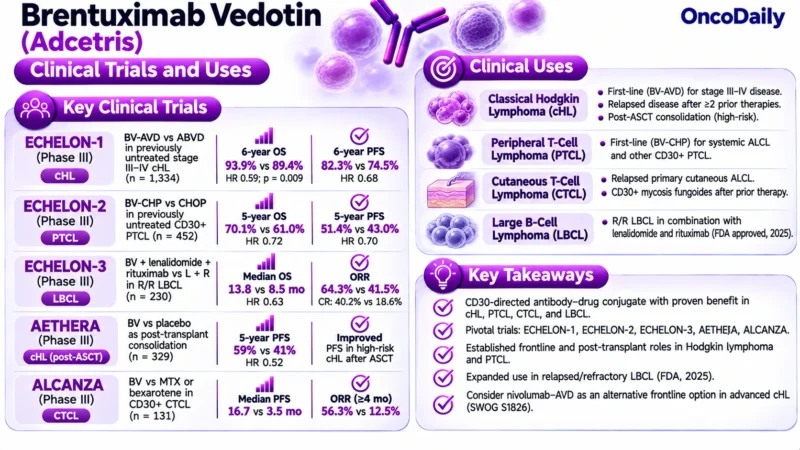
ECHELON-1 — Advanced Classical Hodgkin Lymphoma
The randomized phase III ECHELON-1 trial evaluated:
- Brentuximab vedotin + AVD
- ABVD chemotherapy
The study enrolled 1,334 patients with previously untreated stage III–IV cHL.
Six-Year Overall Survival
- BV-AVD: 93.9%
- ABVD: 89.4%
HR: 0.59; p = 0.009
Six-Year Progression-Free Survival
- BV-AVD: 82.3%
- ABVD: 74.5%
HR: 0.68
The results established an overall survival benefit from adding brentuximab vedotin to frontline chemotherapy in advanced cHL.
Watch More: Brentuximab Vedotin for Advanced Hodgkin Lymphoma in the ECHELON-1 Study.
ECHELON-2 — CD30-Expressing Peripheral T-Cell Lymphoma
This phase III study compared:
- BV-CHP
- CHOP
in 452 patients with previously untreated CD30-positive PTCL.
Five-Year Progression-Free Survival
- BV-CHP: 51.4%
- CHOP: 43.0%
HR: 0.70
Five-Year Overall Survival
- BV-CHP: 70.1%
- CHOP: 61.0%
HR: 0.72
The results supported BV-CHP as a major frontline regimen, particularly for systemic ALCL.
ECHELON-3 — Relapsed or Refractory Large B-Cell Lymphoma
ECHELON-3 evaluated:
- Brentuximab vedotin + lenalidomide + rituximab
- Placebo + lenalidomide + rituximab
A total of 230 patients were randomized.
Median Overall Survival
- Brentuximab combination: 13.8 months
- Control: 8.5 months
HR: 0.63
- Median Progression-Free Survival
4.2 versus 2.6 months
HR: 0.53
Objective Response Rate
- 64.3% versus 41.5%
Complete Response Rate
- 40.2% versus 18.6%
These findings supported the February 2025 FDA approval for eligible patients with previously treated LBCL.
AETHERA — Post-Transplant Hodgkin Lymphoma Consolidation
The randomized phase III AETHERA trial evaluated brentuximab vedotin versus placebo after autologous stem cell transplantation in patients with cHL at high risk of relapse or progression.
Five-Year Progression-Free Survival
- Brentuximab vedotin: 59%
- Placebo: 41%
HR: 0.52
The results established the benefit of brentuximab vedotin as post-transplant consolidation therapy in selected high-risk patients.
ALCANZA — CD30-Expressing Cutaneous T-Cell Lymphoma
ALCANZA compared brentuximab vedotin with physician’s choice of methotrexate or bexarotene in patients with previously treated CD30-expressing cutaneous T-cell lymphoma.
Objective Response Lasting at Least Four Months
- Brentuximab vedotin: 56.3%
- Control: 12.5%
Median Progression-Free Survival
- Brentuximab vedotin: 16.7 months
- Control: 3.5 months
These findings established its efficacy in relapsed CD30-expressing cutaneous lymphoma.
AHOD1331 — Pediatric High-Risk Hodgkin Lymphoma
The phase III AHOD1331 trial evaluated brentuximab vedotin with chemotherapy versus a conventional bleomycin-containing regimen in children and adolescents with high-risk classical Hodgkin lymphoma.
Three-Year Event-Free Survival
- Brentuximab-containing regimen: 92.1%
- Standard regimen: 82.5%
The study supported the expansion of brentuximab vedotin into pediatric frontline treatment.
SWOG S1826 — Nivolumab–AVD Versus Brentuximab–AVD
Although S1826 was not an approval trial for brentuximab vedotin, it is important for understanding its current clinical positioning.
Two-Year Progression-Free Survival
- Nivolumab–AVD: 92%
- Brentuximab–AVD: 83%
HR: 0.45
Nivolumab–AVD demonstrated superior progression-free survival and a more favorable overall toxicity profile, influencing frontline treatment choices in advanced-stage cHL.
Does Brentuximab Vedotin Have CNS Activity?
Brentuximab vedotin is not an established CNS-directed treatment.
The antibody component has limited penetration through an intact blood–brain barrier.
CNS lymphoma involvement may be associated with altered barrier permeability, but clinical evidence remains insufficient to establish reliable intracranial efficacy.
Isolated case reports describe use in unusual CNS-involved CD30-positive malignancies.
However, brentuximab vedotin should not be relied on as standalone therapy for CNS lymphoma.
Is Brentuximab Vedotin FDA Approved?
Yes.
Brentuximab vedotin received its initial FDA approval in August 2011.
Its FDA-approved indications include selected settings in:
- Previously untreated stage III–IV classical Hodgkin lymphoma
- Pediatric high-risk classical Hodgkin lymphoma
- Relapsed classical Hodgkin lymphoma
- Post-autologous transplant consolidation in high-risk cHL
- Previously untreated systemic ALCL and other CD30-expressing PTCL
- Relapsed systemic ALCL
- Relapsed primary cutaneous ALCL and CD30-expressing mycosis fungoides
- Relapsed/refractory LBCL in combination with lenalidomide and rituximab
The most recent major FDA indication expansion was the February 11, 2025 approval in LBCL.
What Is the Current Clinical Role of Brentuximab Vedotin in 2026?
Hodgkin Lymphoma
Brentuximab vedotin remains an important treatment in relapsed disease, post-transplant consolidation, and selected frontline regimens.
However, recent evidence from SWOG S1826 has strengthened the role of nivolumab–AVD in previously untreated advanced-stage cHL.
Consequently, BV-AVD is no longer the sole modern antibody-containing frontline strategy.
Peripheral T-Cell Lymphoma
BV-CHP remains an established treatment for appropriate CD30-positive PTCL, especially systemic ALCL.
Read More: CHEPA in CD30-Positive PTCL: Primary Results of a Phase 2 Trial With Integrated ctDNA Analysis by OncoDaily.
Cutaneous T-Cell Lymphoma
Brentuximab vedotin is a recognized systemic treatment for previously treated CD30-expressing cutaneous disease.
Large B-Cell Lymphoma
The ECHELON-3 results provide a treatment option for selected patients who cannot receive autologous transplantation or CAR-T therapy after multiple previous lines.
Antibody–Drug Conjugate Development
Brentuximab vedotin remains an important example of successful ADC development, demonstrating how selective antigen targeting can deliver a potent antimitotic agent to malignant cells.
What Are the Major Side Effects of Brentuximab Vedotin?
Peripheral Neuropathy
Peripheral neuropathy is one of the most important dose-limiting toxicities.
It can involve sensory or motor nerves and is often cumulative.
Symptoms include:
- Numbness
- Tingling
- Burning sensations
- Neuropathic pain
- Weakness
- Difficulty walking
Neuropathy may improve after dose interruption, reduction, or discontinuation, but recovery can be incomplete.
Neutropenia and Febrile Neutropenia
Brentuximab vedotin can cause significant neutropenia, particularly in combination with chemotherapy.
Complications include:
- Febrile neutropenia
- Serious bacterial infections
- Sepsis
- Treatment delays
Primary G-CSF prophylaxis is required in specified combination regimens, including BV-AVD and BV-CHP.
Progressive Multifocal Leukoencephalopathy
Brentuximab vedotin carries an FDA boxed warning for progressive multifocal leukoencephalopathy (PML).
PML is a rare, potentially fatal demyelinating CNS infection caused by reactivation of the JC virus.
Possible symptoms include:
- Progressive weakness
- Cognitive or behavioral changes
- Speech difficulties
- Visual disturbances
- Gait abnormalities
Confirmed PML requires permanent discontinuation.
Serious Infections
Brentuximab vedotin may cause:
- Pneumonia
- Bacteremia
- Sepsis
- Opportunistic infections
Fatal infections have been reported.
Infusion-Related Reactions
Infusion reactions and anaphylaxis may occur.
Symptoms include:
- Rash
- Dyspnea
- Fever
- Chills
- Hypotension
- Bronchospasm
Hepatotoxicity
Elevated liver enzymes and serious hepatic injury have been reported.
Liver abnormalities may occur after the first dose or after rechallenge.
Pulmonary Toxicity
Potential complications include:
- Pneumonitis
- Interstitial lung disease
- Acute respiratory distress syndrome
Concomitant bleomycin is contraindicated because of increased pulmonary toxicity.
Severe Dermatologic Reactions
Rare but serious reactions include:
- Stevens–Johnson syndrome
- Toxic epidermal necrolysis
Gastrointestinal Complications
Serious complications may include:
- Pancreatitis
- Gastrointestinal perforation
- Enterocolitis
- Ileus
- Gastrointestinal hemorrhage
Tumor Lysis Syndrome
Patients with rapidly proliferating lymphoma or high tumor burden may be at increased risk.
Embryo-Fetal Toxicity
Brentuximab vedotin can cause fetal harm.
Females of reproductive potential should use effective contraception during treatment and for two months after the final dose.
Males with partners of reproductive potential should use effective contraception during treatment and for four months after the final dose.
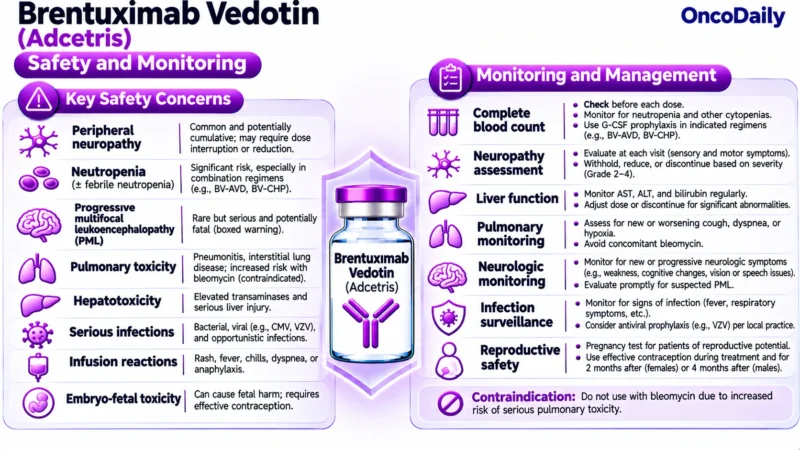
What Monitoring Is Required During Brentuximab Vedotin Treatment?
Complete Blood Count
Monitor before every treatment dose:
- Neutrophils
- Hemoglobin
- Platelets
Increase monitoring frequency when severe cytopenias occur.
Peripheral Neuropathy
At each visit, assess for:
- Sensory changes
- Weakness
- Functional impairment
- Gait difficulties
Dose interruption or modification may be necessary.
Infection Monitoring
Assess for fever, cough, dyspnea, and other infectious symptoms.
Provide G-CSF prophylaxis in indicated combination regimens.
Liver Function
Monitor:
- AST
- ALT
- Bilirubin
Adjust treatment or discontinue for significant hepatotoxicity.
Neurological Monitoring
Investigate new or progressive neurological symptoms promptly.
PML must be considered when unexplained neurological deficits develop.
Pulmonary Monitoring
Assess new respiratory symptoms, including cough, dyspnea, and hypoxia.
Avoid concomitant bleomycin.
Infusion Monitoring
Monitor during and after infusion for hypersensitivity and anaphylaxis.
Tumor Lysis Monitoring
In high-risk patients, monitor relevant metabolic parameters and provide appropriate prophylaxis.
Pregnancy and Reproductive Monitoring
Assess pregnancy status when appropriate and provide counseling about embryo-fetal toxicity and contraception.