


Blinatumomab (Blincyto): Mechanism of Action, Dosing, Clinical Uses, Trials, and Side Effects
Key takeaways
- Blinatumomab is a CD19×CD3 bispecific T-cell engager.
- It redirects endogenous T cells to kill CD19-positive leukemic blasts.
- It was initially FDA approved in 2014.
- Its indications include relapsed/refractory B-ALL, MRD-positive disease, and Ph-negative B-ALL consolidation.
- It is approved for patients one month of age or older in applicable settings.
- It requires continuous IV infusion because of its short half-life.
- TOWER demonstrated median OS of 7.7 versus 4.0 months.
- BLAST demonstrated a 78% complete MRD response rate.
- E1910 demonstrated improved three-year OS of 85% versus 68%.
- AALL1731 demonstrated three-year DFS of 96.0% versus 87.9%.
- AIEOP-BFM ALL 2017 demonstrated improved four-year EFS of 83.0% versus 70.3%.
- The principal serious risks are CRS and neurological toxicity/ICANS.
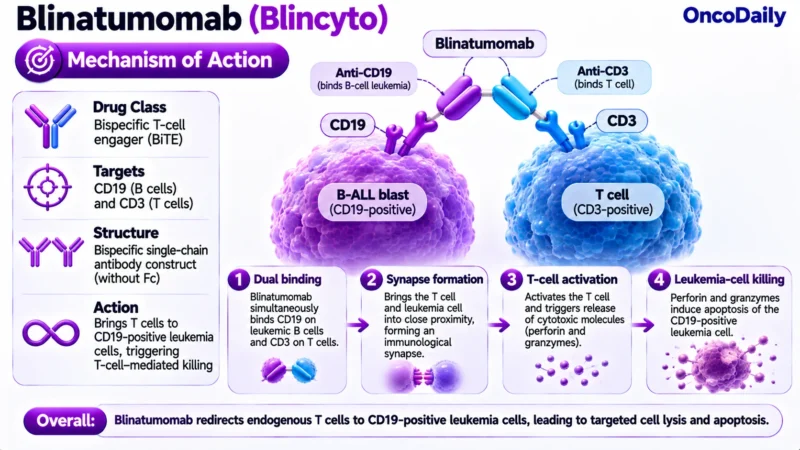
Blinatumomab (Blincyto) is a CD19×CD3 bispecific T-cell engager (BiTE) used in the treatment of B-cell precursor acute lymphoblastic leukemia (B-ALL). Unlike conventional monoclonal antibodies or antibody–drug conjugates, blinatumomab simultaneously binds CD19 on malignant B lymphoblasts and CD3 on T lymphocytes, bringing the two cells into close proximity and triggering T-cell-mediated destruction of leukemic cells.
Blinatumomab does not contain a cytotoxic chemotherapy payload. Instead, it redirects the patient’s endogenous T cells to recognize and eliminate CD19-positive B cells through an immunological synapse, perforin and granzyme release, and apoptosis.
Initially approved by the FDA in December 2014, blinatumomab became a major treatment option for relapsed or refractory B-ALL and subsequently for measurable residual disease (MRD)-positive leukemia.
On June 14, 2024, the FDA expanded its indication to consolidation therapy for CD19-positive, Philadelphia chromosome-negative B-ALL in adults and children aged one month or older. This expansion was supported by randomized trials demonstrating improved survival when blinatumomab was incorporated into chemotherapy-based treatment.
Major studies include TOWER, BLAST, E1910, AALL1331, AALL1731, and the AIEOP-BFM ALL 2017 trial.
Key Facts
- Generic name: Blinatumomab
- Brand name: Blincyto
- Drug class: Bispecific T-cell engager (BiTE)
- Antibody format: Recombinant bispecific single-chain antibody construct
- Targets: CD19 and CD3
- Mechanism: T-cell recruitment, immunological synapse formation, perforin/granzyme-mediated cytotoxicity
- Initial FDA approval: December 2014
- Consolidation approval: June 2024
- Administration: Continuous intravenous infusion
- Typical adult maintenance infusion dose: 28 micrograms/day
- Initial relapsed/refractory dose: 9 micrograms/day for patients weighing at least 45 kg
- Pediatric dosing: Weight- and body-surface-area-dependent
- FDA indications: Relapsed/refractory B-ALL, MRD-positive B-ALL, and consolidation in Philadelphia chromosome-negative B-ALL
- Approved ages: One month and older
- Required biomarker: CD19 expression
- Pivotal studies: TOWER, BLAST, E1910
- Additional pediatric evidence: AALL1331, AALL1731, AIEOP-BFM ALL 2017
- Common adverse reactions: Fever, headache, infusion reactions, infections, neutropenia, anemia, and fatigue
- Boxed warnings: Cytokine release syndrome (CRS) and neurological toxicity, including ICANS
- Monitoring: Neurological examination, vital signs, CBC, infections, liver function, and tumor lysis parameters
- Elimination half-life: Approximately 2.2 hours
- Available formulation: Lyophilized powder for continuous IV infusion
What Is Blinatumomab?
Blinatumomab is a bispecific antibody construct composed of two antigen-binding domains.
One domain recognizes CD19, a B-cell lineage antigen expressed on most B-cell precursor ALL blasts.
The other domain recognizes CD3, a component of the T-cell receptor complex.
By binding both targets, blinatumomab physically connects a T cell to a malignant B cell, allowing cytotoxic T-cell activity to be redirected toward the leukemia.
Blinatumomab can activate T cells without requiring conventional tumor peptide presentation by major histocompatibility complex (MHC) molecules.
This is an important distinction from standard antigen-specific T-cell recognition.
It is also distinct from inotuzumab ozogamicin, which targets CD22 and delivers a calicheamicin cytotoxic payload.
What Is the Mechanism of Action of Blinatumomab?
1. CD19 Recognition
Blinatumomab binds CD19 on the surface of malignant B lymphoblasts.
CD19 is expressed throughout much of B-cell development and is commonly retained in B-ALL.
2. CD3 Binding on T Cells
The second binding domain recognizes CD3 on T lymphocytes.
This recruits an endogenous cytotoxic T cell toward the CD19-positive target.
3. Immunological Synapse Formation
Simultaneous CD19 and CD3 binding creates close contact between the T cell and leukemic blast.
An immunological synapse forms, triggering T-cell activation.
4. T-Cell Cytotoxicity
Activated T cells release:
- Perforin
- Granzymes
These cytotoxic proteins induce apoptosis of the target cell.
5. Serial Tumor-Cell Killing
Activated T cells may detach from a destroyed leukemia cell and engage additional CD19-positive targets.
This allows repeated T-cell-mediated killing.
6. Cytokine Release and Immune Activation
T-cell activation also stimulates release of cytokines, including IL-6, interferon-gamma, and other inflammatory mediators.
These responses contribute to antitumor activity but may also cause cytokine release syndrome.
Overall mechanism:
Blinatumomab → CD19 binding + CD3 binding → immunological synapse → T-cell activation → perforin/granzyme release → B-ALL blast apoptosis.
What Is the Recommended Dose of Blinatumomab?
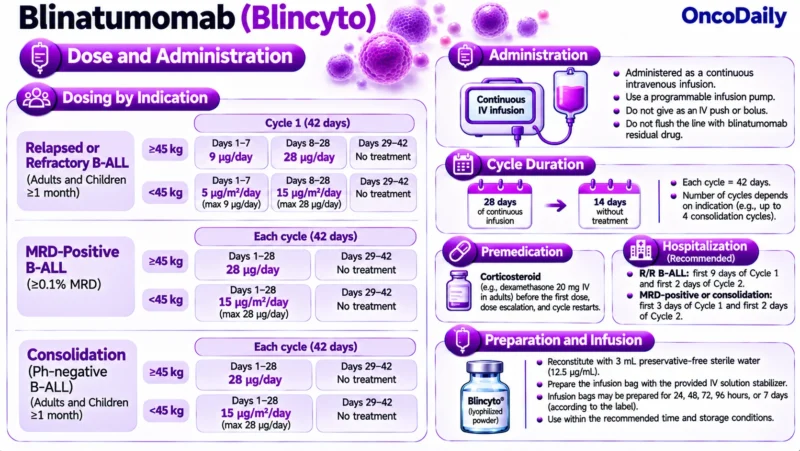
Blinatumomab dosing depends on indication, body weight, and treatment cycle.
Patients weighing 45 kg or more receive a fixed daily dose.
Patients weighing less than 45 kg receive body-surface-area-based doses.
Relapsed or Refractory B-ALL
Cycle 1 — Patients Weighing 45 kg or More
Days 1–7: 9 micrograms/day by continuous IV infusion.
Days 8–28: 28 micrograms/day.
Days 29–42: Treatment-free interval.
Cycle 1 — Patients Weighing Less Than 45 kg
Days 1–7: 5 micrograms/m²/day, maximum 9 micrograms/day.
Days 8–28: 15 micrograms/m²/day, maximum 28 micrograms/day.
Days 29–42: Treatment-free interval.
Cycle 2
- At least 45 kg: 28 micrograms/day
- Below 45 kg: 15 micrograms/m²/day, maximum 28 micrograms/day
Administer continuously for 28 days, followed by 14 days without treatment.
Additional Cycles
The FDA-labeled treatment course may include:
- Up to two induction cycles
- Three additional consolidation cycles
- Up to four cycles of continued therapy
Continued-therapy cycles consist of 28 days of infusion followed by 56 days without treatment.
MRD-Positive B-ALL
For patients in first or second complete remission with MRD of at least 0.1%:
Patients Weighing 45 kg or More
28 micrograms/day on Days 1–28.
Patients Weighing Less Than 45 kg
15 micrograms/m²/day, maximum 28 micrograms/day, on Days 1–28.
Each cycle is followed by a 14-day treatment-free interval.
Treatment consists of one initial cycle followed by up to three additional cycles.
Unlike relapsed/refractory treatment, there is no routine first-week 9-microgram step-up in the MRD-positive regimen.
Consolidation for Philadelphia Chromosome-Negative B-ALL
For adults and children receiving consolidation as part of multiphase treatment:
- At least 45 kg: 28 micrograms/day
- Below 45 kg: 15 micrograms/m²/day, maximum 28 micrograms/day
Each blinatumomab cycle consists of:
28 days of continuous infusion followed by 14 days without treatment.
The number and placement of cycles depend on the overall leukemia treatment protocol.
How Should Blinatumomab Be Administered?
Continuous Intravenous Infusion
Blinatumomab is administered continuously through a programmable infusion pump.
It is not administered as a short conventional IV infusion, push, or bolus.
Treatment requires consistent drug delivery because blinatumomab has a short elimination half-life.
Infusion Bag Duration
Depending on the approved preparation method, infusion bags may be prepared for:
- 24 hours
- 48 hours
- 72 hours
- 96 hours
- Seven days
The longer infusion-bag methods require specific product-label preparation procedures and are not recommended for patients weighing less than 5.4 kg when the formulation contains benzyl alcohol.
Preparation
Blinatumomab is supplied as a lyophilized powder with an accompanying IV solution stabilizer.
For the labeled formulation:
- Reconstitute the vial with 3 mL preservative-free sterile water for injection.
- The resulting concentration is 12.5 micrograms/mL.
- Prepare the infusion bag using the specific instructions and stabilizer.
- Do not improvise dilutions or replace the stabilizer with an unapproved alternative.
Do not flush the infusion tubing, as this may deliver an unintended bolus of blinatumomab.
Hospitalization
For relapsed/refractory B-ALL, hospitalization is recommended for:
- The first nine days of Cycle 1
- The first two days of Cycle 2
For MRD-positive treatment and consolidation, hospitalization is generally recommended for:
- The first three days of Cycle 1
- The first two days of Cycle 2
Subsequent cycle starts and restarts after prolonged infusion interruption require appropriate healthcare supervision.
Premedication
Dexamethasone is administered before starting blinatumomab to reduce treatment-associated inflammatory reactions.
For adult relapsed/refractory disease:
Dexamethasone 20 mg IV or orally, approximately one hour before the initial infusion, dose escalation, and applicable restarts.
For adult MRD-positive disease:
Prednisone 100 mg IV or equivalent, such as dexamethasone 16 mg, before each cycle.
For adult consolidation:
Dexamethasone 20 mg IV before the first dose of each cycle.
Pediatric premedication is body-surface-area based according to the specific indication.
What Should You Do If a Blinatumomab Dose Is Missed or Infusion Is Interrupted?
Blinatumomab requires continuous administration, so an infusion interruption must be addressed promptly.
- Contact the oncology or infusion team.
- Do not independently restart or modify the pump.
- Do not double or rapidly infuse the missed amount.
- Evaluate the reason for interruption and the patient’s clinical condition.
For interruptions of four hours or longer, corticosteroid premedication and supervised restart may be required.
If treatment is interrupted for more than seven days because of toxicity, a new treatment cycle is generally initiated.
How Are Blinatumomab Dose Modifications Managed?
Cytokine Release Syndrome
Grade 3 CRS
Interrupt blinatumomab and administer corticosteroids.
After resolution, treatment may be restarted at the lower dose:
- At least 45 kg: 9 micrograms/day
- Below 45 kg: 5 micrograms/m²/day
If tolerated for seven days, escalate to the full dose.
Grade 4 CRS
Permanently discontinue blinatumomab.
Neurological Toxicity and ICANS
Neurological adverse events require prompt assessment.
Grade 2 ICANS requires treatment interruption until resolution.
For Grade 3 neurological toxicity, withhold treatment until recovery to Grade 1 or lower for at least three days; restart at a reduced dose only if label criteria are met.
Grade 4 neurological toxicity requires permanent discontinuation.
Recurrent seizures may also require permanent discontinuation.
Severe Infection or Other Toxicity
Consider interruption for significant infection, severe inflammatory toxicity, or organ dysfunction.
Dose modification depends on the event and recovery.
What Drug Interactions Are Important With Blinatumomab?
CYP450-Metabolized Medications
Blinatumomab is not directly metabolized by CYP450 enzymes.
However, inflammatory cytokines released during early treatment may transiently suppress CYP450 enzyme activity.
This can increase exposure to some CYP substrates, especially those with a narrow therapeutic index.
Monitor relevant medications during treatment initiation and cytokine changes.
Other Immunosuppressive Treatments
Concomitant immunosuppressive therapy may affect immune responses and infection risk.
Live Vaccines
Live-virus vaccination is not recommended during significant treatment-related immunosuppression.
Vaccination timing should follow the prescribing information and leukemia treatment protocol.
Does Blinatumomab Require Dose Adjustment in Renal or Hepatic Impairment?
Renal Impairment
No routine dose adjustment is established for mild or moderate renal impairment.
Clinical evidence in severe renal impairment is limited.
Hepatic Impairment
No standard dose-adjustment algorithm is established for mild or moderate hepatic impairment.
Severe hepatic impairment has not been adequately studied.
Monitor liver function because treatment-associated transaminase elevations may occur.
What Is the Pharmacokinetic Profile of Blinatumomab?
Molecular Structure
Blinatumomab is a small bispecific antibody construct with a molecular weight of approximately 54 kDa.
It lacks the conventional Fc structure of a complete IgG antibody.
Half-Life
The mean elimination half-life is approximately:
2.2 hours.
Distribution
The estimated mean volume of distribution is approximately:
5.27 L.
Metabolism
Blinatumomab is expected to undergo protein catabolism.
Clearance
Mean systemic clearance is approximately:
3.1 L/hour.
Steady-state concentrations are generally reached within approximately one day of continuous infusion.
The short half-life explains why continuous infusion is required.
What Are the Clinical Uses of Blinatumomab?
Relapsed or Refractory B-Cell ALL
Blinatumomab is an FDA-approved immunotherapy for CD19-positive relapsed or refractory B-cell precursor ALL.
It offers an alternative to conventional salvage chemotherapy and can achieve hematologic and MRD-negative remissions.
It is frequently considered when patients are being evaluated for subsequent allogeneic HSCT or other definitive treatment strategies.
MRD-Positive B-ALL in Complete Remission
Blinatumomab is approved for patients in first or second complete remission who have MRD of at least 0.1%.
The BLAST trial demonstrated substantial MRD clearance with blinatumomab.
This indication is important because persistent MRD predicts a higher risk of relapse even when the marrow appears morphologically normal.
Frontline Consolidation in Philadelphia Chromosome-Negative B-ALL
Following the June 2024 FDA approval, blinatumomab can be incorporated into consolidation therapy for newly diagnosed CD19-positive, Philadelphia chromosome-negative B-ALL.
The E1910 trial demonstrated improved overall survival in adults who were MRD negative after initial chemotherapy.
The evidence supports a role for blinatumomab even when MRD is not detectable by conventional flow cytometry.
Pediatric B-ALL
Blinatumomab has an established role in pediatric B-ALL, including relapsed disease and frontline consolidation.
The AALL1731 trial demonstrated improved disease-free survival in children with newly diagnosed standard-risk B-ALL when blinatumomab was added to chemotherapy.
The AIEOP-BFM ALL 2017 trial also demonstrated that blinatumomab could replace selected chemotherapy blocks in high-risk pediatric B-ALL while improving event-free survival.
Philadelphia Chromosome-Positive B-ALL
Blinatumomab is used in several Ph-positive ALL strategies, often alongside or sequentially with tyrosine kinase inhibitors.
However, the FDA consolidation indication specifically applies to Ph-negative B-ALL, while the relapsed/refractory and MRD-positive indications do not have that same Ph-negative restriction.
What Molecular Testing Is Required Before Blinatumomab?
CD19 Expression
Confirm CD19 expression by flow cytometry or another appropriate immunophenotypic method.
CD19 loss or reduced expression may contribute to resistance after CD19-directed therapy.
Philadelphia Chromosome Status
Assess:
- BCR::ABL1 fusion
- Cytogenetic and molecular findings relevant to ALL classification
This is particularly important when determining eligibility for the FDA-labeled frontline consolidation indication.
MRD Assessment
MRD can be assessed using:
- Multiparameter flow cytometry
- Next-generation sequencing
- Molecular techniques appropriate to the disease
A documented MRD level of at least 0.1% defines the specific FDA-approved MRD-positive indication.
However, patients may also receive blinatumomab during consolidation under the separate Ph-negative indication even when they are MRD negative.
Baseline Disease Evaluation
Assessment includes marrow morphology, blood counts, organ function, neurological history, and CNS involvement.
What Did the Pivotal Clinical Trials Show?
TOWER — Relapsed or Refractory B-ALL
The randomized phase III TOWER trial compared:
- Blinatumomab
- Standard salvage chemotherapy
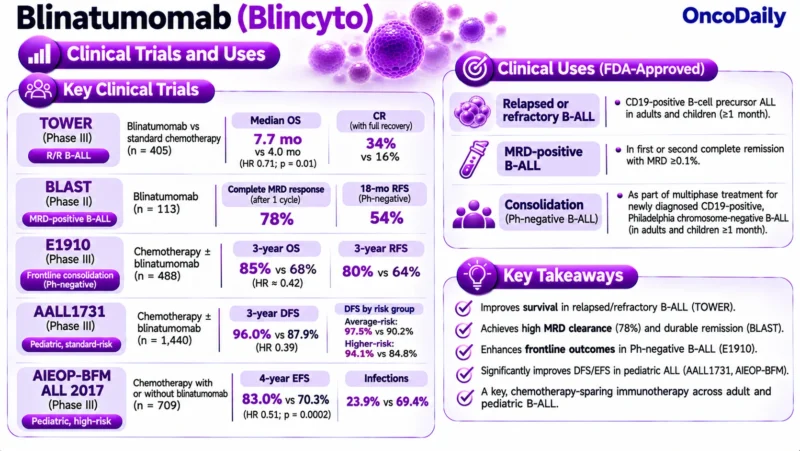
A total of 405 adults with relapsed/refractory B-cell precursor ALL were randomized.
Median Overall Survival
- Blinatumomab: 7.7 months
- Chemotherapy: 4.0 months
HR: 0.71; p = 0.01
Complete Remission With Full Hematologic Recovery
- Blinatumomab: 34%
- Chemotherapy: 16%
The trial established a survival benefit for blinatumomab over conventional salvage chemotherapy.
BLAST — MRD-Positive B-ALL
BLAST was a phase II, single-arm study of blinatumomab in adults with B-ALL who were in hematologic remission but remained MRD positive.
Complete MRD Response After One Cycle
78%
88 of 113 evaluable patients achieved complete MRD response.
Estimated 18-Month Relapse-Free Survival
54% in the Ph-negative hematologic remission subgroup.
The study established the clinical activity of blinatumomab in eliminating residual leukemia.
E1910 — Frontline Consolidation in Ph-Negative B-ALL
The randomized phase III E1910 trial evaluated blinatumomab added to consolidation chemotherapy versus chemotherapy alone in newly diagnosed adult Ph-negative B-ALL.
The principal analysis focused on patients who were MRD negative after induction and intensification.
Three-Year Overall Survival
- Blinatumomab + chemotherapy: 85%
- Chemotherapy alone: 68%
HR: approximately 0.42
Three-Year Relapse-Free Survival
- Blinatumomab + chemotherapy: 80%
- Chemotherapy alone: 64%
The results demonstrated that blinatumomab improves outcomes even in patients who have achieved MRD-negative remission.
This was the key trial supporting the 2024 frontline consolidation approval.
Watch More: ECOG-ACRIN E1910 Study on Blinatumomab in ALL Treatment – Dr. Mark R. Litzow.
AALL1731 — Pediatric Standard-Risk B-ALL
AALL1731 evaluated chemotherapy with or without blinatumomab in children with newly diagnosed standard-risk B-ALL who were classified as having average or higher relapse risk after initial treatment.
A total of 1,440 patients were included in the interim randomized efficacy analysis.
Three-Year Disease-Free Survival
- Blinatumomab + chemotherapy: 96.0%
- Chemotherapy alone: 87.9%
HR: 0.39
Average-Risk Subgroup
- 97.5% versus 90.2%
Higher-Risk Subgroup
- 94.1% versus 84.8%
These findings supported a major expansion of blinatumomab-containing pediatric treatment strategies.
AIEOP-BFM ALL 2017 — High-Risk Pediatric B-ALL
This randomized study evaluated replacing two conventional chemotherapy blocks with blinatumomab in children with newly diagnosed high-risk B-ALL.
A total of 709 patients were randomized.
Estimated Four-Year Event-Free Survival
- Blinatumomab group: 83.0%
- Chemotherapy group: 70.3%
HR: 0.51; p = 0.0002
Treatment-Related Infections
- Blinatumomab group: 23.9%
- Chemotherapy group: 69.4%
Neurotoxic events were more frequent with blinatumomab, although the incidence of life-threatening adverse events was lower.
The study, published in September 2026, supports the evolving role of blinatumomab as a replacement for selected intensive chemotherapy blocks in high-risk pediatric ALL.
Read More: Safer Cancer Care with Blinatumomab for Children With B-ALL ecancer by OncoDaily.
Does Blinatumomab Have CNS Activity?
Blinatumomab is not established as a substitute for CNS-directed treatment in ALL.
Patients require appropriate CNS prophylaxis, generally with intrathecal chemotherapy, even when receiving blinatumomab.
Patients with active CNS leukemia may require dedicated CNS-directed treatment, and those with preexisting neurological conditions need careful assessment because of neurotoxicity risk.
Is Blinatumomab FDA Approved?
Yes.
Important regulatory milestones include:
- December 2014: Initial approval in relapsed/refractory B-ALL.
- July 2017: Full approval based on randomized survival evidence.
- March 2018: Approval for MRD-positive B-ALL in first or second remission.
- June 14, 2024: Expansion to consolidation in CD19-positive Ph-negative B-ALL.
The current U.S. label covers adults and pediatric patients one month and older in the specified treatment settings.
What Is the Current Clinical Role of Blinatumomab in 2026?
Frontline Ph-Negative B-ALL
Blinatumomab is now an important component of consolidation treatment, including in patients who are MRD negative after chemotherapy.
MRD-Positive Disease
Blinatumomab remains a major treatment for clearing MRD and reducing relapse risk.
Relapsed or Refractory Disease
It provides a chemotherapy-sparing immunotherapeutic option and may serve as a bridge to transplant or other definitive therapy.
Pediatric ALL
The AALL1731 and AIEOP-BFM ALL 2017 results have strengthened its role in risk-adapted pediatric treatment.
Relationship to CAR-T and Other Therapies
Blinatumomab and CD19-directed CAR-T therapy share the CD19 target but differ fundamentally in how they recruit T cells.
Blinatumomab is an infused bispecific antibody construct, whereas CAR-T treatment involves genetically modified T cells.
Prior CD19-directed therapy and subsequent CD19 expression should be considered when planning treatment sequencing.
What Are the Major Side Effects of Blinatumomab?
Cytokine Release Syndrome
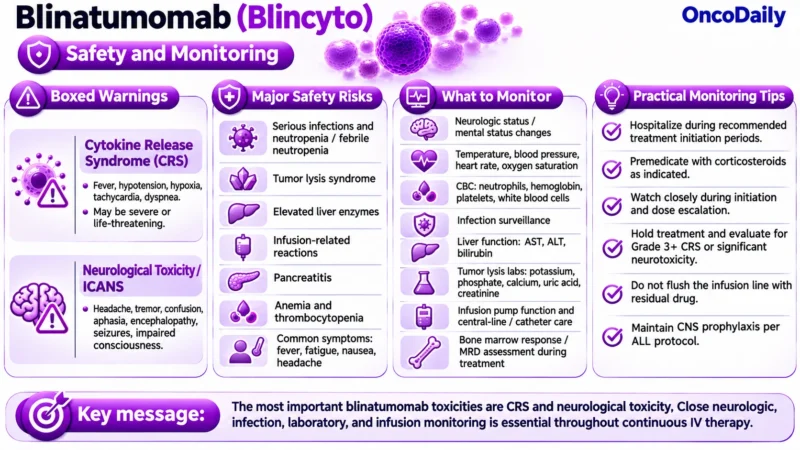
CRS is one of the most important toxicities and carries an FDA boxed warning.
It results from systemic inflammatory cytokine release following T-cell activation.
Symptoms may include:
- Fever
- Hypotension
- Tachycardia
- Hypoxia
- Dyspnea
- Capillary leak
- Organ dysfunction
Severe CRS may be life-threatening or fatal.
Management includes treatment interruption, supportive care, corticosteroids, and additional cytokine-directed treatment when clinically indicated.
Neurological Toxicity and ICANS
Blinatumomab carries a boxed warning for neurological adverse reactions, including immune effector cell-associated neurotoxicity syndrome (ICANS).
Possible manifestations include:
- Headache
- Tremor
- Confusion
- Aphasia
- Encephalopathy
- Seizures
- Impaired consciousness
Severe events may require permanent discontinuation.
Serious Infections
Patients may develop:
- Bacterial infections
- Pneumonia
- Sepsis
- Fungal infections
- Catheter-associated infections
Infection risk is influenced by leukemia, cytopenias, previous chemotherapy, and prolonged IV access.
Neutropenia and Febrile Neutropenia
Severe neutropenia can occur during therapy.
Patients require careful blood count monitoring and infection surveillance.
Tumor Lysis Syndrome
Rapid destruction of leukemic blasts can cause electrolyte abnormalities and acute kidney injury.
Risk is higher in patients with significant disease burden.
Elevated Liver Enzymes
Transient or clinically significant elevations in AST, ALT, and bilirubin may occur, especially early during treatment or in association with CRS.
Pancreatitis
Pancreatitis has been reported and can be serious.
New severe abdominal pain or persistent vomiting requires assessment.
Other Common Adverse Reactions
- Pyrexia
- Headache
- Nausea
- Diarrhea
- Fatigue
- Musculoskeletal pain
- Infusion-related reactions
- Anemia and thrombocytopenia
Embryo-Fetal Toxicity
Blinatumomab may cause fetal harm.
Females of reproductive potential should use effective contraception during treatment and for 48 hours after the final dose.
What Monitoring Is Required During Blinatumomab Treatment?
Neurological Monitoring
Assess neurological status regularly, especially during treatment initiation and dose escalation.
Monitor for confusion, abnormal speech, tremor, seizures, and changes in consciousness.
CRS Monitoring
Monitor:
- Temperature
- Blood pressure
- Heart rate
- Oxygen saturation
- Respiratory status
- Organ function when indicated
Complete Blood Count
Check neutrophils, hemoglobin, platelets, and white blood cell counts.
Infection Surveillance
Assess for fever, respiratory symptoms, suspected catheter infection, and other infectious complications.
Liver Function
Monitor AST, ALT, and bilirubin, particularly early during treatment.
Tumor Lysis Monitoring
In patients at risk, monitor potassium, calcium, phosphate, uric acid, creatinine, and LDH.
MRD and Disease Response
Monitor bone marrow morphology and MRD using validated flow cytometric or molecular methods.
Reassess CD19 expression when treatment resistance or relapse occurs.
Infusion Pump and Vascular Access
Ensure correct pump programming and appropriate catheter care.
Avoid unintended infusion interruptions and never flush residual drug from the line into the patient.