Key takeaways
- Quality cancer care should be patient-centered, timely, evidence-based, dignified, and delivered as close to home as possible.
- Education should extend beyond clinicians to patients, communities, and primary care teams.
- Physicians need to be more engaged in advocacy, policy, and the responsible use of AI.
- Social media can support education, connection, and efforts to address misinformation and distrust.
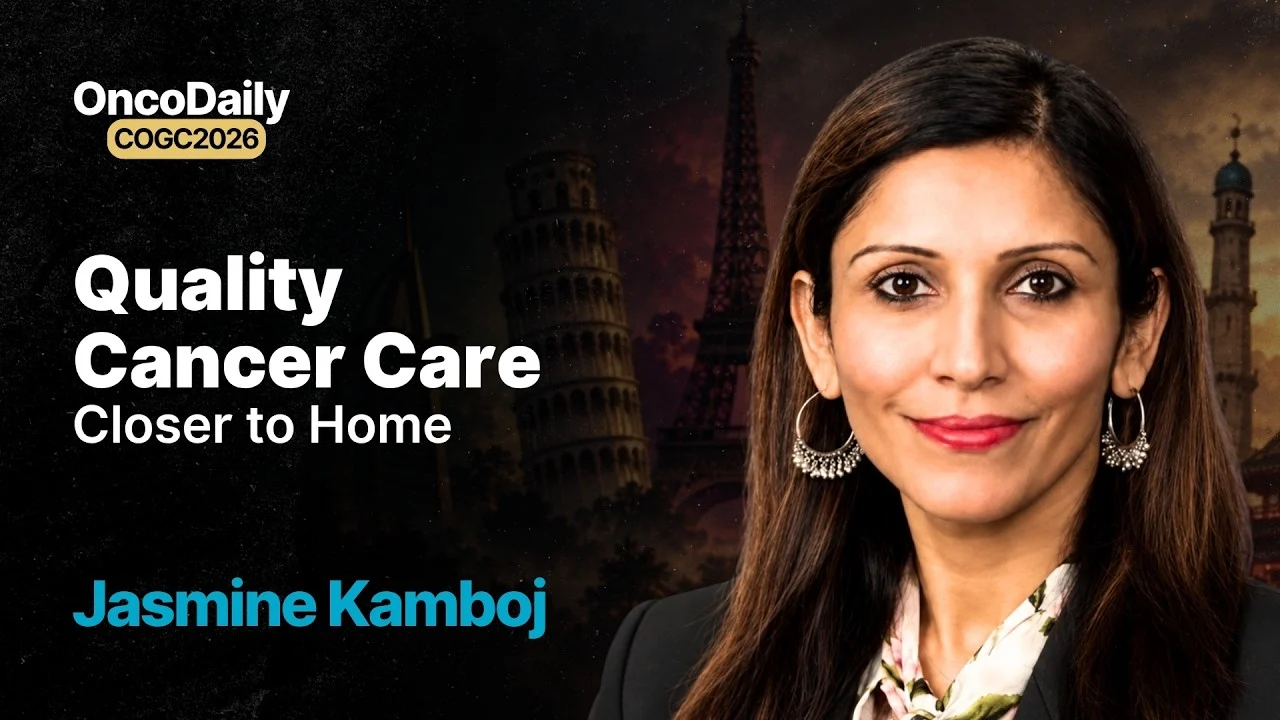
At the Community Oncology Global Congress (COGC 2026), organized by OncoDaily, Jasmine Kamboj, Congress President and Medical Director of the Cancer Care and Infusion Center at Northfield Hospital + Clinics, returned to the question of what quality cancer care should look like in community settings.
Her presentation moved through several areas that shape community oncology: quality cancer care, education, research and access, advocacy and policy, artificial intelligence, social media, and workforce challenges.
She began with the meaning of quality cancer care itself:
“While we are not able to cure cancer for everybody, we must practice and deliver dignity, humane connections, and humane recommendations closer to home.”
Quality Cancer Care Closer to Home
“Let’s review the journey of one of my patients. We will call her K.
K was one of my first patients when I started my first job right out of fellowship at a very small community rural hospital in northern Minnesota. She was diagnosed with stage IV pancreatic cancer two months after the birth of her second child.
After learning the diagnosis, stage, and prognosis of her condition, she did what any new mother in her situation would do. She took it upon herself as a personal responsibility to seek the best possible cancer care, no matter how much she had to travel.
We started her right away on the standard-of-care treatment available at the time, chemotherapy with FOLFIRINOX, but she traveled across the United States seeking additional recommendations from different healthcare systems and organizations.
Unfortunately, there were no additional recommendations or clinical trials for her. She continued all of her care with us, with periodic visits to academic centers, the closest one being five hours away, one way.
Her goal of care was to see her son’s first birthday.
K passed away soon after her son’s first birthday. We gave her the standard of care at that time. This was almost 10 years ago.
We supported her in a deeply humanistic and dignified fashion, and her last few days and weeks were spent exactly where they should have been: in the company of her children, her family, and her friends. Not in a distant hospital, nor traveling on the roads.
While we are not able to cure cancer for everybody, we must practice and deliver dignity, humane connections, and humane recommendations closer to home.
This is the beauty and power of community oncology.
We often talk about delivering quality cancer care, and I want to add two words to that definition. We are getting very good at meeting our metrics and checking our checkboxes. But in K’s example, if she had received the same treatment in an excellent academic center 5,000 miles away from her home, I would not call that quality cancer care. She had a newborn at home and a six-year-old daughter at home.
We need to start adding patient-centered and closer to home, in addition to being evidence-based and delivered in a timely fashion, to our quality cancer care metrics.”
An Educated Patient Is a Safe Patient
“The second part is education.
When we say the word education, what comes to mind is trainees and maybe early-career faculty. But I also want to emphasize the education of our patients, our clinicians, and our communities.
I want to give a huge shout-out to Dr. Joanna Sadurski, my good friend, who runs a digital health literacy platform called Oncology 101, which utilizes videos to educate patients about their condition. She proudly says,
‘An educated patient is a safe patient.’
I want to emphasize the power of educating our patients because educated patients are safer. They know what they are getting, and they know when to seek support.
A lot of patients do not know that black or tarry stools can be a red flag. We need to do a better job of educating them.
The same applies to clinicians and staff. We cannot run a successful oncology program if our ER physicians, nursing staff, hospitalists, and primary care physicians are not educated about the situations our patients may face.
I also want to emphasize the power of educating our communities and our primary care physicians because the International Agency for Research on Cancer has highlighted that 37% of new cancer cases – around 7 million new cancer diagnoses worldwide – are preventable.
They are attributed to tobacco use, alcohol use, infections such as HPV and H. pylori, increased BMI, sedentary lifestyle, air pollution, or ultraviolet radiation exposure.
If we educate our communities and primary care physicians around these preventable malignancies, just think about it: we could prevent nearly 4 out of 10 cancers diagnosed.”
Bringing Research and Innovation Into the Community
“The next part is research.
When we talk about community and rural practices, or practices in low- and middle-income countries, I think it is unrealistic to say that every clinic should have a research infrastructure.
But what we should strive for is that every clinic, community setting, or rural setting has access to include its patients in clinical studies or research studies.
In Minnesota, for example, we have two robust models of research in community clinical practices. One is utilized by Sarah Cannon Research Institute, which provides a research base to community partners such as Minnesota Oncology.
The other is Cancer Trial Connect, where anybody in the state of Minnesota can register and gain access for their patients to studies at other organizations within the state.
I may not have a clinical trial open in my clinic, but that website gives me a very easy and straightforward pathway to allow my patients to participate in those clinical studies.
We also sometimes overestimate how well we are doing in the United States. In the U.S., 70% of counties do not have access to clinical trials. Less than 5% to 7% of patients with cancer are accrued or enrolled in clinical trials.
We can do better by establishing partnerships and creating programs that allow smaller community and rural settings to access research and clinical trials.
This is especially meaningful to me because of a patient with pancreatic cancer in my own practice.
I come from a very small community clinic where the number of medical oncologists is one – me. I came back from the ASCO Annual Meeting invigorated by the data on daraxonrasib, a RAS inhibitor, and I had one patient with pancreatic cancer who would have been eligible.
It took me a lot of courage to ask my leadership whether we could apply for the expanded access program because the drug was not yet FDA approved. We did not have an IRB. We did not have dedicated research staff.
After seven to eight weeks of paperwork and back and forth, we did get access to the drug before FDA approval. I am going to take that as a huge win.
Trying to get access for patients to these drugs or innovative treatments requires a very dedicated team and a physician champion.
Telemedicine and tools such as remote patient monitoring can also help us expand access in remote and rural areas.”
Advocacy, AI, and Social Media
“I am a passionate advocate at heart, and I cannot emphasize enough the power of advocacy and policy.
We are living in times when physicians can no longer afford not to be engaged with advocacy and policy.
In the United States, the Centers for Medicare and Medicaid Services have not kept pace with inflation in the Medicare Physician Fee Schedule. The cost of running a practice has gone up significantly, but reimbursement has not kept up.
What this does to smaller community practices is make it more difficult to sustain them if we are not reimbursed appropriately.
Physicians need to engage with their national and state societies. For people in different countries and regions, engage with your local policy and your local organizations to understand these changes. If we are not engaged in advocacy and policy ourselves, somebody else is making decisions for us, and more than likely they do not have a full understanding of the challenges our patients are going through in cancer care.
No talk is complete without artificial intelligence.
I personally use ambient listening software in my clinical practice for efficiency with documentation. I also use OpenEvidence to support my critical thinking, in addition to NCCN, UpToDate, and ASCO Post. It is by no means solely OpenEvidence-related guidance.
There are also clinics using artificial intelligence to help with prior authorization processes and other administrative or bureaucratic tasks, and I think AI can be a good support system there.
But I also want to emphasize that AI is here not to replace us, but to help us and support us. It is our moral responsibility not just to engage with AI, but to really understand its benefits and challenges and use it responsibly.
The same applies to social media. I was not a huge social media user myself until about two years ago, when I started engaging with it.
I think social media is critically important for community oncologists all over the world because we are often sitting in small clinics, in silos. It is very easy to feel isolated.
Social media is excellent for establishing connections and gaining access to education. Look at what we are doing right now: a global Congress, free of cost, for people across the world.
I also want to give a huge shout-out to Dr. Amol Akhade from India, who runs OncoWisdom. He started through social media, and one thing led to another. Now he is running an educational platform for oncologists around the world.
I would highly encourage physicians and oncologists to engage with social media.
But it is also our responsibility to understand the mistrust and misinformation that can spread there. Patients are often desperate. They need support. They need an intervention that could help them live one month extra or two months extra.
We need to understand these trends so that we can help our patients navigate them.”
Workforce Shortages, Retention, and Continuity of Care
“I also want to emphasize workforce shortages.
I am a big believer in trying to maximize the teams that are already in place.
Within the United States, there is almost a 60% burnout rate in the field of oncology. In low- and middle-income countries, workforce shortages are even more significant.
So how do we use the teams that are already in place and maximize their potential so that it becomes a team effort and physicians are not feeling isolated or burned out? I would encourage people to maximize team-based workflows and the potential within their teams.
There is also a lot of emphasis in leadership and organizations on recruitment. But recruitment does not help the cause if an organization has become a revolving door.
Along with recruitment, retention is equally important.
It is high time that when we give quality metrics to an organization or a cancer center, some kind of retention metric should be part of it.
If an organization is a revolving door, no matter how many other metrics it is meeting, it cannot provide quality cancer care because our patients need continuity of care.”
The Future of Quality Cancer Care
“In my opinion, when we talk about the definition and the future of quality cancer care in community settings, we first have to say that one size does not fit all.
The challenges we have in the United States are different from those in Canada, Brazil, India, or Africa. I do not think it is right to expect the rest of the world simply to extrapolate from guidelines created in the United States.
- Quality cancer care should be closer to home, patient-centered, delivered in a timely fashion, defined by regional and resource limitations, and dignified.
- In education, we need to include patients and communities and take a more comprehensive approach.
- In research, we should work toward a future that is more inclusive and accessible for patients in terms of participation in clinical trials.
- In access, we need physician champions with committed teams, and we need community engagement. Sometimes community engagement can make the impossible possible. When everybody pitches in whatever little they can, it is amazing what communities can do when they come together.
- We all need to be engaged with advocacy and policy. We can no longer afford not to be engaged.
- AI is here to enable us, not replace us, and we need to engage responsibly.
- Social media can be a powerful tool for education, connection, and mitigating distrust among our patients.
- And when it comes to workforce shortages, we need to maximize the existing workforce while also investing in the incoming workforce. We should have realistic expectations for optimizing cancer care based on regional and resource limitations.
Lastly, I want to tell everybody practicing community oncology, or practicing in rural, remote, underserved areas and smaller clinics:
Please do not underestimate the power of what you are doing. Be proud of what you do, stay humble enough to keep learning, and never underestimate the power of time with family, friends, and self-care.”
Written by Eliz Baloyan, MD, Features Writer and Editor at OncoDaily and CancerWorld