Despite decades of research and progress in treatment, metastatic pancreatic cancer remains exceptionally difficult to control, and once the disease progresses after first-line therapy, the options become even more limited. New treatments in this setting have often brought incremental gains rather than major shifts in survival.
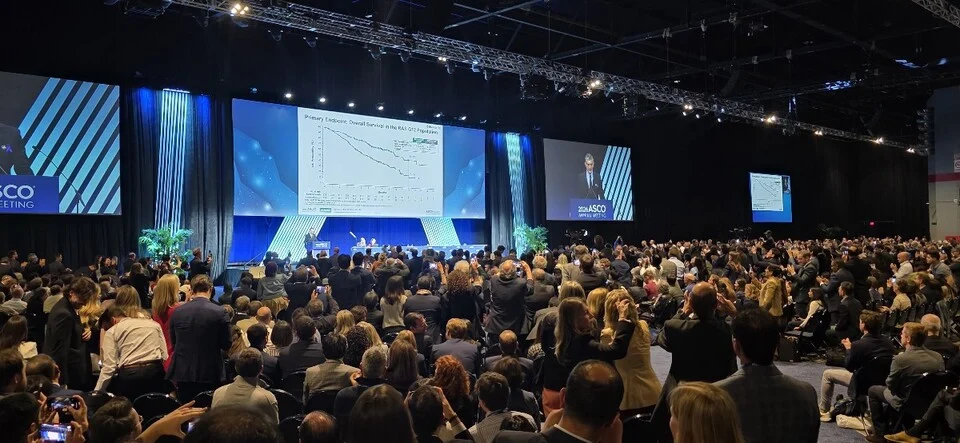
So when a Phase III trial showed a drug that could nearly double survival compared with chemotherapy, while also improving disease control and helping patients maintain quality of life for longer, the result was difficult to view as simply another positive study. The response at the 2026 ASCO Annual Meeting reflected that significance: the RASolute 302 survival curve was met with a rare 42-second standing ovation.
For Eileen M. O’Reilly, gastrointestinal medical oncologist at Memorial Sloan Kettering Cancer Center and a lead investigator in RASolute 302, the results open a much larger conversation – about why this disease has been so difficult to treat, what finally changed with “undruggable” RAS, and how far this new approach could take the field. She also looks beyond the headline results – at toxicity, durability and whether combinations could push outcomes further.
Second-Line Therapy: A Harder Challenge in Pancreatic Cancer
By the time pancreatic cancer reaches second-line treatment, clinicians are often dealing with more than disease progression alone. Patients may already be experiencing a broader decline in health that can complicate the next treatment decision.
“This disease is particularly challenging at any time point, but even more so in the setting of when the disease is progressing and getting more complicated in the metastatic setting. It impacts health in significant ways for people in terms of appetite, energy, weight loss, sometimes pain, decreased level of functioning and just overall poor health.”
That creates a double challenge, making the second-line setting especially difficult: treatment still needs to control an aggressive disease, but the available options remain limited.
“We know that progressive metastatic pancreas cancer is prognostically worrisome. There are treatments in the current standard paradigms that have impacted outcome, but they leave a lot to be desired.”
Addressing that gap has increasingly meant looking beyond conventional chemotherapy and back to the biology driving pancreatic cancer itself – particularly RAS.
Targeting the Biology Behind Pancreatic Cancer
RAS mutations are present in the vast majority of pancreatic cancers, but they are not all the same. Most cluster around a small number of recurrent sites within the KRAS gene.
“So G12D, G12V in the KRAS gene and G12R are the three most common versions of KRAS. And then we occasionally see alterations at other positions, including G13 and more rarely Q61.”
Their importance goes well beyond classification. These mutations help explain why RAS has remained such a central focus of pancreatic cancer research for decades.
“RAS mutations are involved in growth, metastasis and development of pancreatic cancer. And this has been known historically for many decades.”
What proved difficult was not identifying RAS as a driver, but finding a way to turn RAS biology into an effective treatment.
“There’s been lots of ways of targeting RAS in the past, going back to farnesyl transferase inhibitors, but they mechanistically had many limitations. I think where the evolution was, was in understanding the genomics, with bioengineering, drug development and a lot of innovation in terms of the science.”
Those advances began to translate clinically, providing some of the earliest evidence that direct RAS targeting could produce meaningful antitumor activity.
“The initial experience started with KRAS G12C, and that’s about one percent of people with pancreas cancer, more common in non-small cell lung cancer and in colon cancer. In pancreas cancer, the single G12C inhibitors, the first generation and indeed the second generation, also showed a signal that these drugs can shrink cancer, with encouraging progression-free survival and survival signals.”
Although the outcomes of those early pancreatic cancer studies suggested that direct RAS inhibition could work in pancreatic cancer, the studies were single-arm and non-randomized,
“There was a hint a number of years back, but the real change is what this means now: the current class of drugs targets essentially everybody with this disease.”
RASolute 302: What Made This Trial Different?
The shift from recognizing RAS to actually being able to target it set the stage for RASolute 302, a randomized, open-label Phase III trial that enrolled 500 patients with previously treated metastatic pancreatic cancer. Participants were assigned 1:1 to receive either daraxonrasib or investigator-selected standard-of-care chemotherapy, with overall survival and progression-free survival among the key efficacy outcomes.
The drug was developed to overcome one of the main limitations of earlier RAS-directed therapies: their narrow applicability to specific mutations. Its broader reach comes from a different pharmacologic strategy.
“Daraxonrasib is a tricomplex inhibitor. It targets RAS mutant states, RAS wild-type states. It targets all of the versions of RAS to a greater degree, and it binds a protein in the cell called cyclopilin. It locks that into a tricomplex with RAS, and that switches off the downstream stigma. And that’s how we think this drug works.”
Before the Phase III results were available, clinicians had already begun to see signs of activity with pan-RAS and allele-specific inhibitors in individual patients, including early tumor responses and symptomatic improvement.
“There’s something real happening. People are feeling it, and feeling it relatively quickly.”
RASolute 302 was the test of whether those early observations would hold up in a large randomized trial. The results showed that they did, and across more than one measure of benefit.
“The top-level outcome was a doubling, and slightly more, of median overall survival in the daraxonrasib-treated group relative to the chemotherapy group. That was supported by a response rate that was almost tripled, a doubling of progression-free survival, less pain, and maintenance of global health and quality-of-life parameters for longer. So it hit all of the important benchmarks and was a clearly positive study.”
For O’Reilly, the significance went beyond the success of a single drug: it showed that direct RAS targeting could become a meaningful treatment strategy in pancreatic cancer.
“It’s not just that it’s a new drug, but it’s a new way of thinking about this disease. It’s a new way of treating this disease.”
Daraxonrasib in Practice: Tolerability and Quality of Life
The tolerability profile was one of the more practical advantages seen in RASolute 302. O’Reilly points to a clear difference in treatment discontinuation: around 11% of patients stopped chemotherapy because of toxicity, compared with about 1% receiving daraxonrasib.
“People felt better because their cancer was controlled better for longer.”
In clinical practice, three main toxicity concerns were identified with daraxonrasib: rash, gastrointestinal toxicity and mucositis.
Rash was the most common toxicity, typically developing within the first few weeks of treatment. Most patients experienced some degree of rash, although it was manageable in the majority of cases.
“We use and recommend prophylaxis – antibiotics, topical steroids, moisturization and sunblock. If the rash is more active, that can require holding the drug. Once it improves, we reintroduce at the same dose, and if it happens again, we might consider a dose reduction.”
Gastrointestinal toxicity can occur early in treatment, particularly during the first few days. The main symptoms include nausea and acute diarrhea, which are generally managed with supportive care and close monitoring.
“I also tell people to hydrate, use Imodium and keep us posted.”
Mucositis, including stomatitis, tends to appear later in the treatment course. It may require supportive care and, in some cases, temporary treatment interruption or dose modification.
Overall, the toxicity profile requires proactive management, but the low discontinuation rate suggests that most patients are able to remain on treatment.
“We’re just at the start of all of this. As this gets integrated into practice, we will adapt and evolve to manage these toxicities. The hope is that because people are experiencing the benefit and feeling the benefit, that’s an acceptable balance in terms of the quality-of-life impacts.”
Quality of life is also influenced by how treatment is delivered. Daraxonrasib is taken orally, avoiding the repeated infusion visits required with intravenous chemotherapy and giving patients greater flexibility in how treatment fits into daily life.
“We all recognize it comes at a price on the body, and sometimes that is very manageable, but sometimes it’s challenging even in quite fit, healthy people.”
That difference becomes especially relevant when treatment needs to continue for months rather than weeks. For O’Reilly, the possibility of maintaining an oral RAS-targeted therapy over time changes not only treatment delivery, but how patients may experience living with pancreatic cancer.
“The fact that the ability to deliver a treatment and to sustain that treatment on a longitudinal basis is feasible with this class of drugs, it opens up a whole new way of thinking about this disease and people’s perspective on this disease.”
Current Clinical Use and Future Development of RAS-Targeted Therapies
At the time of the interview, FDA approval of daraxonrasib was still pending. O’Reilly noted that she and other clinicians were using the Expanded Access Program (EAP) to provide the drug to eligible patients with previously treated metastatic pancreatic cancer while awaiting routine prescribing access.
“We and others are utilizing the Early Access Program to provide daraxonrasib to individuals that can benefit and have a similar setting to people who are included in the Phase 3, as a bridge to being able to prescribe it in day-to-day practice.”
That bridge has since become clinical practice. On August 26, 2026, the FDA approved daraxonrasib (RASONQUE) for adults with metastatic pancreatic adenocarcinoma who have received at least one prior systemic therapy or who are not candidates for multiagent systemic therapy. Following approval, the U.S. Expanded Access Program closed to new requests.
But the larger question now is whether the benefit seen in previously treated disease can be extended into earlier stages of pancreatic cancer, including first-line and postoperative settings.
“Now we want to also move these drugs to every other setting in pancreas cancer.”
Durability is one of the main reasons this matters. In the second-line setting, disease control has been around six to seven months. The next goal is to extend that benefit – by introducing these drugs earlier, combining them with other treatments, or determining the best sequence in which to use them.
“I think we’re all encouraged by what we see in the clinic, but we’ll need to see the readouts of these studies and understand how best to combine these drugs, but maybe also how best to sequence them.”
Earlier use could also make treatment possible for some patients who might not receive chemotherapy. A targeted therapy used alone in the frontline setting may offer another option for patients who decline chemotherapy or are not well enough to tolerate it.
And that question is already being studied. Early data presented at AACR 2026 showed activity with daraxonrasib both alone and in combination with gemcitabine and nab-paclitaxel in previously untreated metastatic pancreatic cancer. These strategies are now being evaluated further in the Phase III RASolute 303 trial.
“Both of those cohorts showed, again, a similar signal of high response rate relative to what we might expect historically with chemotherapy, and six-month periods of cancer control that were encouraging, and decline in ctDNA and clearance of ctDNA in a percentage, suggesting significant activity in untreated disease.”
The future, however, may not depend on chemotherapy combinations alone.
“Combining allele-specific and pan-RAS inhibitors may be mechanistically a promising strategy in terms of delaying resistance, maybe giving them sequentially. Part of our challenge in the next number of years is figuring out what are the key combinations that we need to utilize and develop in the clinic.”
Another direction is to pair RAS inhibition with other targeted therapies. PRMT5 inhibitors are one example, but their relevance depends on the molecular profile of the tumor.
“That data set looks very encouraging, keeping in mind that PRMT5 inhibitors aren’t for every individual with this disease, but they are for the group of people who have an MTAP deletion.”
Beyond targeted combinations, the search for longer-lasting responses is also pushing researchers toward immunotherapy.
“Can we combine immunotherapy with RAS target and convert some of these responses into a more durable setting? That’s one to stay tuned and look out for.”
The Next Challenge: Matching Patients to Treatment
The progress around RAS also changes what needs to happen before treatment begins. As pancreatic cancer moves toward more targeted and mutation-specific strategies, molecular profiling becomes essential for identifying who may benefit from which approach.
“There are two very basic and important considerations to help refine and select treatment choices. Building off our current guidelines is germline testing for every single individual. And just a reminder there, the guidelines are agnostic of any demographic, age, personal or family history, so everybody with the diagnosis.”
The importance of that approach can extend beyond treatment selection. A germline finding may reveal an inherited cancer syndrome with implications for an entire family.
“I picked up a Lynch family in an 88-year-old with pancreas cancer, and that was incredibly important to that patient and that whole family.”
Somatic profiling adds another layer by identifying alterations within the tumor itself. Both tissue-based testing and circulating tumor DNA can be useful, but they serve slightly different purposes.
“ctDNA has the virtue of the timeline to get a result for clinical decision-making in the frontline. Tumor-based testing is the reference and gold standard, and our ability to detect mutations is very contingent on the stage of the disease.”
When disease burden is lower, ctDNA may be less likely to detect relevant alterations, making tissue testing particularly important.
Five Years From Now: Aiming to Triple Survival
The final question moves beyond individual drugs and trials to the bigger picture: what meaningful progress in pancreatic cancer should look like over the next five years.
“I’m hoping we will have tripled survival. We have to be ambitious, right? We have to be focused, and we’re going to see the impact of these therapies.”
Overall five-year survival in pancreatic cancer is currently around 12–13%. O’Reilly’s hope is to see that figure move closer to 40% – a goal she readily acknowledges is ambitious.
“That’s ambitious. That’s a lot. That’s a high goal.”
Tripling survival may be an ambitious goal, but the direction of travel is clear. With RAS now clinically targetable and new treatment strategies moving into earlier settings, pancreatic cancer is entering a period in which larger gains may finally be possible.
Written by Eliz Baloyan, MD, Editor at OncoDaily
Interview by Amalya Sargsyan, MD, VP of Research and Intelligence at OncoDaily