What do a pot of soup, a breaking cancer study, and a TikTok weight-loss trend have in common?
Apparently, quite a lot. At least if you’re Margaret-Ann Simonetta.
Welcome to “gastrochat”, a new podcast created in partnership with OncoDaily, where gastrointestinal (GI) health meets pop culture, scientific research, and the occasional unexpected internet obsession.
Hosted by Margaret-Ann Simonetta, a Harvard University lecturer, sociocultural anthropologist, researcher, and GI cancer advocate, the podcast brings a fresh, energetic voice to conversations about gastrointestinal health and cancer awareness.
The idea? Talk about GI health in a way that actually makes people want to listen. Think real science, viral TikToks, awkward health questions, and all the things you probably wouldn’t bring up at the dinner table.
Well, until now.
Margaret-Ann doesn’t waste much time setting the tone. She opens the first episode with a cheerful “What’s up, chat?” and gets straight to why she wanted to create “gastrochat” in the first place.
“Listen, I decided to do this podcast in partnership with OncoDaily because I feel as though we need a young representation in the podcast sphere for GI health. I mean, like, come on now, right?”
She’s particularly interested in reaching the people scrolling through TikTok, following the latest trends, and trying to figure out which health headlines actually deserve their attention.
But don’t worry if you’re older than the target audience.
“If you’re above 30 years old and you’re listening to this podcast right now, literally, I love that for you. Don’t think that this podcast isn’t for you.”
“gastrochat”, she insists, is for everybody.
“Although I’m out here trying to talk to people that are young, fun, and flirty because we are the ones who see these crazy videos on our feeds all the time, “gastrochat” is for everybody.”
Meet the Real Margaret-Ann
Before diving into the latest GI headlines, Margaret-Ann starts with a little introduction.
“You can call me Margaret-Ann. Online, I’m also known as The Real Margaret-Ann because I always keep it real.”
For starters, she’s a sociocultural anthropologist, Harvard lecturer, researcher, author, and PhD scholar whose academic work explores the intersections of pop culture, fandom, embodiment, and medical anthropology.
She also holds two degrees in anthropology from Harvard University, both earned with honors.
“The minute you meet a person from Harvard, they’re going to let you know within the first 30 seconds. Uh, yeah, that’s me because I work hard for that.”
Fair enough.
But her work extends well beyond academia.
Margaret-Ann serves as President of the GI Cancers Alliance, a global network connecting more than 125 advocacy organizations and partners working to improve awareness, education, research, and support for people affected by GI cancers. She is also Chief Communications Officer of the Raymond Foundation and conducts research focused on patient-reported outcomes, quality of life, and gastrointestinal oncology.
Alongside all that, she’s an Ironman triathlete, an enthusiastic traveler (preferably somewhere sunny), and someone who’s endlessly curious about people’s stories.
That’s where her background in anthropology becomes particularly relevant to “gastrochat”. Health information doesn’t exist in a vacuum. It circulates through communities, television, social media, and everyday conversations, acquiring new meanings along the way.
There’s also a more personal reason behind her commitment to GI advocacy.
“I not only have a wicked family history of GI complications, but I myself have been through the fricking ringer.”
She doesn’t reveal the whole story just yet. Her experiences with GI health and surgery deserve an episode of their own, she says. For this episode, Margaret-Ann has a Starbucks to sip and a story to tell.
“Here’s a little tale for you. Some lore that happened last night.”
When H. pylori Interrupts Dinner
Picture Cambridge, Massachusetts. It’s cold outside, Margaret-Ann is making soup, and the local news is playing in the background.
Pretty ordinary evening.
Until she hears two words that immediately grab her attention: H. pylori.
“My spidey senses immediately went, What? What are they talking about H. pylori on the news tonight?”
It turns out that a major study had just been published in The Lancet Oncology, examining the global cancer burden attributable to infectious agents.
And the findings were significant.
Published on September 28, 2026, the study by Harriet Rumgay and colleagues, from the International Agency for Research on Cancer (IARC), estimated that 2.3 million new cancer cases worldwide in 2024 were attributable to infections, representing approximately 12% of all new cancer diagnoses.
Among the 12 infectious agents studied, one stood out.
Helicobacter pylori (H. pylori) was the leading infectious cause of cancer globally, associated with an estimated 760,000 cancer cases in 2024, predominantly gastric cancer.
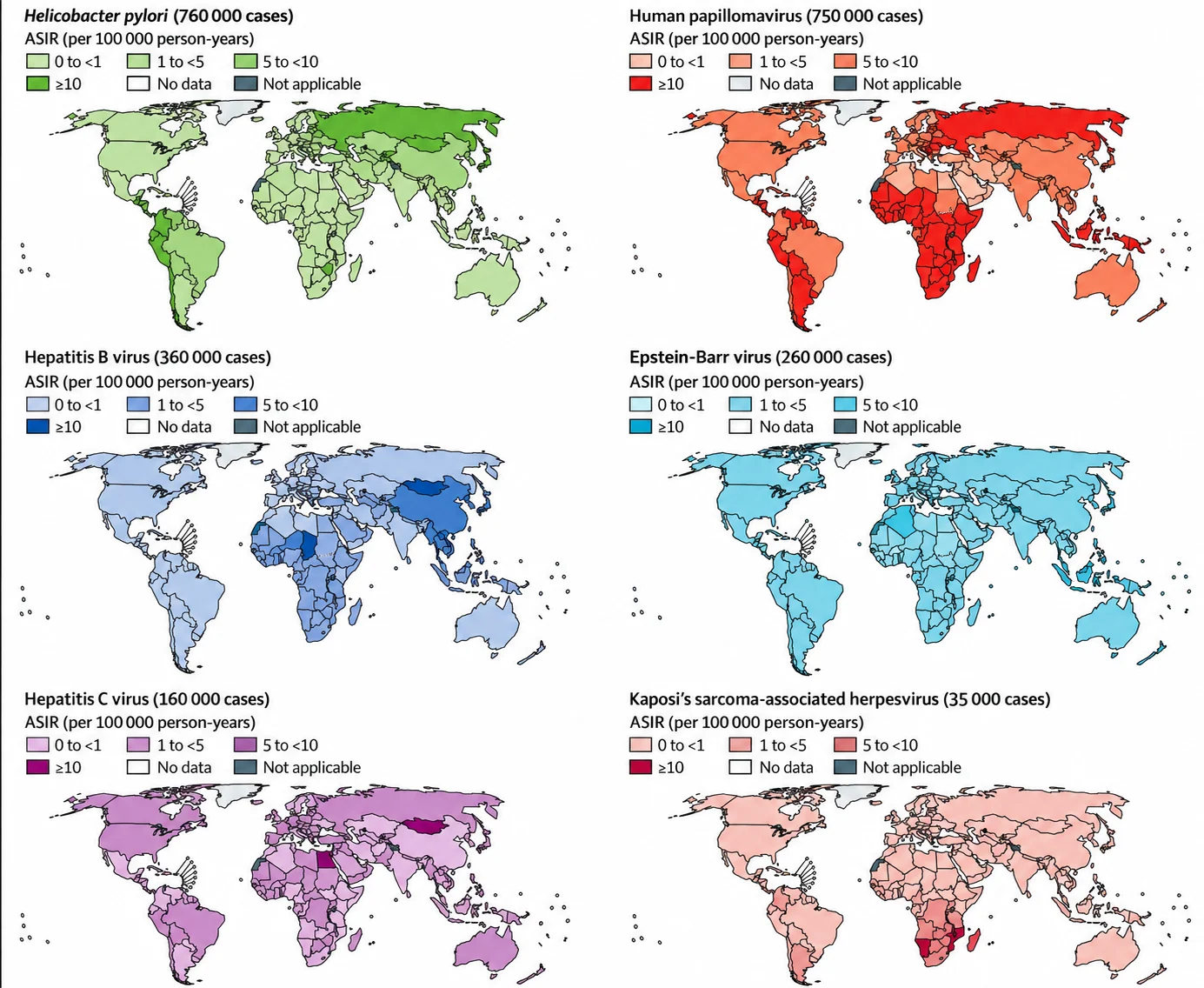
Source: Rumgay H, et al. The Lancet Oncology. 2026;27(10):1237–1248. https://doi.org/10.1016/S1470-2045(26)00307-4 © 2026 World Health Organization. Reproduced under the CC BY-NC-ND 3.0 license.
The bacterium, which colonizes the stomach, can cause chronic inflammation and peptic ulcers. Long-term infection is also an established risk factor for gastric cancer, although most infected individuals will never develop the disease.
Importantly, H. pylori infection is detectable and treatable. Appropriate testing and antibiotic-based eradication treatment can help reduce gastric cancer risk, making infection control an important opportunity for prevention.
The study also revealed major geographical inequalities.
The burden of infection-attributable cancers was particularly high in Eastern Asia, Sub-Saharan Africa, Central and Eastern Europe, and South-East Asia. More than three-quarters of these cancers occurred in low- and middle-income countries, where access to prevention, diagnosis, and treatment remains unequal.
For Margaret-Ann, this is precisely the kind of information that deserves attention.
“That’s important news. And that’s the news you’re going to get here on “gastrochat”.”
The research highlights not only the relationship between infection and cancer, but also the importance of prevention and the disparities that continue to determine who can access it.
But then something interesting happened.
The internet got hold of the story.
And, well, let’s just say it had a few ideas of its own.
H. pylori Goes Viral (And Not in the Way You Think)
As the study circulated through international news outlets, it also began appearing across social media.
Nothing unusual there.
Except that some of the videos emerging on TikTok weren’t particularly interested in the study’s main finding.
Instead, they were asking questions like:
“Does H. pylori cause weight loss?”
Suddenly, a major global cancer prevention story was becoming another conversation about body weight, symptoms, and the latest online health trends. Somewhere between The Lancet Oncology and the TikTok algorithm the conversation had somehow shifted from cancer risk to weight loss. Quite the plot twist.
Margaret-Ann had seen the videos herself.
“They literally piggybacked off of this study from The Lancet Oncology, but they did not mention anything about the gastrointestinal pathogen, H. pylori, as the leading infectious cause of cancer globally.”
A scientific study produces important evidence. The headlines arrive. Social media creators pick up the story. And sometimes, somewhere between the research paper and the algorithm, the most important information gets lost.
The result can be confusion, unnecessary anxiety, and health narratives that have little to do with what the research actually established.
“Oh my God, do I have H. pylori? Oh my God, if I have H. pylori, am I going to lose weight? Oh my God, I was diagnosed with H. pylori, but I haven’t lost weight. It makes people spin.”
Of course, Margaret-Ann understands why these videos spread. Popular culture is her academic territory, after all. But she also knows how easily the science can get lost in the race for attention.
“When we see popular culture take control of the news, these flashy headlines and short videos really pop out of nowhere. They show up on our feeds really for clicks and likes based off of the hottest news that day. And yesterday it ended up being H. pylori. But that can lead to loads of misinformation.”
And her assessment of some of these videos?
“Some of these videos are as helpful as calling a customer service representative in 2026. Honey, that’s not helpful. I’m out here wasting my time.”
Beneath the joke, however, is a serious point.
Social media can bring health topics to audiences who might otherwise never encounter them. But when scientific findings are stripped of their context, the resulting conversation may generate more confusion than understanding.
Margaret-Ann isn’t about to ignore viral health trends. They’re part of pop culture, and she knows they’re not going anywhere. But she’d rather get past the clickbait and talk about what the research actually says.
“That’s why I started this podcast: to give you the real information upfront and cut through those viral videos. They’re a big part of pop culture, of course, and we’re always going to talk about them. But are they actually helpful? Not always.”
Because behind all those weight-loss videos was a much bigger story: an infection linked to hundreds of thousands of cancer cases worldwide, and an opportunity to prevent some of them.
Oversharing Online, Undersharing at the Doctor’s
After all the talk about H. pylori, viral videos, and misleading headlines, Margaret-Ann brings the conversation back to something much more personal: knowing when something feels wrong with your body, and speaking up about it.
GI symptoms aren’t always easy to discuss. Bloating, abdominal discomfort, changes in bowel habits, and other digestive concerns can feel embarrassing, particularly for younger people.
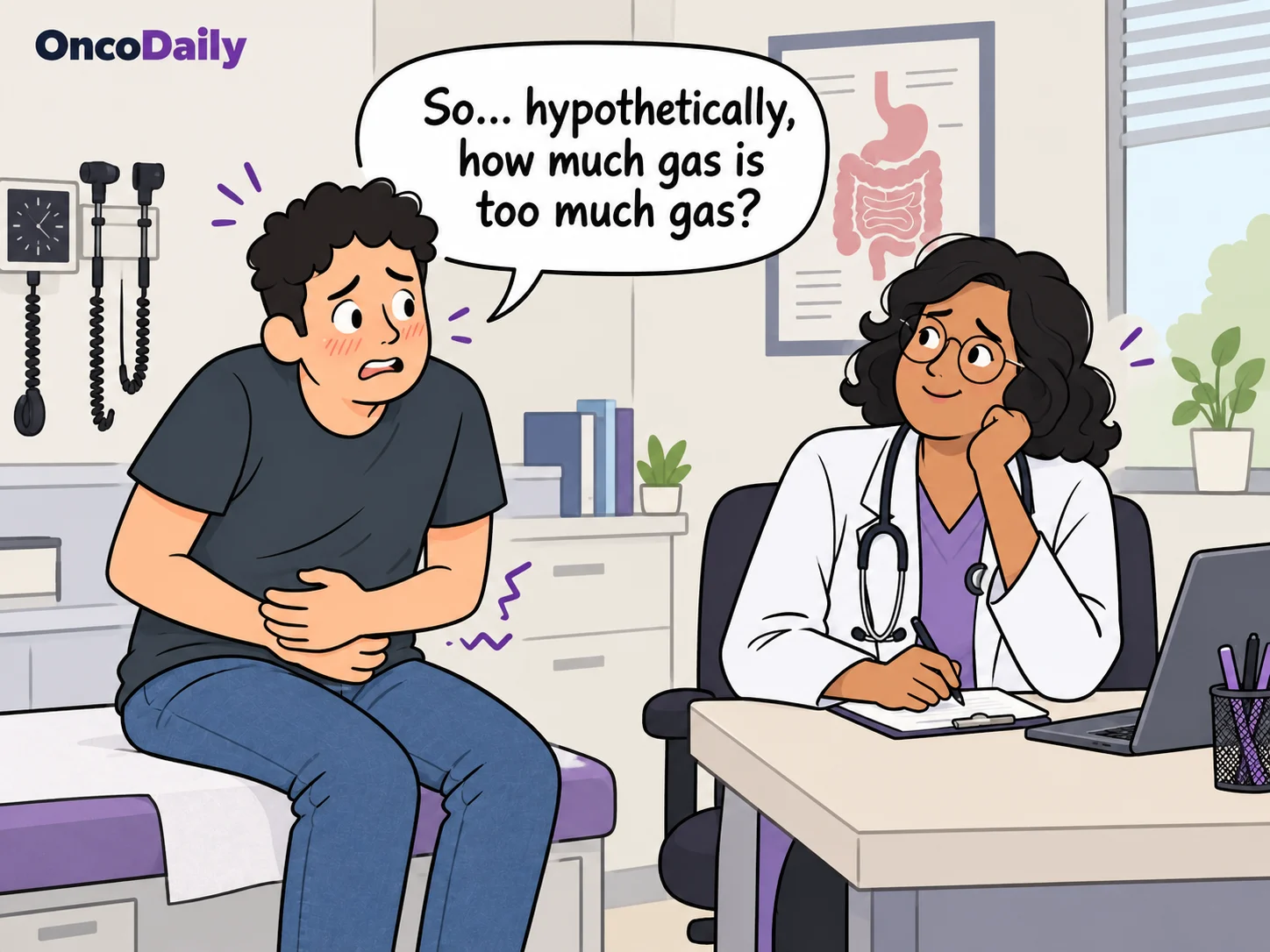
And age doesn’t make someone immune to gastrointestinal problems.
“GI symptoms, they don’t discriminate no matter how young we are.”
Margaret-Ann has some practical advice for anyone experiencing new or worsening GI symptoms:
“If you’re feeling poorly, unwell, please contact your doctor or GI physician for testing, screening, or hey, even just a little chat.”
And for a generation that has no trouble speaking its mind online, she has a question:
“If you can be so opinionated online and in front of people’s faces, then why can’t you be like that with your own doctor?”
She has a point, but of course, she also acknowledges that speaking up isn’t always enough. Younger patients can sometimes feel dismissed, unheard, or reassured without having their concerns adequately explored. It’s an experience she says she knows personally, and another topic she intends to address in future episodes.
“I’m the queen of that narrative, but guess what? I’m still winning. At least that information is going to be put in your chart so that we can start little teeny bits of breadcrumbs.”
Her message is not to panic over every stomachache or diagnose yourself from a viral video. It’s to recognize when something feels different, take persistent concerns seriously, and have an informed conversation with a healthcare professional.
“If it doesn’t feel like how you typically feel, especially with your tummy, then we got to go check it out. We got to go get tested, screened, talk about it.”
Because your symptoms deserve more attention than a comment section can provide.
What’s Next for “gastrochat”?
And “gastrochat” is just getting started. Margaret-Ann still has her own GI health stories to tell, plenty to say about the challenges young patients face, and a whole internet full of questionable health trends to unpack. Throw in the latest scientific discoveries, and there’s certainly no shortage of things to talk about.
So, what’s on the agenda for episode two?
“Do I know what’s upcoming? Absolutely, I do. I have a plan. I always got a plan. She’s a master in disguise.”
She doesn’t give away anything yet. But that’s also part of what makes the podcast interesting.
“I want to leave you hanging on a little bit because the thing about “gastrochat” is that I may have a plan behind the scenes, but you never know what’s going to pop up in the world of GI health. And that’s what’s going to be fun, because it’s always going to be something new, leading in the world of GI and hashtag breaking.”
A new study could change the conversation overnight. A viral video could raise an important question, or completely miss the point. If there’s one thing the first episode makes clear, it’s that “gastrochat” can take GI health seriously without taking itself too seriously. There’s room for science, humor, a little pop culture, and the conversations people might otherwise avoid.
Whatever it is, you can count on her to have something to say about it. And she’s certainly not letting the internet have the last word on GI health. With Margaret-Ann at the mic, who knows where the conversation might go next?
But for now, she signs off in her true fashion:
“The Real Margaret-Ann, out.”