Key takeaways
- Community oncology should connect specialist cancer expertise with the full care pathway, from prevention and diagnosis to treatment, survivorship, palliative care, and end-of-life support.
- Equity means bringing cancer care closer to patients who face geographic, financial, or system-level barriers, rather than expecting everyone to navigate the same pathway.
- Screening alone is not enough; early detection must be linked to timely diagnosis, pathology, treatment, and follow-up.
- Patient navigation, task sharing, and stronger community-based teams can help extend specialist expertise without compromising quality.
- Community oncology should be judged by outcomes such as access, equity, quality, safety, patient experience, and quality of life - not simply by the number of activities delivered.
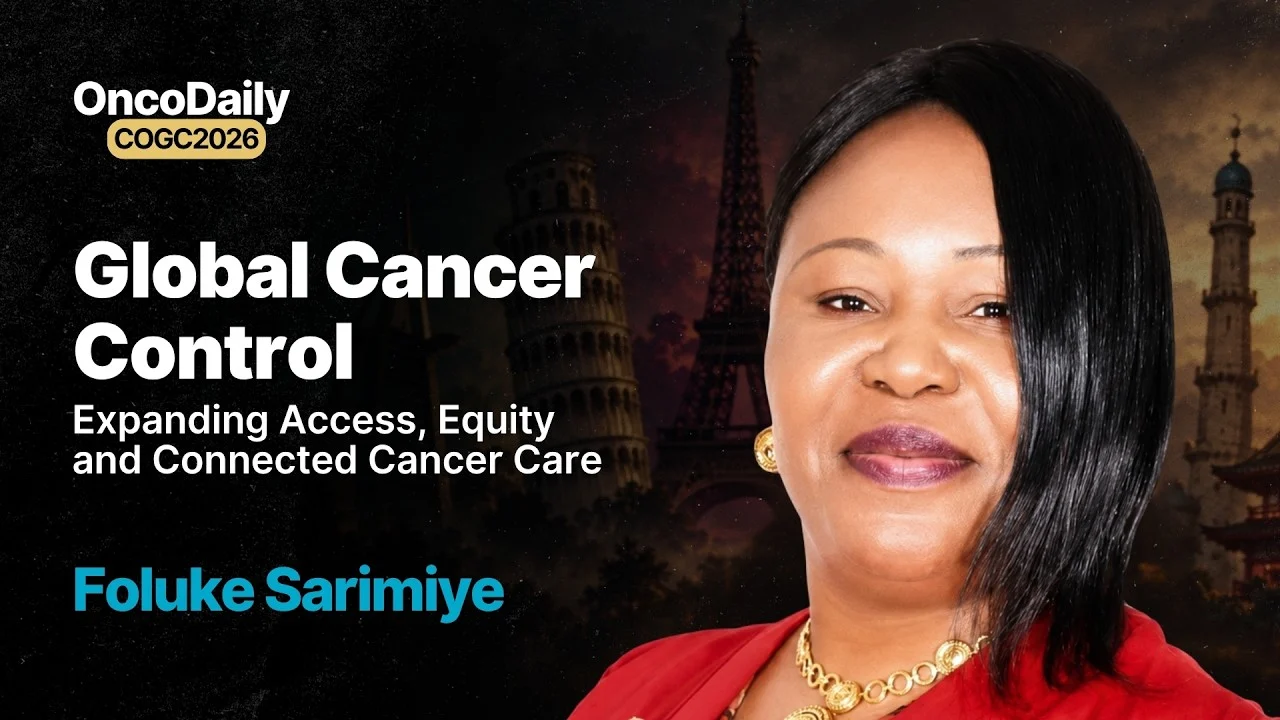
At the Community Oncology Global Congress (COGC 2026), organized by OncoDaily, Foluke Sarimiye, Consultant Radiation and Clinical Oncologist at University College Hospital, Ibadan, Nigeria, focused on a central challenge in modern cancer care: oncology is advancing rapidly, but access to those advances is not keeping pace.
The future of oncology is often measured by how sophisticated treatment becomes. But a harder question sits beneath that progress: what happens when patients cannot reach it?
The presentation used that tension to frame community oncology not as care outside the cancer center, but as the bridge between scientific advances and the people they are meant to serve.
Cancer Care Is Advancing Faster Than Cancer Access
“When we speak about the future of oncology, we often speak about:
- Precision medicine,
- Immunology,
- Artificial intelligence,
- Genomics,
- Increasingly sophisticated radiation and systemic therapies.
But there is another equally important question we need to ask: how do we ensure that these advances actually reach the people who need them?
Community oncology is not oncology that is somehow less sophisticated. It is an approach that connects specialist cancer expertise with the places where people actually live, work, raise families, and experience illness.
This is the paradox that should concern us: cancer care is advancing faster than cancer access.
On one side, oncology has experienced extraordinary scientific progress. We can sequence tumors, identify molecular profiles, and offer molecularly targeted therapies. On the other side, many patients still struggle to obtain something much more fundamental – timely diagnosis and basic cancer treatment.”
Beyond Screening: The Full Cancer Pathway
“Community oncology is a coordinated, people-centered approach to cancer prevention and care that connects specialist oncology services with primary healthcare, community health services, local facilities, patients, families, and community organizations.
One of the misconceptions is that community oncology is simply about screening. Screening is important, but it is much broader than that.
- What happens after a woman has an abnormal cervical screening result?
- Who confirms the diagnosis?
- Who performs the biopsy?
- Who provides the pathology?
- Who makes sure she receives treatment?
- Who supports her emotionally?
- And who follows her afterwards?
The entire pathway is community oncology – from prevention and early detection to diagnosis, treatment, supportive care, survivorship, end-of-life care, and even bereavement.
Community oncology works across the cancer continuum.”
From Equality to Equity
“Cancer does not affect everyone equally, and equality and equity are not the same.
Equality means giving everybody the same services. Equity recognizes that people begin from different positions and may need different approaches to achieve comparable outcomes.
A patient living two hours from an oncology center does not experience the healthcare system in the same way as someone living five minutes away.
Community oncology therefore has an important equity mandate: take cancer care to people rather than expecting patients to overcome every barrier to reach care.
The question we should continually ask is: who is being left behind?”
The Future Is Intelligent Connectivity
“We need to move away from the false debate of whether cancer care should be centralized or decentralized.
Some cancer services absolutely need specialized centers. We need those centers and the expertise they provide. But specialized centers must also remain connected to the communities around them.
Community services should become an extension of specialist expertise.
The future is not about having less centralized care or more decentralized care. It is about intelligent connectivity – connecting tertiary institutions and specialist expertise with local healthcare systems and bringing that expertise closer to patients, particularly those living in underserved and rural communities.”
Screening Without Diagnosis Is Not Enough
“Cancer prevention is one of the fundamental roles of community oncology. It includes tobacco prevention and cessation, HPV vaccination, environmental risk reduction, and cancer literacy.
This requires partnerships with schools, workplaces, public health agencies, local governments, faith-based organizations, community leaders, and civil society. This is where community oncology moves from simply treating disease to protecting populations.
But we also have to move from awareness into action.
This is especially important in low- and middle-income countries, where we often celebrate screening campaigns and outreach programs. Those activities are valuable, but screening without diagnostic capacity can simply create another bottleneck.
If a woman has an abnormal cervical screening result and then waits months for diagnostic confirmation and treatment, we have not solved the problem.
Community oncology must therefore focus on the full pathway from suspicion to definitive care. Community health workers can play an important role in education, navigation, and early detection, but they must be properly trained and integrated into the health system.”
Navigation Is Part of Cancer Care
“Cancer systems can be complicated, and not every patient has the privilege of being treated in a cancer center where everything is available.
We invest heavily in buildings and equipment, but we sometimes underestimate the importance of human navigation.
For someone already frightened by a cancer diagnosis, navigating the healthcare system can be overwhelming. A trained navigator can help patients understand where they need to go, what they need to do next, and how to overcome practical barriers such as transportation and appointment coordination.
Navigators can:
- Reinforce follow-up,
- Support treatment adherence,
- Improve communication,
- Explain the healthcare journey in culturally appropriate language.
We should also remember that we are not simply treating cancer as a disease. We are treating a person diagnosed with cancer.
People have emotions, thoughts, fears, desires, behaviors, families, and communities. Community oncology is where patients return after they leave the hospital, and that means how we communicate and care for them matters just as much as what treatment we prescribe.”
Distribute Competence Without Diluting Quality
“The oncology workforce is not as strong as we need it to be. There are fewer oncologists than the number of patients who need cancer care.
Community oncology can help bridge that gap, but community professionals must be supported rather than isolated.
We need to train nurses, primary care physicians, radiographers, pathologists, and other healthcare professionals to work effectively within community cancer systems. We need task sharing, clear specialist support, and continuous medical education.
The aim is not to replace specialist expertise, but to extend high-quality cancer care more effectively into the community.
Technology can support this through tele-oncology, virtual multidisciplinary meetings, remote specialist consultations, patient education, and clinical decision support.
But technology must reduce inequity, not reproduce it. Connectivity, digital access, and infrastructure matter, particularly in underserved communities.”
Research Should Be Connected to Communities
“Community oncology also has an important research role.
We cannot continue to produce research about people without speaking to them.
Community oncology can facilitate clinical trial participation, real-world evidence, implementation research, patient-reported outcomes, health equity research, and local research leadership.
Research should not only study populations from a distance. It should be connected with them and, where possible, conducted within their own environment.
There is also no single global template for community oncology. High-income settings, low- and middle-income settings, and fragile or conflict-affected settings all face different realities.
The principles may be global, but the solutions must be local.”
From Cancer Centers to Cancer Systems
“Community oncology must be measured by outcomes, not activities.
We need to measure access, equity, quality, safety, patient experience, quality of life, and value. That is how we know whether we are actually reducing barriers rather than simply creating programs.
If we want to reduce the global cancer burden, community oncology must become a central part of cancer control.
We need to bring prevention into everyday community life, bring earlier diagnosis closer to people, bring specialist expertise into local health systems, and bring treatment closer to home wherever it can be delivered safely.
The future of oncology should not only be advanced. It must be accessible, connected, and human.
We need to move from cancer centers to cancer systems, from patients traveling to care to care coming to patients, from fragmented services to connected communities, and from equality to equity.”
Written by Eliz Baloyan, MD, Features Writer and Editor at OncoDaily and CancerWorld
Watch the full video on YouTube.