Key takeaways
- Biomarker testing should happen early and upfront so treatment decisions can be guided by MSI/MMR, RAS, PD-L1, HER2, CLDN18.2, and other relevant markers before therapy begins.
- Liquid biopsy can help when tissue is limited or when tumor biology may have changed, including situations where re-biopsy would otherwise be required.
- A negative liquid biopsy does not always rule out an actionable alteration, so tissue testing may still be needed and the two approaches should often be used together.
- In metastatic colorectal cancer, liquid biopsy can support treatment decisions around anti-EGFR rechallenge by reassessing molecular status.
- Precision oncology is becoming more complex as new targets and therapies emerge, making treatment sequencing and toxicity management increasingly important alongside biomarker selection.
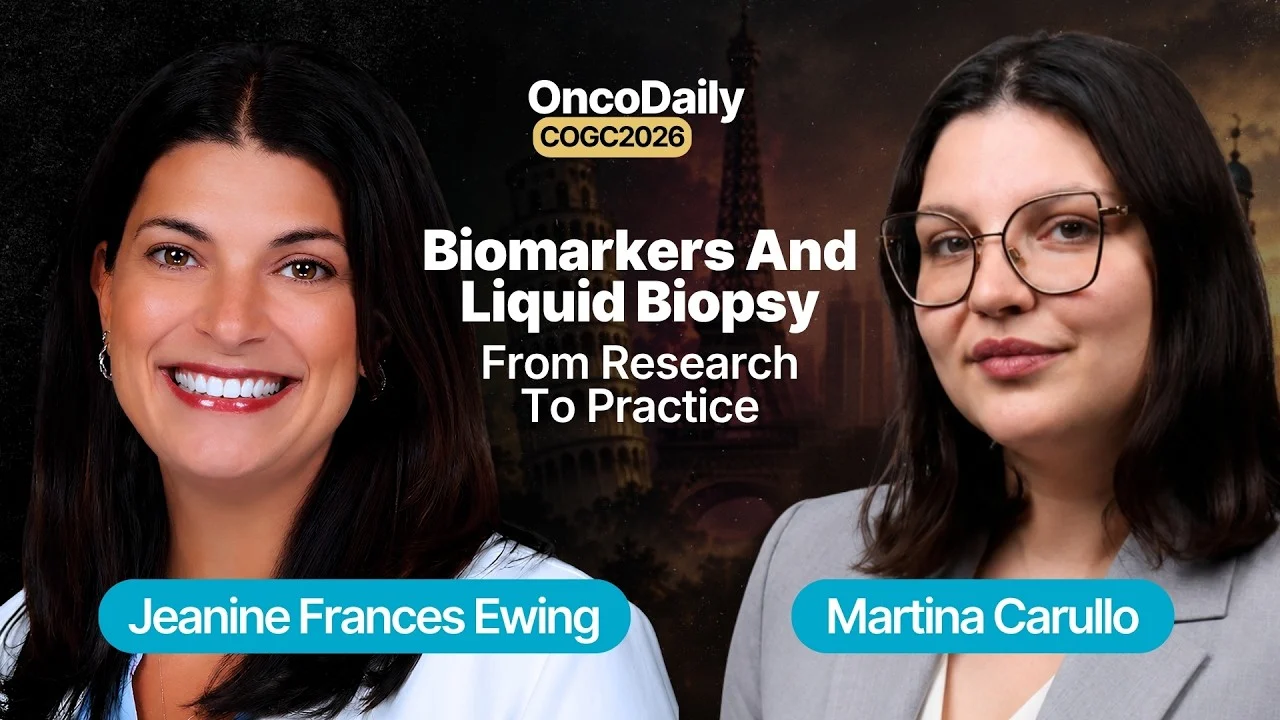
At the Community Oncology Global Congress (COGC 2026), organized by OncoDaily, Josué J. Bravo Espinoza of Universidad Peruana Cayetano Heredia moderated an expert discussion with Martina Carullo, Medical Oncologist at the University of Pisa, and Jeanine Frances Ewing, Clinical Oncology Pharmacist at Florida Cancer Specialists and Research Institute, on how biomarker testing and liquid biopsy are changing treatment decisions in gastrointestinal cancers.
The conversation reflected a major shift in modern oncology. Knowing the diagnosis is no longer enough. In colorectal and gastric cancers, molecular features can determine whether a patient is likely to benefit from immunotherapy, targeted therapy, or an anti-EGFR approach – and can help avoid treatments unlikely to provide benefit.
But as the number of actionable biomarkers grows, another question becomes increasingly important: Are patients being tested early enough – and what happens when tissue is limited or the tumor changes over time?
Test Before You Choose the Treatment
For Ewing, biomarker testing has become inseparable from treatment selection.
“We need the MMR or MSI status because it can determine whether we can use immunotherapy.
In metastatic colon cancer, we also need to know the RAS status. If the tumor is wild-type, we have options such as cetuximab or panitumumab. If it is mutated, we know those therapies are not going to provide the same clinical benefit, and we do not want to expose patients to unnecessary toxicities.
Then, when we look at metastatic gastric cancer, there are multiple biomarkers that can influence treatment decisions – PD-L1, HER2, and CLDN18.2 among them.
A number of these biomarkers can coexist, which is also why we are seeing studies looking at how different targeted and immune-based approaches might eventually be combined.”
The expanding gastric cancer landscape makes that point particularly visible. Ewing also referenced zanidatamab, which received FDA approval in August 2026 as part of first-line regimens for selected patients with HER2-positive unresectable locally advanced or metastatic gastric, gastroesophageal junction, or esophageal adenocarcinoma.
As more biomarkers become clinically relevant, testing one marker at a time after each treatment decision becomes increasingly difficult to justify. The information needs to be available early enough to influence the treatment plan.
When Liquid Biopsy Changes the Next Move
The panel then turned to liquid biopsy and its role in everyday practice.
For Carullo, one of its most practical uses is in metastatic colorectal cancer when considering anti-EGFR rechallenge.
“In clinical practice, we use it mainly when we have to propose an anti-EGFR rechallenge in metastatic treatment.
That is one of the settings where liquid biopsy can help us make the treatment decision.”
The attraction is clear: circulating tumor DNA can provide updated molecular information without requiring another invasive tissue procedure.
That becomes especially relevant when the original tumor tissue is exhausted, unavailable, or may no longer reflect the biology of a cancer that has evolved after several lines of therapy.
Tissue and Liquid Biopsy Should Work Together
Ewing cautioned, however, against treating liquid biopsy as a complete replacement for tissue.
“We use liquid biopsies with NGS testing to see whether there are mutations or targeted therapies that we can use for our patients.
Sometimes there is simply not enough tissue to run all of the testing that we need. In that situation, liquid biopsy can be an alternative.
It can also be useful when we are looking for an acquired mutation and would otherwise have to re-biopsy the patient.
But liquid biopsy can produce false negatives, so if the result is negative, tissue testing may still be needed.
We use them in tandem with each other.”
That distinction is particularly important in community practice. A blood-based test can make molecular profiling easier and faster in some circumstances, but a negative result does not necessarily mean that a relevant alteration is absent.
The value of liquid biopsy therefore depends not simply on ordering the test, but on understanding what the result can – and cannot – reliably answer.
The same caution applies to surveillance. Although circulating tumor DNA is being actively studied as a way to detect molecular residual disease and estimate recurrence risk after treatment, the panel did not present routine ctDNA surveillance as an established replacement for standard follow-up.
Test Early, Then Keep Up With the Biology
As the session closed, both speakers returned to the same practical challenge: treatment options are changing faster, biomarker lists are getting longer, and sequencing those therapies is becoming more complicated.
Carullo emphasized the importance of using available evidence and clinical trials while remaining attentive to toxicity.
Ewing brought the discussion back to the point at which precision oncology begins:
“We need to make sure that we are testing patients early and upfront so that we can make the best treatment decisions.
Things are changing very rapidly. We have new therapies and new targets coming out, and that is going to become increasingly important as we start combining treatments.
Sequencing is a common problem, and toxicity management is important as well.
We want quantity of life, but we also want quality of life for our patients.”
The challenge for community oncology, then, is no longer simply having access to molecular testing.
It is making sure the right biomarker is tested at the right time, the result reaches the treatment decision, and new technology such as liquid biopsy is used for the question it can actually answer.
Written by Eliz Baloyan, MD, Features Writer and Editor at OncoDaily and CancerWorld