Key takeaways
- Financial toxicity can begin before treatment starts, with travel, accommodation, diagnostics, supportive medicines, and lost income all adding to the burden of cancer care.
- Cost discussions should start early, ideally at the first oncology consultation, so financial risk can be identified before it leads to delayed or abandoned treatment.
- Clinicians should recognize and discuss financial risk, but healthcare systems must be responsible for solving it.
- Financial navigation can help patients now, but it should not become a substitute for health system reform.
- Resource-adapted guidelines and person-centered policies are essential so treatment decisions reflect both scientific evidence and what patients and healthcare systems can realistically sustain.
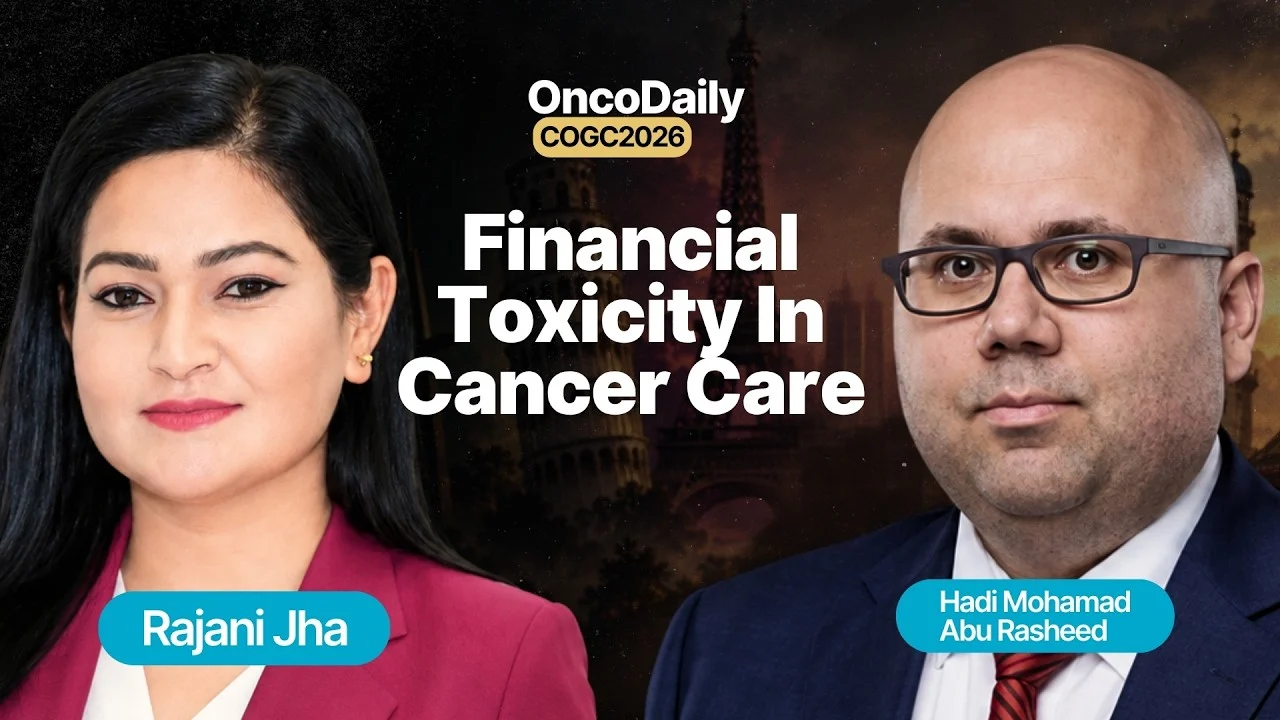
At the Community Oncology Global Congress (COGC 2026), organized by OncoDaily, Felipe Roitberg, Medical Oncologist and Innovation and Health Technology Assessment Specialist at the Brazilian University Hospitals Network, led an expert discussion with Rajani Jha, Assistant Professor of Medical Oncology at Patan Academy of Health Sciences, and Hadi Mohamad Abu Rasheed, Scientific Advisor at Qatar Cancer Society, on one of the most difficult realities of modern oncology: what happens when the recommended treatment exists, but the patient cannot afford everything required to reach and sustain it.
Across Nepal, Qatar, and Brazil, the details were different, but the problem was remarkably similar. Financial toxicity extends far beyond the price of a drug. Transportation, accommodation, lost income, insurance coverage, diagnostic testing, supportive medicines, and time away from work can all determine whether a patient begins treatment, continues it, or abandons it altogether.
The discussion moved beyond identifying the problem to a harder question: how much can clinicians realistically solve – and when does financial toxicity become the responsibility of the healthcare system itself?
Financial Toxicity Can Begin Before the First Treatment
For Jha, the financial burden of cancer in Nepal often begins long before chemotherapy is administered.
“In a resource-constrained setting, the challenge is not only deciding what the appropriate treatment is. The bigger challenge is whether the patient can access, afford, and sustain that treatment.
Financial toxicity does not only mean the cost of chemotherapy.
Patients may have to travel from rural or underprivileged areas of Nepal to cities such as Kathmandu for definitive cancer care. They need transportation, accommodation, food, investigations, supportive medicines, surgery, radiation therapy.
Sometimes even getting a biopsy becomes a financial journey.
These indirect costs matter because patients cannot necessarily receive oncology treatment where they live.”
That reality has changed how Jha approaches the first oncology consultation.
Rather than waiting for patients to disclose financial difficulty after treatment has already started, her team has begun addressing it upfront.
“At the very first oncology consultation, we have started talking about financial toxicity screening.
We ask before the patient has to raise the issue themselves.
We try to understand the risk factors and barriers that may interfere with treatment. We discuss the expected cost of the treatment plan, and then we try to connect the patient with government funding, NGOs, hospital funds, or other assistance that may be available.
We also need more government support, and we need to decentralize laboratory testing and cancer treatment as much as possible.
Because patients are abandoning treatment because of cost.
So we cannot wait until that happens before we start the conversation.”
Talking About Cost Is Clinical Care – Fixing It Is a System Responsibility
Abu Rasheed agreed that cost needs to enter the clinical conversation earlier, but cautioned against making oncologists responsible for solving a problem created by the wider healthcare system.
“We do not want to put all the weight on the oncologist.
Starting the discussion about cost is a responsibility of the clinical team.
But finding the solution is the system’s responsibility and accountability.
We need to normalize the discussion of cost. The oncologist and clinical team should be able to ask about it, recognize risk, and identify that a patient may need help.
But we cannot expect clinicians alone to fix insurance systems, employment problems, transportation costs, or the broader social conditions that create financial toxicity.”
That distinction also matters because the burden is much broader than the expenses visible on a hospital bill.
“Financial toxicity is a global problem. It is not only a low- and middle-income country problem.
It depends on employment, insurance coverage, income, family responsibilities, and the wider healthcare system.
A patient may have their medical treatment recorded, but what about loss of income? Transportation? Housing? The cost of caring for children while a parent is receiving treatment?
Those needs go beyond the walls of the hospital.”
Can Data Help Find Financial Risk Earlier?
Technology could help identify some of those risks before they become crises.
Abu Rasheed pointed to electronic medical records as a potentially powerful tool – but only if healthcare systems collect the right information.
“Electronic medical records can help us understand the direct medical cost and the patient’s healthcare needs.
But many EMRs do not collect enough socioeconomic information.
If the system includes information about occupation, insurance, family situation, and other factors, that information could potentially help identify patients who are at high risk of financial toxicity.
AI tools may eventually help screen those records and create a red flag before a high-cost treatment is started.
The EMR could even act as a behavioral nudge: You are about to start a high-cost targeted therapy – have you discussed cost with this patient?
In a fast clinical environment, where oncologists are seeing more patients and facing more pressure, those reminders may help make sure the conversation is not forgotten.”
In Qatar, Abu Rasheed noted that a national identifier can connect healthcare information with other government systems, creating opportunities to understand patient needs beyond direct medical treatment.
But technology alone is not enough.
“Financial navigation is important, but we also have to be careful about what I call the navigation paradox.
We can keep creating navigation programs and finding Band-Aids for the problem without ever improving the system itself.
Navigation helps the patient today.
But we also need to ask: what does this program teach us about what the system needs to fix tomorrow?
Financial navigation should help people now, but it should not become a replacement for health system reform.”
From Navigation Programs to Health Policy
Roitberg pushed the discussion further, asking what happens when financial toxicity remains something managed locally by individual hospitals, oncologists, or patient assistance programs rather than being formally addressed in health policy.
“We have been talking about financial toxicity within our silos, but it is still not adequately addressed in policy.
The burden is not only the direct cost of cancer treatment.
In large countries such as Brazil, long-distance travel, food, accommodation, time away from work, and other indirect costs can become major barriers.
Patients can lose assets, lose employment, and experience enormous psychological distress because of the financial burden of cancer.
So we need to move the discussion beyond simply documenting financial toxicity.
Who has the mandate to fix it?”
For Abu Rasheed, one possible answer is to stop treating financial support programs as peripheral services and begin integrating what they learn into national cancer planning.
“Instead of keeping affordability programs and financial navigation programs at the periphery of the healthcare system, we should bring them into the system.
They already understand where patients are struggling. They may already negotiate access, connect families with resources, and identify gaps in coverage.
That experience can inform national planning.
We need to move from an individual assistance program to something that helps us understand how the healthcare system itself should change.”
Patient organizations and advocacy groups also need to be involved much earlier.
“Patients and advocacy organizations need to sit at the table when cancer control plans are being designed.
They should not simply be consulted after everything has already been decided.
We also need to communicate with policymakers in a language they understand.
Sometimes that means translating better cancer care into return on investment.
But numbers are not enough.
We also need stories.
Stories humanize the numbers.
Policymakers need to understand what financial toxicity actually looks like in the life of a person with cancer and their family.”
The Best Treatment Is Not Always the Newest One
Roitberg brought the conversation back to the community oncologist sitting across from the patient.
“Financial toxicity is not exclusive to low- and middle-income countries.
It can affect patients across very different healthcare systems through direct costs, indirect costs, lost work, travel, and loss of assets.
And this also has implications for the way physicians prescribe.
It is not a sin not to offer the latest breakthrough innovation if that treatment is going to create an unsustainable financial burden for the patient.
But we have to discuss it.
We cannot say that financial cost has nothing to do with the clinical decision.
That is why resource-adapted clinical guidelines are so important.
We need recommendations that take into account not only the scientific evidence, but also the resources available to the healthcare system and the patient’s ability to realistically receive and sustain that care.
The way we prescribe can itself become a driver of financial toxicity.”
Abu Rasheed closed with the same shift in perspective: financial protection cannot remain an optional service added after the treatment plan has already been decided.
“We need national policies around holistic and person-centered care.
We need to understand what people living with cancer need upfront.
That will not happen without proper navigation, person-centered care, and a healthcare system that recognizes those needs as part of cancer care itself.”
Written by Eliz Baloyan, MD, Features Writer and Editor at OncoDaily and CancerWorld