Key takeaways
- Better cancer registration is essential to understand the true disease burden and plan services around real patient numbers.
- Screening and awareness must lead to earlier action, especially for symptoms that patients in rural communities may otherwise ignore.
- More oncologists alone will not solve access problems; workforce expansion has to happen alongside investment in infrastructure.
- AI can support cancer care in remote settings, but it should complement trained personnel rather than replace them.
- Asia-Pacific countries need more locally generated evidence and context-specific guidelines that reflect their own populations, resources, and healthcare systems.
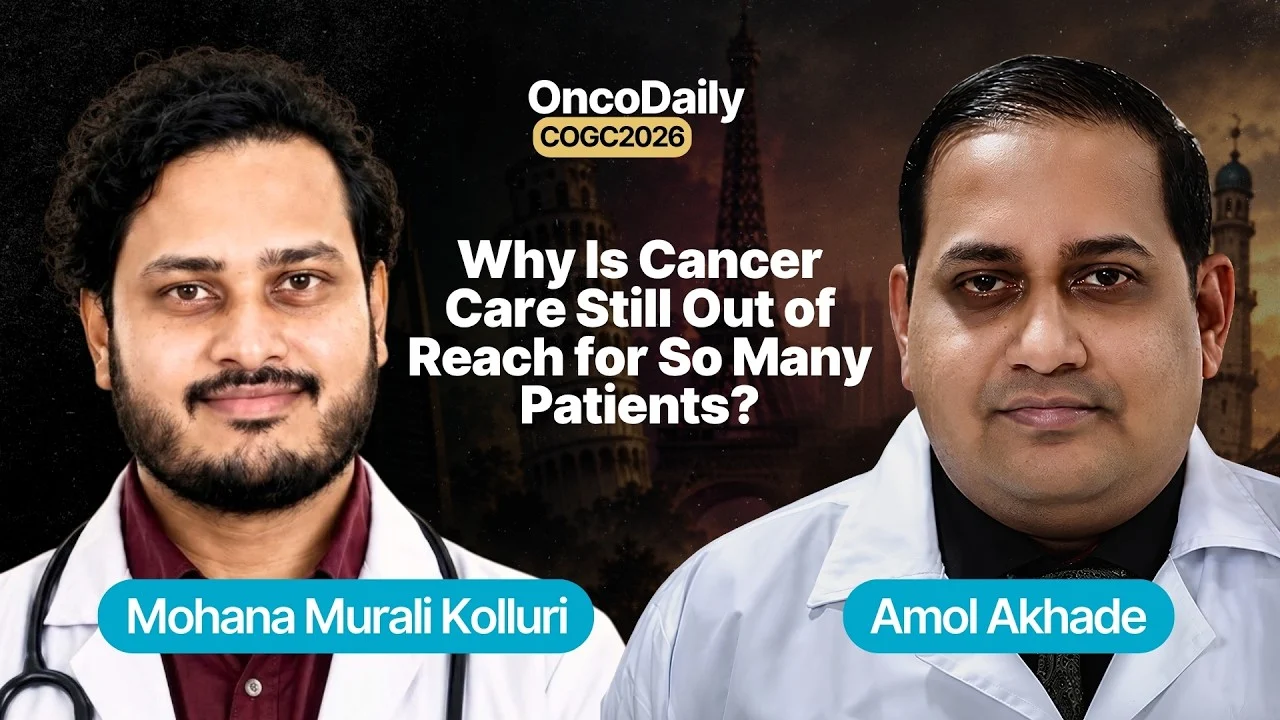
At the Community Oncology Global Congress (COGC 2026), organized by OncoDaily, Amol Akhade, Senior Consultant in Medical Oncology at Fortis Hospital Mulund in Mumbai, sat down with Mohana Murali Kolluri, Consultant Radiation Oncologist at Trinity Hospitals in Kakinada, India, to examine what community oncology across the Asia-Pacific region will need as cancer burden continues to grow.
Their discussion moved well beyond treatment itself.
- How can countries understand their true cancer burden if cases are underreported?
- How can screening and early diagnosis reach rural communities?
- Will training more oncologists be enough without the infrastructure to support them?
- And can artificial intelligence help close some of these gaps?
Across each question, the same theme emerged: expanding cancer care will require more than adding doctors or introducing new technology. Workforce, infrastructure, data, prevention, and locally relevant evidence have to move together.
Knowing the Cancer Burden Comes First
For Akhade, one of the first challenges is deceptively basic: countries need a clearer picture of how many people are actually developing cancer.
Cancer registries can only reflect cases that enter the system. In regions where patients may never reach an oncology center, the documented burden may represent only part of the reality.
Kolluri argued for a more connected approach to cancer registration.
“Every patient entering any hospital should be registered through some kind of national online interface.
It should not only enter the hospital system. It should enter the national registry.”
For Akhade, improving registration has to happen alongside stronger screening and prevention.
He pointed particularly to cancers for which earlier detection or prevention can make a substantial difference, including cervical cancer, while noting that acceptance of HPV vaccination at the community level remains a challenge in parts of the region.
The principle is straightforward: without knowing where cancer is occurring, who is being diagnosed, and who is being missed, it becomes much harder to plan the services needed to respond.
Awareness Has to Lead Patients to the Doctor
Kolluri drew an important distinction between knowing that something causes cancer and knowing when a symptom should trigger medical attention.
Public awareness of smoking and cancer, for example, has improved. But that does not necessarily mean someone living in a rural area will recognize a persistent oral lesion or neck mass as something requiring prompt evaluation.
“People know that smoking causes cancer and drinking causes cancer.
But what we need to take further into rural communities is that any abnormal growth should be taken seriously.
If someone with a smoking or drinking history sees a growth in the oral cavity, a swelling in the neck, or something abnormal, they should go to a doctor.”
He described a similar problem among women who may dismiss breast lumps or other changes because they assume they are related to an old injury, wound, or benign condition.
The challenge, then, is not simply conducting another awareness campaign. It is communicating symptoms in a way that leads to action – particularly among people who may have limited access to oncology services once they decide to seek care.
More Oncologists Will Not Fix an Infrastructure Gap
The conversation then moved to one of the defining challenges across many Asia-Pacific healthcare systems: capacity.
Akhade asked whether increasing the number of medical and radiation oncologists could substantially improve access, particularly in countries where specialist numbers remain limited.
Kolluri’s answer was clear.
“I do not think it will completely solve the problem.
We can train the staff, recruit the staff, and educate the staff, but the infrastructure lag is still a lag. It has to be filled.
It should be both ways. One will not help.”
Radiotherapy illustrates the problem particularly well. Training more radiation oncologists cannot by itself expand treatment if communities lack linear accelerators, treatment centers, imaging, pathology, and the wider systems needed to support care.
Kolluri argued that investment therefore has to bring both professionals and physical infrastructure closer to patients.
He also warned that when formal healthcare leaves a gap, other sources quickly fill it.
“There is a gap between the availability of infrastructure, doctors, what doctors say, and what patients interpret.
And that gap is being filled by the Instagram specialist, the social media specialist, or the traditional medicine specialist.
We have to acknowledge that the gap exists.”
For him, rebuilding trust means making credible cancer care more visible and accessible in the community – not simply expecting patients to navigate toward distant specialist centers on their own.
AI Should Support the Front Line, Not Replace It
Could artificial intelligence help bridge some of these shortages?
Akhade raised the possibility of using AI in remote areas, including settings where access to trained pathology expertise is limited.
Kolluri saw clear potential, but placed an important limit on the role technology should play.
“AI can be a supporting help, not a replacement.
We still need trained personnel.”
And that training, he argued, should not focus only on oncologists.
Nurses, radiation therapists, technicians, community-level workers, and others who interact directly with patients will need enough understanding to use AI-supported systems appropriately and recognize when information needs to move to the next level of care.
“We need to train the lowest staff also – a therapist, a nurse, or a locally available person who can go and talk to the community.
Bringing AI into the system needs to begin with the person who is directly in contact with the patient.”
The point shifts the AI conversation away from replacing scarce specialists and toward something more practical: using technology to strengthen a connected workforce from the community level upward.
Asia-Pacific Needs Evidence That Reflects Asia-Pacific
The discussion ended with a broader question about evidence itself.
Much of oncology practice across the region is built on major international guidelines and clinical trials originating largely from Western healthcare systems. Akhade asked whether Asia-Pacific countries also need stronger real-world data and recommendations built around their own populations, resources, and healthcare structures.
Kolluri strongly agreed.
“The standardized guidelines we follow are very good.
But I feel individualized, country-specific guidelines are very important.
They give the real picture and the real guidance to the people of that region.”
That does not mean abandoning international evidence. It means adding evidence that reflects the realities in which treatment must actually be delivered.
The Asia-Pacific region encompasses enormous differences in workforce, infrastructure, geography, financing, cancer presentation, and access to diagnostics and treatment. A recommendation that is technically evidence-based may still be difficult to implement if the system required to deliver it does not exist.
For Akhade and Kolluri, the path forward therefore cannot rest on a single intervention.
Better cancer registration can reveal the real burden. Screening and prevention can move diagnosis earlier. More oncologists can expand expertise, but only if infrastructure grows with them. AI can extend capacity, but only when trained people remain at the center. And locally generated evidence can help ensure that guidelines reflect the populations and health systems expected to use them.
The solution is not workforce or infrastructure, technology or people, global evidence or local data. Across community oncology in the Asia-Pacific region, each has to advance together.
Written by Eliz Baloyan, MD, Features Writer and Editor at OncoDaily and CancerWorld
Watch the full video on YouTube.