Key takeaways
- Patient-flow data showed that many oncology patients were traveling long distances for routine visits or opinions that could be managed closer to home.
- Telemedicine alone was not enough because language barriers, low health literacy, and limited trained staff affected the quality of remote consultations.
- A physical hub-and-spoke model with a trusted local partner made multidisciplinary decision-making and triage possible within the community.
- Palliative and hospice care can also be decentralized so that patients can receive important end-of-life support closer to home.
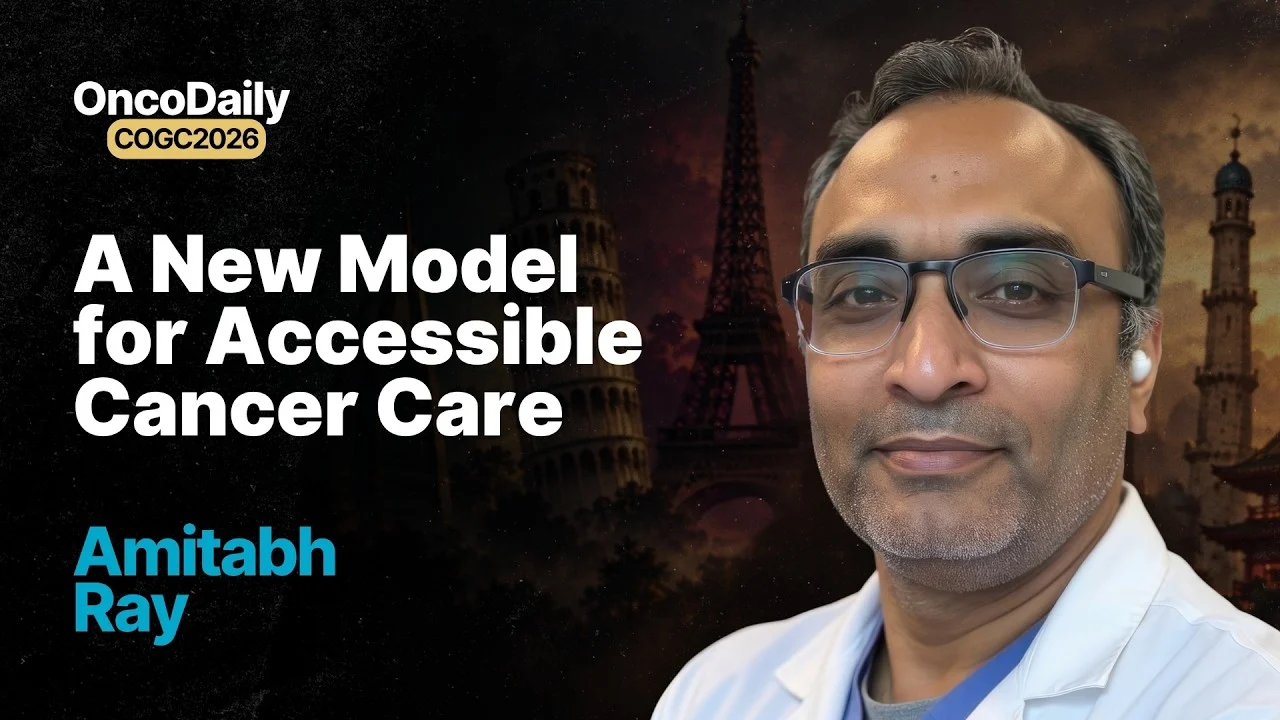
At the Community Oncology Global Congress (COGC 2026), organized by OncoDaily, Amitabh Ray, Radiation Oncologist, Professor and Senior Consultant at Chittaranjan National Cancer Institute (CNCI), shared how a tertiary cancer center in Kolkata began rethinking a problem that looked simple on paper: patients were traveling hundreds of kilometers for visits that often did not require treatment at a major academic center.
The answer was not simply more telemedicine. In fact, their first attempt at a technology-based solution failed. What eventually worked was more practical: bringing oncologists physically closer to patients, creating trusted local partnerships, and reserving travel to the academic center for those who truly needed it.
When the Data Revealed an Avoidable Burden
The Chittaranjan National Cancer Institute draws patients from across West Bengal and other parts of eastern India. When the team examined its own patient-flow data, two patterns became difficult to ignore.
Many patients were traveling overnight for routine follow-up visits, while a significant number were coming from the district of Murshidabad simply to obtain an oncology opinion rather than receive treatment. Some of those journeys covered 300 to 350 kilometers.
The problem was therefore not a lack of specialist oncology care. It was that patients were being required to travel long distances to access decisions that could potentially be made much closer to home.
The objective became clear:
- Reduce unnecessary travel,
- Make more decisions locally,
- Identify which patients truly needed referral to Kolkata,
- Reserve academic center visits for care or expertise unavailable locally.
Why Telemedicine Was Not Enough
The team initially tried what seemed like the obvious solution: teleconsultation.
It did not work as expected.
Low health literacy among patients and families made remote communication difficult. Language barriers complicated consultations further, and there was not enough trained staff at the community end to help gather information and support the interaction.
The result was often incomplete clinical information and advice that did not fully answer what patients or families needed. Despite repeated attempts, the model failed to solve the problem.
That failure became important because it changed the design of the next intervention. Instead of trying to replace physical oncology care with technology alone, the team decided to create a physical hub-and-spoke model built around an established community partner.
Finding that partner was one of the most difficult parts of the project.
Because the Chittaranjan National Cancer Institute is a government-funded institution, establishing an external partnership required legal and administrative approval. The team ultimately partnered with an organization that had already worked in the district for roughly three decades and had an established presence in healthcare.
The memorandum of understanding took several months to complete, but the administrative work was not a formality. Any partnership involving patient care needed clearly defined responsibilities and systems at both ends.
Once the agreement was established, the institute launched a monthly oncology outpatient clinic at the spoke site.
Each visit was staffed by two specialists: a clinical oncologist – either medical or radiation oncology – and a surgical oncologist.
That pairing effectively created small, local multidisciplinary consultations. Patients could be assessed jointly, treatment decisions could be discussed immediately, and clinicians could determine who actually needed referral to the academic center.
The model improved follow-up care, strengthened new consultations, and made triage much more effective. Over time, the institute even saw fewer patients traveling to Kolkata unnecessarily simply to obtain an opinion.
From 20 Patients to 150 a Month
The outreach clinics began in 2024 and continued monthly for the next two years.
Initially, approximately 20 to 30 patients were seen each month. By 2026, monthly volume had increased to roughly 100 to 150 patients.
Definitive treatment still largely depends on the academic hub, but the model has started to extend beyond consultation. A pilot program for daycare chemotherapy has been established in a local hospital with the involvement of a former trainee who returned to practice in the district.
After two years, the program reported a 20% to 25% reduction in travel requirements to the central hospital, alongside increasing patient trust and acceptance of the outreach model.
The experience has also become a proof of concept for expansion. The institute is considering similar clinics in two additional districts and is exploring community awareness and screening activities with its local partners.
What Worked and What Did Not
One of the clearest lessons from the project was that a solution that works in one health system cannot simply be transferred unchanged into another.
Technology alone did not overcome language barriers, limited health literacy, or the absence of trained personnel at the community site.
The local partner proved far more important. The organization already had legitimacy, logistical knowledge, and community acceptance – factors that an academic center operating from hundreds of kilometers away could not easily recreate.
The composition of the visiting team also mattered. Pairing a clinical oncologist with a surgeon allowed more decisions to be made during a single visit and made the outreach clinic function much more like a compact multidisciplinary service rather than a basic referral clinic.
These lessons made the model potentially transferable: understand the local problem first, choose the right partner, then design the service around what the community can realistically use.
Bringing Palliative Care Closer to Home
The same philosophy has also shaped the institute’s approach to palliative and end-of-life care.
Recognizing that hospice and palliative services remain underserved in India, the institute established a district-based hospice in Chandannagar, Hooghly, rather than concentrating those services entirely in Kolkata.
The hospice receives patients from different parts of the country, including the institute’s own patients who require terminal or end-of-life care. Additional supportive services have also been developed locally around it.
The underlying principle is similar to the outreach oncology clinics: care does not always need to move toward the academic center. Sometimes the academic center needs to build a pathway that moves expertise closer to the patient.
Low-Tech and High-Trust Oncology
The experience in West Bengal ultimately produced a relatively simple model.
Patient data first identified the unnecessary travel burden. Telemedicine exposed the limits of a technology-first solution. A trusted local partnership then made it possible to establish regular district clinics staffed by specialists who could make multidisciplinary decisions closer to patients.
Over time, that model reduced travel, supported local treatment, and created a platform that could potentially be expanded to other districts.
Ray’s experience also challenges the assumption that decentralizing cancer care necessarily requires sophisticated infrastructure. In this case, the solution was comparatively low-tech, highly local, and built on trust – but it was designed around a problem that the academic center had first taken the time to measure.
Written by Eliz Baloyan, MD, Features Writer and Editor at OncoDaily and CancerWorld