





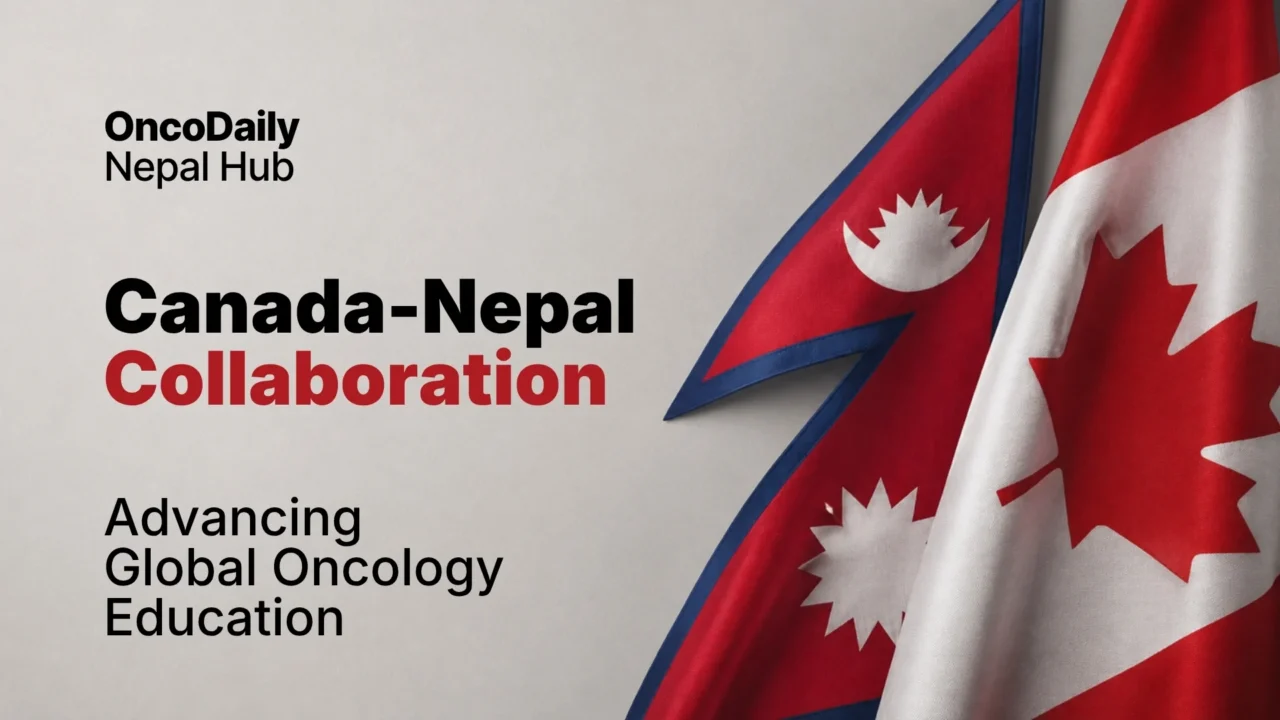
Global oncology collaborations often take years to translate vision into meaningful impact. The Two Worlds Cancer Collaboration has shown that, with a shared commitment and the potential of global oncology education delivered virtually.
In just six weeks, the collaboration successfully delivered three Continuing Medical Education (CME) programmes spanning four major cancer specialties, bringing together leading oncology experts from Canada and Nepal. The initiative demonstrates that world-class oncology education no longer depends on geography, conference travel, or institutional boundaries—it depends on collaboration.
The series began on 15 June with a comprehensive Breast and Gastrointestinal Cancer Update. Breast cancer advances were presented by Dr. Vivek Ghosh (Birat Cancer Institute, Nepal) and Dr. Saroj Niraula (BC Cancer, Canada), while gastrointestinal oncology updates were delivered by Dr. Ramila Shilpakar (National Academy of Medical Sciences, Nepal) and Dr. Navdeep Deher (Arthur J.E. Child Comprehensive Cancer Centre, Canada). The session was moderated by Dr. Marya Hussain and Dr. Rajeev Sharma, setting the tone for a highly interactive and academically rich programme.
The momentum continued on 6 July with a Lung Cancer Update, featuring Dr. Barbara Melosky (BC Cancer, Canada) alongside Dr. Soniya Dulal (BPKIHS, Nepal). The series concluded on 27 July with a Genitourinary Cancer Update, where Dr. Reyes Garcia (Arthur J.E. Child Comprehensive Cancer Centre, Canada) partnered with Dr. Anuj K.C. (CMC Cancer Institute, Nepal). Both the lung and genitourinary sessions were co-moderated by Dr. Maryam Hussain and Dr. Vivek Ghosh, supporting continued exchange between faculty from both countries.
The initiative was conducted under the guidance of Dr. Puneet Bains, Chair of the Two Worlds Cancer Collaboration, and Dr. Bishnudutta Poudel, Senior Medical Oncologist from Nepal, whose leadership has been instrumental in fostering meaningful academic partnerships between the two countries.
A True Two-Way Exchange
The collaboration represents far more than the dissemination of knowledge from one country to another. Nepali oncologists gain rapid access to practice-changing evidence from major international meetings such as ASCO, enabling timely integration of new data into local clinical practice. At the same time, Canadian faculty engage with the realities of delivering cancer care in resource-constrained settings, enriching discussions around implementation, value-based care, and evidence adaptation.
Rather than a traditional model of knowledge transfer, the programme embodies genuine bidirectional learning—where expertise, innovation, and practical experience flow in both directions.
A Sustainable Model for Global Oncology
Within only six weeks, the Two Worlds Cancer Collaboration has evolved beyond a webinar series into a structured educational platform. Covering four disease sites through three high-quality CME sessions, it has established a scalable model for global oncology education that can be replicated following every major oncology conference, including ASCO and ESMO.
The collaboration is already preparing its fourth educational programme—a dedicated Gynaecological Cancer Update—which will further expand the initiative’s multidisciplinary reach and continue its commitment to delivering timely, evidence-based education across cancer specialties.
Without the barriers of international travel or conference costs, the initiative leverages digital connectivity to ensure that the latest advances in cancer care reach clinicians wherever they practise. More importantly, it creates opportunities for mentorship, leadership development, and long-term academic partnerships that strengthen oncology communities on both sides of the world.
As cancer care becomes increasingly global, initiatives such as the Two Worlds Cancer Collaboration demonstrate that meaningful educational partnerships are defined not by distance, but by shared purpose. By connecting expertise across continents and translating cutting-edge science into practical clinical knowledge, this collaboration is building a sustainable model for equitable oncology education—one that is already making an impact today and is poised to grow even further with the upcoming Gynaecological Cancer Update and future disease-focused programmes.