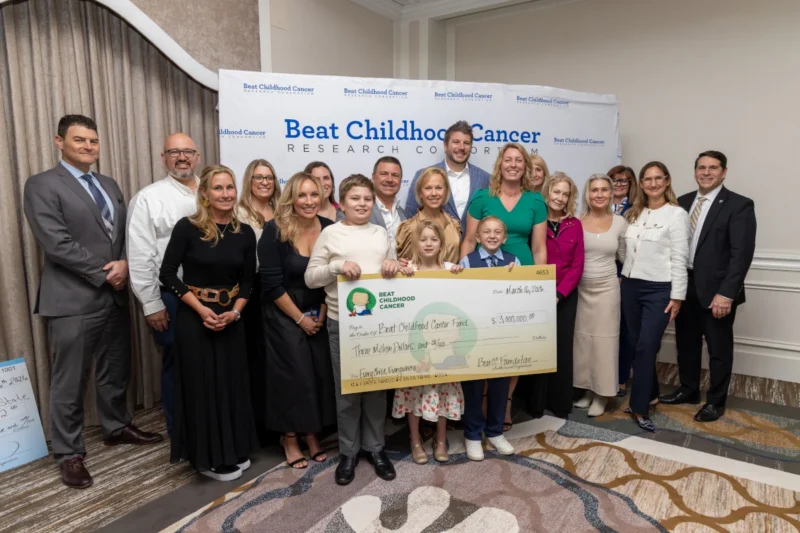
Penn State College of Medicine announced a $3 million philanthropic investment from the Beat Childhood Cancer Foundation to support the Beat Childhood Cancer Research Consortium. The funding is directed toward strengthening the Consortium’s global clinical trial infrastructure and accelerating the development of safer, more effective, and increasingly personalized therapies for children diagnosed with cancer.
This contribution reflects more than financial support. It represents a continuation of a parent-driven movement that has steadily reshaped how pediatric oncology research is conceived, funded, and delivered.
From Advocacy to Action: A Parent-Led Model Driving Innovation
The Beat Childhood Cancer Foundation was established by families seeking better outcomes for children facing cancer. Over time, it has evolved into a strategic force in pediatric oncology, supporting clinical trials, guiding precision medicine initiatives, and prioritizing treatment approaches grounded in real-world patient needs.
Unlike traditional funding pathways, this model places lived experience at the center of research prioritization. The Foundation has worked closely with the Consortium since 2010, helping direct investments toward therapies that address unmet clinical needs, particularly in relapsed and refractory disease.
Sarah Bartosz, Executive Director of the Foundation, emphasized the urgency behind this commitment, noting that for families, progress in pediatric cancer is not abstract, it is immediate, personal, and necessary. The investment, she suggested, ensures that innovative trials are not limited by geography or access, but instead reach children wherever they are.
Building a Global Clinical Trials Network
Headquartered at Penn State College of Medicine, the Beat Childhood Cancer Research Consortium has grown into a robust international network spanning more than 55 children’s hospitals and research institutions across North America, Europe, and South America.
This structure enables a coordinated, multi-site approach to pediatric oncology trials, from early-phase development to large-scale clinical implementation. Importantly, it reduces one of the most persistent barriers in pediatric cancer care: access. By decentralizing trials and expanding participating centers, children can receive cutting-edge therapies closer to home, minimizing the physical, financial, and emotional burden on families.
To date, the Consortium has launched over 28 clinical trials, many focused on high-risk, relapsed, or refractory solid tumors areas where therapeutic options remain limited and outcomes are often poor.
Translating Discovery Into Impact: The IWILFIN Example
One of the Consortium’s most notable successes lies in neuroblastoma research. What began as a hypothesis supported by preclinical data progressed through clinical trials and ultimately resulted in an approved therapy: IWILFIN (DFMO).
This trajectory from laboratory insight to regulatory approval illustrates the Consortium’s ability to bridge the gap between scientific discovery and real-world clinical benefit. More importantly, it provides a blueprint for future efforts in pediatric oncology, particularly in diseases where progress has been historically slow, such as brain tumors and sarcomas.
The current investment aims to replicate and expand this model, enabling similar pathways for emerging therapies targeting rare and difficult-to-treat pediatric cancers.
The Challenge of Pediatric Oncology: Small Populations, Complex Pathways
Pediatric oncology research operates under distinct constraints. Patient populations are small, disease subtypes are heterogeneous, and regulatory pathways are often more complex than in adult oncology. These factors can slow trial enrollment, delay results, and limit pharmaceutical investment.
Giselle Saulnier Sholler, MD, MSc, Chair and Founder of the Consortium, highlighted the importance of sustained partnership in overcoming these barriers. Advancing pediatric therapies requires not only scientific rigor but also long-term commitment from stakeholders willing to invest despite structural challenges.
“We are so grateful for the generous donation of $3 Million dollars this year from the Beat Childhood Cancer Foundation !!! Without them, our clinical trials program Beat Childhood Cancer Research Consortium at Penn State College of Medicine would not be possible. Through their unshakable belief that together we can improve lives for children with cancer our programs have grown over almost 20 years to bring new treatment options to children across the globe.
Special thanks to Sarah Bartosz Patrick Lacey Savannah Billett Crystal Shaw
https://lnkd.in/eDYuTGYX “
Strategic Alignment: Philanthropy Meets Infrastructure
Karen Kim, MD, MS, Dean of Penn State College of Medicine, underscored the significance of aligning philanthropic support with an established clinical trials infrastructure. This combination allows scientific discoveries to transition more efficiently into clinical application, shortening the time between innovation and patient benefit.
The Consortium’s centralized model coordinating trial design, regulatory navigation, and multi-site implementation positions it as an effective platform for translating research into changes in standard of care.
Expanding the Reach of Precision Medicine in Children
A central focus of the Consortium’s work is precision medicine tailoring therapies based on the molecular and genetic characteristics of each patient’s tumor. While this approach has transformed adult oncology, its integration into pediatric care remains uneven.
Through its trials and partnerships, the Consortium has prioritized molecularly guided therapies, aiming to improve response rates while reducing toxicity. The current funding will further support these efforts, enabling broader implementation of precision approaches across participating centers.
Equally important is the emphasis on survivorship. Advances in treatment must be balanced with long-term quality of life, particularly in children who may live decades after therapy. Safer treatments, reduced late effects, and improved functional outcomes are central to the Consortium’s mission.
A Unified Effort Toward Better Outcomes
Although the Beat Childhood Cancer Foundation and the Beat Childhood Cancer Research Consortium operate as separate entities, their collaboration reflects a unified strategy: expanding access to innovative therapies, preventing relapse, and ultimately improving survival in pediatric cancer.
This partnership demonstrates how coordinated efforts between advocacy groups, academic institutions, and clinical networks can accelerate progress in areas where traditional models have struggled.
Stay informed with more articles like this on OncoDaily.
Written by Nare Hovhannisyan, MD