Trastuzumab deruxtecan has transformed the treatment of HER2-low metastatic breast cancer, but its role in curative-intent early disease remains far less certain.
Final results from the phase II TALENT trial, presented at ESMO Congress 2026, showed that neoadjuvant trastuzumab deruxtecan (T-DXd) produced meaningful radiologic tumor responses in hormone receptor-positive, HER2-low early breast cancer but relatively low rates of pathologic complete response.
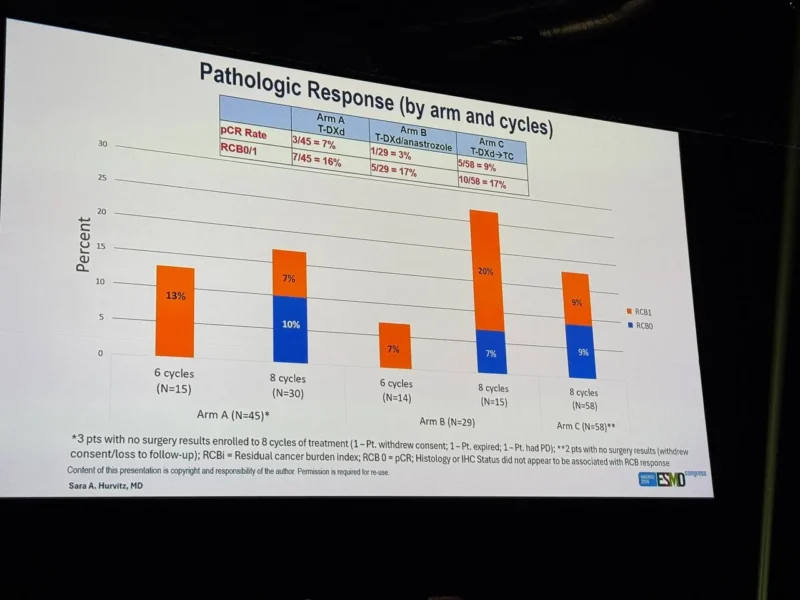
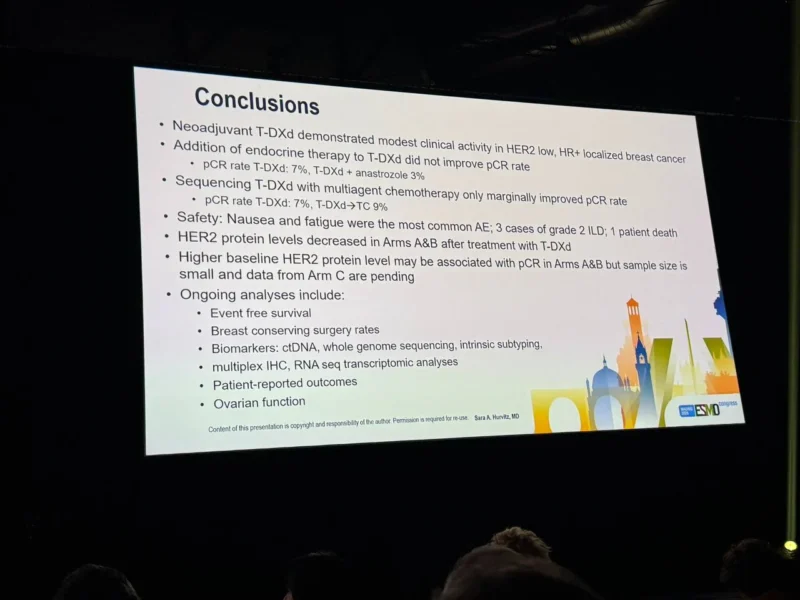
Adding endocrine therapy to T-DXd did not improve pCR, while sequencing T-DXd with conventional docetaxel and cyclophosphamide chemotherapy produced only a modest numerical increase. Among evaluable patients, pCR occurred in 7% with T-DXd alone, 3% with T-DXd plus anastrozole, and 9% with sequential T-DXd followed by docetaxel/cyclophosphamide.
When pCR and near-pCR were combined using residual cancer burden categories RCB0/1, rates remained remarkably similar across the three strategies at 16%, 17%, and 17%, respectively.
The final TALENT results therefore provide a more nuanced message than the metastatic success of T-DXd might have predicted: HER2-low expression is sufficient to support substantial ADC activity in advanced disease, but it may not by itself identify a population likely to achieve deep pathologic eradication when T-DXd is moved into the neoadjuvant setting.
TALENT Tested T-DXd in a Biologically Difficult Early Breast Cancer Population
Pathologic complete response is uncommon in HR-positive, HER2-negative early breast cancer compared with HER2-positive or triple-negative disease.
These tumors often respond to systemic treatment through slower antiproliferative effects rather than rapid tumor eradication, and pCR has historically been an imperfect surrogate for long-term benefit in hormone receptor-positive disease.
TALENT was therefore testing T-DXd in a setting where high pCR rates would not necessarily be expected even with active therapy.
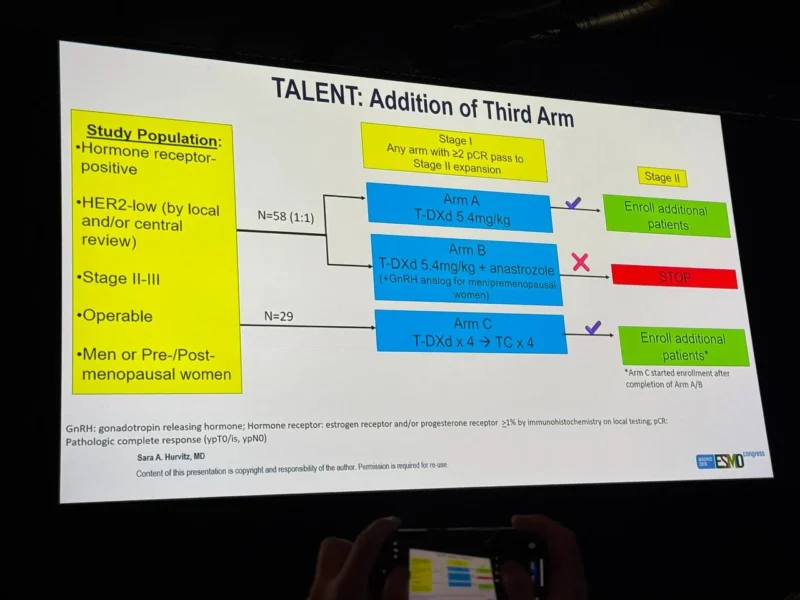
The phase II study enrolled patients with untreated, operable, stage II–III HR-positive, HER2-low breast cancer. HER2-low disease was defined through local and/or central review, and both premenopausal and postmenopausal women as well as men were eligible.
The original randomized portion compared T-DXd alone with T-DXd plus anastrozole. Premenopausal women and men receiving endocrine therapy also received gonadotropin-releasing hormone suppression.
A third treatment strategy was subsequently introduced to evaluate T-DXd followed by conventional chemotherapy. Importantly, this third cohort was not part of the original concurrent randomized comparison. It was added after the first two treatment groups, which limits direct cross-arm interpretation.
The Study Evolved as Early Pathologic Response Data Emerged
The TALENT design used a two-stage approach. Patients were initially randomized between T-DXd alone and T-DXd plus anastrozole, with expansion dependent on whether sufficient pCR activity was observed.
The T-DXd-alone cohort met the prespecified threshold to expand enrollment, whereas the T-DXd plus anastrozole cohort did not. A subsequent cohort evaluated four cycles of T-DXd followed by four cycles of docetaxel and cyclophosphamide.
Ultimately, 132 patients were enrolled: 45 received T-DXd alone, 29 received T-DXd plus anastrozole, and 58 were treated with sequential T-DXd followed by chemotherapy.
The populations were not perfectly balanced. Approximately 53% and 55% of patients in the T-DXd and T-DXd plus anastrozole groups had node-positive disease, compared with 81% in the sequential T-DXd/chemotherapy cohort.
Grade 3 disease was also present in 42%, 38%, and 50%, respectively. These differences reinforce why numerical comparisons between the third cohort and the original randomized groups should remain descriptive rather than be interpreted as evidence of superiority or equivalence.
T-DXd Alone Produced a 7% pCR Rate
Among patients with available surgical pathology in the T-DXd-alone group, pCR was observed in 3 of 42 patients, or 7%. When near-pCR was added, seven patients achieved RCB0 or RCB1, corresponding to approximately 16%.
Radiologic response, however, was substantially more frequent. Objective response rate was approximately: 67% with T-DXd alone. This disconnect between radiographic tumor shrinkage and complete eradication of invasive disease is one of the most important observations from TALENT.
T-DXd clearly demonstrated antitumor activity. But in most patients, tumor shrinkage did not translate into complete pathologic clearance. That distinction is particularly relevant when considering neoadjuvant therapy, where the biological objective differs from treatment of metastatic disease.
In advanced cancer, substantial shrinkage and prolonged disease control can translate directly into clinical benefit. In early disease, residual viable tumor after systemic therapy may still carry prognostic importance and can guide subsequent adjuvant treatment decisions.
Adding Anastrozole Did Not Improve Pathologic Response
The biological rationale for combining endocrine therapy with T-DXd was compelling. HR-positive/HER2-low tumors frequently remain dependent on estrogen receptor signaling, raising the possibility that simultaneous endocrine blockade and HER2-directed ADC therapy could deepen tumor response.
TALENT did not demonstrate that effect. Only 1 of 29 patients, or 3%, achieved pCR with T-DXd plus anastrozole. The combined RCB0/1 rate was approximately 17%, essentially similar to the T-DXd-alone result.
Radiographic ORR was also nearly identical at approximately 66%. The final analysis therefore provides no evidence that adding anastrozole meaningfully improved the pathologic activity of T-DXd in this setting. This does not necessarily mean endocrine therapy has no biological interaction with T-DXd. The study was small and not powered to establish modest differences between strategies.
However, there was no signal strong enough to justify concluding that concurrent aromatase inhibition enhances neoadjuvant T-DXd efficacy.
Longer T-DXd Exposure Did Not Transform the pCR Signal
Treatment duration also evolved during TALENT. Some patients received six cycles of T-DXd, while later participants received eight cycles. Within the T-DXd-alone group, none of the 15 patients treated with six cycles achieved pCR, whereas 3 of 30 patients treated with eight cycles achieved pCR, corresponding to approximately 10%.
In the T-DXd plus anastrozole group, no pCRs occurred among 14 patients treated with six cycles, while 1 of 15 patients receiving eight cycles achieved pCR. These small numbers prevent firm conclusions, but they suggest that extending treatment exposure may increase the chance of deep response in some patients without fundamentally changing the overall pattern.
Even after eight cycles, most tumors retained residual invasive disease.
Sequential Chemotherapy Produced Only a Small Numerical Increase
The third cohort tested a more intensive strategy: four cycles of T-DXd followed by four cycles of docetaxel and cyclophosphamide. Among patients with evaluable surgery results, pCR occurred in 5 of 55 patients, or 9%.
The RCB0/1 rate was approximately 17%. Radiologic ORR was approximately 65%. The investigators therefore concluded that sequencing T-DXd with multiagent chemotherapy produced only a marginal improvement in pCR compared with T-DXd alone.
That finding is clinically provocative. One possible expectation would be that initial ADC therapy followed by conventional cytotoxic treatment might eliminate resistant residual clones and substantially deepen pathologic response.
TALENT did not show a major increase. However, the third cohort contained a higher proportion of node-positive patients and was added sequentially rather than randomized concurrently, so the 9% versus 7% difference should not be interpreted as a formal comparative result.
The more defensible conclusion is that no dramatic improvement in pathologic response emerged from adding sequential TC chemotherapy.
HER2 Quantity May Matter More Than the HER2-Low Label
One of TALENT’s most interesting findings may come from its translational analyses rather than the pCR endpoint itself. Tumors achieving RCB0 had higher quantitative HER2 protein levels than tumors with residual disease.
At baseline, HER2 levels in RCB0 tumors were substantially higher than those observed in tumors categorized as RCB1, RCB2, or RCB3. A similar relationship remained detectable after the first treatment cycle. These observations raise an important hypothesis: within HER2-low disease, the absolute quantity of HER2 expression may influence sensitivity to HER2-directed ADC therapy.
HER2-low is currently defined by conventional immunohistochemical categories, but these categories encompass a biologically broad range of HER2 expression. Two tumors labeled IHC 1+ may not necessarily contain comparable amounts or distributions of HER2 protein.
If quantitative HER2 levels can predict response to T-DXd, future neoadjuvant strategies may require more refined biomarker selection than the current HER2-low classification alone. The current TALENT dataset is too small to establish a validated threshold, and the investigators appropriately describe the finding as hypothesis-generating.
T-DXd Exposure Reduced HER2 Expression
Serial biomarker sampling also revealed dynamic changes during treatment. In the T-DXd-alone group, median quantitative HER2 levels fell from approximately 707 amol/mm² at baseline to 334 after one cycle and 150 at surgery.
In the T-DXd plus anastrozole group, HER2 declined from approximately 778 to 331 and then 83 amol/mm². By contrast, TROP2 expression remained relatively stable. This pattern provides biological evidence that T-DXd imposes selective pressure on HER2-expressing tumor cells.
The progressive decline in HER2 may reflect depletion of HER2-expressing clones, adaptive changes in target expression, or both. This is potentially important for ADC sequencing. If HER2 expression decreases substantially during T-DXd treatment, subsequent HER2-targeted therapy may encounter a biologically different residual tumor.
Conversely, preservation of TROP2 could provide a rationale for investigating TROP2-directed therapy after HER2-targeted ADC exposure. These concepts remain exploratory, but TALENT provides a valuable window into how target expression evolves during ADC treatment in early disease.
Safety Remains Important in a Curative Setting
The safety threshold for neoadjuvant therapy is particularly high because treatment is given with curative intent. Grade 3 or higher treatment-emergent adverse events occurred across all study strategies, with rates generally in the approximately 13%–28% range depending on treatment duration and cohort.
Nausea and fatigue were among the most commonly reported adverse events. Interstitial lung disease remained a clinically relevant concern. Three grade 2 ILD events were reported across the study, including one in the T-DXd plus anastrozole group and two in the sequential T-DXd/chemotherapy group.
No grade 3 or higher ILD was reported in the supplied final analysis. The presentation also reported one patient death, although the provided abstract does not establish its relationship to study treatment.
ILD surveillance therefore remains essential even when T-DXd is used for a finite number of cycles in early-stage disease.
TALENT Should Not Change Neoadjuvant Practice Yet
TALENT is an important study, but its findings do not support replacing established neoadjuvant strategies with T-DXd for HR-positive/HER2-low early breast cancer. This was a relatively small phase II trial, not a definitive comparative phase III study.
Pathologic complete response rates remained low. Adding endocrine therapy did not improve pCR, and sequential chemotherapy produced only a small numerical difference.
Furthermore, pCR is not the only, or necessarily the best—measure of long-term benefit in HR-positive breast cancer. Event-free survival remains under evaluation and could provide a more clinically relevant assessment of whether neoadjuvant T-DXd alters recurrence risk.
Additional analyses are also examining breast-conserving surgery rates, circulating tumor DNA, whole-genome sequencing, intrinsic molecular subtypes, multiplex immunohistochemistry, transcriptomics, patient-reported outcomes, and ovarian function.
These analyses may ultimately be more informative than pCR alone for identifying patients who derive meaningful benefit from the strategy.
The Bigger Question Is Whether HER2-Low Is Enough in Early Disease
TALENT highlights an increasingly important distinction between metastatic and early breast cancer. HER2-low expression has become highly actionable in advanced disease because HER2-directed ADCs can produce deep and durable responses even without HER2 amplification.
But early-stage treatment places a different demand on therapy. The objective is not simply to reduce tumor burden. It is to eradicate micrometastatic disease and maximize the probability of cure while avoiding unnecessary toxicity. The final TALENT results suggest that the broad HER2-low label may not be sufficiently selective for this purpose.
A future neoadjuvant T-DXd strategy may require identification of patients with quantitatively higher HER2 expression, specific molecular subtypes, favorable ADC internalization biology, or biomarker changes that occur early during treatment.
OncoDaily Takeaway
The final TALENT results provide an important counterbalance to the remarkable success of T-DXd in metastatic HER2-low breast cancer. Neoadjuvant T-DXd clearly produced antitumor activity in HR-positive/HER2-low early breast cancer, with radiologic response rates of approximately 65%–67%, but deep pathologic responses remained uncommon.
pCR occurred in 7% with T-DXd alone, 3% with T-DXd plus anastrozole, and 9% with sequential T-DXd followed by docetaxel/cyclophosphamide. Adding endocrine therapy did not improve pCR, while sequential chemotherapy produced only a modest numerical increase.
The most intriguing signal may instead be biological: tumors achieving pCR had higher quantitative HER2 levels, and HER2 expression declined substantially during T-DXd treatment while TROP2 remained relatively stable.
These findings suggest that future neoadjuvant ADC strategies may require better biomarker selection rather than simply broader treatment intensification. TALENT therefore does not establish T-DXd as a new neoadjuvant standard for HER2-low early breast cancer.
Instead, it defines the next research question: which HER2-low tumors are sufficiently dependent on HER2, and sufficiently sensitive to ADC delivery—to justify moving T-DXd into curative-intent therapy?
Source
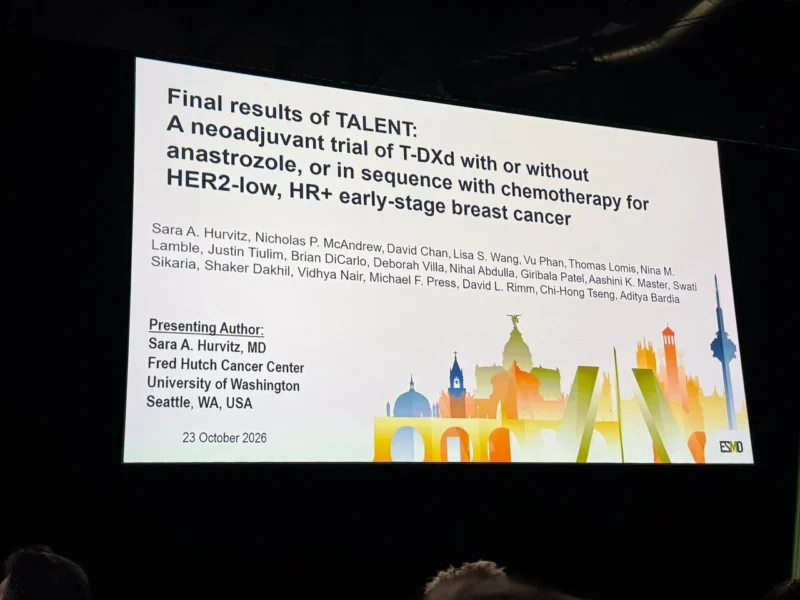
- Hurvitz SA, McAndrew NP, Chan D, et al. Final results of TALENT: A neoadjuvant trial of T-DXd with or without anastrozole, or in sequence with chemotherapy for HER2-low, HR-positive early-stage breast cancer. Presented at ESMO Congress 2026, October 23, 2026. Clinical trial identifier NCT04553770.
- The registered phase II study evaluated neoadjuvant trastuzumab deruxtecan with or without anastrozole in operable HR-positive/HER2-low early breast cancer.