
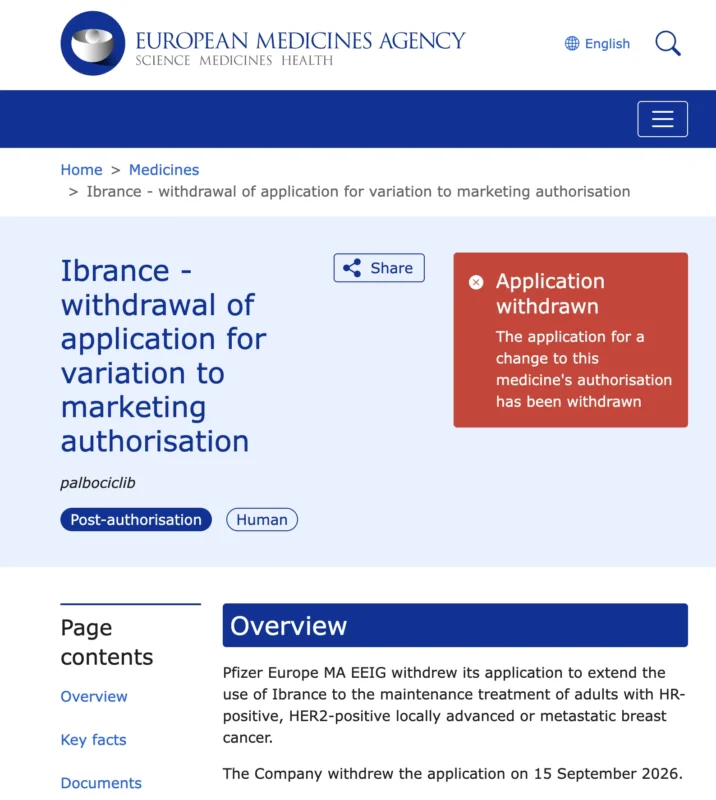
Pfizer has withdrawn its European application seeking to expand palbociclib (Ibrance) into first-line maintenance therapy for patients with hormone receptor-positive, HER2-positive locally advanced or metastatic breast cancer, highlighting an important regulatory debate around how progression-free survival should be interpreted in an open-label trial.
The European Medicines Agency announced the withdrawal following the October 12–15, 2026 meeting of its Committee for Medicinal Products for Human Use. The proposed indication would have added palbociclib to anti-HER2 therapy plus endocrine therapy following induction treatment. EMA said that, at the time of withdrawal, unresolved concerns remained around the evidence supporting efficacy.
The decision is particularly notable because the pivotal phase III PATINA trial was positive for its prespecified primary endpoint and led the US FDA to approve the same palbociclib-based maintenance strategy in June 2026.
The regulatory divergence therefore does not reflect a simple positive-versus-negative trial interpretation. Instead, it centers on a more technical question:
How much confidence should regulators place in investigator-assessed progression-free survival when a blinded independent central review does not confirm the treatment effect with the same level of statistical certainty?
PATINA Tested CDK4/6 Inhibition in “Triple-Positive” Breast Cancer
HR-positive, HER2-positive metastatic breast cancer is biologically driven by interactions between the estrogen receptor, HER2 signaling and downstream cell-cycle pathways.
Standard first-line treatment has traditionally relied on chemotherapy combined with HER2 blockade, followed by maintenance anti-HER2 therapy together with endocrine treatment for HR-positive disease.
The rationale for PATINA was to determine whether adding CDK4/6 inhibition during maintenance could delay resistance to both endocrine and HER2-directed treatment.
PATINA enrolled 518 patients with HR-positive, HER2-positive locally advanced or metastatic breast cancer who had not progressed after four to eight cycles of induction chemotherapy plus HER2-targeted therapy.
Patients were randomized to receive:
- palbociclib + trastuzumab, with or without pertuzumab + endocrine therapy
or
- trastuzumab, with or without pertuzumab + endocrine therapy alone
The phase III trial was randomized but open label, meaning both investigators and patients knew which maintenance treatment had been assigned. The prespecified primary endpoint was progression-free survival assessed by the treating investigators.
Investigator-Assessed PFS Showed a Clinically Meaningful Benefit
The published PATINA results were compelling by the primary analysis. At a median follow-up of 53.5 months, median investigator-assessed PFS was:
- 44.3 months, with palbociclib-based maintenance
versus
- 29.1 months, with anti-HER2 therapy plus endocrine therapy alone.
The hazard ratio for progression or death was:
- HR 0.75
- 95% CI 0.59–0.96
- P=0.02
This represented an approximately 25% relative reduction in the risk of progression or death and an increase in median PFS of more than 15 months. The analysis used for the subsequent FDA review similarly demonstrated a statistically significant investigator-assessed PFS benefit, with an HR of:
- 0.76
- 95% CI 0.59–0.97.
Based on these data, the FDA approved palbociclib in June 2026 in combination with trastuzumab, with or without pertuzumab, and endocrine therapy as maintenance treatment after induction therapy. On the surface, this would appear to represent a straightforward positive phase III study.
The European assessment, however, focused more heavily on what happened when disease progression was evaluated independently.
Blinded Central Review Produced a Less Certain Result
Detailed regulatory data provide an important additional perspective. The blinded independent central review also numerically favored palbociclib. Median centrally assessed PFS was:
- 69.8 months, with palbociclib
versus
- 41.5 months in the control arm
The corresponding hazard ratio was:
- HR 0.78
- 95% CI 0.591–1.041
The point estimate was therefore broadly similar to the investigator-assessed HR of 0.76. But there is an important statistical difference: the confidence interval crossed 1.0. The central review therefore did not independently establish a statistically clear PFS advantage at that analysis.
Only 95 patients (36.4%) in the palbociclib arm and 98 patients (38.1%) in the control arm had centrally confirmed PFS events, compared with 124 and 133 events, respectively, in the investigator assessment. That difference became central to EMA’s concerns.
EMA Was Concerned About Potential Bias in an Open-Label Study
Because PATINA was open label, investigators knew whether a patient was receiving palbociclib. That does not invalidate investigator assessment, and investigator-assessed PFS is frequently used as a primary endpoint in oncology trials.
But when an open-label study relies on investigator-assessed progression, regulators may look particularly closely for independent evidence that knowledge of treatment assignment did not influence progression decisions.
EMA said that discrepancies between investigator assessment and independent scan review raised concerns that the results could have been biased in favor of palbociclib.
According to EMA’s public explanation, the independent review did not confirm a sufficiently clear improvement, and other efficacy measures did not provide enough supporting evidence to resolve the uncertainty. At the time Pfizer withdrew the application, EMA’s provisional position was that the proposed indication could not have been authorized on the evidence then available.
This distinction is important. The central review did not demonstrate that palbociclib was ineffective. Its HR of 0.78 still numerically favored palbociclib.
Rather, the issue was that the independent analysis carried greater statistical uncertainty and therefore did not validate the investigator-assessed result to the degree EMA considered necessary.
Why Did Investigator Assessment and Central Review Differ?
The detailed regulatory evaluation suggests that the discrepancy is more complex than simply saying investigators “overcalled” progression in the control group. Discordance between investigator and central-review PFS events occurred in approximately:
- 33.7% of patients in the palbociclib arm
and
- 30.4% in the control arm
One important methodological issue was what happened after investigators declared progression. Under the PATINA design, scheduled tumor imaging could stop once the local investigator determined that a patient had progressed or another anticancer therapy began.
Consequently, if the investigator declared progression but the central reviewer did not agree based on the scans available at that point, subsequent imaging needed to independently document progression might no longer exist.
There were 42 patients in the palbociclib arm and 43 in the control arm who were considered to have experienced a PFS event by investigators but not by central review. This can create an important problem for retrospective blinded central review: fewer centrally confirmed events and more censoring reduce statistical precision.
Therefore, the BICR result should not necessarily be interpreted as evidence contradicting the primary analysis. The more accurate interpretation is that it did not confirm the result with equivalent certainty.
Sensitivity Analyses Still Generally Favored Palbociclib
The Japanese regulatory review provides another useful perspective. Several sensitivity analyses incorporating investigator and independent progression assessments continued to produce hazard-ratio point estimates below 1.0. One analysis produced:
- HR 0.79
- 95% CI 0.622–0.997
while a more conservative approach produced:
- HR 0.81
- 95% CI 0.637–1.020
These analyses again illustrate the same pattern: the treatment effect consistently trends toward palbociclib, but the degree of statistical certainty depends on how progression and censoring are handled.
This is precisely why different regulatory agencies can reach different conclusions from the same randomized trial without either necessarily misreading the data.
PATINA’s Design Also Selected Patients Who Had Already Benefited From Induction Therapy
Another important feature of PATINA is the timing of randomization. Patients were not randomized at the beginning of first-line metastatic treatment.
They first received four to eight cycles of taxane-based chemotherapy plus HER2-directed therapy and were eligible for randomization only if they had not progressed. Consequently, PATINA specifically evaluated a maintenance strategy in an induction-sensitive population.
This is clinically appropriate for the study question, but it also means PATINA does not establish that palbociclib should be added from the beginning of first-line treatment. It establishes, according to the investigator-assessed primary endpoint, that adding palbociclib after successful induction can extend disease control during maintenance.
The trial design has also generated academic discussion because excluding patients who progress during induction enriches the randomized population for patients with relatively favorable treatment-sensitive biology.

Read About PATINA Trial Results on OncoDaily
Overall Survival Remains Immature
Another consideration for EMA was the absence of mature overall survival evidence. Overall survival was a secondary endpoint in PATINA and was not mature at the PFS analysis. That is not unusual for metastatic HR-positive breast cancer, particularly when PFS is prolonged and subsequent therapies are available.
Nevertheless, when uncertainty exists around an open-label PFS endpoint, mature OS or another robust supporting endpoint becomes particularly valuable.
At present, PATINA establishes an investigator-assessed PFS benefit but does not yet establish an overall survival advantage.
The Benefit Comes With Additional Hematologic Toxicity
Palbociclib’s toxicity profile in PATINA was consistent with its established use in HR-positive/HER2-negative breast cancer, but treatment clearly added toxicity. Grade 3 and grade 4 adverse events occurred substantially more frequently with palbociclib than with maintenance therapy alone, predominantly because of hematologic toxicity.
In the US regulatory dataset, grade ≥3 neutropenia occurred in 61% of patients receiving palbociclib-based maintenance, while febrile neutropenia remained uncommon at approximately 0.8%. Other adverse events included leukopenia, diarrhea, infection, stomatitis and fatigue.
This matters because maintenance therapy can continue for years. A clinically meaningful improvement in PFS must therefore be weighed against chronic treatment burden, monitoring requirements, dose interruptions and hematologic toxicity.
Why the FDA and EMA Reached Different Regulatory Outcomes
The contrast between US and European decisions is one of the most important aspects of the PATINA story. On June 24, 2026, the FDA approved palbociclib for HR-positive/HER2-positive metastatic breast cancer maintenance based on the statistically significant investigator-assessed PFS endpoint.
In Europe, EMA gave greater weight to uncertainty generated by the open-label design and the absence of equally clear confirmation from independent review.
Pfizer subsequently withdrew the application. The company stated that withdrawal would allow additional data collection and analyses to address the questions raised during the European review. The withdrawal does not affect palbociclib’s existing EU authorization for HR-positive/HER2-negative locally advanced or metastatic breast cancer.
This is therefore not equivalent to withdrawal of palbociclib from the European market. It affects only the proposed HR-positive/HER2-positive maintenance indication.
Does the EMA Withdrawal Invalidate PATINA?
No. The strongest evidence supporting PATINA remains unchanged:
- 518 patients were randomized
- the trial met its prespecified primary endpoint
- the investigator-assessed HR was approximately 0.75–0.76
- median investigator-assessed PFS improved by approximately 15 months
The blinded central analysis also numerically favored palbociclib, with an HR of 0.78. What changes is the level of certainty regulators assign to those findings.
EMA’s position highlights that a statistically positive primary endpoint does not automatically guarantee regulatory approval when the endpoint is potentially susceptible to assessment bias and key supportive analyses do not provide equally definitive confirmation. That distinction is particularly important in open-label oncology trials.
The PATINA Debate Is Also About How Oncology Trials Measure Progression
The case raises a broader methodological issue. Progression-free survival sounds objective, but radiological progression frequently requires clinical interpretation. Borderline changes in lesion size, non-target lesions, bone disease and timing of confirmatory scans can introduce judgment.
In a blinded trial, that risk is reduced because investigators do not know which treatment the patient is receiving. In an open-label trial, independent central review can provide reassurance, but only when the imaging schedule allows the central reviewers to observe progression with enough completeness.
PATINA demonstrates the limitations of both approaches. Investigator assessment had more events and therefore greater statistical maturity, but knowledge of treatment assignment introduced potential bias.
Central review was blinded, but fewer events could be confirmed, partly because imaging often stopped after investigator-defined progression. The result is not a simple choice between a “correct” and “incorrect” analysis. It is a question of which analysis provides the most reliable estimate of the true treatment effect.
Clinical Context Is Also Changing Rapidly
The regulatory discussion comes as first-line HER2-positive metastatic breast cancer is undergoing substantial change. The 2026 ESMO metastatic breast cancer guideline recognized palbociclib combined with pertuzumab, trastuzumab and endocrine therapy as a maintenance option that could be considered for ER-positive/HER2-positive disease based on PATINA.
Since then, the US treatment landscape has expanded further. T-DXd plus pertuzumab has entered first-line HER2-positive metastatic disease, while tucatinib plus trastuzumab and pertuzumab received FDA approval in October 2026 as another maintenance strategy following induction therapy.
That increasingly crowded landscape raises the evidentiary bar for new maintenance approaches. Future treatment decisions may need to consider not only whether a regimen delays progression, but also:
- which patients benefit most
- whether CNS control differs
- how toxicity affects long-term treatment
- how one maintenance strategy influences subsequent treatment sequencing
What Could Resolve the European Uncertainty?
Several developments could potentially strengthen the evidence supporting palbociclib in Europe. The first is additional follow-up, particularly as overall survival matures. The second is further analysis of progression events and censoring to better explain the relationship between investigator and blinded central assessment.
Longer follow-up may also increase the number of independently evaluable progression events. Additional clinically relevant endpoints, including subsequent treatment outcomes and longer-term disease control, could also help establish whether the PFS effect translates into durable patient benefit.
Pfizer’s withdrawal leaves open the possibility of a future resubmission once additional evidence is available.
OncoDaily Takeaway
Pfizer’s withdrawal of the European application for palbociclib in HR-positive/HER2-positive metastatic breast cancer should not be interpreted as meaning that the phase III PATINA trial was negative. PATINA met its prespecified primary endpoint.
Adding palbociclib to anti-HER2 and endocrine maintenance therapy extended investigator-assessed median PFS from approximately 29 months to 44 months, with an HR of approximately 0.75–0.76. The regulatory uncertainty arose because PATINA was an open-label study and the blinded independent central review did not confirm the magnitude of benefit with the same statistical certainty.
Importantly, BICR still numerically favored palbociclib:
- 69.8 versus 41.5 months, HR 0.78.
But its 95% confidence interval crossed 1.0, and substantially fewer progression events were independently confirmed. EMA therefore concluded that the available supporting evidence was insufficient to resolve concerns about potential bias in the investigator-assessed primary endpoint.
The result is a striking regulatory divergence: the FDA approved the PATINA regimen in June 2026, while Pfizer has now withdrawn the corresponding European application.
For clinicians and researchers, the case carries a broader lesson. A statistically positive PFS endpoint can be clinically compelling while still leaving regulatory uncertainty when the study is open label and independent endpoint verification is inconclusive.
The next chapter for PATINA will depend on additional analyses, longer follow-up and mature survival data.
Until then, the evidence supports genuine biological and clinical activity from adding CDK4/6 inhibition to HER2 and endocrine blockade, but Europe has concluded that the current dataset does not yet establish that benefit with sufficient regulatory certainty.
Sources
- European Medicines Agency, CHMP October 2026 meeting highlights and Ibrance withdrawal assessment.
- Metzger O, et al. Palbociclib for Hormone-Receptor–Positive, HER2-Positive Advanced Breast Cancer. N Engl J Med. 2026;394:451-462. DOI: 10.1056/NEJMoa2511218.
- US Food and Drug Administration. FDA approval of palbociclib plus trastuzumab ± pertuzumab and endocrine therapy, June 24, 2026.
- Japan Pharmaceuticals and Medical Devices Agency regulatory review of palbociclib, including investigator and BICR analyses of PATINA.