
A bispecific antibody-drug conjugate targeting EGFR and HER3 has produced a substantial progression-free survival improvement in heavily pretreated hormone receptor-positive, HER2-negative advanced breast cancer.
At ESMO Congress 2026, the randomized phase III PANKU-Breast01 trial showed that izalontamab brengitecan, or iza-bren, reduced the hazard of progression or death by 59% compared with physician’s choice chemotherapy in patients whose disease had already progressed after endocrine therapy, CDK4/6 inhibition, taxane treatment, and one or two previous lines of chemotherapy.
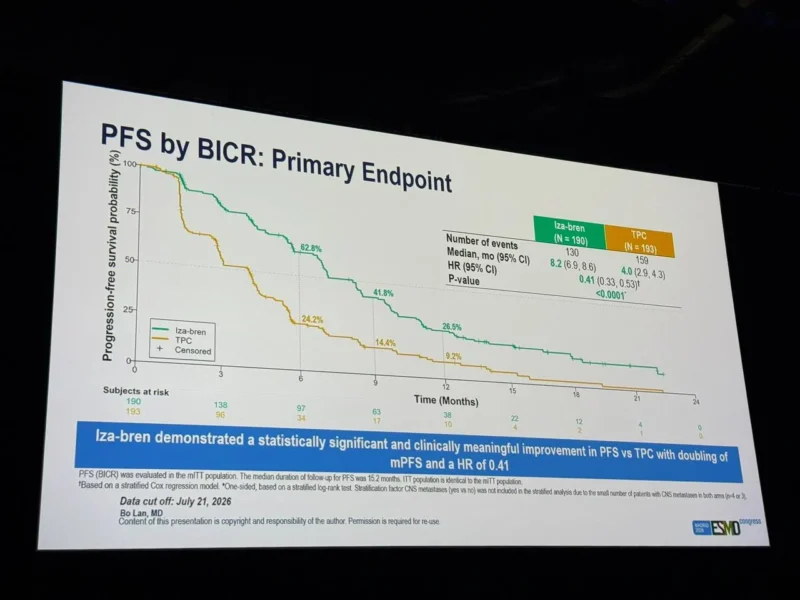
Median progression-free survival by blinded independent central review was 8.2 months with iza-bren compared with 4.0 months with chemotherapy, corresponding to an HR of 0.41 (95% CI 0.33–0.53; P<0.0001).
The confirmed objective response rate was also higher with iza-bren, reaching 40.5% compared with 20.2% with chemotherapy. Overall survival remained immature at the prespecified analysis.
The findings place iza-bren among the most clinically advanced bispecific ADCs being developed for breast cancer and suggest a potentially important role after resistance to endocrine-based and cytotoxic therapy.
The Post-CDK4/6 Setting Remains a Major Unmet Need
CDK4/6 inhibitors combined with endocrine therapy have transformed the management of HR-positive, HER2-negative metastatic breast cancer, but resistance eventually develops in most patients.
After progression through endocrine therapy and CDK4/6 inhibition, treatment increasingly depends on additional endocrine-targeted strategies, molecularly selected agents, chemotherapy, and antibody-drug conjugates. For patients who have already received multiple systemic therapies, the therapeutic objective becomes increasingly difficult: achieve meaningful disease control without adding intolerable cumulative toxicity.
PANKU-Breast01 specifically enrolled a population with substantial prior treatment exposure. All patients had previously received a CDK4/6 inhibitor and a taxane, had progressed after at least one line of endocrine therapy, and had received one or two prior chemotherapy regimens for advanced disease.
The magnitude of the PFS improvement therefore needs to be interpreted in the context of a population in which treatment options were already considerably narrowed.
What Is Izalontamab Brengitecan?
Izalontamab brengitecan is an investigational bispecific antibody-drug conjugate directed against EGFR and HER3. The ADC carries Ed-04, a topoisomerase I inhibitor payload.
The dual-targeting design is intended to broaden tumor-cell recognition by engaging two receptors that may contribute to tumor proliferation, survival, and treatment resistance.
After binding and internalization, the ADC delivers its cytotoxic payload intracellularly, generating DNA damage and tumor-cell death. This approach differs from conventional single-target ADCs and may be particularly relevant in tumors with heterogeneous expression of cell-surface targets.
PANKU-Breast01 Enrolled 383 Previously Treated Patients
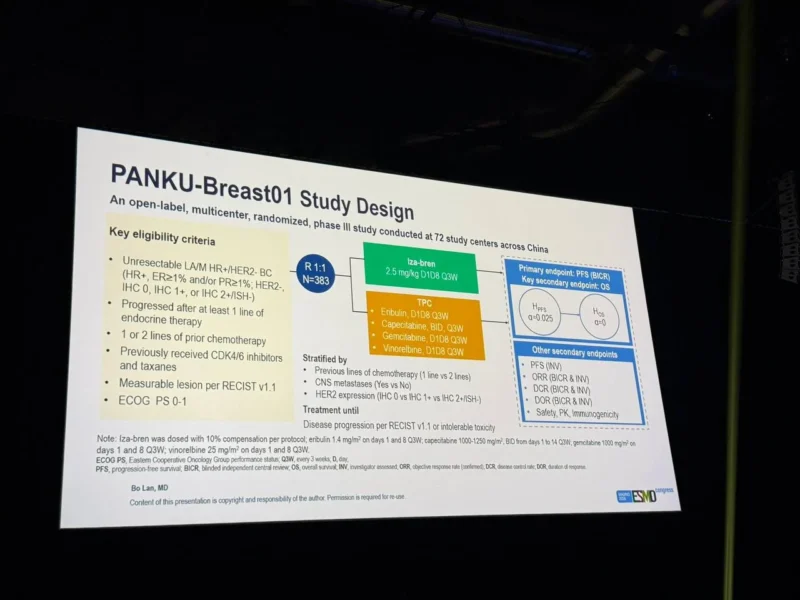
PANKU-Breast01 was an open-label, randomized, multicenter phase III trial conducted at 72 study centers across China. A total of 383 patients with unresectable locally advanced or metastatic HR-positive, HER2-negative breast cancer were randomized 1:1.
HER2-negative disease included tumors classified as IHC 0, IHC 1+, or IHC 2+/ISH-negative. Patients were required to have estrogen receptor expression of at least 1% and/or progesterone receptor expression of at least 1%. They had progressed after at least one line of endocrine therapy and had previously received both a CDK4/6 inhibitor and a taxane.
Patients also had to have received one or two prior lines of chemotherapy for advanced disease, have measurable disease according to RECIST v1.1, and have ECOG performance status 0–1.
Patients received iza-bren at 2.5 mg/kg on days 1 and 8 of each three-week cycle or physician’s choice chemotherapy with eribulin, capecitabine, gemcitabine, or vinorelbine.
The primary endpoint was PFS assessed by blinded independent central review. Overall survival was the key secondary endpoint.
Median PFS More Than Doubled
At the July 21, 2026 data cutoff, 190 patients had received iza-bren and 193 had received physician’s choice chemotherapy. Median follow-up for PFS was approximately 15 months.
Median BICR-assessed PFS was 8.18 months with iza-bren compared with 4.01 months with chemotherapy. The HR was 0.41 (95% CI 0.33–0.53; P<0.0001), representing a 59% relative reduction in the hazard of progression or death.
The trial therefore met its prespecified primary endpoint. The benefit was also maintained over time. At six months, approximately 62.8% of patients receiving iza-bren remained progression free compared with 24.2% receiving chemotherapy. At nine months, the corresponding rates were approximately 41.8% versus 14.4%, and at 12 months they were approximately 26.5% versus 9.2%.
The sustained separation suggests that the benefit was not limited to an early improvement in response but translated into prolonged disease control for a proportion of patients.
Response Rate Also Approximately Doubled
The progression-free survival advantage was supported by tumor-response data. Confirmed objective response rate by blinded independent central review was 40.5% with iza-bren compared with 20.2% with physician’s choice chemotherapy.
Median duration of response was 6.93 months with iza-bren compared with 4.21 months with chemotherapy. These findings indicate that iza-bren not only increased the probability of tumor response but also prolonged the duration of those responses.
In a heavily pretreated population, doubling the response rate together with doubling median PFS represents a clinically meaningful efficacy signal.
Overall Survival Remains Immature
Overall survival was not mature at the prespecified PFS analysis. The current results therefore should not be interpreted as demonstrating an overall survival advantage. Investigators reported no evidence of a detrimental OS effect, but longer follow-up will be required to determine whether the PFS improvement ultimately translates into prolonged survival.
This distinction is important in HR-positive metastatic breast cancer, where patients may receive several subsequent systemic therapies after progression. For now, the strongest evidence supporting iza-bren comes from its improvement in BICR-assessed PFS and objective response.
Hematologic Toxicity Was Substantial
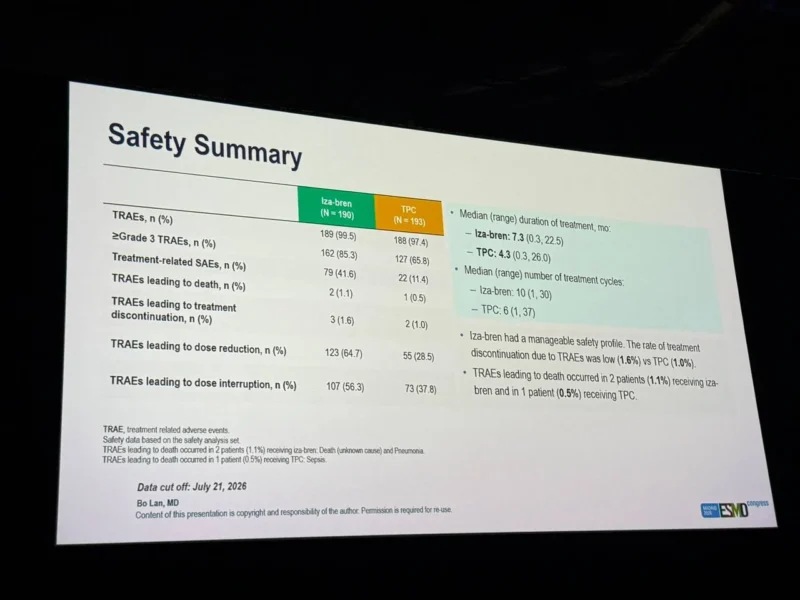
The efficacy of iza-bren was accompanied by a considerable treatment-related toxicity burden. Treatment-related adverse events of any grade occurred in 99.5% of patients receiving iza-bren and 97.4% receiving chemotherapy.
Grade 3 or higher treatment-related adverse events occurred in 85.3% with iza-bren compared with 65.8% with chemotherapy. Treatment-related serious adverse events occurred in 41.6% and 11.4%, respectively.
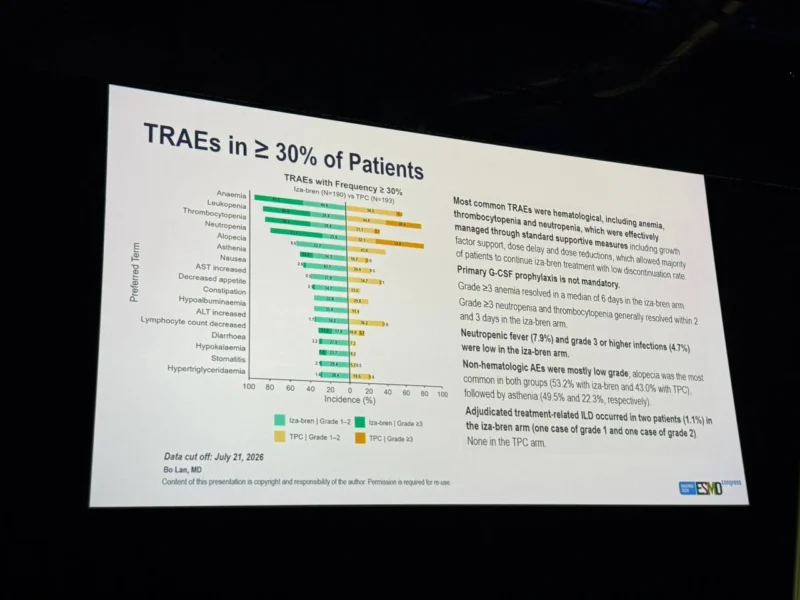
The toxicity profile was predominantly hematologic, with anemia, thrombocytopenia, leukopenia, and neutropenia among the most frequent treatment-related events.
These data make it important not to describe iza-bren simply as a low-toxicity therapy. Rather, the phase III results suggest that its adverse events were frequently significant but were generally manageable with supportive care and dose modification.
Dose Reduction Was Common, but Permanent Discontinuation Was Uncommon
Dose modification played a major role in treatment management. Dose reductions were required in 64.7% of patients receiving iza-bren compared with 28.5% receiving chemotherapy, while dose interruptions occurred in 56.3% versus 37.8%, respectively.
Despite this high rate of modification, permanent discontinuation because of treatment-related adverse events remained relatively uncommon, occurring in 1.6% of patients receiving iza-bren and 1.0% receiving chemotherapy.
This is an important distinction. The drug clearly required active toxicity management, but most patients experiencing adverse events were apparently able to continue treatment through supportive measures, treatment delays, and dose reductions.
Median treatment duration was also longer with iza-bren, at approximately 7.3 months compared with 4.3 months with chemotherapy. Longer treatment exposure itself may contribute to the cumulative incidence of reported toxicity and should be considered when interpreting cross-arm safety differences.
Neutropenia and Thrombocytopenia Were Generally Reversible
Hematologic adverse events were managed using standard supportive strategies, including growth-factor support, dose delays, interruptions, and reductions. Primary prophylaxis with G-CSF was not mandatory.
Investigators reported that grade 3 or higher anemia resolved within a median of approximately six days in the iza-bren arm, while grade 3 or higher neutropenia and thrombocytopenia generally resolved within approximately two and three days, respectively.
Febrile neutropenia occurred in approximately 7.9% of patients receiving iza-bren, while grade 3 or higher infections occurred in approximately 4.7%.
These rates indicate that hematologic monitoring and proactive supportive care would be essential if the therapy enters routine clinical use.
ILD Incidence Was Low
Interstitial lung disease remains an important concern with topoisomerase I-containing ADCs. In PANKU-Breast01, adjudicated treatment-related ILD occurred in two patients receiving iza-bren, corresponding to 1.1% of the treatment arm.
One event was grade 1 and one was grade 2. No grade 3, grade 4, or grade 5 treatment-related ILD was reported. The low incidence is encouraging, although longer follow-up and broader clinical exposure will be required before meaningful comparisons can be made with other topoisomerase I ADCs.
Treatment-Related Deaths Were Uncommon
Treatment-related deaths occurred in two patients receiving iza-bren, or 1.1%, and one patient receiving chemotherapy, or 0.5%. The reported deaths in the iza-bren arm were attributed to pneumonia and an unknown cause, while sepsis was reported in the chemotherapy group.
Although uncommon, these events should remain part of the overall benefit-risk assessment, particularly when the regimen is considered for heavily pretreated patients.
The Trial Adds Another ADC to an Already Crowded HR+/HER2− Landscape
The therapeutic landscape after CDK4/6 inhibitor progression is becoming increasingly complex.
Treatment selection may now depend on ESR1, PIK3CA, AKT1, PTEN, germline BRCA status, endocrine sensitivity, previous chemotherapy exposure, HER2 expression, visceral disease, and prior ADC use. Antibody-drug conjugates have become increasingly important in this sequence.
TROP2-directed ADCs and HER2-directed ADCs already occupy important positions in advanced breast cancer, and multiple next-generation ADCs are now moving through phase III development. Iza-bren adds a different biological strategy by simultaneously targeting EGFR and HER3.
The key question is therefore not only whether iza-bren is superior to chemotherapy in an ADC-naïve population. It is where the drug should ultimately sit in relation to other ADCs and molecularly targeted therapies.
ADC Sequencing Will Be a Major Unanswered Question
PANKU-Breast01 demonstrates clear superiority over physician’s choice chemotherapy, but the control arm does not fully answer how iza-bren should be positioned within an increasingly modern treatment sequence. Patients with HR-positive, HER2-negative metastatic breast cancer may now receive several targeted therapies and ADCs before reaching later chemotherapy lines.
The efficacy of iza-bren after previous exposure to other topoisomerase I ADCs will therefore become particularly important. Resistance to ADCs can arise through changes in target expression, internalization, lysosomal processing, drug efflux, DNA damage response, and payload sensitivity.
Because multiple breast cancer ADCs use related topoisomerase I payloads, cross-resistance could eventually become a major determinant of treatment sequencing.
PANKU-Breast01 establishes activity before that question has been resolved.
Global Generalizability Remains an Important Limitation
PANKU-Breast01 was conducted entirely in China. The randomized phase III design provides strong evidence for the efficacy comparison within the studied population, but broader global validation remains important.
Treatment patterns before enrollment, access to targeted therapies, supportive-care practices, and sequencing of ADCs may differ substantially between China, Europe, and North America. The investigators concluded that the results support iza-bren as a new standard-of-care option for this population in China. That geographical qualification is important.
The current evidence supports iza-bren as a potentially important treatment option internationally, but describing it as a new global standard of care would be premature without broader regulatory evaluation and clinical integration.
OncoDaily Takeaway
PANKU-Breast01 provides phase III evidence that dual EGFR/HER3 targeting with izalontamab brengitecan can substantially improve disease control in heavily pretreated HR-positive, HER2-negative advanced breast cancer.
Median BICR-assessed PFS more than doubled from 4.0 months with physician’s choice chemotherapy to 8.2 months with iza-bren, corresponding to a 59% reduction in the hazard of progression or death. Objective response rate also approximately doubled, from 20.2% to 40.5%.
The efficacy signal is clinically meaningful because patients had already received endocrine therapy, CDK4/6 inhibition, taxanes, and one or two lines of chemotherapy.
However, the benefit was accompanied by substantial hematologic toxicity. Grade ≥3 treatment-related adverse events occurred in 85.3% of patients, dose reductions were required in 64.7%, and treatment interruptions occurred in 56.3%.
Permanent discontinuation remained uncommon at 1.6%, suggesting that toxicity could often be managed without abandoning treatment. The observed ILD incidence was low at 1.1%, with only grade 1 or 2 events reported. Overall survival remains immature, and the study was conducted entirely in China.
PANKU-Breast01 therefore establishes iza-bren as a strong new ADC candidate after multiple prior therapies, but its eventual place in global practice will depend on mature survival data, regulatory review, broader geographic experience, and—perhaps most importantly—how it performs within an increasingly complex sequence of other antibody-drug conjugates.
Source
- PANKU-Breast01, LBA50. Randomized phase III study of izalontamab brengitecan in previously treated unresectable locally advanced or metastatic HR-positive/HER2-negative breast cancer. Presented by Bo Lan, MD, at ESMO Congress 2026. ClinicalTrials.gov identifier: NCT06343948.