Another HER2-directed antibody-drug conjugate has delivered a major phase III result in HER2-low metastatic breast cancer, adding further competition to one of the fastest-evolving treatment spaces in breast oncology.
At ESMO Congress 2026, the randomized phase III APEX-Breast01 trial showed that TQB2102, also known as rolditamig deuderuxtecan, substantially improved progression-free survival compared with physician’s choice chemotherapy in patients with HER2-low recurrent or metastatic breast cancer who had not previously received chemotherapy for advanced disease.
The primary analysis focused on patients with hormone receptor-positive, HER2-low disease. Median progression-free survival by blinded independent review was 16.4 months with TQB2102 compared with 5.5 months with chemotherapy, corresponding to an HR of 0.29 (95% CI 0.22–0.39; P<0.0001). This represents an approximately 71% reduction in the hazard of progression or death.
The benefit was nearly identical when the entire HER2-low population was analyzed, with median PFS of 16.4 versus 5.5 months and an HR of 0.29 (95% CI 0.22–0.38; P<0.0001). Objective response rates also more than doubled, while overall survival data remained immature but showed an encouraging trend favoring TQB2102.
A Biparatopic Approach to HER2 Targeting
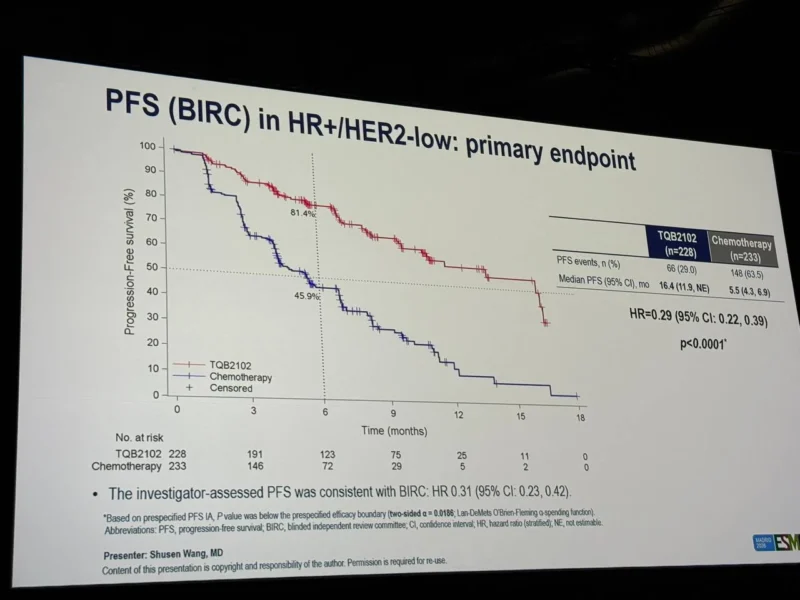
TQB2102 is a next-generation HER2-directed ADC designed differently from conventional single-epitope HER2 therapies.
The drug simultaneously recognizes two non-overlapping regions of HER2, extracellular domains 2 and 4. This biparatopic architecture is intended to increase receptor cross-linking and internalization, potentially improving cytotoxic delivery in tumors with heterogeneous or relatively low levels of HER2 expression.
TQB2102 uses a cleavable linker and a topoisomerase I inhibitor payload, with a drug-to-antibody ratio of approximately six. The international nonproprietary name rolditamig deuderuxtecan has also begun to be used for TQB2102, including in recent licensing announcements.
Earlier-phase studies had already demonstrated antitumor activity across HER2-expressing malignancies, including HER2-low breast cancer. Those signals led directly to phase III development in a setting in which HER2-directed ADC therapy is becoming increasingly relevant.
The developer, Chia Tai Tianqing Pharmaceutical Group, describes TQB2102 as a biparatopic HER2 ADC targeting both ECD2 and ECD4 and designed to increase HER2 cross-linking and internalization. APEX-Breast01 provides the first phase III test of whether that design translates into clinically meaningful benefit.
APEX-Breast01 Moved HER2-Directed ADC Therapy Before Metastatic Chemotherapy
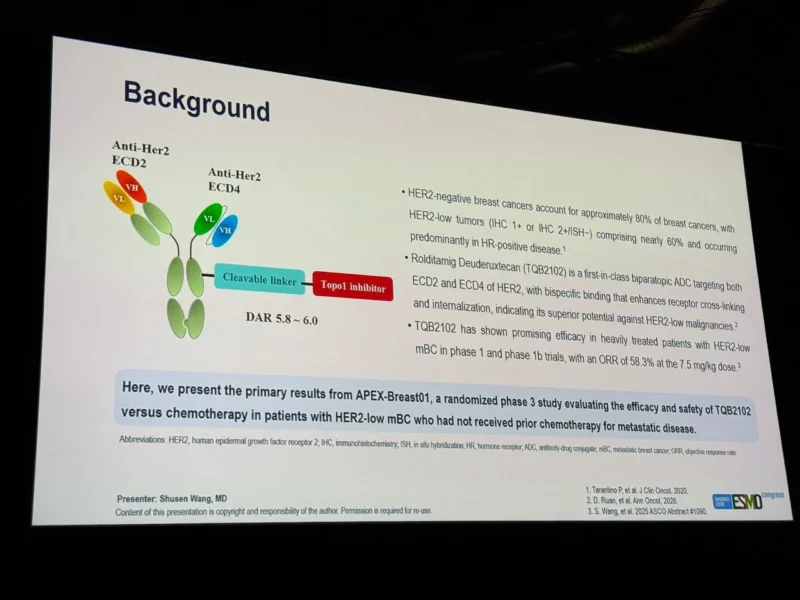
APEX-Breast01 was a randomized, open-label, multicenter phase III trial evaluating TQB2102 against physician’s choice chemotherapy in HER2-low recurrent or metastatic breast cancer. Patients had HER2 IHC 1+ or IHC 2+/ISH-negative disease and had not previously received chemotherapy for recurrent or metastatic breast cancer.
Patients with HR-positive disease had to have progressed after at least one line of endocrine therapy for metastatic disease or within 24 months after beginning adjuvant or neoadjuvant endocrine therapy. The HR-negative population was more specifically selected. Patients with known PD-L1 CPS ≥1 were excluded, meaning the HR-negative results primarily apply to patients with PD-L1-negative or unknown disease rather than to the full contemporary triple-negative population.
Patients were randomized to receive TQB2102 7.5 mg/kg intravenously every three weeks or chemotherapy with capecitabine, paclitaxel, or nab-paclitaxel. The primary endpoint was BIRC-assessed PFS in HR-positive/HER2-low disease. PFS in the overall HER2-low population was a key secondary endpoint.
The registered phase III study was designed specifically around chemotherapy-naïve metastatic HER2-low disease.
Most HR-Positive Patients Had Already Received CDK4/6 Inhibition
A total of 543 patients were randomized, including 461 with HR-positive disease. This was not an endocrine-therapy-naïve population. Among the HR-positive patients, approximately 91.3% had previously received a CDK4/6 inhibitor, making the PFS result particularly relevant to contemporary practice.
Previous taxane exposure in the non-metastatic setting was also common, occurring in approximately 62% of patients. The trial therefore addressed an increasingly familiar clinical problem: patients whose HR-positive/HER2-low disease has become endocrine resistant after modern endocrine and CDK4/6-based therapy but who have not yet begun chemotherapy for metastatic disease.
That is precisely the treatment window in which ADCs are increasingly competing with conventional cytotoxic therapy.
PFS Reached 16.4 Months in the Primary HR-Positive Population
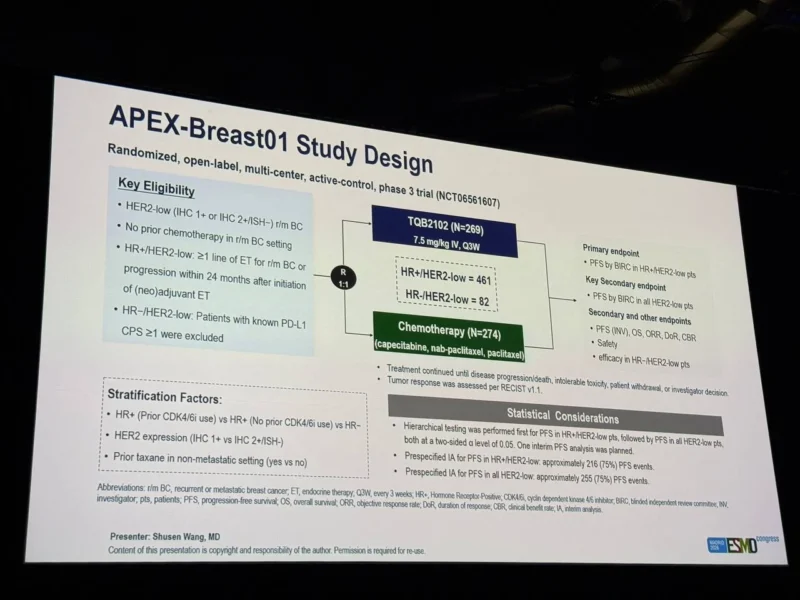
The primary endpoint produced a large treatment effect. Among 461 patients with HR-positive/HER2-low disease, median BIRC-assessed PFS was 16.4 months with TQB2102 compared with 5.5 months with chemotherapy. The HR of 0.29 represents an approximately 71% relative reduction in the hazard of progression or death.
At six months, approximately 81.4% of patients receiving TQB2102 remained progression free, compared with 45.9% receiving chemotherapy.
Investigator-assessed PFS was consistent with the central review, with an HR of approximately 0.31, providing additional reassurance that the large treatment effect was not dependent on one method of progression assessment.
The magnitude of the PFS difference is especially notable because more than 90% of the HR-positive population had previously been exposed to CDK4/6 inhibition.
 The Benefit Extended Across the Entire HER2-Low Population
The key secondary PFS analysis included both HR-positive and HR-negative patients. Median PFS again reached 16.4 months with TQB2102 versus 5.5 months with chemotherapy, with an HR of 0.29 (95% CI 0.22–0.38; P<0.0001).
The similarity between the primary HR-positive analysis and the overall population suggests that inclusion of the smaller HR-negative cohort did not materially change the overall treatment effect.
These findings establish substantial activity for TQB2102 across HER2-low disease, although the strength of evidence remains greatest in the much larger HR-positive population.
Response Rates More Than Doubled
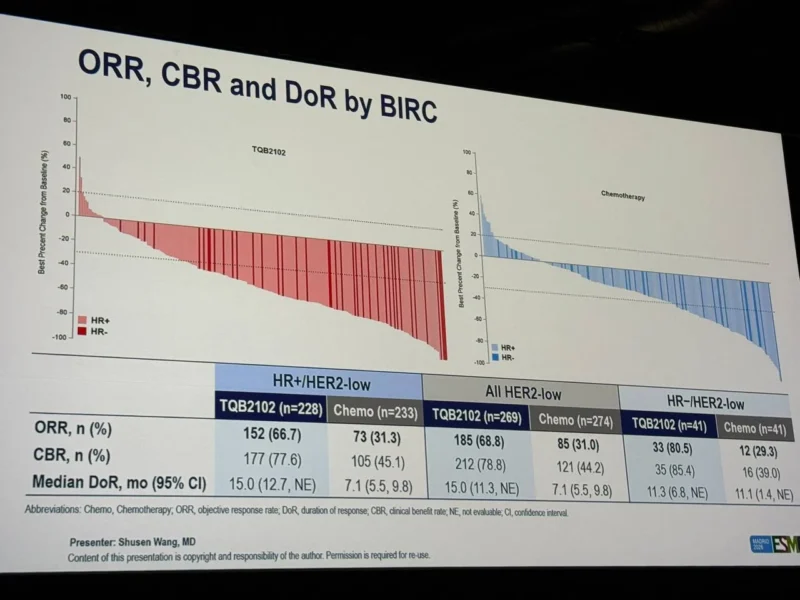
The PFS benefit was supported by substantial differences in tumor response. Among patients with HR-positive/HER2-low disease, confirmed objective response rate by independent review was 66.7% with TQB2102 compared with 31.3% with chemotherapy.
Clinical benefit rate was 77.6% versus 45.1%, respectively. Median duration of response was 15.0 months with TQB2102 compared with 7.1 months with chemotherapy. Across all patients with HER2-low disease, ORR was similarly high at 68.8% versus 31.0%, while clinical benefit rate reached 78.8% versus 44.2%.
Median duration of response was again 15.0 months with TQB2102 versus 7.1 months with chemotherapy. The consistency between response rate, response durability, and progression-free survival strengthens the overall efficacy signal.
HR-Negative Disease Showed an Encouraging but Smaller Dataset
Only 82 patients in APEX-Breast01 had HR-negative/HER2-low disease, with 41 patients in each treatment group. Median PFS was 8.5 months with TQB2102 compared with 5.4 months with chemotherapy, with an HR of approximately 0.27.
Objective response rate was 80.5% with TQB2102 compared with 29.3% with chemotherapy. These results are striking numerically but require more cautious interpretation than the HR-positive findings because of the small subgroup size.
The population also does not represent all contemporary HR-negative/HER2-low metastatic breast cancer. Patients with known PD-L1 CPS ≥1 were excluded, meaning many patients who would currently be candidates for first-line pembrolizumab-based therapy were not represented.
The HR-negative findings should therefore be viewed as an important signal requiring further confirmation rather than as a definitive first-line treatment strategy for all HER2-low triple-negative disease.
Overall Survival Is Encouraging but Not Yet Mature
Overall survival data were immature at the interim analysis. The available hazard ratios favored TQB2102, including an HR of approximately 0.47 in the HR-positive population and 0.44 across the overall HER2-low population.
Despite confidence intervals favoring TQB2102 in these analyses, the trial had not reached its planned mature OS analysis. It would therefore be premature to describe APEX-Breast01 as demonstrating a definitive overall survival advantage.
The appropriate interpretation at this stage is that the OS trend is encouraging and directionally consistent with the PFS result, but longer follow-up is needed.
Safety Appeared Manageable, With Hematologic Toxicity Predominating
The most frequent severe treatment-related toxicities were hematologic. Grade ≥3 decreased neutrophil counts occurred in 30.1% of patients receiving TQB2102 compared with 23.3% receiving chemotherapy. Grade ≥3 decreased white blood cell counts occurred in 21.6% versus 14.0%, respectively.
Despite these events, permanent treatment discontinuation due to treatment-related adverse events was relatively uncommon and occurred in approximately 1.5% of patients in both groups. This distinction is clinically important. TQB2102 produced greater hematologic toxicity in several categories, but these events did not translate into a large increase in permanent treatment cessation.
ILD Remains an Important ADC Safety Question
Interstitial lung disease remains particularly important when evaluating HER2-directed ADCs carrying topoisomerase I payloads. Treatment-related ILD occurred in six patients receiving TQB2102, corresponding to 2.2% of the treatment group.
Grade 3 ILD occurred in approximately 1.1%. The observed rate appears relatively low, but cross-trial comparisons with other HER2 ADCs should be avoided. Differences in follow-up, eligibility criteria, adjudication, monitoring, geographic population, dose, and previous treatment exposure can all influence reported ILD incidence.
Longer follow-up and broader clinical exposure will be necessary to determine whether pulmonary toxicity ultimately becomes a meaningful differentiating feature of TQB2102.
HER2-Low Is Rapidly Becoming a Multi-ADC Treatment Space
APEX-Breast01 arrives during an unusually competitive period for HER2-low breast cancer. T-DXd established HER2-low disease as an actionable category and subsequently moved earlier in HR-positive metastatic disease. At the same ESMO Congress, HORIZON-Breast06 reported another major phase III PFS improvement with trastuzumab rezetecan compared with chemotherapy.
TQB2102 now joins that landscape with a different antibody architecture and another strong randomized PFS result. These trials should not be compared numerically as if they represent direct comparisons between ADCs.
Differences in eligibility, hormone receptor status, prior therapy, geography, chemotherapy control arms, follow-up, and trial design make cross-trial efficacy rankings unreliable. The more important conclusion is that HER2-low breast cancer is no longer a therapeutic space defined by a single ADC.
The field is moving rapidly toward questions of ADC selection and sequencing.
Prior ADC Exposure Will Become the Critical Unanswered Question
APEX-Breast01 evaluated TQB2102 before metastatic chemotherapy and before routine exposure to another HER2-directed ADC. That means the study does not answer how TQB2102 performs after T-DXd, trastuzumab rezetecan, or another topoisomerase I-containing ADC.
This may ultimately become more important than comparison with conventional chemotherapy. If several HER2 ADCs become available, treatment decisions will increasingly depend on whether switching antibody architecture while retaining a similar payload can overcome resistance.
Cross-resistance could emerge through changes in HER2 expression, ADC internalization, lysosomal processing, drug efflux, payload sensitivity, or DNA damage-response pathways. Prospective sequencing studies will therefore become essential.
Global Applicability Still Needs to Be Established
APEX-Breast01 was conducted in China, and broader international experience will be necessary before assuming identical efficacy and safety across global populations.
The regulatory pathway is already advancing. A Chinese marketing application for TQB2102 in HER2-low unresectable or metastatic breast cancer without previous chemotherapy for recurrent or metastatic disease was accepted for review in September 2026. Acceptance for review represents regulatory evaluation, not approval.
TQB2102 has also entered international commercial development through licensing agreements covering several emerging markets. The key question now is whether the phase III result can be reproduced and integrated within treatment sequences outside China.
OncoDaily Takeaway
APEX-Breast01 delivers one of the strongest phase III signals yet for an emerging HER2-directed ADC in HER2-low metastatic breast cancer. In the primary HR-positive population, TQB2102 extended median PFS from 5.5 to 16.4 months and reduced the hazard of progression or death by 71%.
The response rate more than doubled, reaching 66.7% versus 31.3%, while median response duration increased from 7.1 to 15.0 months. The efficacy is particularly relevant because more than 90% of HR-positive patients had previously received CDK4/6 inhibition.
An encouraging signal was also observed in the smaller HR-negative subgroup, but those results require caution because only 82 patients were included and patients with known PD-L1 CPS ≥1 were excluded.
Overall survival remains immature and should not yet be presented as definitively improved. Safety was characterized mainly by hematologic toxicity, while treatment-related ILD occurred in 2.2% of patients.
APEX-Breast01 therefore establishes TQB2102 as a serious new competitor in HER2-low breast cancer but does not answer the question that is rapidly becoming central to this field: which HER2 ADC should be used first, and what should follow when resistance develops?
As HER2-low treatment expands from one dominant ADC toward multiple active platforms, sequencing rather than simple proof of efficacy may become the defining challenge.
Source
- APEX-Breast01, LBA27. TQB2102 versus chemotherapy in HER2-low recurrent or metastatic breast cancer: Results from a randomized phase III study. Presented by Shusen Wang, MD, at ESMO Congress 2026. ClinicalTrials.gov identifier NCT06561607. The sponsor describes TQB2102 as a biparatopic HER2 ADC targeting HER2 ECD2 and ECD4 with a topoisomerase I payload.